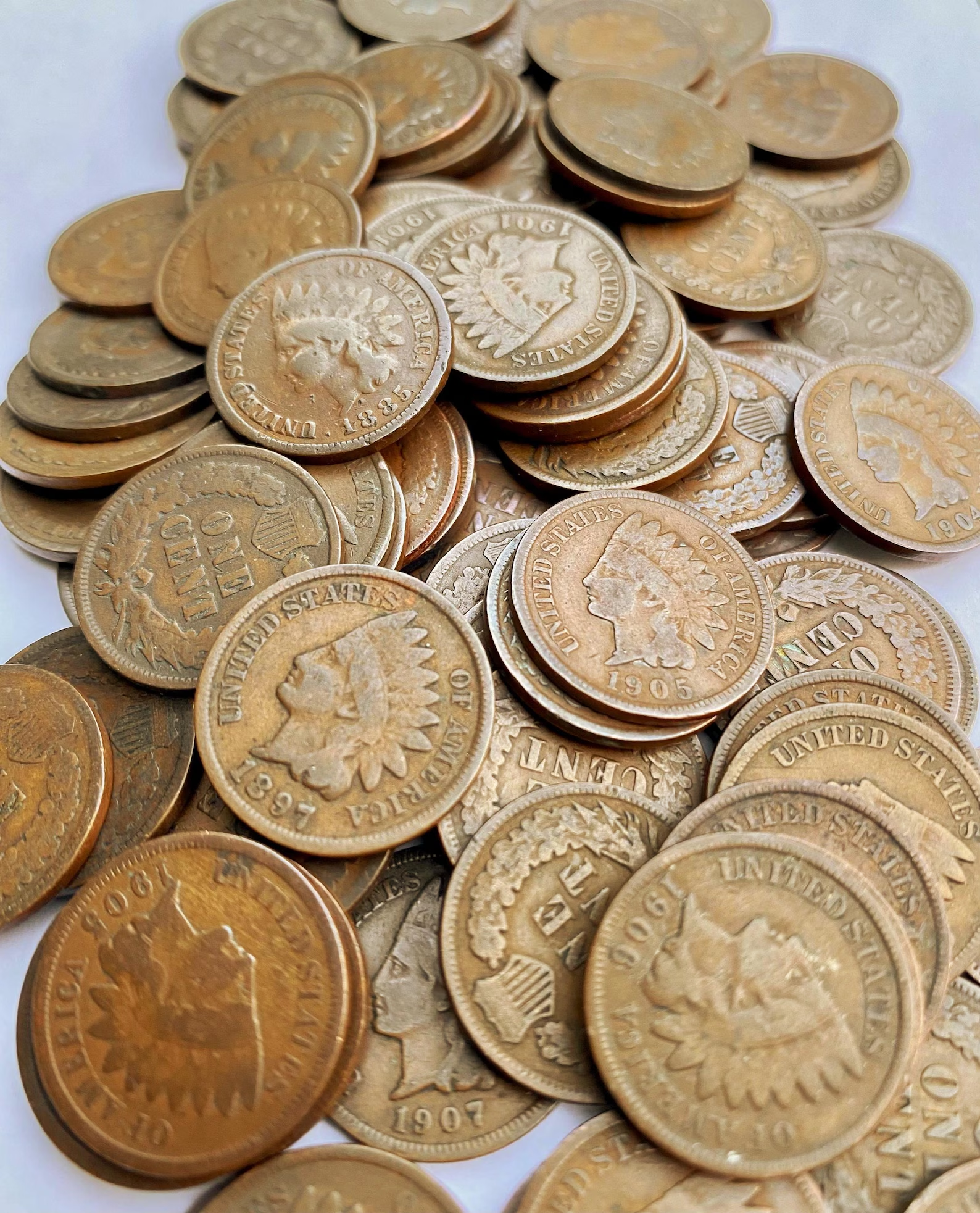
What can 57 cents do?
Money doesn’t always mean what you think it does, and how much we give or pay for something is not always rational.
UK bank notes are inscribed with ‘I promise to pay the bearer’ this dates back to a time when the value of bank notes was linked with gold and you could take the note to the Bank of England and for your £5 note you could exchange it for five gold sovereigns. Now you can only exchange your note for other notes of the same face value.
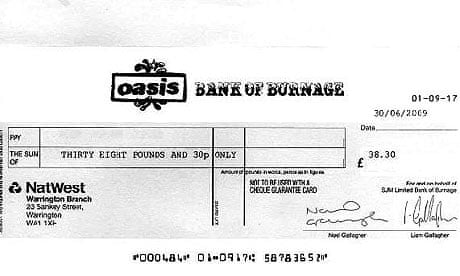
In 2009, Oasis promised a refund after a technically disastrous gig at Heaton Park. They sent cheques signed by Liam and Noel Gallagher with the hope that the signatures would make them souvenirs and fans would not cash in the signed cheque. They were right. Fans valued the signed cheque more than the financial value of the cheque.
When Notre Dame was burnt down and the campaign to rebuild was launched the multi million corporate donations got press attention but so did the small euro contribution of nine year old British girl called Caitlin.
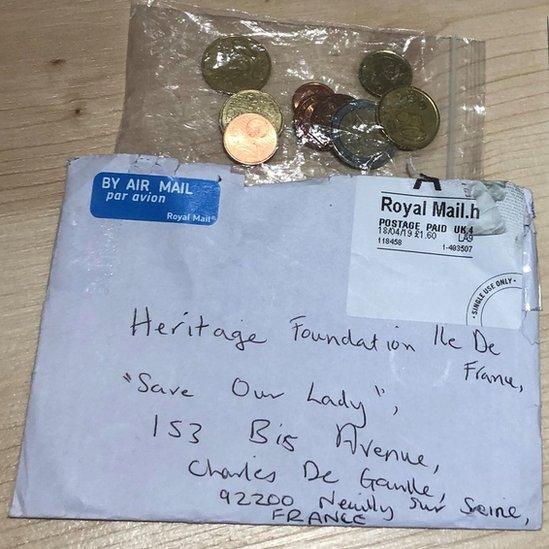
The few euros represents a larger share of what Cailtin has to offer, than the multi millions that a large company has. Therefore it feels more meaningful.
A child donating pocket money or someone giving “what they can” is easy to relate to. We can relate and think that we can do that too. Then giving becomes social contagion and we want to give. Witnessing these small sacrificial acts can also trigger feelings of uplift and we want to act too.
Small symbolic gifts can therefore “unlock” generosity from others.
The 57 cent church
But in 1885 a young girl called Hattie and her 57 cents had a fantastic multiplier effect.
6 year old Hattie May Wiatt could not get into the Grace Baptist Church Sunday School
The room was too small and the Sunday school too popular. So popular that tickets were issued to the Sunday school. One Sunday Hattie was standing outside and unable to enter, the minister Russell H. Conwell picked her up and escorted her in and said one day they would have the funds to build a bigger church.
Hattie started saving.
A year later she died of diphtheria.
Under her pillow a bag with 57 cents with a note
‘To help build bigger church so that more children can go to Sunday school.’
Her mother passed on the gift and Rev Conwell used the inspiration of this small gift to launch the campaign for the bigger church building.
The 57 cents was changed into pennies and each sold to raise funds for the church.
$250 raised from the sale of the pennies.
That’s a 125% more than they are worth.
Not only did people pay above and beyond the face value of the coins. 54 people donated back the physical pennies to the church (three kept them as souvenirs).
When emotion is involved we are not rational about money.
The $250 was also turned into pennies and each penny sold for more than its face value raising enough to buy the church. And the man who owned the land where they wanted to build took 54 cents as the deposit for the land.
From that the Wiatt Mite Society was formed (to commemorate Hattie Wiatt May and her gift). The money from the original 57 cents was invested and more ‘mites’ donated.
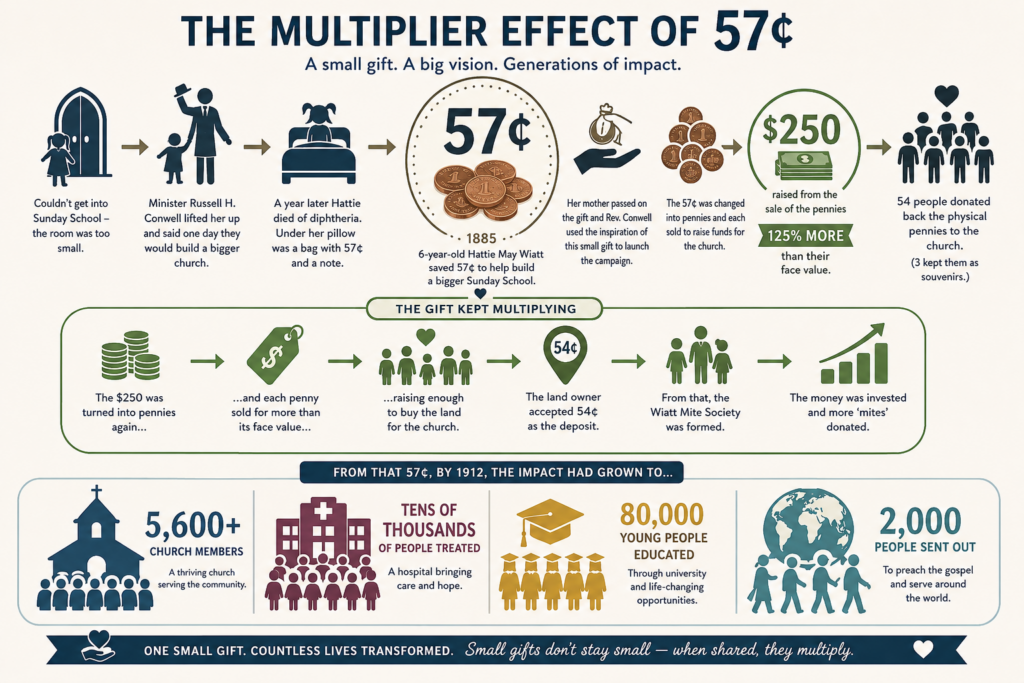
In 1912 Conwell’s sermons detailed what had been achieved by the multiplier effect of those 57 cents and from that gift there was:
- a church with a membership of over 5,600 people,
- a hospital where tens of thousands of people had been treated,
- 80,000 young people going through university,
- 2,000 people going out to preach the gospel.
This infographic shows the multiplier effect
“She was a school girl, living in one of the homes of the industrious, honorable, upright and saving classes of society, not of the wealthy and great, yet think how her life was used; think what God did with her and the great, yet think how her life was used; think what God did with her and the 54 cents that was used of hers. A glance at it would put many to shame. Think of this large church; think of the membership added to it – over 5600 – since that time. Think of the influence of its membership going out and spreading over the world. Think of the influence of the Sabbath school carried on in this great building for more than twenty years. Then think of the institutions this church founded. Think of the Samaritan Hospital and the thousands of sick people that have been cured there, and the thousands of poor that are ministered to every year. I received the report of the Samaritan Hospital for October last Saturday and find that during the month 2540 had visited the dispensary.
“Think of the influence of that 57 cents just for a moment. Almost 80,000 young people have gone through the classes of the Temple University, and think where they are. … Just estimate how they will go and teach thousands more, and how those thousands will in turn teach many thousands more in their lifetime; think how it sweeps the world in a century with one teacher, multiplying himself or herself a hundred times, perhaps, nearly every year.”

Why was this so successful?
A powerful and emotional story – the minister revealing the 57 cent gift as a last wish of a child is and powerful and emotive hook. This story framed the campaign as an emotional mission. Framing the pennies as “keepsakes” and displaying them made the abstract gift tangible.
Hattie’s gift was framed as the first gift – inviting further social participation and we are more motivated to give when donations have already been received.
As humans we are evolutionary programmed to want to reciprocate when someone does something kind for us. Hattie’s gift of 57 cent evoked that reaction. Church members reciprocated by far greater giving.
What can we learn today?
- Great fundraising isn’t about the size of the first gift — it’s about how well you use it to create meaning, momentum, and belonging.
- Tell stories that do the work
- Don’t just describe the need ‘frame’ it through a human story that carries meaning.
- Hattie’s one contribution was an emotional entry point to the campaign and her 57 cents played huge role in the mission.
- People don’t give to projects. They give to people. We need to give them stories that make those people real – and frames that show the real, urgent and human need.
- Make giving visible – momentum is only useful when it can be seen. Talk about gifts, big and small, demonstrate that you have supporters who believe in you.
- Size of donations is less important than what they represent – celebrate the meaning and the stories.