
Amuse bouche and pre desserts – more ways that menu nudges help you fundraise
So we started with a standard menu – a starter of an emotional story, a main of labour illusion, followed by a desert of costly signalling and a cheese course of choice architecture https://marinajones.uk/menu/
Now we move onto the amuse bouche, the snacks, the sides, the pre-desserts. and the palate cleaners – a tasting menu or tapas selection of the ways in which restaurant menus use the behavioural economics, evolutionary psychology, and neuroscience.
Cocktail: Pictures of food
Some people hate pictures of food on menus, others love them. Food like faces holds a primal allure for us and attracts our attention – it is part of our evolved psychology to pay attention to faces as they may be a friend or foe, or to food as we don’t know where our next meal may be coming from. We pay more attention to more calorific food – so cake is more enticing than salad – our primitive brains know we need more calories to fight and hunt.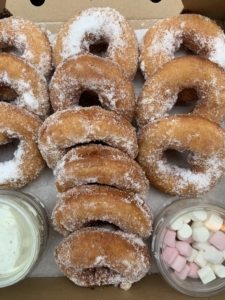 We can use these evolutionary psychological principles in the images that we use to attract attention in our appeals. It might not be food but we can use the power of faces to gain the attention of would be supporters.
Amuse-bouche: FOMO and scarcity
Chalk board menus can be used to evoke the scarcity principle. We value something more if it seems less available – if there are several dishes already crossed out or a scribbled ‘two left’ we don’t want to miss out.
How does scarcity work for fundraising?
Scarcity works in fundraising to – we are motivated by the fear of missing out or that something is scarce.
Maybe it is the matched campaign is only valid for a week or 24 hours – so a final email reminder that there is 24 hours left to make your £25 gift worth £50. Can we add a clock to the email so they can literally see the time ticking down?

Or a natural disaster means that urgent aid is needed now.
Or it can be about a giving circle or membership being limited to a certain number so if you want to guarantee that you are a founding member, or supporting that project, or naming a brick then you need to act now so as not to miss out.
Snacks: Priming, anchors and decoys
First thing stays with us and the order in which the information is presented is important. As this graphic illustrates

So the order in which items are presented on a menu is important.
Equally the things that stand out in a box or a separate colour attract our notice – something called the isolation effect
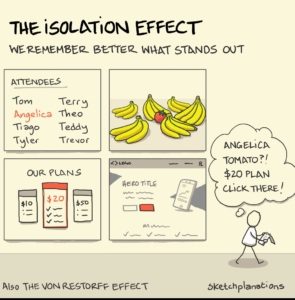
These work just as well in fundraising – the order in which we present effect what information we retain and how important it is.
Presenting the important information first – and making it stand out.
The isolation effect can also work with the Goldilocks effect – we prefer a middle option – not too much, not too little, something just right. Which is why in both choice of wine in a restaurant – we tend to avoid the cheapest wine on the menu and the most expensive – anecdotally the most frequently chosen wine is the second cheapest (and consequentially the one with the highest mark up).
Similarly with ask strings on a donation form we tend to prime supporters with the first number they see which can be a higher number this makes the second offer seem more reasonable and desirable. The Girlscout cookie seller is often cited to demonstrate this. A girl scout selling charity cookies in the US asks if you want to buy $1000 worth of cookies, when this is rejected as far too much, the more counter offer of $98 seems much more reasonable.
(There is an example, although I cannot find it online of a donation response form that included $/£500,000 as one of the five options to donate – using it to anchor donations higher and just to encourage those that could and might (a technique used by Make A Wish Canada and written up in this SOFII blog post)
Hors d’oeurve: Social proof
We are social animals and like to do what others do this comes from the times when we lived in more tribally and if we did not do what the group did then we would be isolated and potentially not survive. However, our brains have not evolved that much since then and we still like to go with the norm – and follow the herd. In restaurants subtle clues such as ‘our favourite dishes’ can guide people to what to choose.

(although surely ‘your favourite dishes’ would be more potent. And as my daughter commented the leaf here looks like a signal that it for vegetarians – so you need to use clear signals and visuals that help the customer stay in system one and not go into system two and think why do I need to worry about a vegetarian pudding)
The same is true in fundraising – often supporters don’t  know what a desirable or normal gift is by using clues we can help make it easier for supporters to choose by adding ‘most people donate…’ or ‘other donors in Manchester gave this’ (matching the gender or locality of the supporter reinforces the social norms for people like them)
Sides: Messengers
We listen and respect who gives us a message. The authority signalling of the chef’s special as the dish to try or the quotes – the messengers we select – here we have a restaurant dinner like us – and also a quote about good wine from Leonardo di Vinci (now I know he could paint a ceiling but I have no knowledge of his opinions on wine but as an Italian we are asked to trust his view on wine and therefore the restaurants).
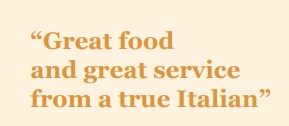

Who asks in fundraising is just as important – are they someone like us that we can relate to, are they someone with authority on the subject (a Nobel prize winner, a scientist, a curator, a field worker), are they respected, likeable, or are they are beneficiary? Often with legacies it is about a peer like them asking them to consider including a legacy as can be seen by these two examples.
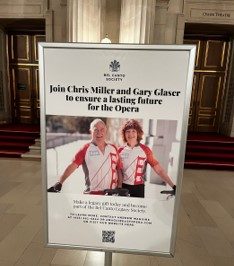
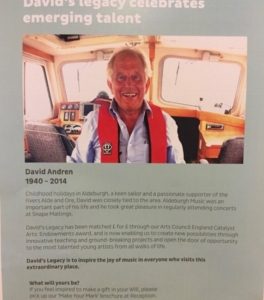
Choosing who deliver the message and to which segment of our audience is important.
Sides: Autonomy – add on the bacon
We all have some foods that we don’t like or certain preferences for extra bacon or hot milk on the sides. Many restaurants as standard give us the options to add extra toppings, remove the things we don’t like or make substitutions or reasonable requests.
All this gives us autonomy and agency – we want to feel we have control over any situation and are masters of our destiny.
How can we as fundraisers give supporters more autonomy in what they are supporting and how and where it makes a difference?
Often we do this with a shopping list that shows very specific items and that we have the autonomy in choosing where our support goes.
How can we build an ask string that allows a supporter to customise (add the bacon, remove the pineapple) to their gift so it is more meaningful to them?
Palate cleanser: Removal of £ signs
The removal of the currency signifier the £ or $ or Euro removes the connection in our brains to the cost of the menu and experiments have repeatedly shown that when the signifier is removed we spend more money on the meal. So 8% increase in spend if a menu item is priced at 44 rather than $44 or 44 dollars (See Yang_202009_20__20or_20dollars.pdf (cornell.edu))
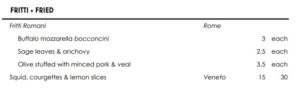
Has it been used in charity? Not that I have seen but definitely one to test and see if it increases donation amounts.
The surprise course: What You See is All There Is
In a subversion of Daniel Kahneman’s principle of ‘What You See Is All There Is’ There is a restaurant in London and New York and their signature dish (a burger) is not listed on the menu. You need to know that it is the signature dish and ask for it.
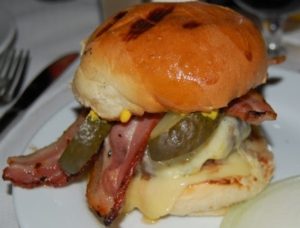
Kahneman talks about a cognitive bias that means that with presented with credible evidence you believe what is in front of you – you do not question it. What you see is all there is.
How might leaning in to this principle or subversion of it delight our supporters?
The pre-dessert: Cause related items – £ to charity
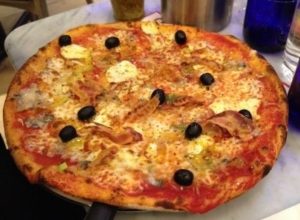
The Venezia Pizza is the most obvious example that comes to mind and has to date raised over £2m to support Venice Fund.
Charities with cafes tend to focus on an ‘every purchase helps our work’ approach but could certain items on the menu – like the Venezia pizza – can you add an item with a £1 premium that supports an area of the work?
Final thought…..
So next time you are in a restaurant, whether MacDonalds or Michelin starred treat – look at the menu, see how these nudges are there and what impact they have on you but also pause to think how these could applied to how you fundraise and communicate with supporters.






Leave a Reply
Want to join the discussion?Feel free to contribute!