

Sackler Sludge and Purdue Priming
Nudges encourage us to change our behaviour for the better, but when nudges are used for nefarious reasons e.g. to get more money or do something not in our best interests, then it is called sludge.
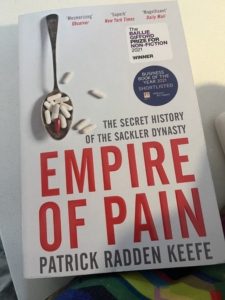
Having read Patrick Radden Keefe’s ‘Empire of Pain’ on the Sackler dynasty (which was a great charity shop find) I was struck by the uses of these sludge techniques in the Sackler’s Purdue Pharma’s marketing from the 1950s onwards. The understanding of what nudges are, and how they can be used, or abused, may have only been codified in the past few decades with the emerging field of behavioural science, but humans have always had an innate understanding of what motivates behaviours, and how to manipulate it.
The Sackler story is a timely reminder that nudges need to be used ethically and appropriately.
So what nudges did the Sacklers and Purdue Pharma use, and why were they effective?

Authority messenger
We react to who is telling us information – the messenger – they can be an authority figure or have authority in their field. This creates an authority bias, and we want to do what we are asked to because it reduces the cognitive load for our lazy brains to trust the person in authority.
In the 1950s, Arthur Sackler recruited doctors to sell medicines to other doctors.
“Seeing that physicians were most heavily influence by their own peers, he enlisted prominent doctors to endorse his products”
Patrick Radden Keefe ‘Empire of Pain’
Doctors trust and respect other doctors so using doctor as a messenger is effective as it uses their positional and medical authority, and the social norm of other peers doing it.
Authority messengers in a fundraising campaign might be the Chair of the Board, the CEO or a known figure with authority on your subject area (a teacher, a social worker), or a frontline worker.
When launching Librium tranquilliser (a precursor to Valium), Purdue sent vinyl records to doctors with recordings of other doctors talking about how well the drugs worked.
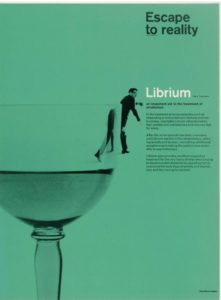
Many doctors were anxious about prescribing opioids and concerned about the addictive nature, so Purdue and the advertising campaign really focussed on doctors endorsing the product. These trusted messengers could cut through these concerns and if your peers were also prescribing it was creating a strong social norm for other doctors to follow. Doctors were incentivised to be paid speakers to promote OxyContin at conferences and pain management seminars.
Made up doctors
However, sometimes this authority bias was entirely misused and abused, for example, in the 1956 adverts for the new antibiotic Sigmamycin produced by the Arthur Sackler’s marketing firm MacAdams. These adverts were in the form of a brochure entitled ‘More and More Physicians Find Sigmamycin the Antibiotic Therapy of Choice’. In the brochure, eight doctors were quoted giving testimony about the effectiveness of the drug and how it was clinically proven. The doctors were from across the country including Tucson, Miami, Massachusetts – as well as authority messengers, we react to what is relevant and salient to us – so if our local doctor has said we are more likely to trust them than one from another state. Investigative reporter John Lear wrote, rang and tried to reach these eight doctors – his letters were returned, the phones went unanswered – the doctors did not exist – they had been made up:
“it looked so plausible, so real with the special patina of authority conferred by eights MDs. The ad was polished, impressive and fundamentally deceptive”
Patrick Radden Keefe ‘Empire of Pain’
Blinded by the white coat
As well as being blinded by the title of doctor, we are susceptible to visual clues about authority – someone in a high vis jacket, a smart suit, with a clip board, wearing a lanyard, or a white coat signal to us their position of authority or their job. In the Milgram experiment (1961), 66% of people would shock a ‘patient’ with 450 volts (enough to kill them) if told to do so by a man in a lab coat – the visual signal of the white coat gives them authority and we trust that authority.
When the opioid court cases were dominating the news in the US, Purdue Pharma moved to the other emerging markets using a subsidiary called Mundipharma and they continued their focus on the authority bias –
“Mundipharma reps in hospitals actually donned white coats and pretended to be doctors themselves”
Patrick Radden Keefe “Empire of Pain’

Note in this case it was the sales reps not the doctors in the white coat. The visual clue is a shortcut for our brains as to the authority of the messenger – but again fundamentally deceptive.
Who might be the authority messengers that you are susceptible to? The white coat? The suit? The status? The blue tick?
Experience messenger
Messengers are not always those with positional authority, sometimes a messenger who has direct experience and their personal testimony can speak powerfully to the audience. They need to be likeable and believable and may have the authority of experience. In 1997 Purdue Pharma created a video called ‘I Got My Life Back’ which featured real life testimonials from those whose lives had been changed by taking OxyContin.

Incentives
Incentives motivate us to do something – they can be financial or moral, subtle or overt.
At Purdue, they used financial incentives for the pharmacy reps who worked on commission, and unlike other agencies, Purdue had no caps on bonuses for reps, so the financial incentive for them to get doctors prescribing OxyContin was a strong motivation.
FREE
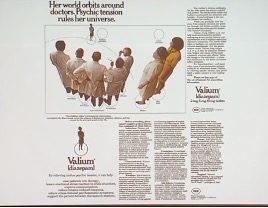
One of the best known incentives is the free trial.
The word ‘free’ excites our brain and we fear that we are missing out on something. Purdue inherently knew this and used free trials to get doctors and patients to try the product (additionally concerning with a highly addictive painkiller, and a tactic often used by illegal drug dealers). Free monthly prescriptions and samples formed part of the marketing strategy for Valium and for OxyContin– with over 82 million free samples of Valium given in 1970s in Canada.
Reciprocity
When someone does something for you there is a natural human impulse to reciprocate and return the favour, and this builds relationship and can increase liking.
In the 1950s various pharmaceutical companies used free products to incite the reciprocal impulse with doctors – Eli Lilly gave free stethoscopes to students and Roche free text books.
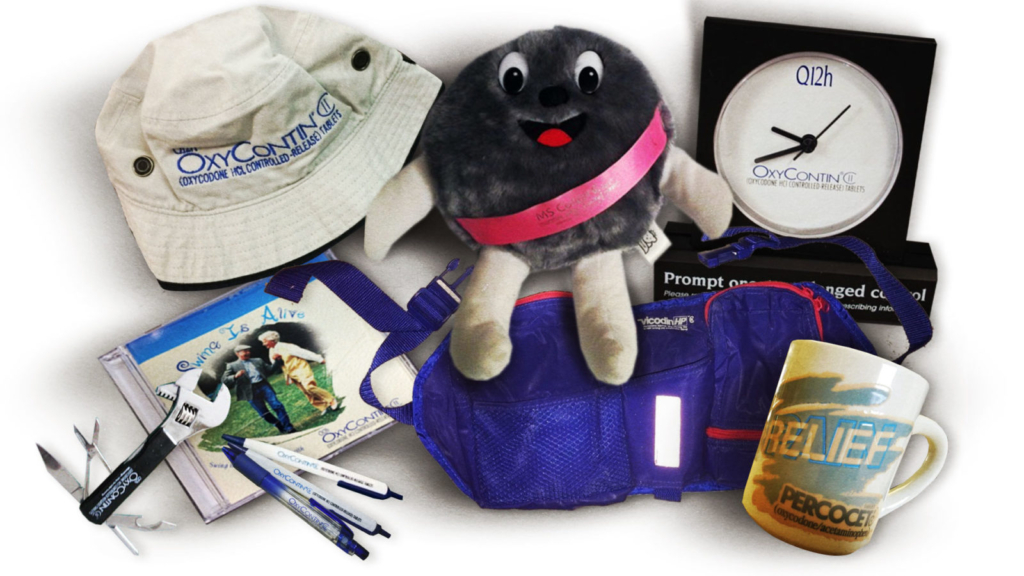
When Purdue were launching Oxycontin they delivered over 7,000 fully paid weekend pain management seminars in exotic in five years. They gave out branded free merchandise including fishing hats, plush toys, luggage tags, music CDs and a Percocet mug that says Pain and when hot liquid is added changes to Relief.
There’s no such thing as a free lunch?
Free is not just about free products and swag. If someone does something nice for us. like buys us lunch, the same human impulse to reciprocate is triggered. In one year Purdue allocated a budget of $9m on food for physicians and an internal email in 1996 noted how effective these incentives were:
“physicians who attended dinner programs wrote more than double the number of new Rxs [prescription] for Oxycontin compared to the control group”
Patrick Radden Keefe ‘Empire of Pain’
Salience
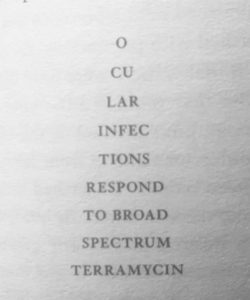
We pay more attention to things that are relevant to us. To make the adverts for antibiotics more relevant and noticeable to optometrists the 1950s MacAdams adverts were made to look like eye charts.
Linguistic relativity
Giving something a name makes it more real. The Sapir Whorf hypothesis says if you give something a name, you fundamentally alter the way it’s perceived. ‘Designated driver’ is one example of a phrase that was introduced when trying to promote safer approaches to alcohol and driving. It was introduced in Scandinavia in the 80s, and when it was used in the US they got $100m of donated airtime to cement the concept in the language by using it in over 100 TV shows like Cheers.
MacAdams advertising agency created the name ‘broad spectrum’ to cover the impacts of the new antibiotic Terramycin (above) in the 1950s. Previously antibiotics had been narrow spectrum and targeted at specific infections, by changing the name it changed how the drug was perceived and encouraged physicians to prescribe for a multiple of conditions.
How did the Sacklers respond to concerns about their marketing practices?
Arthur Sackler dismissed concerns about biasing physicians with marketing saying they were too smart to be biased by these endorsements and would follow the science.
“a cornerstone of Arthur Sackler’s world view; the notion that doctors are priest like figures, immune to flattery or temptation or greed, forced exclusively on the narrow dictates of appropriate medical care”
Patrick Radden Keefe ‘Empire of Pain’
In 1997 Dr Arthur Sackler was inducted into the Medical Advertising Hall of Fame with the citation “No one single individual did more to shape the character of medical advertising than the multi talented Dr Arthur Sackler”
The marketing practices used by Purdue were heavily criticized by the U.S. Government Accountability Office in a 2003 report.
So when we apply nudges …
We need to make sure that they are there to help people make better choices.
Sometimes in the charitable sector there can be a suspicion about applying behavioural science interventions to our work as it feels too commercial practices or like marketing. Charities can feel that the value of their work ought to speak for itself, and because the need is so great, or so obvious, charities should not need to resort to these ‘commercial tricks’. Perhaps there is a concern about a double standard, that using these nudges for business and profit is allowable, but charities with their desire to change the world for the better, ought to be somehow purer.
Nudges are powerful but must be used suitably, ethically and in a way that is aligned to the values of your organisation (and your own personal values) and ensure that the donor still has autonomy to make choices.
By not adopting what is known to work, and used to effect in the commercial sector, could the charitable sector be doing itself a disservice if it does not engage in these practices?








Leave a Reply
Want to join the discussion?Feel free to contribute!