When Fundraising Built a Nation’s Memory – the women who fundraised for America’s centenary
In 1876, America was preparing to celebrate its centenary.
Everyone loves an anniversary, right?
To mark the moment, a Centennial Exhibition was planned in Philadelphia. But to deliver something on that scale, you need fundraising.
The campaign began a full decade in advance – large scale capital campaigns need long lead time to create the case for support and secure the donations. Initially, the case for support focused on economic, scientific and industrial prestige. The case did not resonate with donors. Also, they failed to advertise.
And this is an important lesson: a campaign only works if the case for support works for donors. Framing matters.
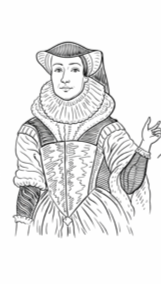
By 1873, in the midst of a financial depression, it was clear a new approach was needed. The (all-male) committee looked to what had worked before and turned to the women who had successfully led the Sanitary Fair campaign. Enter the Women’s Centennial Exhibition Committee (WCEC), led by Elizabeth Duane Gillespie, great-granddaughter of Benjamin Franklin. She had experience raising funds from previous campaigns, and also organising a hospital for wounded soldiers during the Revolutionary wars.
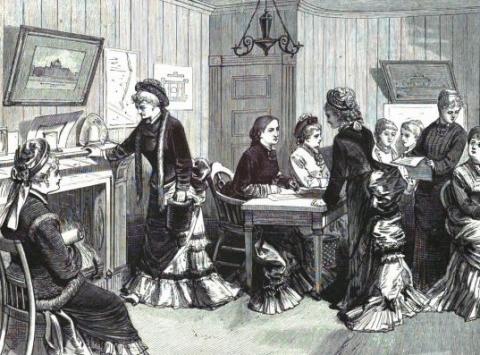
Frank H. Norton, ed., Frank Leslie’s Historical Register of the United States Centennial Exposition, 1876 (New York: Frank Leslie’s Publishing House, 1877).
They reframed everything.
The campaign shifted from industry to identity from economic prestige to patriotism, nostalgia, and national pride. It became not just an exhibition, but a story about America at 100 – where it had come from, who had made it, and especially the women who had made it. The Committee moved it from an intellectual and rational (system two) appeal, to an instinctive and emotional connection (system one).
So how did they fundraise?
To unlock a promised government grant they needed to demonstrate popular support of the scheme – within two days Gillespie and the Committee members had secured 82,000 signatures by going to door by door across the city which unlocked the $1m of federal funds. Being organised and systematic in fundraising is key. They organised a letter writing campaign and letters of support from across the country also unlocked a loan to secure further funds ($1.5m).
Centennial “stock” was sold in $10 units. Gillespie and the committee spread out across the city and went door to door selling the stock. However, the Committee recognised that not all donors had capacity to make a $10 gift – so the option to make $2 instalments was added. The Committee also worked to encourage factory workers to club together to buy units of stock. This lowered the barrier to entry and encouraged wider participation. Buying a unit of stock gave each donor a stake in the Centennial exhibition and by extension America’s future – creating ownership (what we now call the IKEA effect – we value something more when we have helped create)
Events celebrated the past and required attendees to dress as Martha Washington but only those giving at a certain level were allowed to do so. There was scarcity too, Gillespie put a strict limit on ticket purchases which drove up demand and publicity (a classic application of scarcity bias). Events became so oversubscribed that an additional venue was secured, and even an iron bridge built between buildings to accommodate demand – funded by, of course, more fundraising.
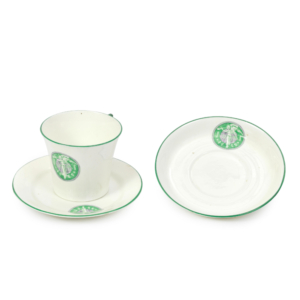
They sold merchandise – teacups, napkins, poems all linking to America’s past. Diversifying income is crucial but also giving supporters tangible ways to own and further embed their identity with your campaign.
They lent into national pride and nostalgia and at fundraising events they curated relic displays — objects linked to Washington and Franklin – candle stand of Benjamin Franklin, scraps of Martha Washington’s clothes, Washington’s snuff box and copy of his will, weapons, flags, cannon balls from Yorktown (all with donor credits of who had lent them – you must credit your donors).
They created themed experiences like the Boston Tea Party re-enactments tapping into what we would now call the experience economy. They produced medals (raising over $5,600), embedding commitment and signalling belonging. They even published a National Cookery Book, sourcing recipes from across the states and creating national identity whilst also raising funds.
And underpinning it all – timing.
Anniversaries are powerful “temporal landmarks.” Behavioural science shows they prompt reflection, reset identity, and create socially sanctioned moments to act. The centenary combined nostalgia for the past with optimism for the future — a potent dual frame still used in modern capital campaigns and milestone appeals.
Like campaigns today they were even challenged on what they needed the money for as the exhibition was opening:
“What further need have you for money?”
A clear response was forthcoming
“Our insurance, our watchmen and our employees will require money”
A reminder that the core costs are always hard to articulate! And too many people think fundraisers are unpaid volunteers.
Then came a twist.
Despite their success, the women were denied the promised space in the main exhibition due to international demand to be part of the Exhibition. Instead, they were told to fund and build their own pavilion.
So they did.
They raised an additional over $31,000 in jut a few months and created the Women’s Pavilion with a working Kindergarten – not just as a physical space, but as a statement. The exhibition included 74 inventions patented by women as well as examples of women’s arts and science
Who gets to write history?
The WCEC reframed the campaign to be about patriotism, nostalgia, and national pride. This was especially important in America after the Revolutionary War as a way of creating a cohesive national narrative but it was more than that.
“They inserted women into the past as participants rather than as bystanders, but in a non-threatening way that sanitised the violence of the American revolution”1
There was an active and intentional insertion of women’s role in the founding of America that threaded through the campaign.
Although, campaign leader Gillespie was great granddaughter of Benjamin Franklin she did not emphasise this familial connection, but her connection to her grandmother, Sarah Franklin Bache. Her grandmother who led relief effort for soldiers during the American Revolutionary war. Examples like Sarah Franklin Bache emphasised the role that women had played not in direct fighting, but in upholding American ideals. This, and the emphasis on Martha Washington, and other female leaders, shifted and shaped the historical narrative.
“privileged women constructed a classed and gendered historical memory, which aimed to unite women into national historical narrative and present themselves as custodians of history. They constructed a subversive historical account that placed women on equal footing with male historical figures and argued that women played a significant role in shaping the nation’s history”2
Who writes and re-writes history is crucial. There is an African proverb “that until the lion learns to write, every story will glorify the hunter”
History is a constantly shifting thing, and our interpretation is shaped by our interpretation, our times and culture, and what we choose to prioritise and how the stories are told.
“[History is] unending dialogue between the present and the past”
E H Carr
There was a deliberate choice to include women’s stories in the history of America, an influence still felt today in how those narratives are constructed and told. This involved an active widening of the story of the nation, centring it on women’s experiences’ and roles. The role that women played in collecting, keeping and preserving family histories can still be felt today.
Funds raised and legacy
The exhibition itself was a huge success: one fifth of the US population attended. The WCEC campaign raised $93,000 for the general exhibition and $45,000 for kindergarten display in the exhibition. Its legacy includes the founding of the Philadelphia Museum of Art.
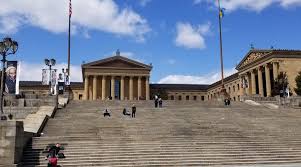
And importantly, structural change followed. After initial exclusion, Elizabeth Duane Gillespie successfully fought for women’s representation at board level — and was elected.
So what are the takeaways for fundraisers today?
- Frame the story for the donor, not the institution.
- Lead with identity, emotion, and meaning – not just function.
- Create ownership.
- Use scarcity and social proof.
- Design experiences, not just transactions.
- Leverage moments in time – anniversaries matter.
- And never underestimate the power of who gets to tell the story. Because fundraising doesn’t just respond to history. Sometimes it helps write it.
References:
‘For the Love of One’s Country: The Construction of a Gendered Memory in Philadelphia and Montgomery County, Pennsylvania 1860-1914” by Smadar Shtuhl
‘Remembrance and the American revolution Women and the 1876 Centennial Exhibition’ by Dolores Pfeuffer-Scherer
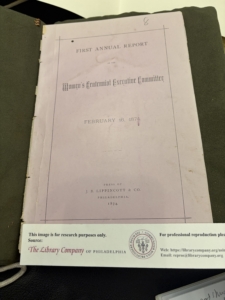
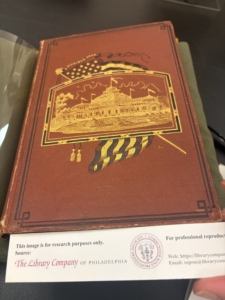
Original materials from The Library Company, Philadelphia
- ‘Remembrance and the American Revolution Women and the 1876 Centennial Exhibition’ by Dolores Pfeuffer Scherer ↩︎
- ‘For the Love of One’s Country: The Construction of a Gendered Memory in Philadelphia and Mont Co Pennsylvania 1860-1914’ by Smadar Shtuhl ↩︎
‘