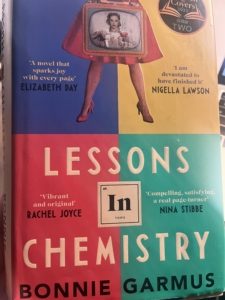
Here is an AI version of me dressed as Elizabeth Zott from Lessons in Chemistry
The challenge for World Book Day is often finding a character from a book, not a TV programme or film (although this version of looks rather more like Brie Larson in the tv show, that how I pictured her in the book.)
Elizabeth Zott in the book is a scientist who has to battle to get, and keep, academic grants, and fit into the priorities of funders. All the time being undermined by her boss who misleads the philanthropist supporting her work that she is a man and diverting funds from their proper use.
‘A fairy godmother is just another word for a philanthropist. A rich person who gives money to causes’
Harriet tells Zott’s daughter Mad
Zott’s struggles remind me of a real life scientist, Professor Sarah Gilbert, who devised the Oxford Astra Zeneca Covid19 vaccination who said:
“Actually, raising funds had been my main activity for years… I trained for years to become really good at ‘doing science! .. but… what I actually spend my time doing these days is, mostly, bringing in the money. This [system] can be counterproductive for the cause of scientific research itself… ”
‘Vaxxers’ by Prof Sarah Gilbert and Dr Cath Green
The other reason I choose Elizabeth Zott is because of her scientific approach – when applying the principles of decision science to fundraising is important to be rigour and scientific – see here for more https://marinajones.uk/chemistry/
So in what other stories do we see fundraisers that we could dress up as – or be inspired by?
So in the words of Tom Lehrer ‘drag out the Dickens’, Charles Dickens novels in Victorian London often feature fundraising activities.
A Christmas Carol starts with fundraisers collecting for the poor who are dismissed by Scrooge (and told the poor should die and decrease the surplus population
Mrs Jellaby in Bleak House so concerned for the far away Borrioboola-Gha and assuming raising funds that she cannot look after her own family or needs
For either of these a Victorian bonnet outfit could work for World Book Day.
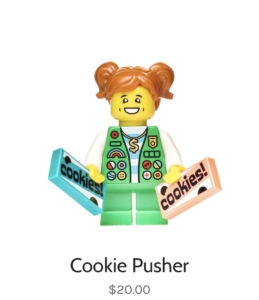
An easy possibly generic costume would be a Girl Scout and girl scouts raising funds via cookie sales could be used.
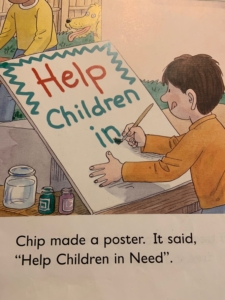
For parents, or those that remember learning to read with them, the Biff and Chip Oxford Reading Tree books could offer the answer – raising funds features in several books
Or do we go with a smart business look and go as Sarah Jane in Janice Hallet’s The Appealmystery where she uses her professional fundraising skills to coordinate an Appeal for Poppy?
You are what you consume
Cultivation theory tells us our perception of the world around us is learnt from the culture we consume which we unconsciously mimic and how tropes and exposure to these story impacts how we may think about fundraising. The challenge when exploring fundraising and fundraisers through fiction is sometimes our experience of positive role models can be limiting, sometimes the reputational laundering, nefarious billionaire hiding a dirty secret through philanthropic acts dominates the literary tropes. Although, sometimes perhaps deeper truths are revealed about our attitudes to raising money or money itself.
So we may quickly run out of positive and easily recognisable or achievable costumes. And move to some more real world types that expose different facets of fundraising and insights into the profession but not always in the best light.
Some less salubrious fundraisers in fiction
Jack Schmidt, Arts Administrator– Jack turns into an Arts Administrator (fundraising consultant) when private detective work dries up because ‘What your arts organizations need is a guy who can ask people for large amounts without blushing and twisting his hankies’.
The short story begins with this line
‘It was one of those sweltering days toward the end of the fiscal year when Minneapolis smells of melting asphalt and foundation money is as tight as a rusted nut’
and includes lines like
‘Now anyone who can spell ‘innovative’ can apply for a grant … but that doesn’t mean that the bozo who reads the application is necessarily going to burst into tears and run right down to Western Union’
and goes on to extol the added value of the consultant writing the application (he is a consultant after all) and
‘Your fat cats will millions to build an arts center, but nobody wants to donate to pay the light bill because you can’t put a plaque on it. They’ll pay for Chippewa junk sculpture but who wants to endow janitors’
In The Ask by Sam Lypsite a major gifts fundraiser at “Mediocre University” gets fired, but is reinstated in the role to make an ask from a rich friend from college. (‘Our job was to grovel for more money’ offering a rather cynical and depressing outlook on fundraising from protagonist Milo on naming rights, fundraising practice and ‘asks’)
In Jacqueline Wilson’s Hetty Feather series of books set in the Foundling Hospital the reliance on fundraised income is apparent – using the foundlings to demonstrate impact, having visitors watch them at Sunday church services and dinners and various fundraising events including charity concerts, fairs and events – living our the show don’t tell approach.
It is frequently through events that we see more glimpses of fundraisers and fundraising in stories.
In Emily Henry’s Book Lovers a community comes together and donating time and talents to fundraiser together and save the store (this is a familiar trope for the Hallmark type stories)
Margaret Mitchell’s Gone With the Wind includes the Charity Bazaar dance where they are raising funds and Rhett bids to dance with widow Scarlett and Mellie and Scarlett donate their wedding rings to raise funds.
In Jenny Jackson – Pineapple Streetat fundraising gala we see ‘The hope, of course, was that he would be so moved by the evening’s proceedings that he would leave a pledge in a small envelope set under his dinner plate’
The psychology of when to making the ask can be seen A Changed Man by Francine Prose – when the key moment is described as
“monitoring his tiny tics has turned out to be excellent training, useful now in her work as she watched a donor’s face for the perfect moment to raise the subject of giving.”
Although a book that describes fundraising as ‘physic blackmail’ and working a room at a gala dinner as balancing
‘nerdy sincerity…reassuring to potential big ticket donors’ and knowing everyone ‘kiss kiss, chat chat, say a few words, spin off … it’s her job’
might not be the best way to inspire us to take pride in the profession!
So lets return to a more positive example in Elizabeth Zott blending expertise in your field with navigating the world of securing the grants to make your work happen.
https://marinajones.uk/wp-content/uploads/2022/12/f2b903e010104f5aa61ea1821a685913.png00adminhttps://marinajones.uk/wp-content/uploads/2022/12/f2b903e010104f5aa61ea1821a685913.pngadmin2026-03-02 13:04:442026-03-02 13:04:51What should a fundraiser dress up for on World Book Day?
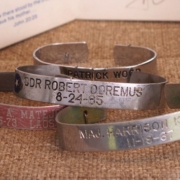
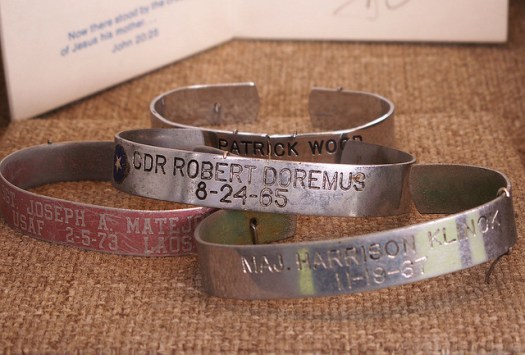
In the early 1970s, millions of Americans wore thin aluminium bracelets engraved with the name of a man they had never met.
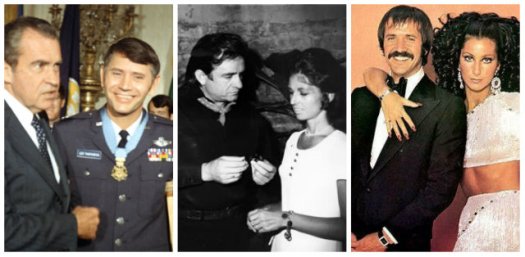
They wore them in classrooms, on television, on red carpets and at kitchen tables. Johnny Cash wore one. Sonny and Cher wore them. John Wayne wore one. So did Princess Grace of Monaco. So did students who could barely afford the $2.50 donation that came with it.
Each bracelet carried the name and date of capture of a single prisoner of war or missing serviceman in Vietnam. You wore the bracelet until the man named on it returned, or until the truth of his fate was known.
The bracelets worked because they exploited something deeply human: a personal connection. It connected you with one individual, one missing serviceman – they became yours. This is called the identifiable victim effect the tendency to feel greater empathy and act more decisively when a single, specific person is identified, rather than an anonymous group. The POW/MIA bracelets replaced a collective of anonymous prisoners with one named individual.
Development of the idea …
Congressman Bob Dornan wore a bracelet made from scrap aluminium, given to him by a Montagnard tribesman in the Vietnamese highlands in 1966. It came with the plea – ‘do not take it off until my people are free‘.
Bob did not take it off. He wore it every day. Every time his arm hit a wall the bracelet clinked, every time he saw it, every time it got caught in his sleeve – he was reminded of the suffering and why he was wearing it.
The story of Bob Dornan’s bracelet inspired Carol Bates and other students involved in Voices in Vital America (VIVA) to do something to raise awareness of the prisoners of war in the Vietnam war. The first batch of bracelets was intended for students, priced to match the cost of a cinema ticket.
Visibility as commitment
Behavioural economics tells us that public commitments change behaviour. Once we signal who we are, and especially when we do that visibly with an outward sign, like a bracelet or badge, we want to stay consistentto that identity. The bracelet didn’t just express alignment, it showed and embodied commitment.
What started as a kitchen table enterprise caught the imagination.
Demand jumped from hundreds a week, to tens of thousands. Nearly five million were eventually sold raising over $7m.
This is the behavioural hinge – once support becomes visible, it stops being individual and starts being social.
Wearing the bracelet did three things at once.
It personalised an abstract war.
It signalled allegiance to others.
And it made non-participation noticeable.
When objects become norms
The POW/MIA bracelets didn’t just raise money. They changed the atmosphere.
The bracelet turned support into a default behaviour. If everyone else was wearing one, not wearing one became a decision.
It was not just a fundraiser. It became social norming made tangible.
This is the same dynamic we use as charities with badges, donor walls, name plaques, digital badges and public thank yous. Visibility creates legitimacy. Legitimacy creates momentum.
The difference is that the bracelet didn’t say I donated. It said I’m part of this.
Wearing as giving
Psychologists call this social proof. Fundraisers call it recognition. Donors experience it as belonging.
We know from decades of research that people give more, and more often, when generosity is visible. Donation boxes that show visible gifts drive more donations – the social proof of others donating reassures us that this is the normal thing to do and encourages more gifts, more belonging. Public donor lists can increase participation by crowding in support (although be careful not to crowd it out). Badges, ribbons and pins turn our private values and identities into shared social norms.
But the bracelet did something more sophisticated. It fused identity, sacrifice and time.
You didn’t just buy a bracelet. You lived with it. Every day reminded of your soldier, your prisoner of war, your connection and your commitment.
From bracelets to badges
This logic has repeated itself across centuries. The bracelet was not a new way to belong and to embody commitment and identity.
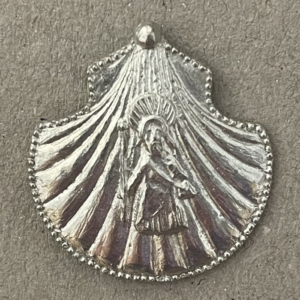
Medieval pilgrims wore badges showing the shrine they had visited. These could be bought as souvenirs to demonstrate your identity as a pilgrim, to show you had been on pilgrimage (and helped also raise additional funds). You wore them on your cloak or hat, put them in your prayer book or could nail them up at home. They showed to the world that they had been on pilgrimage and what tribe they belonged to. Each shrine had its own badges so you could collect them from various shrines demonstrating your piety and connection.
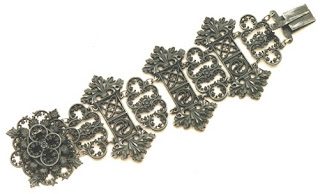
In 1813, Princess Marianne of Prussia used the power of social norming (and a bit of royal celebrity messenger) to appeal to Prussian aristocrats to give their gold jewellery for the Prussian cause against Napoleon. This proved a popular way to fundraise and the gold items were exchanged for iron jewellery emblazoned with ‘Gold gab fur Eisen’ (‘I gave gold for iron’). It became the social norm to wear these iron rings and broaches, and gold was considered unpatriotic.
Our brains have evolved to feel social rejection in the same way that we feel real pain – as our primitive selves needed to be with the group to get food and shelter – that is why doing what is normal for the group is so important. What we know now about how our brains work helps us to understand what is happening inside our brains and why social norming and embodied commitment are such a powerful drivers of behaviour.
Why we want the badge or the sticker everyone else has got.
We want to do what people like us are doing.
We want to belong to the tribe.
From tote bags to pin badges, from poppies to daffodils and forget-me-nots – charities continue to give supporters the chance to demonstrate their belonging and identity as a supporter. To belong to that supporter tribe. Each turns the body into a message, and the donor into a carrier.
Wear what you feel
Objects work when they carry emotional weight. When they ask something of the wearer. When they make values visible without making them performative.
The most powerful fundraising symbols don’t reward generosity — they enrol it.
They say: If you care, wear it. If you wear it, live up to it. If enough of us do, it becomes normal.
And once something is normal, it no longer needs to shout. It just needs to be seen.
References:
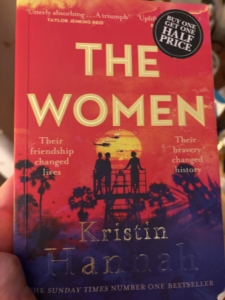
I found out about these bracelets by reading ‘The Women’ by Kristin Hannah – which tells the powerful story of American female nurses working in Vietnam, friendship and the aftermath of the war.
https://marinajones.uk/wp-content/uploads/2026/01/image-4.jpeg355525adminhttps://marinajones.uk/wp-content/uploads/2022/12/f2b903e010104f5aa61ea1821a685913.pngadmin2026-01-27 19:52:292026-01-30 20:33:34Why did five million people wear the same bracelet?
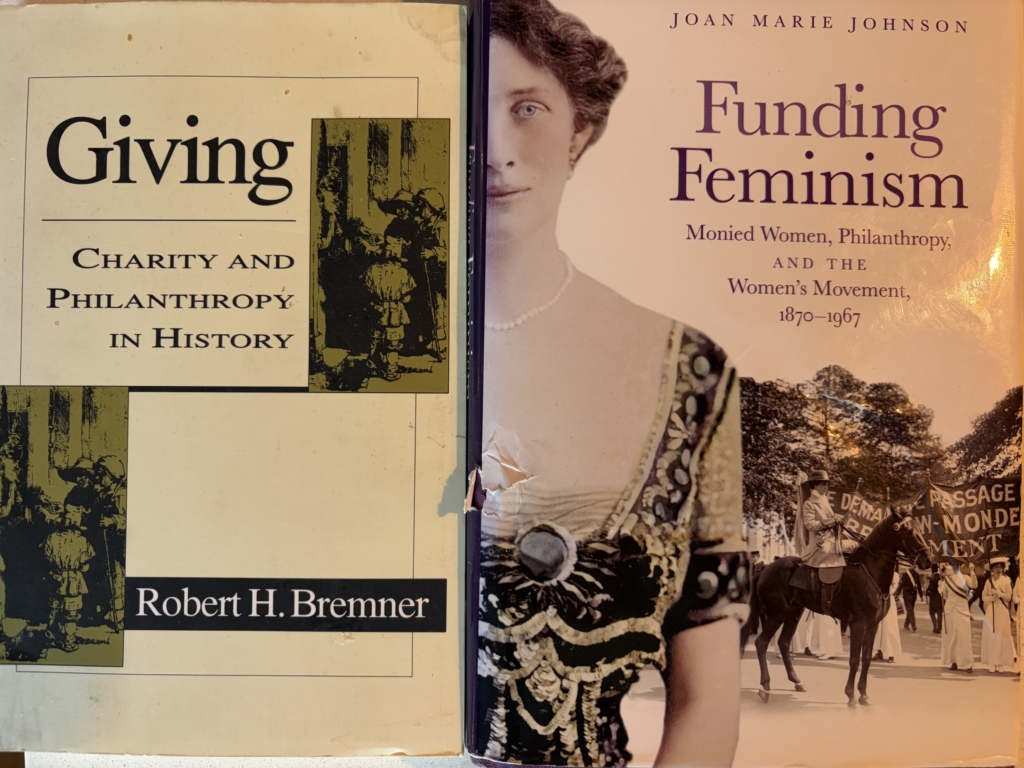
‘Funding Feminism Monied Women, Philanthropy, and the Women’s Movement, 1870–1967’ by Joan Marie Johnson
‘Giving Charity and Philanthropy in History’ by Robert H Bremner
‘The Women’ by Kristin Hannah
‘Lady Bountiful Revisited – Women, Philanthropy and Power’ edited by Kathleen D McCarthy
‘Bleak House’ by Charles Dickens
‘Act of Oblivion’ by Robert Harris
‘The Wasp Trap’ by Mark Edwards
‘Half his Age’ by Jennette McCurdy
‘Art Cure – the Science of How Arts Transform our Health’ by Daisy Fancourt
‘There are Rivers in the Sky’ by Elif Shafak
‘Opera Wars Inside the World of opera and the Battles for its future’ by Caitlin Vincent
‘Unravelling Oliver’ by Liz Nugent
‘State of Terror’ by Hilalary Rodham Clinton and Louise Penny
‘The Hitchhikers Guide to the Galaxy’ by Douglas Adams
“Small Bomb at Dimperely’ by Lisa Evans
‘Acts and Omissions’ by Catherine Fox
‘Women’s Culture – American Philanthropy and Arts, 1830 – 1930’ by Kathleen D McCarthy
‘The Golden Calves’ by Louis Auchincloss
‘The House that Stoll Built’ by Felix Barker
‘Sunrise on the Reaping’ by Suzanne Collins
‘The Restaurant at the end of the universe’ by Douglas Adams
‘Beth is Dead’ by Katie Bernet
‘By Your Side’ by Ruth Jones
‘To Tell You the Truth’ by Gilly Macmillan
‘The New York Triology – City of Glass, Ghosts. The Locked Room’ by Paul Auster
‘Yesteryear’ by Caro Claire Burke
‘Unseen Things Above’ by Catherine Fox
‘Shakespeare’ by Bill Bryson
‘The Gustav Sonata’ by Rose Tremain
‘Three Victorian Women who changed their world: Josephine Butler, Octavia Hill and Florence Nightingale’ by Nancy Boyd
‘Realms of Glory’ by Catherine Fox
‘The Predicament’ by William Boyd
‘The Killer Question’ by Janice Hallet
‘Two Kinds of Stranger’ by Steve Cavannagh
‘The Hummingbird’ by Sandro Veronesi
‘Tales from Lindford’ by Catherine Fox
‘The Briar Club’ by Kate Quinn
“No Friend of this House’ by Nathalie Haynes
‘The Ending Writes itself’ by Evelyn Clarke
‘The Institute’ by Katherine Bradley
‘The Company of Heaven’ by Catherine Fox
‘Frida Slattery as Herself’ by Ana Kinsella
‘The Psychology of Money’ by Morgan Housel
‘Middlemarch’ by George Elliott
‘One Year Before Your Capital Campaign’ by Mark Quigley
‘Whistler’ by Ann Patchett
‘Bring the House Down’ by Charlotte Runcie
‘The Correspondant’ by Virginia Evans
‘All in’ by Claire Powell
‘The Sentence is Death’ by Anthony Horowitz
‘Summer Island’ by Kristin Hannah
‘Dear Debbie’ by Freida McFadden
‘Inside the Nudge Unit’ by David Halpern
“Broken Country’ by Clare Leslie Hall
‘A Man of Parts’ by David Lodge
‘The Return of the Solider’ by Rebecca West
‘Our Noble Selves’ by Kate Atkinson
‘Nightingale’ by Kristin Hannah
‘Lexicon’ by Max Barry
‘Flashlight’ by Susan Choi
‘The Four Winds’ by Kristin Hannah
‘What we can know’ by Ian MacEwan
‘Heartburn’ by Nora Ephron
‘Gastrophysics’ by Charles Spence
‘London Falling’ by Patrick Radden Keefe
https://marinajones.uk/wp-content/uploads/2026/01/IMG_0972-scaled-e1767450212521.jpeg19202560adminhttps://marinajones.uk/wp-content/uploads/2022/12/f2b903e010104f5aa61ea1821a685913.pngadmin2026-01-04 09:13:232026-11-20 16:41:52Reading List 2026
When we think about social change we think in terms of great leaders, of the justice of the change, of the collective action of many to be effect the change they want to see in the world.
We celebrate the individuals and what happened. We think about being on the right side of history, of moral fibre, of progression.
We don’t want to think about the logistics. We don’t want to talk about the money. We don’t think about the fundraising.
We just talk about the injustice overcame.
This speaks to the taboos in our society talking about money.
Social change does not happen in a vacuum and however much we want to think change happens because of well meaning people doing the right thing. To get change you need to organize. To organize you need money. And to get money you need to ask. As academics Bekkers & Wipeking (2007) say the main reason that someone gives to a charitable cause is because they were aware of the need and were asked.
So how were these social change movements funded?
Even when you start digging into how these movements were funded is obscured – partly through what is recorded in the archives from social change, and that within that fundraising is not prioritized.
When we think of the civil rights leaders and the activists – we think of Martin Luther King, Rosa Parks on the bus, we think of the ‘I have a dream speech’, we think of the hundreds of thousands marching on Washington, the sit ins and the civil disobedience, the horror of Jim Crow laws, we think of an organized nonviolent movement
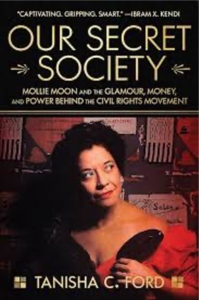
As historian Tanisha C Ford says
“The civil rights movement has become crystalized in our collective and national consciousness as this ideal movement, led by principled and charismatic male leaders that showed the power of racial liberation”
but as with all history it is
“never simple, never perfect and new never obedient”
We don’t think about how that change was funded. We prefer a narrative of passion good people making that social change. Of civil rights won, voting rights gained, a step towards equality – rather than a fundraising campaign, donor segments for targeted asks, fundraising events and securing grants. To make these things happen didn’t just take guts and determination. It took organization. It took donor lists. It took asking. It took preparation, passion, persuasion. It took stewardship.
It took fundraisers.
And today I want to share and celebrate some of those stories of fundraising for social change
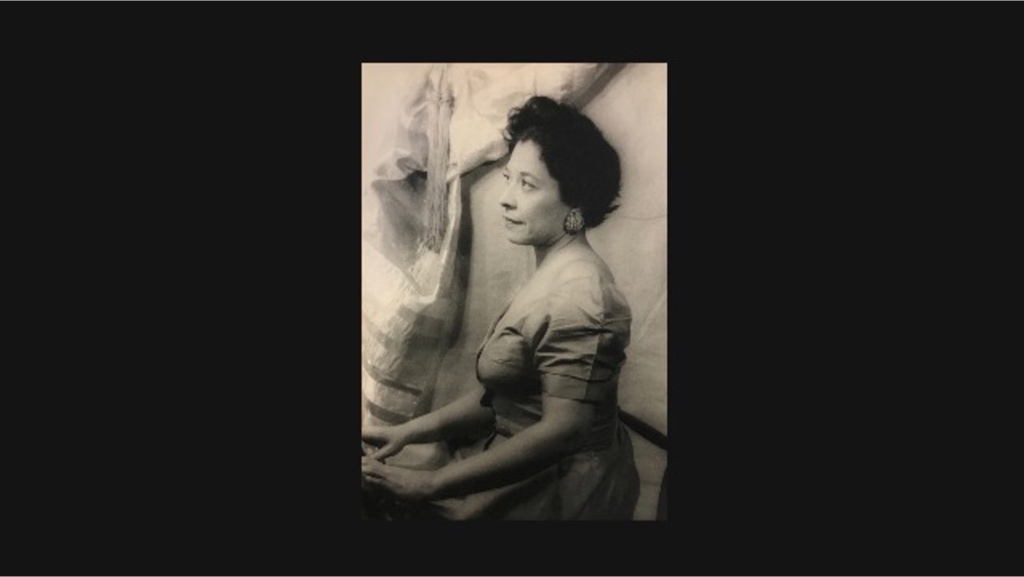
Let me introduce you to Mollie Moon a fundraiser who I learned about in Tanisha C Ford’s book Our Secret Society.
Mollie was a fundraiser and activist who played a crucial role in the civil rights movements raising money from African American grassroots supporters and also courting the wealthy New York philanthropists and grant givers
Ford notes that Mollie Moon had the fundraisers skill of choreography and
“bringing the right people – politicians, artists, European aristocrats and philanthropists together in the right rooms”
As we understand and study more about history, the history of the civil rights movements and the role that women played we are increasingly finding active and involved women who played pivotal roles in social change and as fundraisers.
Mollie Moon was born in 1912 in Ohio. She trained to be a pharmacist at college before her interest in social work and moved to New York. She went to Moscow with a bit part in a propaganda film (the communist equated the cause of civil rights with workers’ rights) and returned home via a few years in Berlin. On returning to New York, she worked at the Department of Social Services. The National Urban League was founded to “to enable African Americans to secure economic self-reliance, parity, power and civil rights.”. Mollie founded the National Urban League Guild – one of the key fundraising arms of the League and for decades was a leading fundraiser, activist and campaigner.
So what did Mollie do? Why is she so important in the civil rights movement?
What lessons can fundraisers learn from her about fundraising, and fundraising for social change?
1. Create the event that everyone wants to be at – and that all your supporters can afford to attend
In 1941 Mollie founded the Beaux Arts Ball – a major fundraiser.
Now events fundraising has been around since Biblical times so what did Mollie do differently?
The Beaux Arts Ball was the equivalent of today’s Met Gala. This was the must go to / must be seen at society event. The ball was costumed and the costumes allowed a certain level of licentiousness and risqué skimpy outfits.
Mollie recognized that within this type of event the audience attending had very different motivations
the great night out gala guest
the support the artists gala guest
the support the cause
and she catered for all of these.
The gala model was criticized by some as all events fundraisers is for costing too much vs its ROI and perpetuating the conspicuous consumerism of the Gilded Age. Detractors saw it as at odds with the needs of the League’s work to help the poorest amongst them struggling to get by.
There was concern that these types of glamourous social events would price out in the grassroots community supporters. But Mollie ensured that there was a sliding scale of prices to suit all purses. This made sure that the grassroot community supporters and the white philanthropists could attend and paid proportionally according to their means.
Mollie was pressurized to take the event downtown into Manhattan (from Uptown Harlem) to appeal more to wealthy white elites but held her ground. She wanted to keep it in Harlem and keep its grassroots origins. There was a home court advantage of making whites come to a traditionally black space
These balls raised thousands of dollars for the Guild and its work. Throughout the decades it evolved in terms of location (from Harlem to South Bronx to the Waldorf Astoria in Manhattan) and themes (from costume to fashion) as every fundraiser knows you want to have the calendar highlight event but you need to keep it fresh and your loyal audience coming back for more.
Her work on the balls was trivialized as being a socialite (she was called ‘a beauty with a social mission’ by the Pittsburgh Courier) bringing in both racist and sexist assumptions about the breadth, approach and strategy involved in raising this money.
2. Fundraising – is also education
Mollie spent a lot of telling rich white Americans why racism is bad and how it impacted on her day-to-day life. If you cannot see something happening you cannot understand that it is happening or what it means. Telling the truth and giving powerful testimony is an important but also an emotional labour for fundraisers. And Mollie had to do that. She also, as many fundraisers do, had a guiding role in understanding what the donor wants and finding the right project for them to support. This match making of matching the donor to the project is a key fundraising attribute.
3. The power of an emergency appeal
Mollie knew the power of urgency and the need to act now. She rebranded appeals to create a sense of urgency to get people to come
“Unless the citizens of Harlem respond to this call, the continuation of the cultural program at the center will cease and the community will cease and the community lose one of the most progressive institutions of its kind”
Tanisha C Ford
4. Celebrity endorsers
We listen to the message more when it is someone likeable and with authority that is endorsing it – so from Beaux Arts Ball to the other events – having the names of prominent sponsors on the event advertisement was crucial. And Mollie used this to her advantage – the adverts in the papers for the balls contained lists of celebrity patrons and endorsers including Orson Welles, Paul Robeson, Katherine Dunham, Billie Holliday and Marlon Brando.
It was not just their endorsement she also wanted their talent. She arranged fundraisers of Paintings by Famous Amateurs getting Dwight Eisenhower and Bojangles amongst others to paint pictures and auctioning them for the League.
5. Power of press
Mollie used her networks and contacts to get stories of the fundraisers and the League’s work into the press. She didn’t just focus on the news section but also society and fashion.
6. Importance of CPD
Like every good fundraiser Mollie understood the power of professional development and training. She ran programmes to train and inspire volunteers to go out asking.
7. Importance of being organized
fundraising doesn’t happen in a vacuum. You need to be organized. You need to know who has given and when, who knows who, who asked who. Mollie and the Guild had donor rolls, lists of last donation and last contact like any good fundraisers CRM system.
Mollie Moon
But fundraising for social change – like any kind of fundraising – is not easy.
It raises questions about who you work with.
So who did Mollie work with?
One of the key people was Winthtrop Rockefeller – known as Win – grandson of John D Rockefeller. He positioned himself as a rebel. A former a soldier, expelled from Yale, worked Texan oilfields. Win Rockefeller did not want to trade on family name, but had cash and connections (and perhaps an element of rebelling against the establishment family by supporting civil rights)
Win was known for saying:
“its not enough to contribute money. People must make the gift of themselves of their own time, their creative talent and spiritual strength”
A precursor of the 3 TS of fundraising – treasure, time and talent
How you treat donors differently? (They aways know)
The National Urban League suffered controversy in 1949 when a newspaper leaked the existence of separate donor lists. A list for downtown Manhattan white donors offered exclusive events and a list of uptown Harlem African American supporters invited to engage in the struggle. This caused their membership to drop 150,000.
This feeds into an issue at the centre of funding for social change
Who do you take the money from and if you take money from certain people does that change what you are fighting for?
Are there more ‘donor friendly’ projects that are less radical projects and therefore more palatable? Within the civil rights movement was education for African Americans more fundable than voting rights? How do you know what cause to focus on when there are so many urgent needs? How led are you by where the money is vs the cause you are fighting for?
Ebony magazine said that taking white money reproduced white supremacy and racial hierarchy and for many within the movement taking money from wealthy philanthropists or foundations for many perpetuated the capitalist structure that had so benefited from slavery.
Do you like Greenpeace say you wont solicit corporate money? Or like the Mackenzie Scott grant recipients, Frida- the young feminist fund, take the money and then release a statement saying how you fundamentally disagree with the wealth that created it? Take it and hold your nose? Have more money for the education programme but not enough for the activist work?
These were fundamental challenges for those fighting for social change – and social change is not just one agenda item, it is a broad movement, some want fast radical change – you have to hold the collective together as well as get the money.
When there are mixed motives for giving, do you take the cash or question the principles?
Many businesses supported civil rights movement and made donations because it was good for business. Companies like General Electric and American Airlines wanted to attract the new wealth African American professional classes to spend their money with them.
Although there were those that genuinely supported the cause and championed it, in 1962 a business man’s lunch aim to raise $3m for the League and a business man stood up to say cost of racial prejudice costing business $7.5bn
Competition for limited resources – but play to your unique strengths
There was competition between different organsiations trying to achieve the same aim – sounds familiar? There have always been arguments about too many similar charities doing the same thing. The National Urban League and the NAACP (National Association for the Advancement of Coloured People) were in competition for donors and resources. However they each played to their strengths and structures – the National Urban League was 501c3 so had structure to receive grants and tax efficient giving but could not be politically active – the NAACP was a 501c4 so could lead on sits ins and strikes.
Things change – do you?
Funding models change and evolve over time. Can you and the movement you are funding?
In 1963 a new president of the National Urban League, Whitney Young declared they would no longer be a ‘nickel and dime’ outfit signifying a strategic shift from small grassroots membership to major philanthropic contributions. This strategy had a powerful impact shifting the funding model – from being 18% foundations to 75% and pushing down the grassroots membership support. By the end of 60s 14% of annual income coming from African American donors. It is worth noting that the money from African American donors came without restriction but often the money from philanthropists comes directed towards programme.
Legacy fundraising for social change? Social change always feels immediate and urgent – so you would not be thinking about legacies for it. Your ideals and aspirations would be that the problem has been solved by the time that the legacy is realised. But there were two substantial legacies that helped support the civil rights movement – which speak to sophistication of the methods used by the fundraising divisions of the movement (and that somewhere in an archive the legacy brochures might exist…)
Dorothy ParkerMadam CJ Walker
Dorothy Parker left her literary estate to Martin Luther King having been a funder and supporter of civil rights in her lifetime, which got her put on the FBI watchlist. After he was assassinated the copyright for her works moved to the NAACP which still approves use of her work and benefits from her estate.
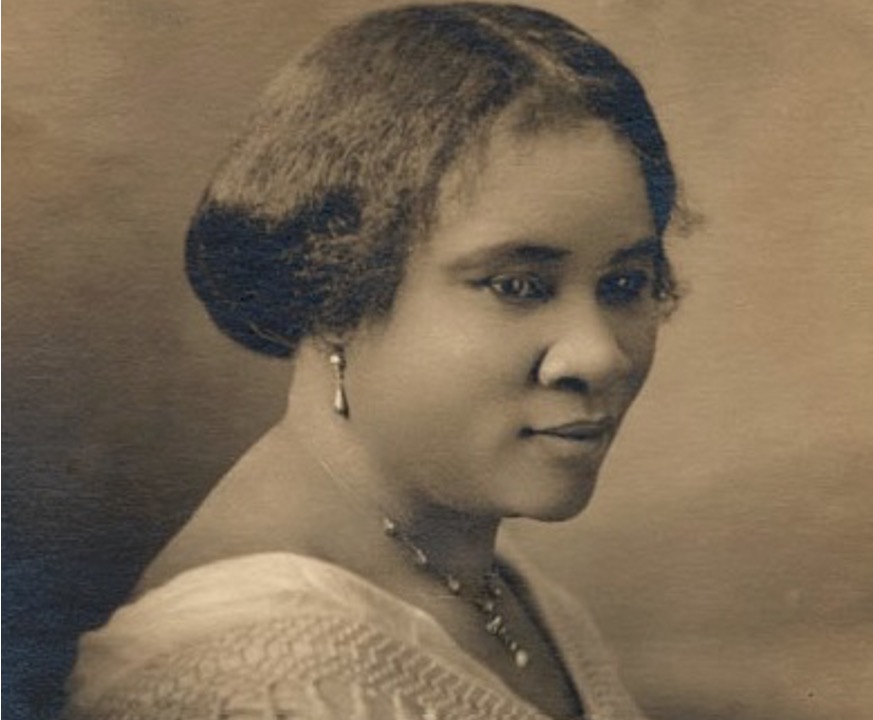
Madam CJ Walker left a left legacy to the NAACP against the advise of her financial advisors who thought that it was a nascent organisation that wouldn’t last. The Secretary of the NAACP Walter White said in the 1950s that ‘Madam Walker’s generosity virtually saved the NAACP in the dark days of depression.’
As with any legacy gift you never know what it may go on to accomplish …
With fundraising for social change and with the history of fundraising there is a challenge of what gets recorded and how we record history.
What does the academic world regard as historic? Where are gendered and racial lens applied to what ‘counts’ as what is worth recording.
With most history we rely on written records. And when you are campaigning to change laws less is written down.
Fundraising history hidden at the best of times – and especially within social change movements. We don’t want to talk about the money that made change happen. And that means the history of fundraising, social change is poorer – we don’t get to hear the impact of powerful players and fundraisers like Mollie Moon.
And with all fundraising history – money talks. Major foundations have archives that record what was given and to which organizations. This fails to record and recognize the many small gifts by hundreds of thousands – the National Urban League did have 501c3 status but many campaigning organisations didn’t so there are not records of these gifts.
Where we look for the items that form this history is also different. In writing the history of Mollie Moon Tanisha C Ford has used ephemera – menus from gala, newspaper reports not just traditional
“recognizing that Black women’s documents, objects and keepsakes are rarely housed in brick-and-mortar archives. To tell our stories we must be willing to dig in unexpected places, to utilise objects and other materials that archives and museums might consider of little use. And we must approach this work with an ethic of care that honours our subjects.”
Even in Mollie’s lifetime we see how history gets forgotten, remembered and retold. At the 1972 at the Beaux Arts Ball was led by all male board celebrating the history of the National Urban League. Mollie was present but there was no mention of her contribution and work and this led to a backlash from a new generation of activists who sought to get Mollie’s place and skills recognized.
When we tell our history we are always as Tanisha C Ford says
“how we choose to remember people, how we choose to forget, what we omit and distort’
changes the narrative of how the fundraising for social change happens.
We can be too close to an event to see it – we may need to reevaluate it and see the complexity
Philanthropy is always historically and culturally placed . They raised funds to keep slavery, to stop women getting the vote and to marry off unmarried ladies.
What is right side of history now that we will look at differently in 100 years and be shocked that there was an anti side?
And where will that fundraising appear in the history of social change?
https://marinajones.uk/wp-content/uploads/2025/04/Cover-Book.jpg1052698adminhttps://marinajones.uk/wp-content/uploads/2022/12/f2b903e010104f5aa61ea1821a685913.pngadmin2025-04-25 18:35:242025-04-25 20:31:26Mollie Moon – fundraising for social change
So 89 books (2023) and 67 (2024) including a mix of fiction, non-fiction, business, plays, new reads and re-reads. And 2025 so far
‘London Rules’ by Mick Herron
‘The Great Gatsby’ by F Scott Fitzgerald
‘When. The scientific secrets of perfect timing’ by Daniel H Pink
‘The Heart of the Matter’ by Graham Greene
‘London’s Burning’ by Anthony Quinn
‘Precipice’ by Robert Harris
‘Joe Country’ by Mick Herron
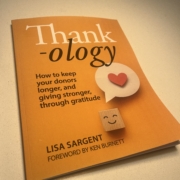
‘Thankology’ by Lisa Sargeant
‘Blue Sisters’ by Coco Mellors
‘The Housemaid’ by Freida McFadden
‘The Snobs’ by Muriel Spark
‘Glorious Exploits’ by Ferdia Lennon
‘Show Don’t Tell’ by Curtis Sittenfeld
“Our secret society’ by Tanisha C Ford
‘The Bee Sting’ by Paul Murray
‘Fundamentally’ by Nussaibah Younis
‘Until August’ by Gabriel Garcia Marquez
‘Great Fundraising Organizations’ by Alan Clayton
‘Shades of Grey’ Jasper Fforde
‘Slough House’ by Mick Herron
‘Bad Actors’ by Mick Herron
‘How Much of These Hills is Gold’ by C Pam Zhang
‘Gabriel’s Moon’ by
‘Mania’ by Lionel Shriver
‘The Ministry of Time’ by Kaliane Bradley
‘Bad Eminence’ by James Greer
‘Great Big Beautiful Life’ by Emily Henry
‘The Dinner Guest’ by B P Walter
‘Great Big Beautiful Life’ by Emily Henry
‘Atmosphere’ by Taylor Jenkins Reid
‘Neurogiving’ by Cherian Kosher (advance copy)
‘The Art of Thinking Clearly’ by Rolf Dobelli
‘The Other Passenger’ by Louise Candlish
‘Creative Deviations’ by John Lepp
‘A Gentleman in Moscow’ by Amor Towles
‘Butter’ by Asako Suzuki
‘Charity, mutuality and philanthropy; voluntary provision in Bristol 1800-70’ by Martin Gorky (phd thesis)
‘Financial Cathedral Building in the Middle Ages The Generosity of the Faithful’ by Wim Vroom
‘The Cathedral of Milan and its Fabulous Donor’ by Martina Saltamacchia (phd thesis)
‘The Library Book’ by Susan Orlean
‘The Angels of Venice’ by Philip Gwynn Jones
‘Like Happiness’ bu Ursula Villarreal-Moira
‘The Other Valley’ by Scott Alexander Howard
‘Ripple’ by Jen Groom and April Vellacott
‘Fahrenheit 451’ by Ray Bradbury
‘Midnight Feast’ by Lucy Foley
‘Rules of Civility’ by Amor Towles
‘Brooklyn’ by Colm Toibin
‘Long Island’ by Colm Toibin
‘Someone’s Gotta Give’ by Alisha Fernadez Miranda
‘Crooked Cross’ by Sally Carson
‘Maybe in another life’ by Taylor Jenkins Read
‘The Paris Apartment’ by Lucy Foley
‘Three Eight One’ by Aliya Wheatley
‘Jane and Dan at the end of the world’ by Colleen Oakley
‘Make Me Famous’ by Maud Ventura
‘Drayton and Mackenzie’ by Alexander Starritt
‘Moon Gate’ by Amanda Geard
‘Early Morning Riser’ by Katherine Heinz
‘Our Evenings’ by Alan Hollingshurst
‘Itch’ by Simon Mayo
‘Itch Rocks’ by Simon Mayo
‘Murder at the Black Cat Cafe’ by Seishi Yokomizo
‘Itch Craft’ by Simon Mayo
‘100 Things Every Designer needs to know about people’ by Susan M Weinschenk, phD
‘Clown Town’ by Mick Herron
‘The Bride of Lammermoor’ by Walter Scott
‘The Third Man’ by Graham Greene
‘Diva’ by Daisy Goodwin
‘Ordinary Saints’ by Niamh Ni Mhaoilcoin
‘My Husband’ by Maud Ventura
‘Richer Expectations: Why rich people give’ by Beth Breeze, Rhodri Davies and Theresa Lloyd
‘The Translator’ by Harriet Crawley
‘You think it, I’ll say it’ by Curtis Sittenfield
‘Wuthering Heights’ by Emily Bronte
‘Fundraising Strategy’ by Claire Routley and Richard Sved
‘The Need to Give The Patron and the Arts’ by Andrew Sinclair
‘The Ballad of Songbirds and Snakes’ by Suzanne Collins
https://marinajones.uk/wp-content/uploads/2025/01/IMG_3637-scaled.jpeg25601920adminhttps://marinajones.uk/wp-content/uploads/2022/12/f2b903e010104f5aa61ea1821a685913.pngadmin2025-01-04 10:06:322026-01-03 12:31:49Reading list 2025
Where do we see legacies in literature, poetry, plays, opera and music?
Some fun examples and lessons to be learned from them.
A fun cultural list for legacy fundraisers …
Music
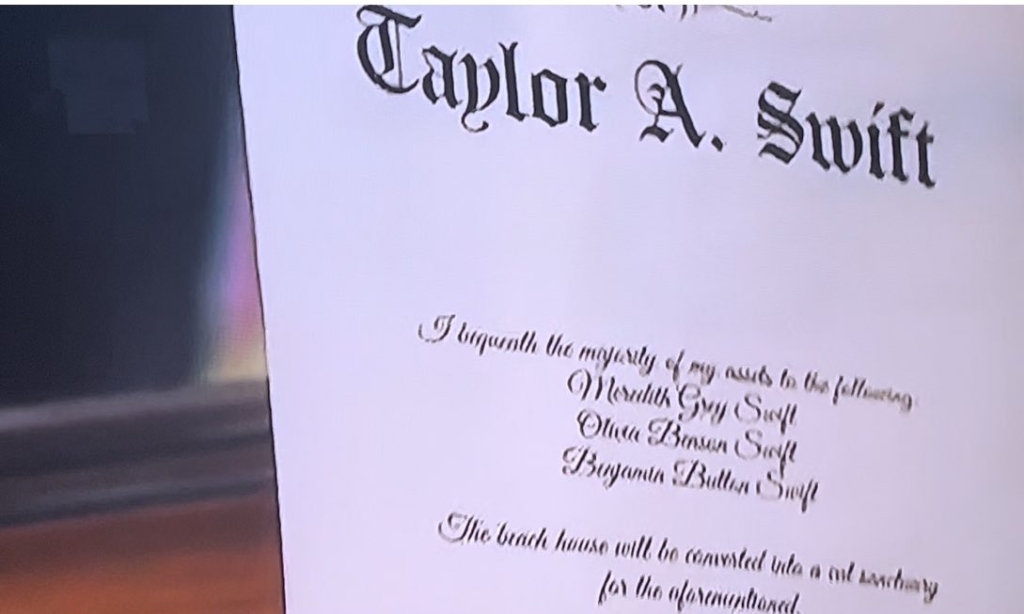
Anti Heroine – Taylor Swift
The rise of charitable legacies to spite relations or family is often cited and results in contested wills – in the song ‘Anti Heroine’ Taylor Swift leaves the money to the cat sanctuary and her family are surprised as they wanted to get their hands on the cash. During the funeral scene the will is read saying:
‘The beach house will be converted into a cat sanctuary for the aforementioned’
If pledgers speak to their family about their wishes before they die it can avoid these contested wills.
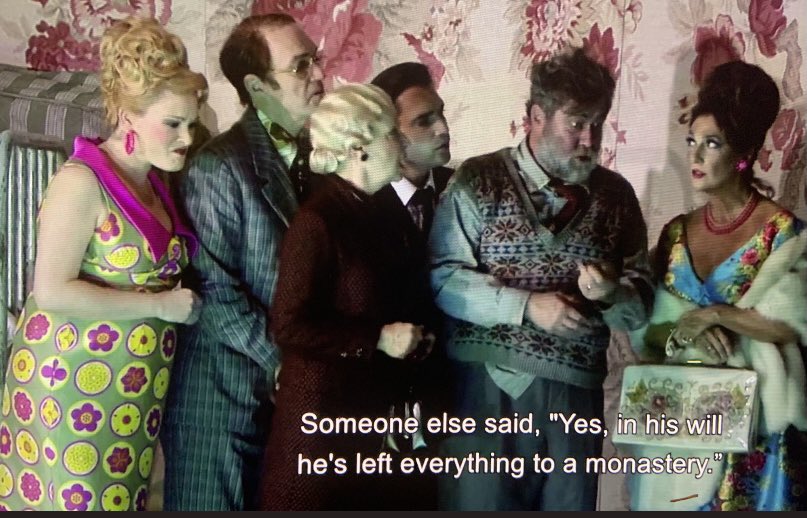
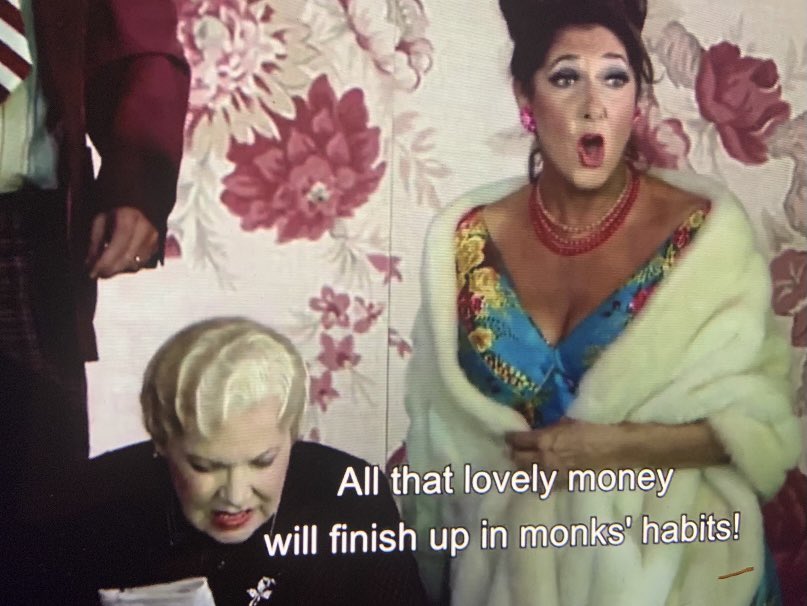
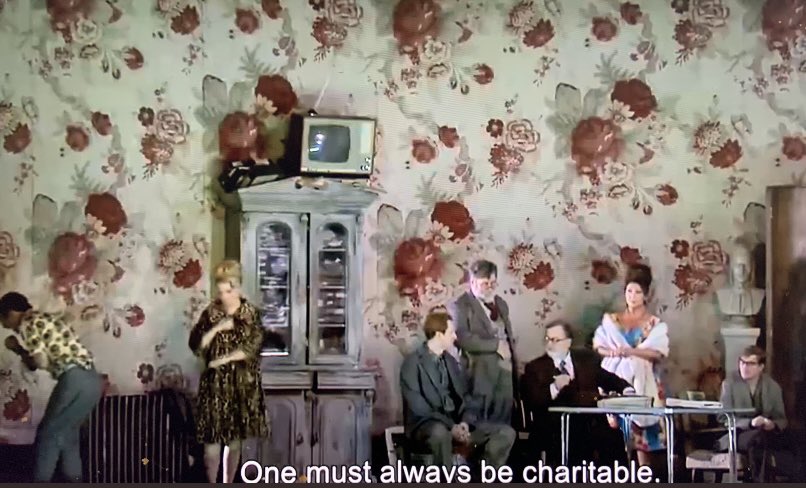
Scheming relatives in Puccini’s Gianni Schicchi when hearing of the charitable intention of their dying relation plot to rewrite his will to their advantage – but they still want to appear charitable so include a small bequest to the monastery.
.
And in literature – where a bequest is central to the plot
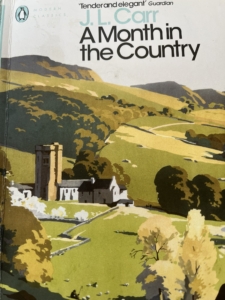
3. A Month in the Country by J L Carr
Tom Birkin’s employment is based on a legacy bequest with conditions. The church’s Fabric Fund won’t get the £1,000 legacy until the deceased wishes are honoured to uncover the hidden painting (with £25 set aside for it)
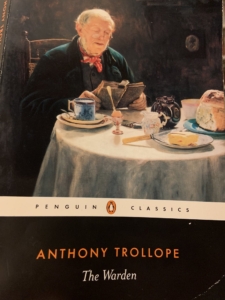
4. The Warden
The Warden (could be subtitled ‘When charitable legacies go wrong’) by Anthony Trollope centres around whether Hiram’s will and charitable legacy to create a hospital for 12 wool carders of Barchester. This has been correctly enacted and the good management of the land affords the warden a higher income and greater benefits to those living there – as times have changed and they do not follow the strict conditions of the will.
John Bold a reformer launches a campaign in the press to protest how the will has been enacted. Mr Harding, at the advice of the archdeacon stands his ground. Trollope is concerned with contemporary scandals and suspicions ‘that the grasping priests of the Church of England are gorged with wealth which the charity of former times has left for the solace of the aged, or the education of the young’
The arguments are played out in the popular press, pamphlets and courts. Dr Pessimist Anticant (pause for a moment to admire the name) publishes a pamphlet on ‘Modern Charity’ contrasting the legator’s generousity with the warden’s current ‘avarice’ And reformer Mr Popular Sentiment (a fictional Charles Dickens) has written a novel about the whole almshouse system and scandal – Trollope highlights the power of fiction to inform and influence us saying ‘monthly novels convince, when learned quartos fail to do so“.
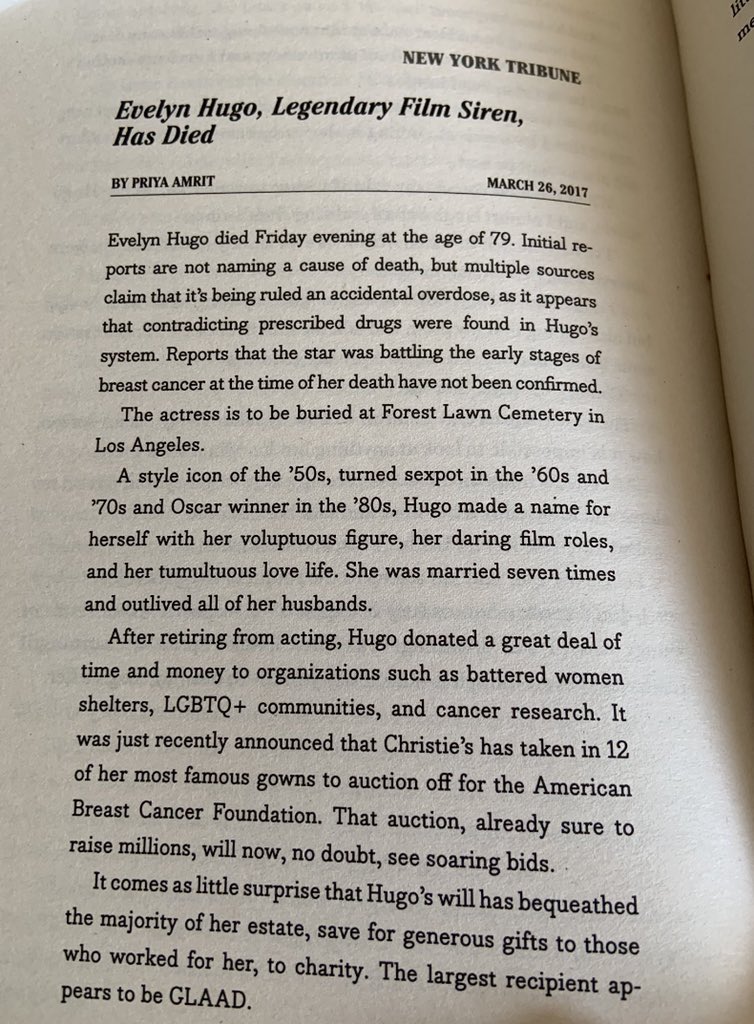
5. The Seven Husband of Evelyn Hugo
It is rare for a book to begin with a charitable bequest – but that is just what Taylor Jenkins Reid’s ‘The Seven Husbands of Evelyn Hugo’ does – her in death giving reflect her lifetime giving. It shows that as well as money items can be donated and sold to benefit the charity.
Do you offer your supporters the chance to donate items or just money?
.
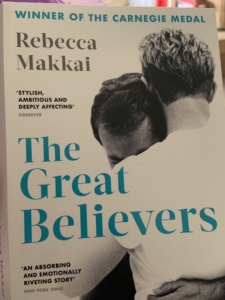
7. The Great Believers
This novel takes place during the AIDS crisis and the story centres on a character who is navigating a substantial art donation for a university gallery.
“What we’re hoping for is a flat out bequest. She hasn’t given to the annual fund since 1970, and those were small gifts… People like that tend to underestimate how much they have”
This highlights a truth often seen in legacy fundraising that your prospects may be asset rich but cash poor – but incredibly loyal. Just because someone hasn’t been coming or giving a lot doesn’t mean that you are not important.
The fundraiser protects the wishes of the legator over the gallery’s more commercial plans for the space. It is important that legators have trust that their legacy wishes will be honoured and enacted.
Poetry
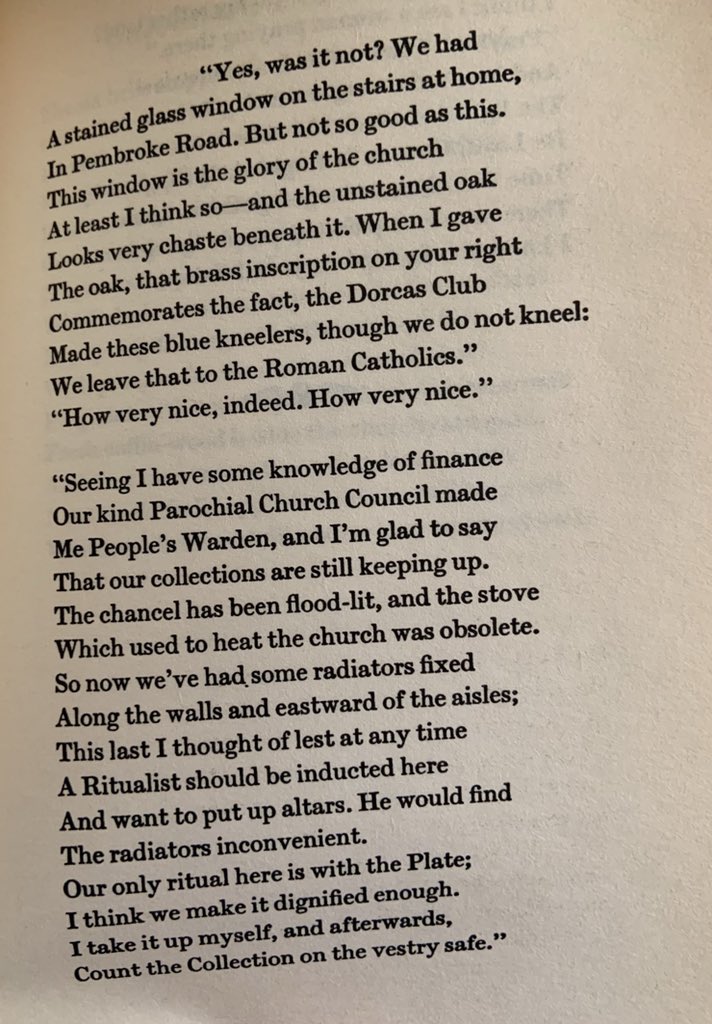
6. Bristol and Clifton – John Betjeman
And this poem by John Betjeman ‘Bristol and Clifton’ talks of in memory given for the his late wife. The poem also talks of brass donor plaques and congregational collections.
Donors who give in memory are more likely to include gifts in their will to support the cause so it is important to engage with the whole family.
Short stories and comics
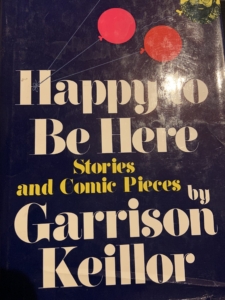
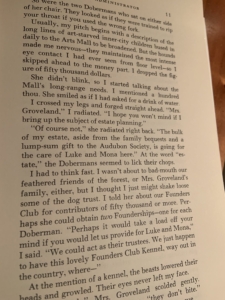
8. Jack Schmidt Arts Administrator
‘It was one of those sweltering days toward the end of the fiscal year when Minneapolis smells of melting asphalt and foundation money is as tight as a rusted nut’
How’s this for a (philanthropic) first line?
Jack turns into an Arts Administrator (fundraising consultant) when private detective work dries up because ‘What your arts organizations need is a guy who can ask people for large amounts without blushing and twisting his hankies’
He secures a range of grants for various arts causes …but struggles to get core costs funded (plus ca change)
Your fat cats will millions to build an arts center, but nobody wants to donate to pay the light bill because you can’t put a plaque on it. They’ll pay for Chippewa junk sculpture but who wants to endow janitors“
He even makes a legacy pitch – although the dogs that the donor adores look at him suspiciously …
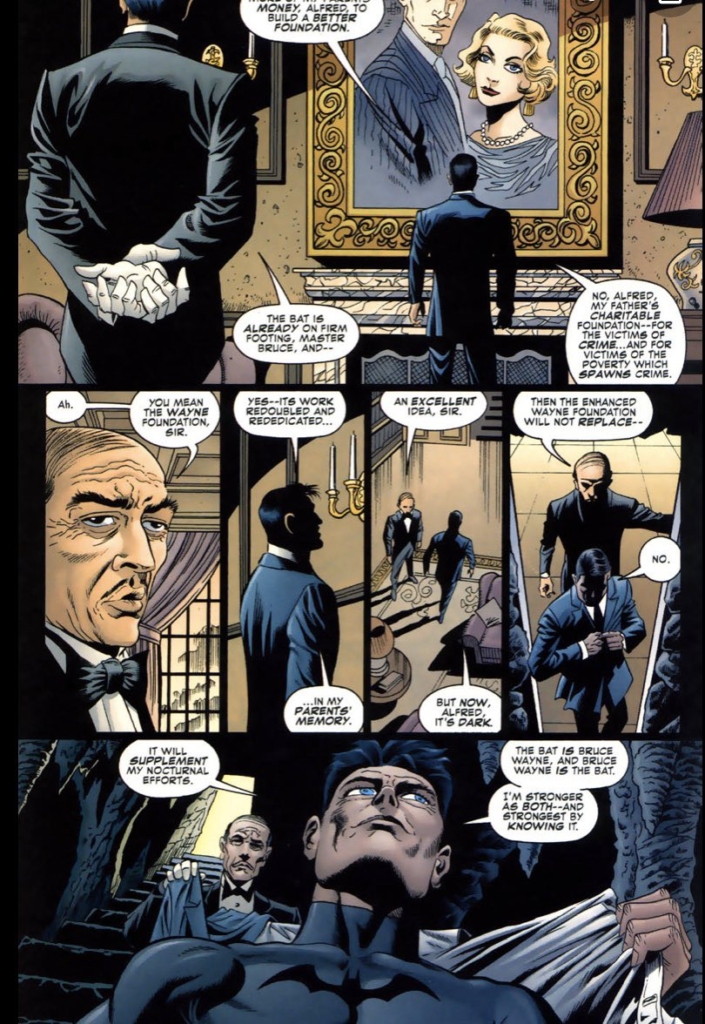
9. Batman
Batman’s mission to fight crime and injustice comes from a desire to honour the legacy of his parents. Sometimes in life gifts reflect others who have been influential in our lives.
So look out for legacy giving in all forms of literature … and remember
Encourage your supporters to talk to their family about their wishes
In memory givers make great potential legators
In life giving and connections drive legacy pledgers
Think about the various ways people can
Encourage legacy pledgers to speak to a legal professional to ensure that the conditions of the will can be enacted correctly.
https://marinajones.uk/wp-content/uploads/2024/09/FfnWG0gWQAgRzyd.jpef_.jpeg383680adminhttps://marinajones.uk/wp-content/uploads/2022/12/f2b903e010104f5aa61ea1821a685913.pngadmin2024-09-09 21:31:092024-09-09 21:31:10Legacy fundraisers cultural list …
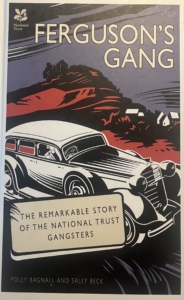
Before MrBeast and stunt philanthropy there was another stunt philanthropist on the scene – a gang of them in fact. Ferguson’s Gang – from the 1920s to the 1950s they fundraised for the National Trust.
But they didn’t just post a cheque with a donation. They wanted to make a splash with their donations so they always involved a stunt, often masked like gangsters, and helped generate publicity, and further funds.
This was reported in The Guardian and I read the book detailing their activities, activism with more autobiographical details about the gang members – you can read for yourself.
Introduction to Ferguson’s Gang
In 1927, on a picnic the idea for the gang was formed to protect the natural world and historic houses from the ever expanding urbanisation and sprawl of London. They wanted to raise money to preserve the countryside and save beauty spots – England for them was Stonehenge not Whitehall.
The idea was formed by a group of women who decided that they would do this as a gang with gangster names – the gang names were:
Bill Stickers
Kate O’Brien The Nark
Red Biddy
Sister Agatha
Bludy Beershop
In total over their career, Ferguson’s Gang donated over £5,000 to the National Trust and preserved six properties including the Old Mill, Shalford, Trevescan Cliffs Sennon and Priory Cottages Stevenson.
So a little more about their approach and what is useful from a fundraising point of view.
Stunt philanthropy
Ferguson’s Gang recorded each donation as a ‘drop’ adopting the gangster argot.
Their first drop was in 1932. They had raised £100 but rather than a cheque or a banknote they used half crowns – half crowns were 1/8th of a British pound so this would be 800 coins. They put these coins in a gangster style swag bag.
So the first donation…
They arrived in a taxi, having stopped en route at luxury department store Harrods to purchase masks to hide their identity, rang the doorbell of the National Trust’s headquarters and handed over Ferguson’s Gang business card and were taken to see the Secretary of the National Trust. They were admitted and made their gift.
The novelty of the approach got them press coverage who reported ‘Some benevolent “gangsters” masked lady weighed down with swag”and encouraged others to make donations.
“Anonymity is a quality not unknown among donors of gifts to the National Trust, but rarely is generosity concealed by a disguise so mysterious that assumed by the benefactors … known as ‘Ferguson’s Gang’. … a masked lady, recently astonished officials of the Trust … Without lifting her mask she gave £100 in silver to the secretary”
The Times
Each ‘drop’ (except one) was reported in the paper.
The second drop involved Erb the Smasher (the brother of Bill Stickers) in a maskdelivering two £100 notes.
“Gangsters in England are not common but this is a type of gangster who ought to be encouraged”
Good Housekeeping
Sometimes however there stunts were a little risky and had the potential to go wrong. At the National Trust annual dinner in 1936 they made a drop – this time a £100 note was wrapped in a cigar and given to Lord Zealand of the National Trust. They then spent the evening in fear that he would light the cigar and destroy the gift! But luckily he realised in time.
The National Trust came to expect the drama of each drop and reported themselves disappointed when a Christmas Eve donation arrived in a sweet tin without the theatrics. Their acknowledgement to the Gang reports that ‘we didn’t think it up to standard.’
Their 1939 July drop at the National Trust’s AGM was perhaps their boldest.
With the threat of war and IRA activity in London, three masked figures burst into the meeting and presented the assembled National Trust leadership with what they feared was a bomb. It then became almost like a game of pass the parcel – it was handed to James Lee Milne, who passed it o Donald Macleod Matheson to Lord Zetland. Closer examination revealed that it was not a bomb but a large metal pineapple with the note
“Open this fruit and you will find a kernel greatly to your mind”
Inside was £100 note
This was widely reported in The Daily Telegraph as a ‘Benevolent Bomb.’
Aside – what would happen if Ferguson’s Gang made at a drop at your charity today?
A masked bandit arrives in reception with a business card and a swag bag, what would the response be?
sorry, we don’t take cash
sorry we don’t know the source of this wealth and need to go through due diligence processes
sorry we find the violent connotations of criminal gangs problematic and not aligned with our values
or would it become a viral TikTok sensation?
Power of cash
The ‘drops’ were always made using cash which is interesting to note.
With debates now on giving cash or contactless – physical money and for the gang coins were important. There is something more tangible about physical money – we can hold it, feel its weight and when we make a donation hear the sound it makes. When natural disasters happen, there is often a desire to give stuff not cash as we want to do something concrete and meaningful – you can read more about this here. When the ask is for cash there is something more meaningful and personal about cash rather than tapping a device. Cash can also be used to fund treats rather than traceable necessities which you can read more about here.
Before #FirstFiver there was another royal money fundraiser
#FirstFiver was set up in 2016 when the new banknotes were issued and it raised over £12 million when it was suggested by John Thompson that you donate your first fiver to charity.
Ferguson’s Gang had a novel way of raising some of their funds.
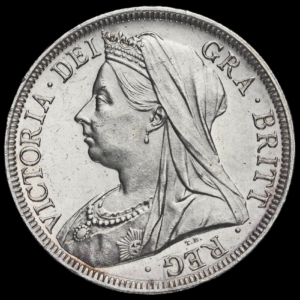
All coins they received with Queen Victorias head on had to go into the collection for their work. Queen Victoria had been dead for over twenty five years when they started collecting but evidently there were enough coins still in circulation to make this a good way of fundraising, but novel enough that it was not all the coins in their purse!
Let's hope round two of #FirstFiver is even more successful.
— John Thompson, aka Johnny Five (@JTCHANGINGBIZ) May 28, 2024
In June 2024, the new Charles III banknotes are due out in the UK, who will you donate your #FirstFiver to?
Admin is important
Although an anarchic gang with bohemian tendencies administration was still important.
Ferguson’s Gang bought a stamp at stationers WHSmith with Ferguson’s signature to stamp on documents.
And at each ‘drop’ at the National Trust despite the clandestine nature of their operation they always waited for a receipt for the gift.
Even gangsters need receipts.
Identity – join the gang
One of the ways they raised their charitable funds was through subscription. When you joined as a subscribing member of the gang you got to choose your own gang name. This is a great way to show connection with the cause and identify as a supporter. Membership tier levels often have names themed to the charity.
How can you reinforce your supporters’ connection to your charity by giving them a linked name and identity?
Imitation is the sincerest form of flattery
In 1938 a copy cat gang called Black Atropine Sisters started who did some similar stunt philanthropy after The Daily Mail falsely reported that the gang has disbanded. It was reported in the paper that jealously of the new Sisters gang, reawakened the gang’s activities. The Black Atropine Sisters eventually joined up with Ferguson’s Gang on some stunts.
It can be great to learn from the best and adapt ideas from what you see working for other charities. But a word of warning, just because something works for one charity or gang, doesn’t necessarily mean it can work for you. You need to test what works for your donors.
How you can anonymously appear on the radio?
Ferguson’s Gang was invited to do the BBC Radio 4 charity appeal in 1935 for the National Trust.
How could they do that and retain their anonymity?
Bill Stickers’ brother, Erb the Smasher was roped in to do it on condition that the anonymity of the gang could be protected. So he delivered the message wearing a mask. He directly appealed for support for members (equating the membership fee to the same fee for a radio licence fee) and donations.
At this time, the National Trust was 40 years old with only 5,000 subscribers. The radio appeal resulted in a 20% increase in membership getting 300 new Associate Members at 2/6 and 600 members at 10/ a year. The largest donation was £100 and the smallest was 5d and £900 was raised.
(It also raises the question about those raising money on your behalf. Ferguson’s Gang were independent of the National Trust and could support or generate publicity and funds for any cause they chose to. Their unorthodox tactics generated a great deal of positive press coverage and added to support of the National Trust. The National Trust choosing them to front this appeal shows how connected they were. But there can be risks associated with unconnected people raising funds that could damage reputation (if a stunt had gone wrong….))
So how could you be more ‘benevolent gangster’ in your fundraising approach?
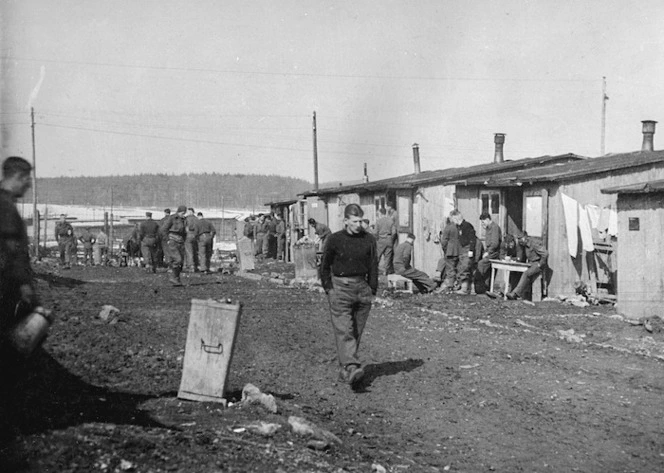
In researching the Spitfire Fund fundraising campaign, I came across a great piece of fundraising history which is crying out to be turned into a film.
A group of Prisoners of War in Germany who made up a fake charity to send German money to England to help buy a Spitfire and fight the war.
If people want to donate they will find a way
Sergeant Miles-Osborne was shot down and imprisoned in the prisoner of war camp Stalag 383. He organised fellow prisoners of war to donate towards the Spitfire Fund. The Spitfire Fund was a national campaign to raise funds for Spitfires.
Now where did prisoners of war get money to donate to charity?
In prison prisoners still received their army pay, but also ordinary soldiers also received payments (minimum wage) from the Germans for manual work that they did in the camps, and these funds were credited to their army accounts. So, the soldiers used these funds to donate and via the great bureaucratic machine these could be used for donations.
How did their scheme work?
And it really was a scheme – working in coded messages and avoiding the censors to get messages to England about what they wanted to do and where the money was coming from.
Miles-Osborne worked with soldiers, airman and sailors from across the forces imprisoned at Stalag 383. They decided that they wanted to donate towards the Spitfire Appeal. Each Spitfire nominally cost £5,000 so that was their target. They could not just write to say they wanted to support the war effort in this way as it would never have got through the censors.
But how to get the money and communicate with the UK?
Sergeant Miles-Osborne had previously been a soldier with Duncan Sandys who was now an MP and working in the Ministry of Supply.
But he could not just write and say him and his fellow prisoners wanted to buy a Spitfire as all letters were read and their contents censored.
So they made up a fake charity.
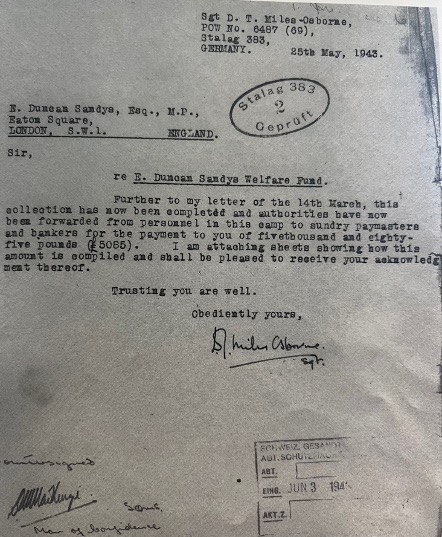
So Miles-Osborne wrote Duncan Sandys a letter in Spring 1943 saying that £5,085 had been collected for the Duncan Sandys Welfare Fund. It listed 108 different military units and the payment from each
Royal Horse Guards £3
Royal Navy £4
Royal Marines £27
Gordon Highlanders £82 etc.,
This confused Duncan Sandys who had no idea what this fund was for and why monies were being directed to it. Miles-Osborne had written a previous letter that was lost in transit.
Cheques and postcards from the prisoner of war camp with pledges started arriving at the Ministry of Supply for the Duncan Sandys Welfare Fund.
This Duncan Sandys Fund was a fictitious Welfare Fund used to hide their true intention. They could not say what the funds were for as all letters were read and censored.
The pledges continued to come in but Duncan had no idea what the funds were for.
In September 1943, Regimental Sergeant Major Cooper was released as a prisoner of war on medical grounds he carried with him a message
“The so called Duncan Sandys Welfare Fund provides over £5,000. It is the wishes of the warrant officers and non-commissioned officers of our empire at Stalag 383 to present a Spitfire to the Wings for Victory Fund”
Cooper was unable to deliver this message until February 1943
In the meantime, one of Miles-Osborne’s postcards (with some help from M19 and the War Office) managed to crack the code of where they wanted the money to go. There was a reference to ‘w for v’ – wings for victory.
So the Spitfire was commissioned.
There followed a complicated administrative process to get the funds in from all branches of the military which with war and admin process took some time.
(Getting the pledged money in always takes time & effort!)
But the prisoners had achieved their mission from a German prisoner of war camp they had raised the funds to buy a Spitfire.
Duncan Sandys wrote to Miles-Osborne to confirm that they knew what the funds were for
“I am going ahead with the necessary arrangements. I shall be glad to know whether you wish an inscription of any kind painted on the vehicle.”
(always important to ask about donor crediting!)
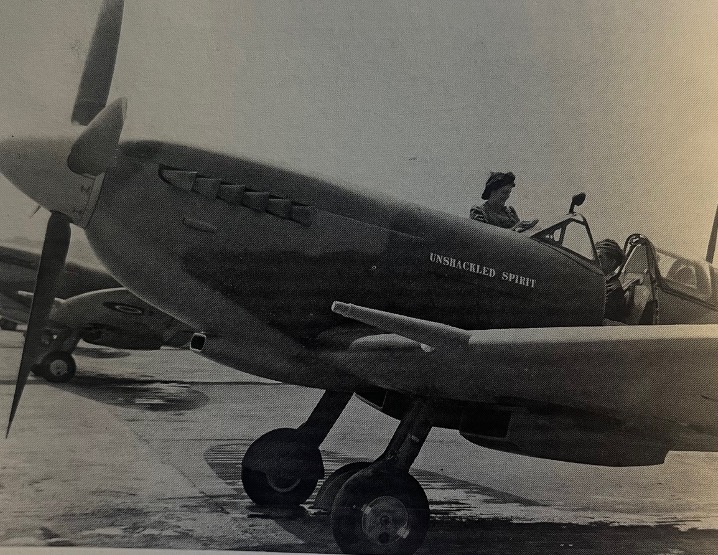
An answer on the name from Stalag 383 was not forthcoming and many were thought about to capture the spirit of this unusual gift – and they settled on Unshackled Spirit.
His Secretary noted in the letter informing the Ministry of Aircraft Production
“Mr Sandys has now decided on the name Unshackled Spirit. He thinks that, while the significance of this name will be obvious to all concerned with the fund, it would not be in anyway connected with prisoners of war if the aircraft should fall into enemy hands”
Two photographs were taken – one sent to Duncan Sandys and one to Cooper the medically repatriated officer who was asked if they could safely send the picture to the camp without getting the prisoners in trouble and revealing what the Welfare Fund had really been raising funds for.
In the end a telegram was sent to the camp saying:
“Your spitfire which as christened quote unshackled spirit unquote – has been in battle over German tell Miles Osborne”
As fundraisers it can be easy to focus on the money and to follow the 80/20 rule and know that you get most from your major donors and you get a higher ROI.
But you have fans everywhere and every contribution does matter. We can shy away from asking those impacted by issues. Maybe because we think as those in need they will not have the resources to help.
But they can be our biggest supporters and be desperate to help in any way they can.
And can help us financially as well as with stories of the impact of our charity’s work.
So the moral of this story – people will find a way to give to causes they care about
Reference
The detail from this comes from Colin Pateman’s book Unshackled Spirit Prisoners of War and the Secret Spitfire
https://marinajones.uk/wp-content/uploads/2024/05/secret.jpg604604adminhttps://marinajones.uk/wp-content/uploads/2022/12/f2b903e010104f5aa61ea1821a685913.pngadmin2024-05-19 21:24:062024-05-19 21:30:11A tale of courage, ingenuity, and sheer British pluck … and fundraising success against all the odds
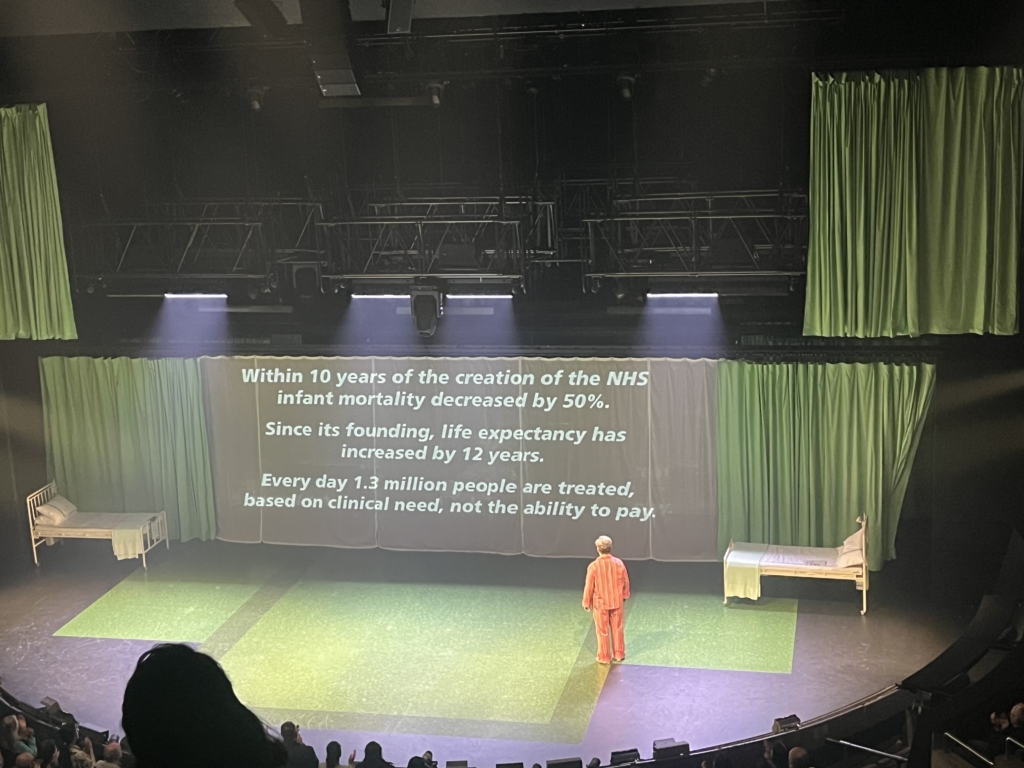
After watching Nye at the National Theatre and reading the play, I have been reflecting on the importance of philanthropy and fundraising to fund healthcare before the NHS was introduced in 1948 in the UK (and of course it has remained fundamental, but this article focuses on pre 1948 examples).
Playtext of ‘Nye’
Aneurin Bevan, known as Nye said he wanted to ‘replace the patchwork quilt of local philanthropies’ with a nationalised health service.
In the play he says:
“The health service is a complete mess, it is impossible to navigate and grossly unfair. The voluntary hospitals serve the rich, and the council hospitals serve the poor. The wealthy cities have all the facilities and all the specialists. And poor regions are stuck with Victorian hospitals falling apart”
Nye was inspired by the Tredegear Medical Aid Society where (quoting Nye in the play)
“All miners pay into it every week. And it covers the cost of six doctors and six nurses who take care of the whole town … The Tredegear Medical Aid Society covesr not only those who pay into it but those that don’t. Women, children, the elderly. .. And it works.
The mutual aid model of the Medical Aid Society was a well established one, and Nye wanted to ‘Tregegarise’ the whole country so everyone got the same health service
What was that patchwork quilt of philanthropies like?
To describe the provision of healthcare as patchwork is a very apt. The provision of healthcare relied on local patronage and campaigns, an inspired local leader, guild, monastery, legacy or philanthropist.
Here are just a few of the pre-NHS patches of how fundraising and philanthropy enabled healthcare and hospitals.
In the Bible, in the Last Judgement parable of the sheep and the goats in Matthew 25, Jesus says
Come, ye blessed of my Father, inherit the kingdom prepared for you from the foundation of the world: For I was an hungred, and ye gave me meat: I was thirsty, and ye gave me drink: I was a stranger, and ye took me in: Naked, and ye clothed me: I was sick, and ye visited me: I was in prison, and ye came unto me. Then shall the righteous answer him, saying, Lord, when saw we thee an hungred, and fed thee? or thirsty, and gave thee drink? When saw we thee a stranger, and took thee in? or naked, and clothed thee? Or when saw we thee sick, or in prison, and came unto thee? And the King shall answer and say unto them, Verily I say unto you, Inasmuch as ye have done it unto one of the least of these my brethren, ye have done it unto me.
Matthew 25, King James Bible
Caring for the sick in hospital and supporting hospitals was one of the corporal works of mercy and in Christianity, and in other faiths, a way of living out your faith. So churches, monasteries and religious communities frequently administered and raised funds for hospitals – you can read more about how here although it is frequently through an extrapolation of the existence of hospitals that we can see that some sort of organised fundraising must have been in action.
Stained glass window from Freiburg Minster, c1230 showing the six Corporal Works of Mercy
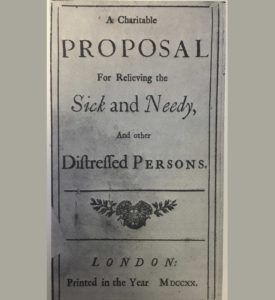
The first hospital founded by subscriptions was in 1719. Banker ‘Good Henry’ Hoare, also know as Henry the Magnificent made a donation of £10 and with three friends they founded the Westminster Hospital with the aim to ‘provide poor sick people…with necessary food and physic during illness‘.
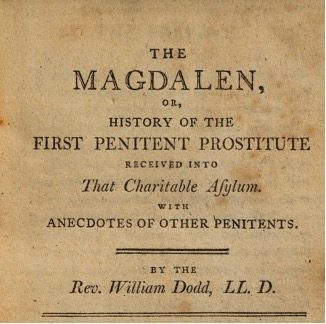
Selling sensational novels to raise funds was another way in which money was raised to support the work of hospitals. The Magdelen – History of the First Penitent Prostitute Received Into that Charitable Asylum. With Anecdotes of Other Penitents by the Rev. William Dodd was one such novel. It told, in letter form, the story of a young woman who was seduced by an inappropriate suitor, ended up pregnant and in care of the Magdalen hospital as part of her rehabilitation. These novels were very popular both for their salacious stories, as well as, raising the money needed to run the hospitals.
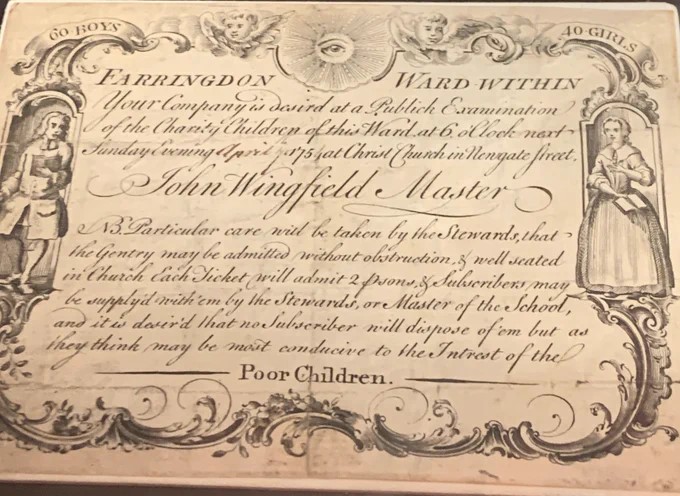
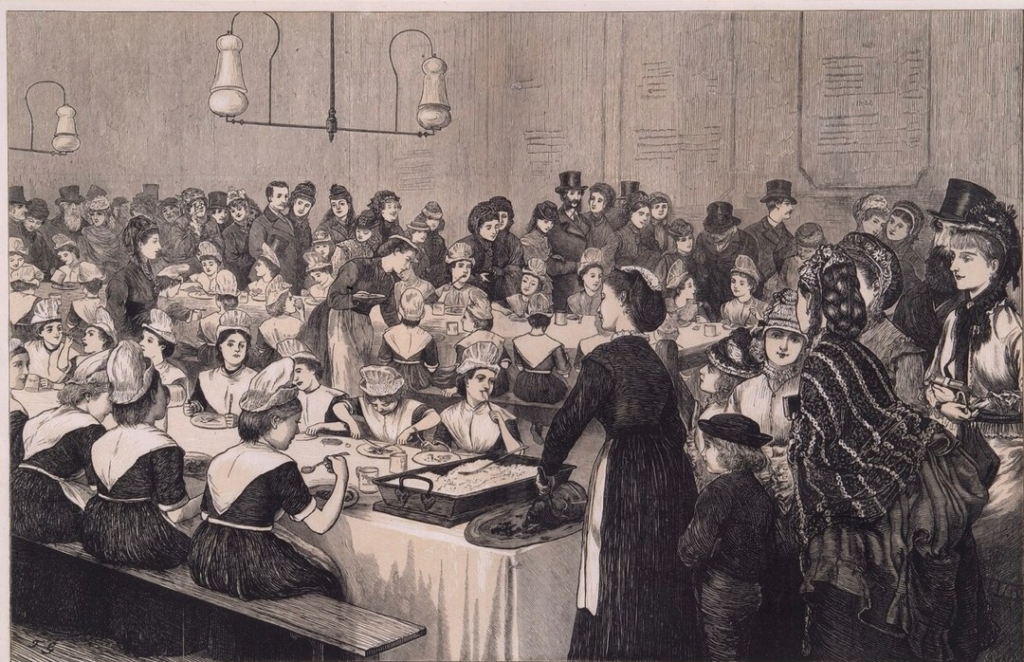
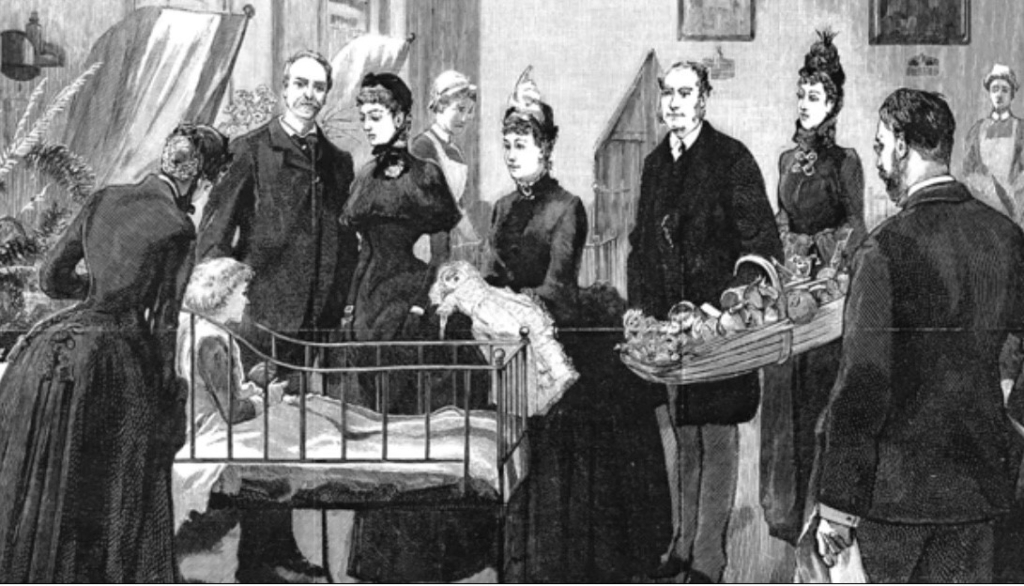
The appeal to raise the funds for the Foundling Hospital by Sir Thomas Coram took 17 years, beginning in 1728. Thomas Coram returned from his sea merchant career and was appalled by the number of children abandoned (known as foundlings) and wanted to provide for them with a new Foundling Hospital. Celebrity and well connected patrons were essential to the success and achieving his ambitions and the necessary funds. He enlisted William Hogarth the famous painter to be a Governor of the charity and he (and his celebrity painting friends – Reynolds and Gainsborough) donated paintings to be sold for the good of the hospital establishing an art gallery on site. Composer Handel also supported the Hospital with his Foundling Hospital Anthem which concludes with his famous Messiah and Hallelujah Chorus which raised over £7,000 for the hospital (there is a suggestion that ending this reflection on charitable giving with the Chorus links back to Matthew 25 and the parable of the sheep and the goats). Handel also donated an organ to the hospital which was repeatedly used for fundraising concerts. Coram is often credited with being one of the first fundraisers, but as we have been discovering there were paid and professional fundraisers much earlier. More Coram and the campaign for the Foundling Hospital here. Raising funds for the hospital’s continuing operation was an ongoing task and so public parades and public examinations of poor children such as the children from the Foundling Hospital were common place. They were used as a way to solicit contributions, thank donors and demonstrate the impact of the gifts in rehabilitating and training children (show don’t tell!) Attending Sunday lunch at the Foundling Hospital was a fashionable Sunday outing.
An invitation to examine the charity childrenSunday lunch at the Foundling Hospital with donors watching
In Birmingham in 1860s, it took just five days for Thomas Heslop’s campaign to raise the funds needed to create the Birmingham and Midlands Free Hospital for Sick Children. This shows a clear appetitive from the general public to support hospitals and the care of the sick.
May Seacole financed herself to go to the Crimean War to assist the soldiers, running her British Hotel caring for those that could afford to pay. She was the first woman to enter Sevastopol and was praised by Lord Rokesby for her bravery. When the war finished she was left nearly bankrupt with stock, and campaigns were held to support her (by The Times and Punch). A four day festival at the Royal Albert Hall attended by over 40,000 people was so badly organised that she barely received any of the proceeds – as captured in this Horrible Histories clip
#fundraisingfail Mary Seacole returned from the Crimea & was declared bankrupt – a 4 day fundraising gala Seacole Fund Grand Mimitary Festival attended by over 40,000 people raised only £57 because of poor organisation via Horrible Histories #fundraisinghistorypic.twitter.com/gs1YO33DJx
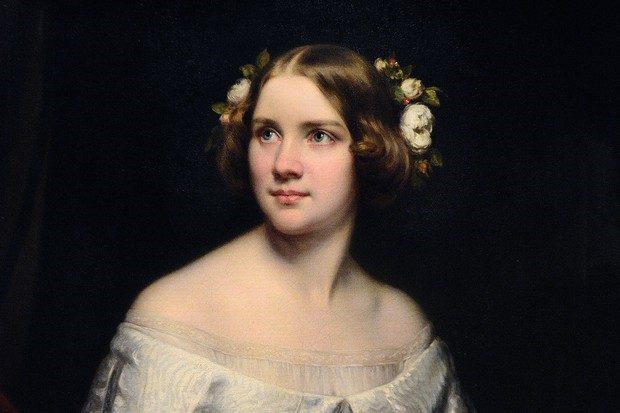
Famous singer Jenny Lind helped raise the funds for the England’s second children’s hospital in Norwich. The Norwich Hospital was the 17th established in England in 1772 (after first being proposed in 1758) and raised funds through subscriptions and fundraising sermons at the cathedral as was common at the time. As part of her world tour, Jenny Lind visited Norwich in 1847 for two sell out concerts. She stayed with the Bishop of Norwich at the cathedral. She was performing at St Andrew Hall and added a third concert especially so that the poor of the city could attend. She developed a strong relationship with the Bishop’s family and Katherine, the bishop’s wife, became godmother to Jenny Lind’s daughter. In 1849, Jenny Lind returned to the city and raised £1,253 for the poor of the city with a concert. But this was raised with no specific purpose in mind, and the city had to decide what to do with it. One suggestion, from Jenny Lind herself, was to stand in the marketplace and throw the money to the poor (certainly a novel way to distribute charity!) However, whilst they were deciding what the funds should do Great Ormond Street Hospital was founded in 1852, and the idea of a children’s hospital in Norwich was mooted. In 1853 this was unanimously endorsed at a public meeting. The funds that the Jenny Lind concert had raised were used to purchase the two houses that would form the hospital. The hospital was known locally as The Jenny.
Jenny Lind at the Jenny
1859 the Kings Hospital Fund introduced Hospital Shopping Days in London on a Tuesday in November when shops and cabs had to show poster and give a % of that day’s profits to charity. The first day raised £1,027 but was not repeated as the tradespeople felt that the Hospital Shopping Day was a levy imposed on them – a reminder that those involved in fundraising must feel is there choice about how they are supporting – philanthropy is often defined as ‘voluntary action for the public good’ (Michael Moody) – so extrapolating from that fundraising must be a voluntary choice about how to support the public good rather than a tax imposed!
Like the relic quests above, there were designated days for raising funds for certain causes and hospitals were often the recipients. In 1912 Liverpool League of Welldoers raised funds for the Hospital Saturday Fund by a ‘travelling Christmas tree’ on cart with presents and collection boxes.
Author Thomas Hardy made a rare guest appearance at the fundraising fair for the Dorset County Hospital in 1921 – the fair included processions, bands, a “Money Trail”, stalls, dancing in the evening and a Japanese daylight firework display. This fair raised 20% of the revenue needed for the hospital that year showing how important and necessary fundraising was https://historydch.com/news/archive2014/
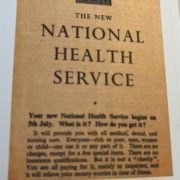
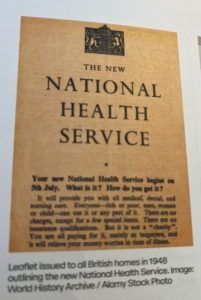
The leaflet issued to all British homes about the advent of the National Health service clearly stated:
“But it is not a “charity”. You are paying all paying for it, mainly as taxpayers, and it will relieve your money worries in times of illness”
The above examples are just a few ways in which healthcare was fundraised for and enacted pre 1948. There is much more research to be done on how funds were raised and organised for healthcare – pre and post the introduction of the NHS.
End of ‘Nye’ at the National Theatre
https://marinajones.uk/wp-content/uploads/2024/03/IMG_0639-scaled.jpeg25601713adminhttps://marinajones.uk/wp-content/uploads/2022/12/f2b903e010104f5aa61ea1821a685913.pngadmin2024-03-28 22:15:592024-03-28 22:16:00Pathwork quilt of local philanthropies
So 89 books last year and a mix of fiction, non-fiction, business, plays, new reads and re-reads. And what will 2024 bring
‘The Mysteries of Udolpho‘ by Mrs Radcliffe
“Your Brain on Art” by Susan Magdalen and Ivy Ross
‘Our Country Friends’ by Gary Shteyngart
‘The Marriage Portrait’ by Maggie O’Farrell
‘The Other Half’ by Charlotte Vassell
‘Clytemnestra’ by Constanza Casati
‘Your Love in Not Good’ by Johanna Hedva
‘How I won a Nobel Prize’ by Julius Taranto
‘Carrie Soto is Back’ by Taylor Jenkins Reid
‘Sharp Objects’ by Gillian Flynn
‘Pineapple Street’ by Jenny Jackson
‘Cuckooland: Where the Rich Own the Truth’ by Tom Burgis
‘Gold Was the Mortar The Economics of Cathedral Building’ by Henry Kraus
‘The American Wife’ by Curtis Sitetenfeld
“Diary of an MP’s wife’ by Sasha Swire
‘Curtain Call’ by Anthony Quinn
‘Nye’ by Tim Price
‘Invisible Women: Exposing Data Bias in a World Designed for Men’ by Caroline Cried Perez
‘Bright Young Women’ by Jessica Knoll
‘This Family’ by Kate Sawyer
‘Poor Things’ by Alasdair Gray
‘The Business’ by Iain Banks
‘Uncle Vanya’ by Anton Chekhov
‘The Wasp Factory’ by Iain Banks
‘An Actor’s Life in Twelve Productions’ by Oliver Ford Davies
‘1066 and all that’ by W C Sellar & R J Yeatman
‘Lessons’ by Ian McEwan
‘Fundraising without burnout’ by Radha Friedman
‘Lanark’ by Alasdair Gray
‘You are Here’ by David Nicholls
‘Change for Better’ by Bernard Ross and Omar Mahmoud
‘Ferguson’s Gang’ by Polly Bagnall and Sally Beck
‘The List’ by Yomi Adegoke
‘Unsheltered’ by Barbara Kingsolver
‘The Tenant of Wildfell Hall’ by Anne Bronte
‘Commonwealth’ by Ann Patchett
‘Funny Story’ by Emily Henry
‘Murder at the Monastery’ by Richard Coles
‘Why legacies are brilliant for charities and how to get them’ by Richard Radcliffe
‘Slow Horses’ by Mick Herron
‘The Rachel Incident’ by Caroline O’Donoghue
‘The Undoing Project’ by Michael Lewis
‘Strange Sally Diamond’ by Liz Nugent
‘Philanthropy Revolution: How to Inspire Donors, Build relatiosnhips and make a difference’ by Lisa Greer
‘The Lost Book of the Odyssey’ by Zachary Mason
‘When Women Kill: Four Crimes Retold’ by Alia Trabucco Zeran
‘Kairos’ by Jenny Erpenbeck
‘Atlas: The Story of Pa Salt’ by Lucinda Riley and Harry Whitaker
‘The Mystery Guest’ by Nina Prose
‘Atlanta’ by Jennifer Sant
‘Standard Deviation’ by Katherine Heinz
‘The Cornish Hideaway’ by Jennifer Bibby
‘Test Kitchen’ by Neil D A Stewart
‘The Secret Diary of Adrian Mole aged 13 3/4’ by Sue Townend
‘Margot’s Got Money Troubles’ by Rufi Thorpe
‘Dead Lions’ by Mick Herron
‘The Essential Fundraiser’s Handbook’ by Lisa Greer
‘The Voyage Home’ by Pat Barker
‘Kairos’ by Jenny Erpenbeck
‘Molly and the Captain’ by Anthony Quinn
‘The Romantic’ by William Boyd
‘Murder at the Sign of the Rook’ by Kate Atkinson
‘What a Way to Go’ by Bella Mackie
‘Someone Else’s Shoes’ by Jojo Moyes
‘East Lynne’ by Ellen Wood
‘The Wizard of Oz’ by Frank Baum
‘Wicked’ by Gregory Maguire
https://marinajones.uk/wp-content/uploads/2024/01/mystery.jpg566904adminhttps://marinajones.uk/wp-content/uploads/2022/12/f2b903e010104f5aa61ea1821a685913.pngadmin2024-01-12 12:49:292025-01-04 10:04:19Reading list 2024
We may request cookies to be set on your device. We use cookies to let us know when you visit our websites, how you interact with us, to enrich your user experience, and to customize your relationship with our website.
Click on the different category headings to find out more. You can also change some of your preferences. Note that blocking some types of cookies may impact your experience on our websites and the services we are able to offer.
Essential Website Cookies
These cookies are strictly necessary to provide you with services available through our website and to use some of its features.
Because these cookies are strictly necessary to deliver the website, refusing them will have impact how our site functions. You always can block or delete cookies by changing your browser settings and force blocking all cookies on this website. But this will always prompt you to accept/refuse cookies when revisiting our site.
We fully respect if you want to refuse cookies but to avoid asking you again and again kindly allow us to store a cookie for that. You are free to opt out any time or opt in for other cookies to get a better experience. If you refuse cookies we will remove all set cookies in our domain.
We provide you with a list of stored cookies on your computer in our domain so you can check what we stored. Due to security reasons we are not able to show or modify cookies from other domains. You can check these in your browser security settings.
Google Analytics Cookies
These cookies collect information that is used either in aggregate form to help us understand how our website is being used or how effective our marketing campaigns are, or to help us customize our website and application for you in order to enhance your experience.
If you do not want that we track your visit to our site you can disable tracking in your browser here:
Other external services
We also use different external services like Google Webfonts, Google Maps, and external Video providers. Since these providers may collect personal data like your IP address we allow you to block them here. Please be aware that this might heavily reduce the functionality and appearance of our site. Changes will take effect once you reload the page.
Google Webfont Settings:
Google Map Settings:
Google reCaptcha Settings:
Vimeo and Youtube video embeds:
Other cookies
The following cookies are also needed - You can choose if you want to allow them:
Privacy Policy
You can read about our cookies and privacy settings in detail on our Privacy Policy Page.