

How a blank cheque sparked a fundraising revolution?
Would you ever write a blank cheque? Or have you ever received a blank cheque from a donor?
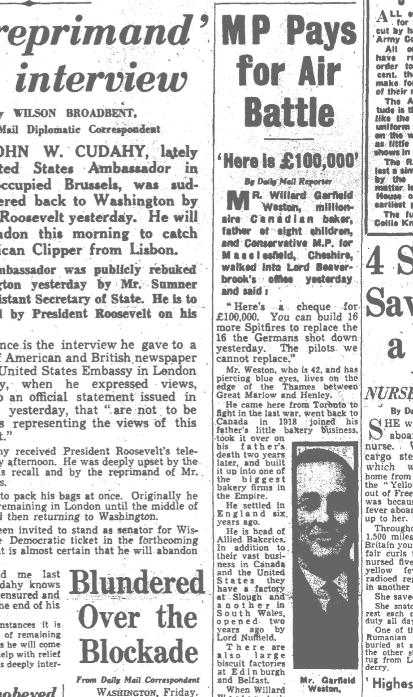
In August 1940 16 spitfires had been shot down in the English Channel and 13 pilots were killed Horrified by what he saw, Garfield Weston reacted – yes that Garfield Weston of the Garfield Weston Foundation that has given away over £2bn to good causes. At that time he was a businessman, entrepreneur and also a member of parliament in the UK.
Garfield Weston gave a blank cheque to Lord Beaverbrook saying:
‘All I can say is that I’ve a blank cheque here. You know, Max, only God can replace those boys, I’d like to replace the machines.’
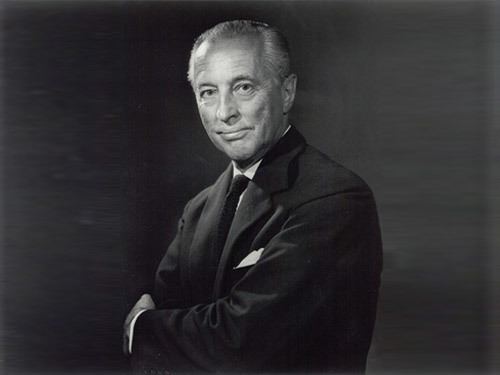
This shows a total trust from a donor that we don’t always see – a complete trust that you will use the money you need for the purposes they want.
How did Lord Beaverbrook react?
He burst into tears. (who has had a gift so generous, or kind, that they have shed a little tear?)
Fundraising is, and continues to be emotional work, and we are emotionally invested in raising funds for the causes we support.
So what happened next…
First secure the gift.
Max Beaverbrook wrote in £100,000 in the cheque.
As good fundraisers know you should not waste an opportunity.
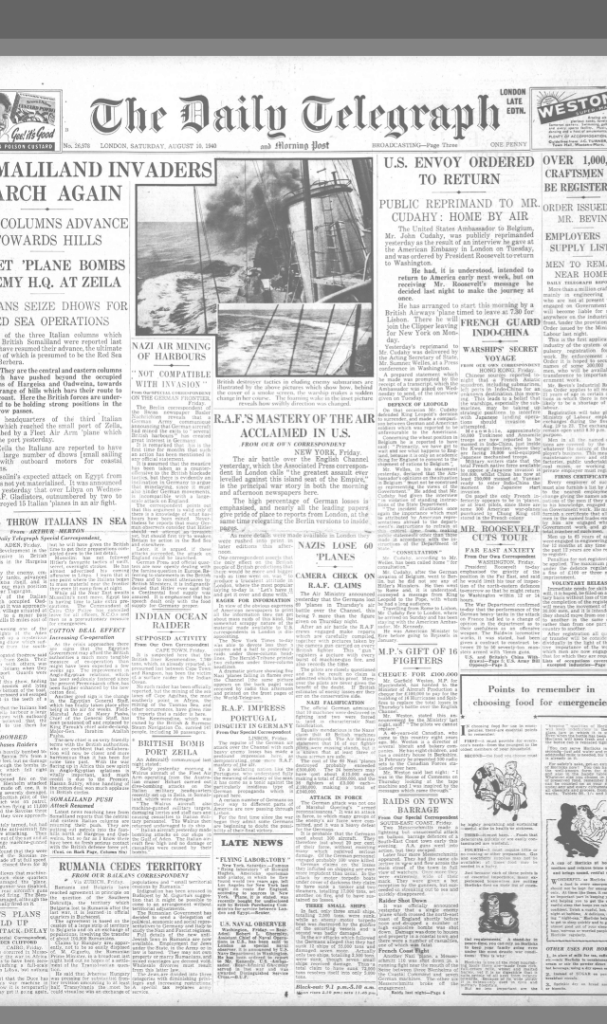
Lord Beaverbrook asked for permission to publicise the gift. Garfield Weston was reluctant and wanted the donation to remain private. But Lord Beaverbrook said “between you and me … there’s too [much] power behind this” and that if the gift was made public it would help raise over £1m. This incentive to do more good was too much to resist and so the story of this generous donation appeared in the papers (the Daily Mail mentions Garfield Weston’s ‘piercing blue eyes’).
Keeping up with the Joneses
The lead gift from Garfield Weston inspired J W McConnell another Canadian businessman to give $1m to buy a whole squadron.
We often use the inspiration of a lead gift to launch a campaign and inspire others to give.
Major philanthropists want to be seen to be supporting good causes and publicising gifts creates a powerful social norm about what your peers are doing – so publicity can help and inspire others.
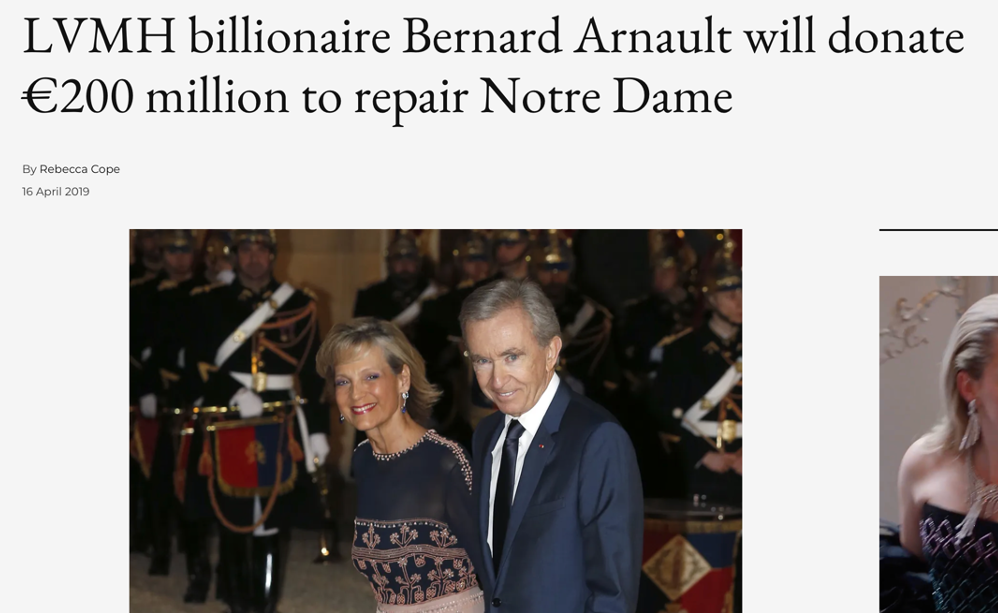
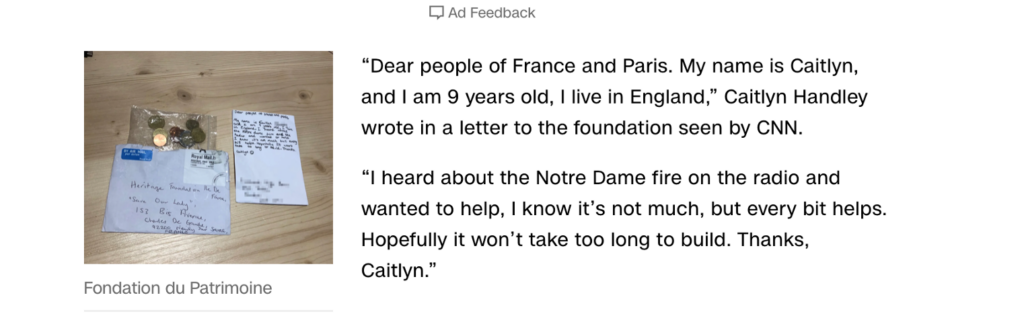
We saw similar behaviour after the Notre Dame fire. When one major donation was quickly followed by another – but as well as the big mega gifts our attention was also drawn to the smaller and more personal gifts. The two images below capture these extremes the 200 million and the 9 year old sending in her picket money. We tend to focus at both extremes of the gift spectrum. But like Notre Dame with spitfire campaigns – it was the big gifts and the small but mighty ones that attracted the attention.
Shopping list
So the promote the campaign, Lord Beaverbrook put together a price list of various engines needed but the Spitfire caught the imagination. On his list each Spitfire cost £5,000.
Now this was a made up number, the true cost was just over £12,000. So maybe not the most ethical approach.
This shopping list enabled every one to ‘do their bit’
- A Merlin engine costs £2,000
- Gun was £100
- Spark plugs cost 8 shillings
- 60 screws cost 5 shillings
- Rivet was sixpence
Why and how does this work?
When faced with a big target – financial or aspirational in changing the world (£10m or 2million starving children) donors can often worry that there small contribution is just a drop in the bucket and not going to make a tangible different to the cause. By breaking the total down into manageable chunks every person can see how their 8 shillings or sixpence is going to help and make a difference.
It reduces the cognitive load if we can see how one small – and real number makes the difference. And the realness and specificity of the number adds to our belief that it is a real number (we can sometimes mistrust a nice round number and have more belief that a mosquito net costs £5.20 rather than a round £5).
They can then exercise their moral imagination and see like this boy their gift in action….
Is that my rear tyre wheel mummy?
Every time one boy saw a spitfire he asked ‘Is that my rear wheel tyre?’ as he had donated his pocket money to the spitfire fund, and received a thank you from Buckingham Palace saying he had raised enough for the rear tyre.
Spitfires were constantly flying overhead so their personal donation remained salient and they were constantly reminded of the impact that they had. And to imagine that Spitfire was the one that they had contributed to. We often ask our supporters to imagine what their gift has done, but in this case they could see daily the planes in the air.
When you donate blood you get a text message after the donation to tell you where the donation has gone, with a map showing you where it is and in which hospital and that it has been used.
This is what happened to my blood after it was donated:
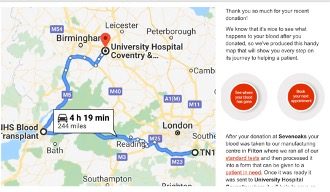
Isn’t that amazing? And a really powerful way to show donor’s the impact of what their gift is doing. What is the equivalent for your charity?
Receiving feedback like this floods our brain with happy reward chemicals.
As well as seeing the tangible impact of the donations we make, we like to see the progress we are making towards a goal – this is called the endowed progress effect.
This endowed progress effect is often employed in the famous fundraising thermometer. A device used by Mayor of Islington in August 1940. He sat opposite the Nag’s Head pub raising money (only interrupted for lunch and an air raid warning) with a giant thermometer marking progress hour by hour– he eventually raised £2,500 for spitfires.
In Market Lavington – a village in Wiltshire – they created an outline of a Spitfire in the square and challenged the villagers to fill it with coins.
This image of a spitfire was created at the Green Dragon on 1941
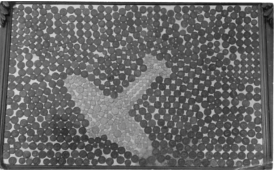
Now we know that this uses something called the endowed progress effect.
You want some donors lined up at the start of the campaign to start donating, creating a powerful social norm, creating a bandwagon effect and showing that this is normal and anchoring people in what a normal gift looks like – if everyone is giving 6d, you will give 6d too but if others are giving two shillings you will follow suit. As we want to see our progress rewarded you would expect that the speed of donations would also increase as they near completion and people might be fighting over who gets to put that final coin down and complete the mission. Completing things is satisfying and proximity to success is motivational, as an individual realises they can make something happen.
Messengers like you
For some an authority messenger like Garfield Weston can be attractive and inspiring, but for others it can be off putting – it can make us react and say ‘well its fine for a millionaire entrepreneur to give but people like me can’t afford to’
However in this campaign they understood the power of likeable messengers who people could identify with. Donations came pouring in with testimonial messages of support such as:
“From all at No.15 Station Lane”,
“My week’s pocket money – Fred Smith aged 7″, “
“My first week’s old age pension – 10 shillings towards our Spitfire”.
Like all good fundraisers we know that testimony from real life donors helps create a powerful social norm showing other people like you are giving. This range of quotes from local areas, from children and pensioners enable people to identify with people like them.
So whether your regional identity, your gender, your employment status, your age was how you identified there was a messenger for you.
Now this might seem common sense to you and I think is one of the special things about looking into fundraising history – we see things that we instinctively know work as fundraisers, as humans interact with humans, about how we communicate – and in recent years we have the science to back that up – that might be academic papers, it might be fMRI scanners literally seeing what is happening inside our brains in certain conditions or often with lab tests with university students being studied for prosocial behaviour. This example comes from academic research and shows the real power of social norms when ‘people like me’ are used – generosity increases as the other people are identified as being nearer you – university students in Sweden are more generous than just other people, but university students from your university encourages even bigger donations.
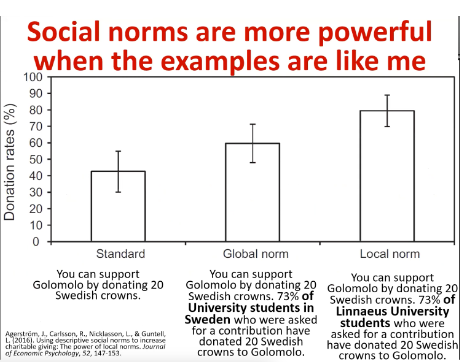
All of these academic and other studies confirm what we know about the philanthropic psychology and human behaviour that the old wisdom from the past instinctively knew. But now we know it we can apply it rigorously and target the interventions we know work to help provide more ways to offer people ways to help change the world.
Name Letter effect
Have you ever heard your name spoken through the noise of a crowded pub or party?
In behavioural science the ‘cocktail party effect’ is essentially selective attention. At a cocktail party or any loud social setting, we can hear our own name amongst the hubbub – we are the most important to ourselves and we pay attention to things that resonate with our sense of self.
This draws on a deep identity connection to our own name. Ever since we were born our neurons have been trained to react and fire together when they hear our own name (or names similar to our own).
So as a Dorothy you are wired to hear and pay attention to Dorothy.
And a Canadian Dorothy used the power of her name to fundraise …
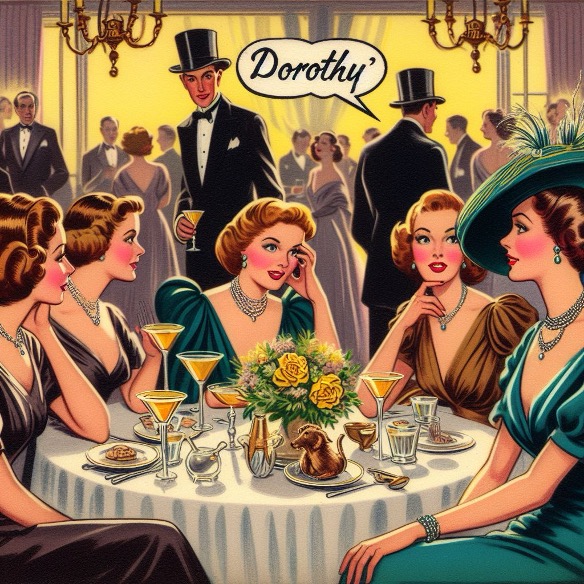
Dorothy wanted to raise funds to support the Spitfire fund, so she sold some of her evening gowns to raise money. She printed cards that said
Is your name Dorothy? If so, rally around and help buy a Spitfire for Britain.
She and her friends posted them to every Dorothy they knew and themed their fundraising around Dorothys
- 20,000 tea parties all hosted by someone called Dorothy
- All Dorothy musical evenings
- Auction of actor Dorothy Lamour’s sarong
- This created momentum and they took advantage of the bandwagon and excitement to get more Dorothy’s involved – t this spread across to US with the “Vancouver chapter of the Canadian Dorothy Spitfire Fund is seeking noted Dorothys of the United States,”
- “Dorothys Plan Galloping Teas,” – 25 women called Dorothy invited friends to tea charging 25 cents each – and like a chain letter they passed it onto other Dorothys of their acquaintance.
- Dorothy Thompson, journalist and broadcaster donated a copy of her radio talk
- Dorothy Parker was invited to write a poem
This global appeal successfully raised the funds and they bought a Spitfire which was named for the Dorothys that raised the money and called Dorothy of Great Britain and Empire .
But why does this work?
In 2008, data from seven emergency hurricane appeals were examined including Hurricanes Katrina, Mitch and Rita. Researchers Chandler, Griffin, and Sorensen found donors who shared an initial with the hurricane were overrepresented in the donors. So donors beginning with ‘K’ were 31% more likely to have given to support Hurricane Katrina relief in the 6 months after the hurricane.
‘M’ named people made up 30% more of the donor population during the two months period after Mitch devastated Honduras and Nicaragua in 1998.
Sharing the same first name or letter has also been shown to help donors identify more with fundraisers (Burger, Messian, Patel, del Prado& Anderson, 2004 and Bekkers, 2010 in an article entitled ‘George gives to geology Jane’)
A lab experiment showed a request to give to a child in need resulted in 61% giving but adding the name, age and a picture increased giving rates to 90% (Kogut, Ritow, 2005)
Learning the fundraisers’ name increased the average gift size by 50% (Bohnet and Frey, 1999) For alumni fundraisers donors were more likely to give when their first name was similar to the name of the university.
Knowing someone’s name builds a connection, a relationship, when we know the name – the name of the beneficiary – even the name of the fundraiser we are more likely to give (people give to people!)
So Canadian Dorothy knew that innate and personal connection to a name as a rallying call to donate. (This is one of the reasons why decision science is fascinating – we know these things work, we have seen them used, maybe unconsciously used them ourselves, but as our understanding of the science develops we can prove they work, and test how they work and see what is happening inside our brains as these things work)
Naming Rights
Which brings me onto naming rights. One of the components of the campaign was the joy of raising the funds was naming the Spitfire.
Now when people are not just naming it for themselves and have a little creative freedom we can see some interesting names – Boaty McBoatface being a prime example, and the Greenpeace whale Mr Splashy Pants spring to mind (as well as the names of all the Scottish Gritters) And Spitfire names were no different. Some were conventionally named for the country that funded them such as Trinidad, or Hong Kong or Sheffield.
However, a sense humour was demonstrated in the naming of the planes
- The Kennel Club named theirs the Dog Fighter
- The ABC cinema chain named them– Miss ABCs (there were 3 bought)
- Marks & Spencer named theirs ‘The Marksmen’ following in store collection
- Woolworths named theirs Nix Six Primus (which referred to their pre-war policy of keeping all prices below sixpence – don’t waste a marketing opportunity to get your corporate message into a naming opportunity!)
Some were more traditionally named. One anonymous donor named a plane Heather for his daughter.
Interestingly the RAF faced a challenge similar to fundraisers today, with donors and their naming rights demands. There was a designated space on the plane where a name ought to go (9 inches by six inches) but donors wanted their names in all sorts of shapes, font and sizes even including coats of arms!
When planes were completed donors got a photograph and a certificate acknowledging their support and so they could see their plane. These were again used for publicity and to generate further funds.
Merch
Another important identity marker can be in self branding and wearing merchandise that aligns with the band, the cause or marks you out as you.
As part of the campaign an important visual symbol of your support of your local Spitfire fund was getting the badge. Some of these were your standard pin badge but many were shaped like spitfires and some were even made from the Perspex used in the windows of the planes. There were also bracelets made.

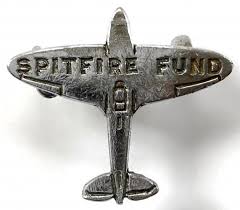

In certain towns and villages this became like not wearing a poppy on Remembrance Sunday – it would have been unpatriotic not to be seen to be supporting.
Strange how potent cheap music is
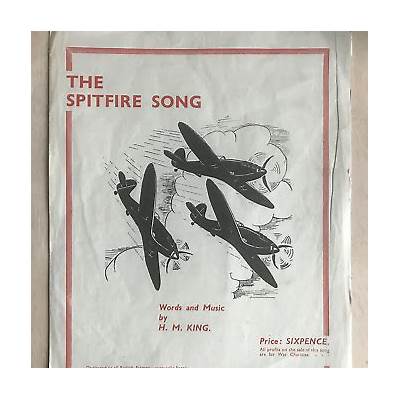
And what better than combining the power of the local identity with another powerful tool – the power of music, and rhyme.
The Spitfire Song was written as a fundraising song and it was customisable so you could add your local area name into the song e.g. Hampshire or Bournemouth
Again the importance of geography and local identity in fundraising
‘We’ll make one of their number, write our name upon the wing
When the planes are flying over, you will hear old Britain sing”
Spitfire song https://www.youtube.com/watch?v=RzRrmlrGXSo
A Spitfire a Day keeps the Nazis Away – the Rhyme is the reason
The slogan of the Islington Spitfire Club was ‘each bob you pay keeps the bomber away.’
Or acrostic poems were made
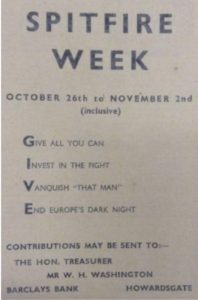
Invest in the Fight
Vanquish ‘that man’
End Europe’s Dark Night
Why is that important? because we now know that we find messages more persuasive and more memorable when they rhyme and more accurate.
Using rhymes in campaigns can make them more memorable.
Creative and local fundraising
There was no centralised campaign and each community or group was empowered to fundraise and donate in ways that suited them.
We have already seen some creative examples, here are a few more … what links all of these that the methods are really linked to spitfires and the war
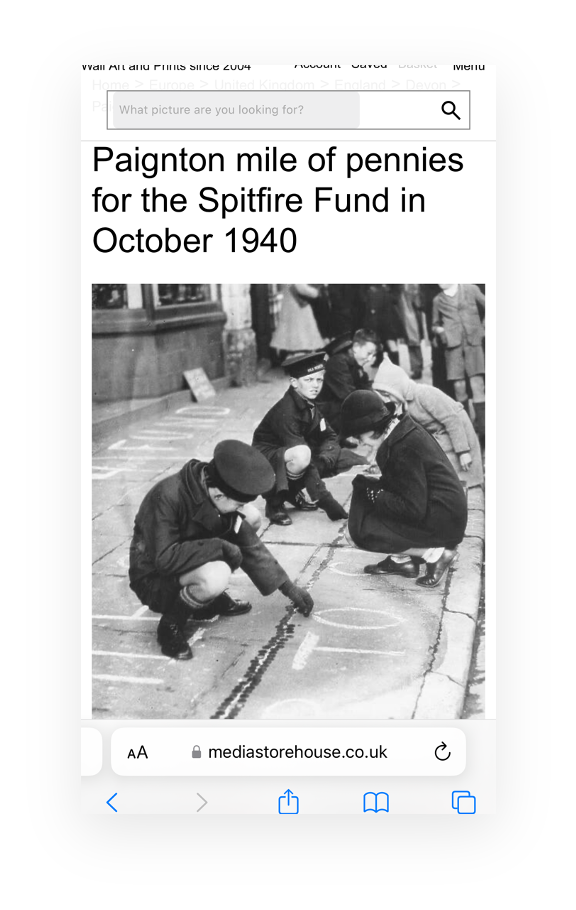
- Penny on the red – every time the air raid siren sounded every member of the club had to donate a penny to the Shoreham Spitfire Club
- 6 pence was charged to view a crashed German plane in Kent to raise funds for Spitfires and in Dudley they charged sixpence to have a look at a Messerschmitt – band leader Henry Hall bought his band and they played They’ll Always Be an England and a dog called Jerry climbed on the wreck
- A Mrs Clark charged a penny to see a deactivated mine and raised over £9 from 2000 visitors to it
- In a London cinema, during an air raid, the manager of a cinema pushed a wheelbarrow up and down the aisle saying “the more you give, the less raids there will be” as he solicited donations.
- 10 a penny club – for every ten aircraft you had to donate penny – the fishmonger in Stevenage had a chalk board outside the shop to mark off shot down planes – they raised £454 in the first 5 days
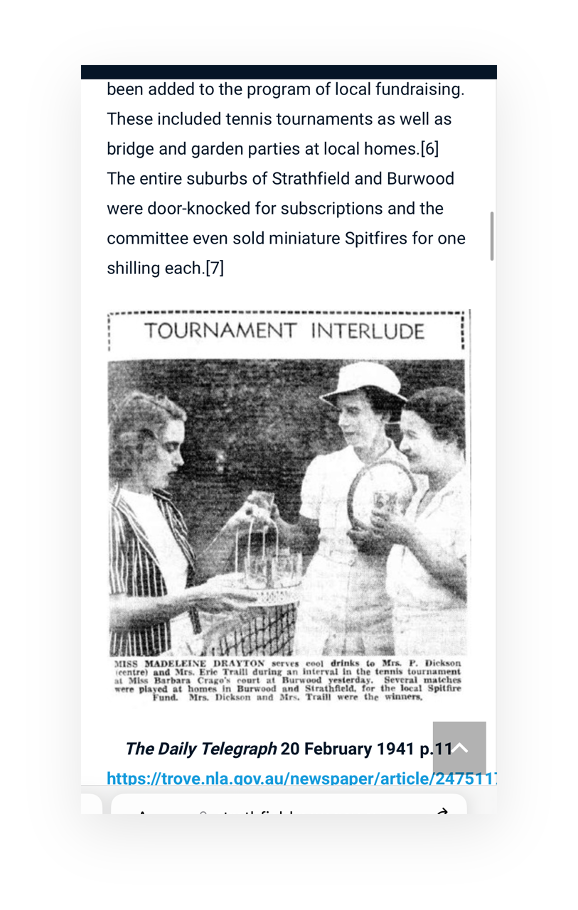
- Madeline and Nanette Drayton painted 12 large posters of Spitfires and people filled them with coins – raising £3750
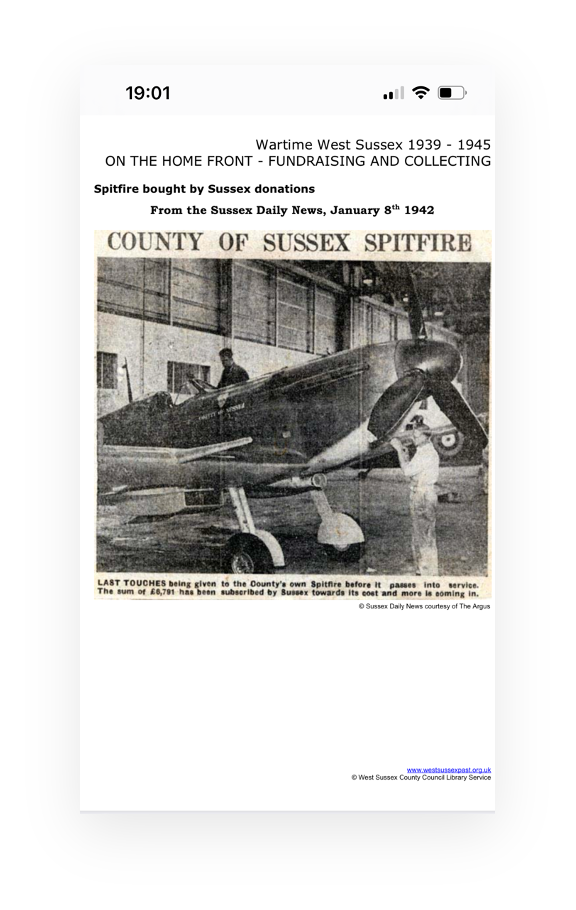
The campaign ultimately raised £13m.
What fundraising lessons are there from this Spitfire Fund campaign?
- React quickly to current events
- Keep the story in the news
- Make it easy for donors to see their impact – chunk the campaign into small and manageable achievable goals that they can help achieve
- You don’t have to do all the work – empower people to raise funds and have fun and be creatively
- Use the identities that donors have – to their village, their town, to their employment status, age, gender to help connect and establish a powerful norm
- Rhyme and song can be powerful tools
There is so much history in this campaign
See here for a story about prisoners of war secretly donating – if people want to give they will find a way.
And the importance of people choosing amounts that are important to them – with a special gift from a ‘lady of the night’ in Liverpool.
This is a reduced version of a talk given at Fundraising Summer School in Dublin, May 2024.



Leave a Reply
Want to join the discussion?Feel free to contribute!