
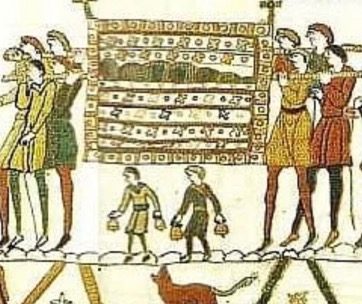
Look! Fundraisers on the Bayeux Tapestry
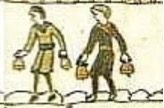
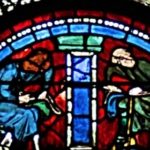
This scene depicts the funeral procession of Edward the Confessor (later a saint) on the way to Westminster Abbey. Look closely and underneath his funeral cortege are two men carrying what appear to be collecting bags for donations.
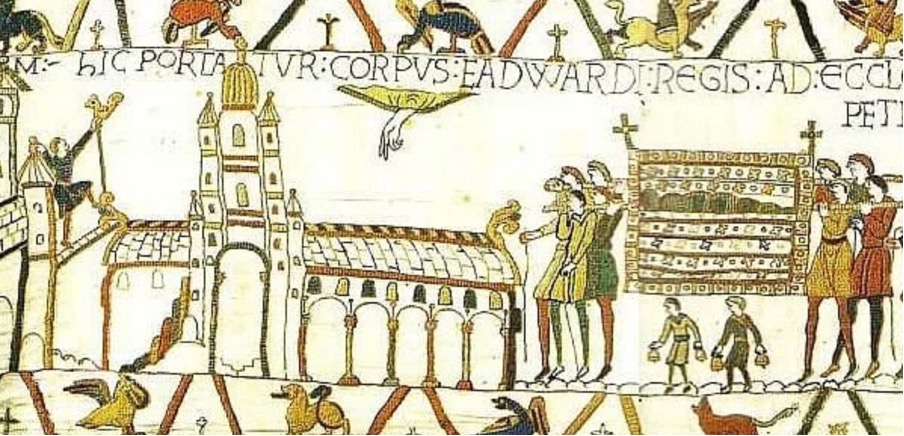
It was common from the tenth century onwards to tour saint’s relics to raise money for cathedral fabric funds, and for two men to collect the money from the crowds who had worshipped and venerated the relics and listened to emotive and inspiring sermons. Hence, the translation of Edward the Confessor’s body to the Abbey could have been used to raise funds for building his shrine and the enhancing his saintly reputation. Therefore, academics have suggested that this is fundraising in action – and in tapestry form!
What was a relic quest?
A relic quest was a reverse pilgrimage – instead of pilgrims travelling to see the saint’s relics – the saint was toured to them. The relic quest usually involved:-
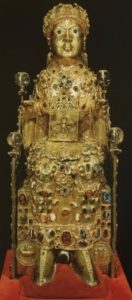
- The relics of a saint being toured locally, regionally, nationally or internationally in a reliquary (a specially designed ornate receptacle)
- Veneration of the relics by the local people
- Stories of the miracles performed by the the saint and/or their relics
- A stirring sermon detailing the power of the saint, sinful nature of humanity, need for repentance and penance, and the need for funds and the project (often a cathedral or monastery building project after a fire or another disaster)
- In exchange for donations to the cause, indulgences could be offered, reducing the amount of time the donor spent in purgatory, and hence placing them nearer to heaven
From the Council of Rome in 1078 there was a duty for all the faithful to donate at mass, on feast days, pilgrimages and other holy days. There was a Christian duty to give alms; the care for Christ’s body on earth, the church, was an important area where alms were encouraged.
Although fundraising was the primary purpose of these tours, they were also used to cement the reputation of the saint locally. Depending on the needs they could be time limited to secure funds to (re)build the cathedral or monastery or become annual calendar events.
Who did this fundraising?
Those on these tours were given the title questor seeking alms (donations) for religious purposes – this is one of the earliest titles for fundraisers. Originally these questors were canons or friars associated with the church or monastery conducting the building project, but as early as 1094 there were specially paid priests (unconnected with the institution) for these fundraising expeditions.
The preaching and collecting donations model was so popular that in the eleventh century, there were special preachers employed to raise funds for other areas of work, notably for the hospitals run by the cathedral or monastery – special preachers known as vulganter vociarus pardoner had special permission to preach and collect one Sunday a year for hospital funds.
They were contracted by the Bishop or Chapter and made contracts about how the funds earned were donated – 1/3 to the pardoner and 2/3 to the cause was common. But some times (as today) these contracts were subcontracted out.
Antonies, raising funds for the hospital of St Anthony the Abbot in the 1200s received contracts to cross diocesan boundaries to raise money. St Anthony Abbot is often shown with a pig, a Tau cross and a bell on a stick – the bell was there to attract donations.
When relic quests began they were mainly focussed on church building and conducted by canons and friars. By the fourteenth century, given their success at raising funds they were used for raising funds for hospitals, the poor, bridges, lights and a wider variety of causes areas. (For example, St Anthony’s Hospital in London received £500 of its £550 income from questors.) This could be seen as mission creep, or the success of the mechanism and the nascent professionalisation of fundraising. With this those asking for the funds stopped being ordained ministers or from the clerical class and laymen were recruited to collect. Then as now, good questors (fundraisers) were hard to find, but they were paid for their work. There were serval models – some were paid an annual fee and others were paid up to a third of the collection. Questors as a profession ran in families and they were expected to police the behaviour of other collectors.
1215 – Regulation of how fundraising could be done
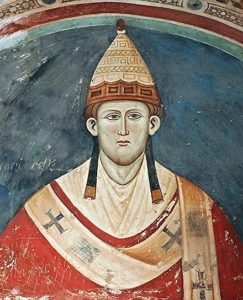
These relic quests became a popular way to raise funds but there were concerns about abuses of power (and fake fundraisers) so in 1215 at the Lateran Council IV, Pope Innocent III decreed that all questors needed a licence from the pope and permission from the local diocesan bishop or king to hold a relic tour. These licences generally lasted a year.
Instead of stirring emotional sermons, questers had to read out a set letter as they solicited alms. This meant that the letters got longer (from 500 words to 2,000+) which included multiple asks for alms and donations. The letter would be read out and two worthy men would collect the funds (as we see above in the Bayeux tapestry).
It also included stipulations on what the questors ought to be wearing and how they ought to behave! No taverns, modest behaviour and clean and tidy dark clothes – they should not dress like wealthy people.
The Lateran IV Council also tried to limit the indulgences that could be offered in exchange for donations – setting specific amounts of days remittance in purgatory for donations. Indulgences worked as a powerful incentive for donations, but are definitely more at the transactional/ self interested end of the giving spectrum – rather than altruistic. Indulgences were pardons for sins, giving reduced time in purgatory for those that truly repented. Although indulgences did not strictly require payment, the physical paper proof of forgiveness of sines was proof of the transaction. Their use increased and became increasingly problematic throughout the centuries (This is a gross oversimplification of a complicated and nuanced topic but to give a summary of the challenges and evolution of the issue and its problem.) By the fifteenth century the questors became known as pardoners (and the Pardoner can be seen and is mocked in Chaucer’s Canterbury Tales)
It was ever thus … a few medieval issues that we still see today
- Repeat the ask – the twelfth century sermon preached at Amiens with a relic tour includes four asks for funds in the sermon. Repetition helps our brains process things more easily. The more repetition the faster we process. The more the ask is repeated – the more we are being primed to give – so it is important for our appeals to repeat the ask multiple times. Remember, donors are not paying super close attention to what we write or say – they skim read/selective hear, so a repeated message helps convey what we want them to do.
- Not everyone agrees about charitable priorities, Bernard of Clairvaux said that the church collections and relic quests were too focussed on beautiful church buildings and not the poor in need (‘She dresses her stones in gold and lets her sons go naked’). There are still debates today about how philanthropic money should be spent and where it is most needed.
- Fundraising is not always successful – in 1086 the Benedictine monks toured St Eusebia’s relics and lost money on the tour
- Fundraising is based in time and place and what is charitable and acceptable evolves. In the tenth century, indulgences were an unproblematic way to offer a spiritual reward to donors, but as the practice evolved they become more transactional, less philanthropic and much more controversial (A few decades ago, a charity sixth form slave auction that might have run as a fundraiser, or accepting a collection from the local hunt (which the RNLI recently turned down), but what is socially, morally and ethically acceptable changes and evolves with societal norms). Fundraising for pirates ransoms used to be common – see more here. Fundraising practice, like what is charitable, evolves with time and place.
- Who you take money from – the church would not take money that had been earned in certain ways particularly from usury (taking interest on loans) and prostitution. Nowadays your acceptance of gifts policy might meant that oil, tobacco, fur or arms dealers are not acceptable to your charity. What is ethically acceptable, like fundraising methods, evolve over time, but reputational risk has always been a concern….
- Need for a strategy – Bernard of Clairvaux was concerned that church building projects should not be started unless the relevant funds were in place to complete the project.

What did these sermons say
Set words of a sermon for the reading out for alms from Amiens (blame Google translate, my school girl Latin is not what it was)
For as the Apostle says, we shall all stand before the judgment seat. We must receive Christ according to what we have done in our bodies, whether it has been good or bad the extreme mercy of the Messiah to prevent the works and to sow eternal ones in the earth, which By returning to the Lord with a multiplied fruit, we must collect in the heavens, firm hope and confidence holding, because he who sows sparingly also reaps sparingly, and he who sows in blessings, the blessings and reaps eternal life. Since then, for the support of the brothers who were in need of such things. At the confluence hospital, the facilities are not properly available, we advise your university and we are exhorted in the Lord and we have commanded you to forgive your sins, as far as good things a contributing to God, give them pious alms and acceptable charitable support, as by subsidizing them. Let your own poverty be consulted, and you through this and other goods which the Lord inspires having done this, you can reach eternal joys’.
And the Reformation changed all these practices.
So happy questing fundraisers!
Coming next … relic quests were just one way that cathedrals and churches were financed – find out how butter helps build a cathedral. Read more here https://marinajones.uk/butter/
References:
‘Relic Tours in England and France’ by Cristine Oakland (which includes quotes from my former professor)
https://kar.kent.ac.uk/77090/1/39Relic%20Tours%20in%20England%20and%20France%20%28c.1050-c.1350%29.pdf






Leave a Reply
Want to join the discussion?Feel free to contribute!