What do you do about lost donors?
Advertise for them?
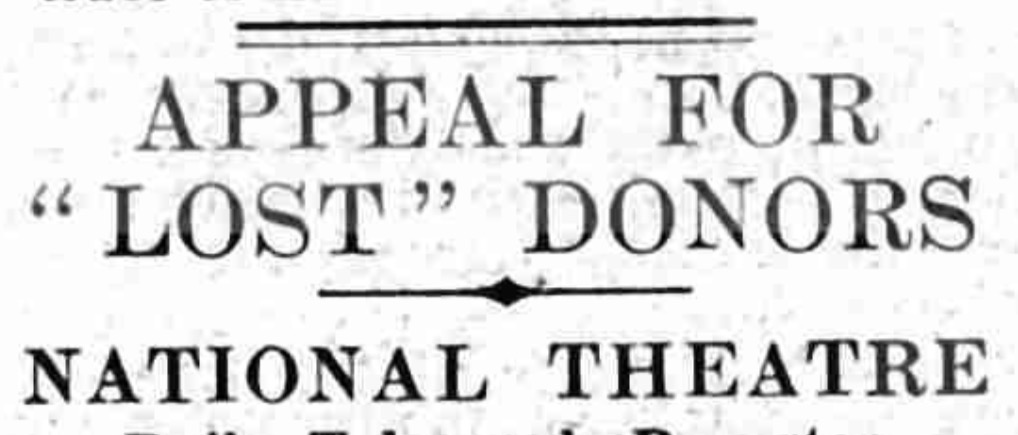
In January 1950 that’s exactly what the Shakespeare Memorial National Theatre Committee – the proto National Theatre, did.
Can you remember donations you made 20 years ago?
We can only know who our donors are if we have records – but what if those records were destroyed.
How do you go about locating them? Put an advert in the paper?
The campaign for a National Theatre for England began in 1848 and it was not until 1949 that an Act of Parliament established it. For over hundred years various schemes and fundraisers tried to raise enough public support and funds to make it a reality (more of that in future articles).
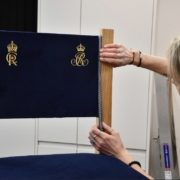
In the 1930s as part of the fundraising campaign, seats were sold at the theatre for £100 – supporters were invited to dedicate a seat in the theatre – in their own name, the name of a famous actor or artist, a virtue, or in the name of their city.
‘buying the right to dedicate one seat either in the name of a person, a society, a township or in the name of some historic act, ambition or ideal, in exchange for an endowment gift of £100”
Dame Sybil Thorndike
The seats are offered in perpetuity – rarely done now – the National Theatre the website states – Seats will bear your dedication for at least 10 years)
“And so when you head of proposals that your home town should endow a seat, and commemorate itself, at a cost of £100 of when (for all I know) you are boldly asked on your own half crown, do not shrug your shoulders as no concern of yours. A Theatre is National because the nation needs it. And you, after all, are the nation”
Lord Elton
This seat naming scheme was popular, and examples include the University of Cambridge endowed a seat in the name of Christopher Marlowe, the Dickens Society bought one for Charles Dickens and many cities and local authorities supported the scheme (would they today?)
However, all the records from the 1930s campaign to endow seats had been destroyed by ‘enemy action during the war’.
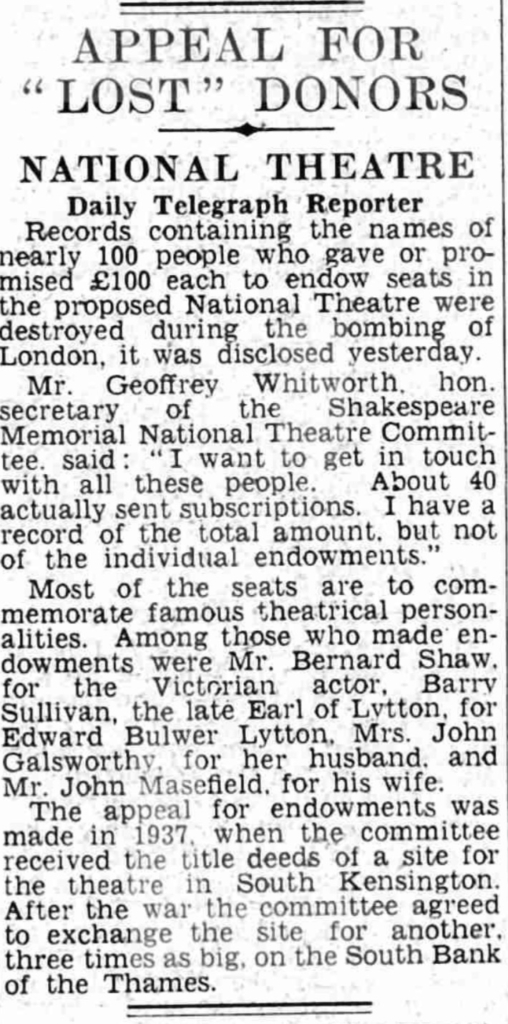
Following the advert, the archives record people writing in with their names and that they subscribed a seat 20+ years ago.
“I found my cheque book I sent you a cheque for £100 … on the 16th April 1930”
They have the details of the date that they wrote the cheque (Do your records go back that far? Do your donors? I know some donors who have all their donations in a spreadsheet)
All of these responses are taken on trust and added to the paper sheets of names for the future theatre. One letter alludes to the original form and says it is included with the letter but, alas, it is not in the archive. One response from The Mayor of Fulham writes to ask about ‘the use of this seat by Fulham people’ – as this was promised as part of the endowment scheme – one night in that seat. (a great offer but feels very impractical to implement).
In 1958 one donor requested a refund ‘with interest’ for the £100 paid back as the theatre was not open.
According to the Bank of England inflation calculator what cost £100 in 1938 would be nearly £6,000 nowadays (£5,873 in January 2026) so it is not an insignificant amount of money to contribute towards the scheme. (Seats are available to name today at the Dorfman Theatre, one of the three theatres at the National for £6,000)
Is the Zeigarnik effect in action?
The Zeigarnik effect refers to the tendency for people to remember unfinished or interrupted tasks better than completed ones. An “open loop” keeps cognitive tension active, which motivates attention, recall, and often completion. Not having the theatre built, their name on a seat keeps a loop open in the donor’s brain and so this advert would stand out – both for being unusual, and for those that have made a significant contribution, but not had the satisfaction of seeing the project happen.
It also raises an interesting question: do your donors see their gift as a donation or a transaction?
How are they mentally accounting for it in their heads and mental budgets?
Gifts and donations are legally voluntary and with no expectation of return.
Does the name on the seat move it mentally from being a pure donation into a transaction with the obligation and expectation of a name on a seat as a contractual type relationship?
Are you demanding the rights you were promised? Or more aligned to the mission and goal?
The language we use around asking for gifts and donations make a difference. Framing a charitable gift as a ‘gift’ rather than a ‘donation’ significantly boosts giving – both amounts given and intention to give (Wang et al 2022) (In one of their studies amounts contributed rose over 25% when framed as a gift not a donation)
So, what does the term ‘endow’ mean to donors?
The publicity that remains of this campaign uses the phrase ‘endow’ – no academic tests I can see have tested the use of this phrase. However, because an endowment is meant to last, donors who use the term “endow” might have stronger expectations about how the money will be used. Endowment equals permanence. They expect permanent support for this specific purpose – to name a seat in a theatre and mentally have assigned it to a different mental account. Decision science shows that people categorise money by its source and purpose in the mental accounts, but also how we use words matters – the linguistic relativity (or Saphir-Whorl hypothesis – we assign words meaning) – by assigning this to an endowment they have potentially given it a profile and status above a charitable gift or donation – tracking its use and implementation separately.
These seats were even considered in legacy bequests
One of the letters in the archive in response to the advert a letter from an executor of a will in 1955 enquires about passing the right of the seat to a new recipient in the will. The publicity had said that they were entitled to use the seat one night a year.
‘this endowment entitles the donor to have the right to nominate a guest occupant for one night of a year’
The reply states: ‘I doubt very much whether the question of the right of nominating a guest should pass on death was ever considered by the Committee as the question has never been raised before’
A lesson for fundraisers to always thinking of the unintended and future consequences of the fundraising offers and opportunities we make available to donors.
The results of this advert shows how meaningful these gifts are to the donors – even twenty years later.
What fundraisers today can learn
- Record-keeping is mission-critical. Lost data creates real financial and stewardship risk decades later.
- Donor memory can outlast organisational memory. Never assume supporters will forget.
- Language shapes expectations. ‘Gift’, ‘donation’, and ‘endowment’ create materially different mental contracts.
- Naming rights blur the line between philanthropy and transaction. Be explicit about what is and is not guaranteed (and for how long!)
- Perpetuity promises are dangerous. Time-limit benefits wherever possible and state this clearly.
- Open loops drive engagement. Unfulfilled promises keep donors cognitively and emotionally invested — sometimes for decades.
- Historical cases are live warnings. Today’s campaign wording may shape donor expectations for generations.