How can you give your donors the time to respond?
We are busy, and our donors are busy.
The WHEN we make the ask can be as important as the HOW.
When we are busy, however kind we are, we do not have the attention and bandwidth to act. It is easier not to give however frictionless we make the ask.
When do we have the bandwidth to read, feel and donate?
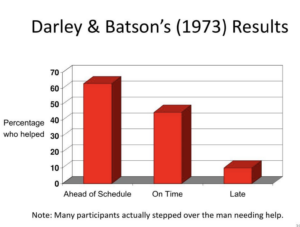
Darley and Batson did an experiment to show the impact of time pressure on our helpfulness.
Working with Princeton theology students they were asked to prepare a talk then go to where the talk was under three conditions
- Low-hurry – ‘It’s a few minutes before they’re ready for you, but you might as well head on over’
- Intermediate hurry – ‘The assistant is ready for you so please go right over’
- High-hurry – ‘you’re late. They were expecting you a few minutes ago. We’d better get going’
As they walked to deliver the talk, they walked past a person slumped on the floor who coughed twice as they went past.
(Not sure this would pass an ethics assessment these days?)
As potential priests you would expect them to act with kindness.
Did they help?
- Only about 10% of those in a rush stopped to help.
- Around 60%+ of those with time stopped.
Time becomes the crucial factor here.
What is even more enlightening is that one group were primed with a story about helpfulness, and not just any story, but the parable of the Good Samaritan.
A parable Jesus told in response to the question ‘who is my neighbour?’ about a man attacked by robbers on the road and left beaten up. A priest and a Levite (a religious man) walked past in a hurry and did not stop to help, a third passerby, a Samaritan, and historically enemies of the traveller stopped and helped him, taking him to an inn and paying for his care.
In decision science we often talk about priming as pre-suasian – that the information (words, stories, emotions) that we absorb subconsciously are impacting our future behaviour.
You would expect these proto-priests to be primed to be kind by thinking about a story about helping and kindness – and telling other people about it and how to use it in their everyday lives.
But no.
Being primed with a message about helping did not make a significant difference the key difference is the time they had to act.
Time to act matters.
“ethics becomes a luxury as the speed of our daily lives increases” (Darley and Batson)
The instinct to help was in conflict with instructions to help the researcher who had told them to be there quickly versus the immediate need in front of them.
“Indeed on several occasions, a seminary student going to give his talk on the parable of the Good Samaritan literally stepped over the victim as he hurried on his way!” (Darley and Batson)
Before we judge these potential priests
People don’t lack compassion, but lack time, and time and context matter.
We can reduce friction for donors with fewer choices, fewer clicks, default options – removing barriers makes for a smoother donor journey.
But what can we do about timing? How can we give our donors the time to act? Permission to take time to listen
We need to think about the WHEN when making the ask. That the donor has the time and space to react and respond. We don’t ask a donor as they are leaving the room, or in a busy noisy space – they need to be relaxed, engaged and able to hear us. We have scheduled time to meet and to talk. They are ready to listen.
As fundraisers we are taught to add a pause after the ask and to let the donor sit with the ask. One of the reasons is to give time to absorb, review and respond. Self-sabotaging fundraisers might be tempted to leap in and fill the silence already making a counter-offer or pushing the decision to later but the pause is there for a reason.
How might giving time work with direct mail?
We read, we feel and we intend to give – but the intention gap means that the next email, the news alert stops us even when we have good intentions.
Mail is tangible and gives the donor something to hold on to – but we cannot control when the post will come, or when people will read it. So how can we give donors permission to take the time and engage?
This case study shared on SOFII highlights one way to give donors permission to stop and to engage.
Guide Dogs NSW in Australia did a clever thing with their mail pack. They included a tea bag (with a cute puppy pic) (more on why cute puppy pics work here)

The outer envelope said
“Put your feet up… Have a cuppa on us!”
“Please enjoy a cuppa on me … then find a comfortable place to sit down, relax, and allow me to tell you….”
The letter went on
“While you’re waiting for the kettle to boil, feel the tea bag in your fingers…now read on.”
Giving permission to pause.
This pack outperformed others as a space was created to stop, to engage, to give.
This not only gave permission but also created a sensory experience. Smell and sound are two of the most evocative senses and often underutilised in fundraising – they can trigger profound and deep memories. (See more about sensory priming here)
During the pandemic, the Chair of our Development Committee sent us all biscuits to have together in a meeting. There have been campaigns that use small, tasty treats (offering a sweet bit of hope) which gives us a reward, but also permission to stop. Anything tangible also excites curiosity and engagement but also the endowment effect – we value something as ours when we have touched it and engaged with it. Giving a gift also incites reciprocity because you have shared a tea bag the social contract dictates that something (ideally a financial donation) ought to be shared in return.
But as with all this science the important thing is to test what works for your donors (or segments of your donors)
How might that work with email?
There are multiple studies about the best time to send email and get response rates.
The ‘weekend effect’ suggests that Sunday emails have higher donation rates – the prosocial timing when people are more values orientated and less rushed increases open rates and donation rates. (Because we don’t work weekends generally, do we not send at the weekend?)
None of these studies shows conclusively when is the best time for your donors, or a segment of your donors to receive an ask.
Each donor will have different time pressures and with data on open rates and click throughs perhaps ultra tailored programes will know to send retired David an email on a Tuesday at 11.17 when he sits down with a coffee to answer emails, or to send busy working parent Clare an email post school run on the commute and another late at night in the pre-bed doom scrolling window.
(Can you have music playing in the background as they read? Can your use of words evoke space and time and pause? Can you give an estimated reading time like news articles do? Or a TL:DR summary?)
With the bandwidth being the challenge it is not just when to ask, but a sequence and layering of asks and other nudges that can be used to nudge a gift (an upcoming deadline, a limited match pot window).
Fundraising isn’t just about making people care.
It’s about making it easy to act while they do.
How can you give your supporter the time to be kind?
References:
John M. Darley & C. Daniel Batson (1973) “From Jerusalem to Jericho: A Study of Situational and Dispositional Variables in Helping Behavior” Published in Journal of Personality and Social Psychology