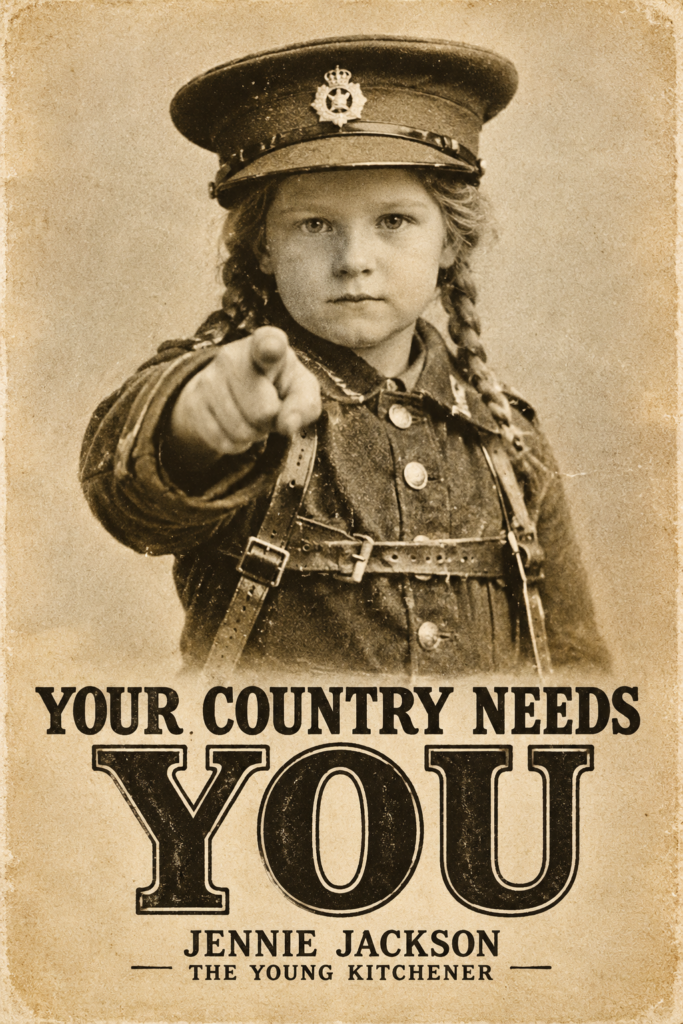
Jennie wants YOU!
Why is it so difficult to say no to a child collecting for charity? Why do charity images often feature children?
During the First World War a little girl called Jennie Jackson raised thousands for the troops
Why can children be so impactful in fundraising?
Our primitive brains are primed to pay attention to faces. More than half of the brain’s cortex is involved in processing visual information, and faces are among the most compelling things we encounter.
We are remarkably quick at recognising and interpreting faces, instinctively assessing the person in front of us. Friend or foe? Threat or ally? Someone to approach or avoid?
A baby’s or young child’s face tends to trigger a particularly powerful response. Certain facial characteristics – large eyes, a relatively large forehead, rounded cheeks and a small nose and mouth – form what scientists call baby schema, or Kindchenschema. These features can activate nurturing and caregiving responses. We recognise something small, vulnerable and dependent, and are more inclined to protect and care for it. Our primitive brains have evolved to pay attention and care.
Jennie Jackson – Burnley’s “Young Kitchener”
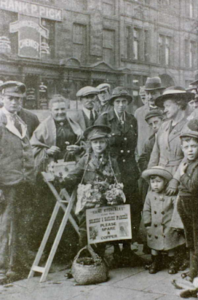
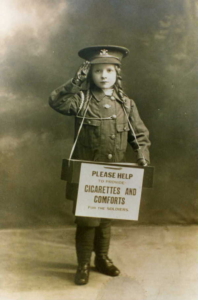
Jennie Jackson was born in Burnley on 27 December 1907, the daughter of John and Kate Jackson. Her father was a miner. Soon after the outbreak of the First World War, Kate reportedly saw two soldiers sharing a cigarette while walking in Towneley Holmes. The sight prompted her to consider how she and her young daughter might provide tobacco and other comforts for men serving in the trenches (a useful reminder that philanthropy is a product of time and culture – no child today would do a fundraiser to generate funds for cigarettes!). Kate painstakingly made Jennie a carefully crafted replica military uniform making her look like Lord Kitchner on the famous ‘Your Country Needs You’ pointing poster. She got permission to dress in military dress from Burnley’s Chief Constable, and began collecting to raise funds for comforts for the troops. Because of her outfit she became known as Young Kitchener.
Jennie stood out for two reasons (1) she was a child fundraiser, and (2) she wore a striking outfit. This illustrates salience – we notice things that are different or unexpected. A uniform attracts attention – a child in uniform attracts even more because the combination is unusual.
Aside: Why is that Lord Kitchener pointing poster so effective and iconic? You may remember from school history lessons. There is a visual trick employed – Kitchener’s eyes and foreshortened finger appears to follow you around the room – you cannot look away and you feel watch. This is called the eye tracking effect.
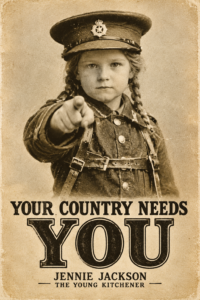
Eyes, as discussed above, attract attention and we are drawn to faces and assessing what they are telling us. Lord Kitchener in the poster is looking directly at us – and he is not happy! In an infamous decision science experiment, pictures were put up by an office coffee point asking for contributions towards the coffee. When the images were of flowers there were fewer donations. When there were eyes there were more donations. However, when the eyes were angrier there was more compliance.
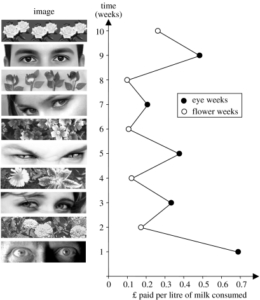
When are observed we want to do the ‘correct’ behaviour – more moral and more pro social. Kitchener’s eyes let you know your behaviour is being watched and judged.
We also pay attention to who the message comes from – the messenger effect – in this case it is coupled with the authority bias effect. Lord Kitchener was not any general, he was a war hero and with a legendary reputation. We are more likely to comply to messages that come from authority figures that we respect and fear.
Back to Jenny and her fundraising. …
Jennie as a mini Lord Kitchener was a brilliant piece of fundraising theatre. The uniform gave Jennie a recognisable identity and made her collection memorable. The novelty of a child collecting in costume, and the salience, of a military uniform encouraged people who might otherwise have walked past a collecting tin to stop, smile and contribute.
Jennie was by no means the only child fundraiser – following in the Victorian tradition of young fundraisers there were thousands of juvenile societies collecting funds pre war for missions. There are many ways that children were involved in fundraising especially in Victorian times, you can read more about them here.
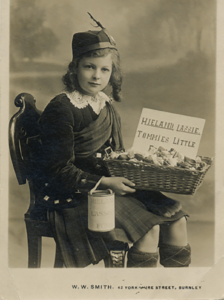
During the Great War, Scouts even collected conkers to be used in explosives. Jennie wasn’t even the only star child fundraiser in Burnley – another local girl Amy Foster, appeared every Saturday dressed in the uniform of the Black Watch, complete with kilt and sporran. She became known as the “Hieland Lassie”.
Jenny was not content with just raising money for comforts and cigarettes. In 1916 she set the herself the goal of raising enough money for an ambulance. She collected over £1,100 in copper coins over twelve months. Of this, £450 paid for a vehicle named the Young Kitchener, while the rest went towards comforts for servicemen.
This shows that the power of naming rights and recognising the donor and their donation. Donors want to see their names on what they have helped purchase – here it was ambulances (see the names they come up with for Spitfires!)
Over the course of the war, Jennie is reported to have raised approximately £4,000. She received the War Medal of the British Red Cross Society.
What else inspired Jenny? Her eldest brother William has been a Dragoon Guard and was killed in 1915 at Loos. Her other two brothers were fighting – Richard with the Shropshire Light Infantry and was decorated for gallantry at Ypres, while John Samuel joined the Royal Field Artillery in October 1915. The personal connections we have and the life experience impact the causes that we feel passionate about and dedicate our time, talent and treasure to.
Jennie’s contribution received national recognition. In 1919, she was reportedly the only child permitted to take part in London’s victory celebrations, the Great March of Peace.
Jennie’s story shows how a child fundraiser could turn public affection into tangible financial support. Her uniform attracted attention, her age made her memorable, and her enthusiasm and persistence encouraged people to give. In effect, she became a miniature fundraising ambassador: her appearance and personality helped her create an emotional connection and translate it into support.
What can fundraisers learn?
Jennie’s story illustrates several enduring principles of fundraising psychology:
- Attention comes first. Before someone can give, they need to notice us. A child in a distinctive uniform provides an immediate visual hook.
- Distinctiveness matters. Something unexpected interrupts our normal patterns of attention. Jennie’s miniature military outfit made her instantly recognisable.
- Emotion influences decisions. We don’t always make giving decisions through a rational calculation of need, impact or financial value. Feelings of affection, empathy and protectiveness can play an important part.
- Personal stories create connections. Jennie wasn’t asking people to support an anonymous appeal. Her brother had died – it mattered. She was a local girl with a visible mission, a recognisable identity and a compelling story.
- Participation creates ownership. By giving Jennie their pennies, people in Burnley could feel they were contributing to something tangible and worthwhile: an ambulance for the men serving at the front.
Of course, children should never be treated simply as fundraising props. Their involvement and use of their images must be voluntary, appropriate and safeguarded, and their contribution should be valued in its own right.
But Jennie’s story reminds us that fundraising is not simply about presenting people with a logical case for giving. It is about understanding how people notice, feel, connect and respond.