Saltburn ends with Barry Keoghan dancing to Sophie Ellis Bextor’s 2001 pop hit ‘Murder on the Dance Floor’ – for those that remember it from 23 years ago it will have specific associations and memories – a certain bar, lifestage or nightclub (and for some it may have completely passed you by).
Our brains are wired to emotionally respond to music which is why certain songs have a power to transport us physically and emotionally to a moment – a university bar, a crush, a city, a holiday, a road trip, childhood, someone we love. Familiar music, especially music with vocals, causes a psychological response (increased heart rate & blood pressure) – music is wired to our memory.
And our brains are constantly rewiring and making and remaking associations to music, so ‘Murder on the Dance Floor’ may become newly associated for you with Saltburn, as well as keeping a trace of the former memories.
Sound is one of the most powerful senses we have, but one often under used in fundraising.
Listening to music can give you thrills and produces endorphins and activates the brains reward circuits.
“Music does a lot of things for a lot of people. It’s transporting, for sure. It can take you right back, years back, to the very moment certain things happened in your life. It’s uplifting, it’s encouraging, it’s strengthening.”
Aretha Franklin
The power and embodiment of music can be seen in this former ballet dancer with Alzheimer’s hearing Swan Lake and recreating the steps
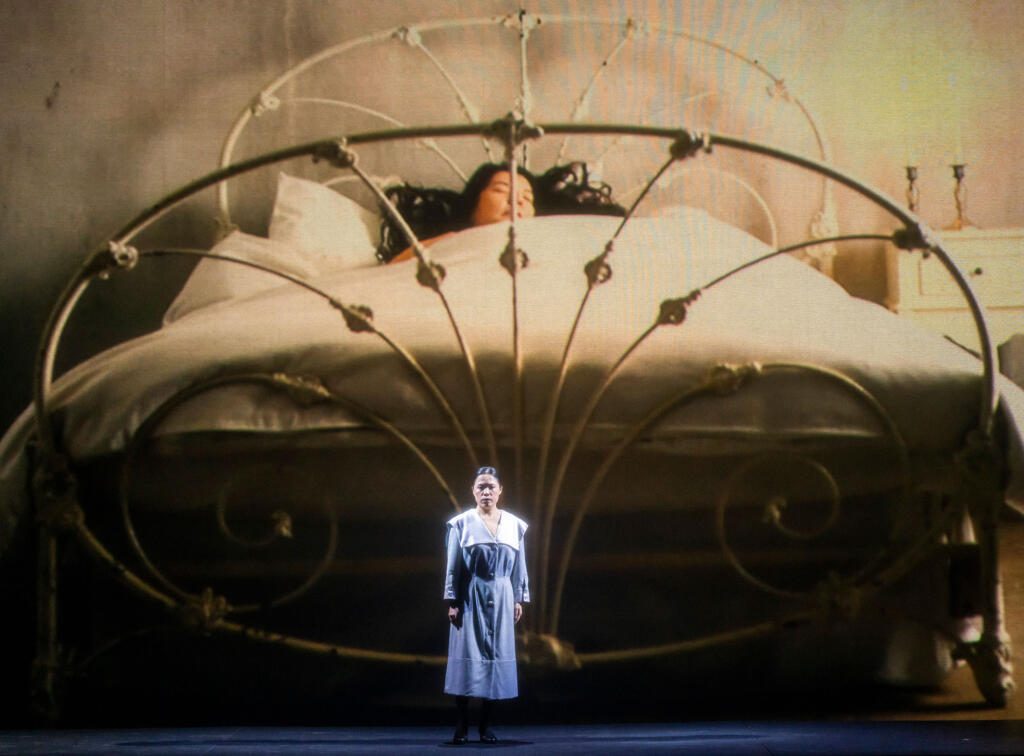
At the Coliseum we recently had Marina Abramovic’s opera project 7 Deaths of Maria Callas which used seven famous arias of dying sopranos to explore the life of Maria Callas. The first one was from La traviata – the aria at the beginning of the final act where a dying Violetta is contemplating her imminent death. For me, this 6 minute aria, was like a concentrated experience of the opera. Despite just having this extract, and not seeing the previous two acts, every time I saw this aria it moved me to tears as I could feel and remember the emotions I would have experienced watching the whole piece, and knew where we had reached in the plot, and what was coming.
Mood music
The cues music can give us are subliminal nudges, that can impact our mood, but also our behaviour, how fast and what we eat, and what we buy.
Music with a faster tempo makes us eat faster, and people tend to spend more money and eat slower when jazz or classical music is played. Think about the ambient background music you might have in a restaurant – fast and pop for somewhere that wants to turn tables, and more mellow and chilled for a restaurant that wants to encourage you to spend longer, spend more and enjoy the experience. (Although music can also be used as a deterrent, a Welsh branch of MacDonalds plays classical music after 17.00 to deter anti social behaviour)
This real life experiment in an East Midlands supermarket shows how the background music has more impact that we might think it would
When French music was played 75% bought French wine
When German music was played 73% bought German wine
When asked about their choice of wine, and whether the music had impacted their choice, only one of those surveyed noted the impact. (North, A. C., Hargreaves, D. J., & McKendrick, J. (1999))
What does your brand sound like?
Brands use sounds, known as sonic branding, to help us readily recognise them:-
Coca Cola used this image and the slogan ‘try not to hear this’ to evoke the sound of the fizz of the bubbles (there were also adverts showing a detailed close up of the ring pull being pulled back, and a bottle opener opening a bottle). The advert invites us to hear the remembered sound and trick our brains to almost hear it.
We know sound (and taste/smell – think Proust and the madeleines) are some of the most powerful senses but unless you have the budget for a TV ad (or create a ‘scratch’n’sniff appeal) they can be underused in fundraising appeals (in direct mail or adverts.)
We know that we and our supporters receive information in many ways – that the words are only part of it, and that the real and imagined images we use have an impact – as does the weight of the paper, the design of the piece, the feel of appeal in the hand, the order we present information. We know that appealing to many of the donor’s senses can make our appeals more vivid and effective. So, we might appeal to donors to remember a sound (children crying) or imagine a future sound (children laughing), but we largely rely on the words and the visual of the design of the pack – letter, the lift letter, response mechanism, the call to action.
For someone working in opera and fundraising, the sounds created and remembered are key – the emotions they stir in audiences from the dopamine of anticipating what it will feel like to hear that music again, to the oxytocin of the emotional engagement with the story – music is so important. And not just the music, but the whole holistic and acoustic experience of the performance, of being together, with an audience, inside a theatre. The hubbub in the bars before hand, the orchestra tuning up as you take your seats, the silent anticipation with the audience holding its breath before the curtain rises and the applause at the end.
How can we integrate soundscapes into an appeal?
How can we create appeals that bring more of the sound world – real, remembered or future created by the donor’s action into our appeals?
How can technology help us integrate and create an immersive sound world?
How could we use sound to provide a richer and deeper connection with our donors? To their memory? To their identity?
What segments of donors will this soundscape be most effective with?
I have some ideas that I am developing to try and find ways to test, gamify and play with sound in supporter communications and see if it can be used to enhance the communication and their connections.
https://marinajones.uk/wp-content/uploads/2024/01/fTlCNdgFhcW1V5-OO8UV6xT-xw1k-LGXcpTIN_sgpSY.jpg.webp576768adminhttps://marinajones.uk/wp-content/uploads/2022/12/f2b903e010104f5aa61ea1821a685913.pngadmin2024-01-24 08:24:142024-01-24 08:24:14Murder on the Dance Floor – Extraordinary How Potent Cheap Music is
1. Challenge events – raise a minimum to participate
You may have thought that raising £5,000 to walk the Great Wall of China or bungee jump off a bridge were newer inventions but it is something fundraisers have done for over a hundred years.
In 1902 the Young Helpers League of the Salvation Army had to fundraise and then present a purse with a minimum donation to attend an event at the Royal Albert Hall.
2. Mircodonations before microdonations were a thing
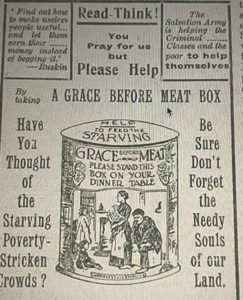
‘Grace before meat’ boxes encouraged small and regular donations throughout the day with a penny before each meal with grace.
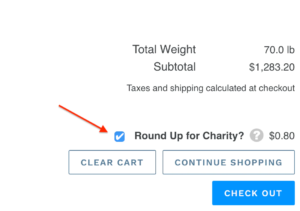
Like rounding up at the till at the supermarket, or other shopping experiences, they offer a gentle and frequent opportunities to give.
3. Give yourself if you want to ask
‘Make some definite sacrifice yourself as your soldiers are sure to reflect your conduct’
The Officer, 1893
The peer to peer ask is a powerful one – when someone like you asks you to join them in also making a gift it invokes a social norm and shows that they are committed to it too.
If you want to be asking other people be a donor yourself. If you don’t care enough to give, in some small way, why should anyone else?
Also, being a donor to your charity (in whatever way you can) allows you to better understand the donor journey and what it feels like to be part of the supporter group, track the appeal and see when the letter or magazine lands on the doorstep and how quick and effective the thanking process really is.
4. Ethical products can also support mission
In 1891, playwright George Bernard Shaw and Fabian Society member Annie Besant were amongst others were campaigning against the Bryant and May match factories and their use of phosphorus in match production. The match girls went on strike to protest working conditions and the use of phosphorus in matches which resulted in ‘Phossy Jaw’ (a painful deterioration of the jaw and teeth caused by the phosphorus used in the match production process).
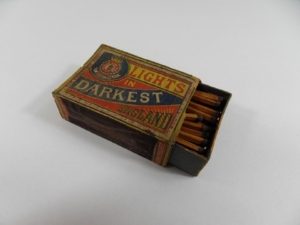
The Salvation Army created a new match factory that did not use phosphorus and produced matches with better pay and processes – these were called Lights in Darkest England and were more expensive to purchase than other matches. They were promoted as a way of supporting the ethical production but the factory closed down after a year.
So not everything works – and it is important to fail fast if a new idea doesn’t work stop doing it.
How else can you give supporters a chance to live out and align with your values with other purchases?
5. Issues of ready cash & when to ask
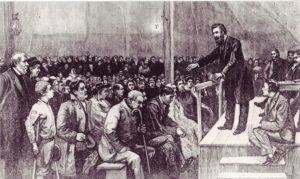
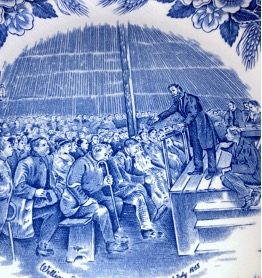
William Booth preaching at a meeting
We might think the challenges are of cash giving are a modern problem. Post pandemic many shops and charitable donations only offer contactless donation opportunities.
But 140 years ago fundraisers were worrying about donors having cash on them and their ability to give at collection time.
“Well-to-do people seldom carry much money with them in their purses, and yet the best time to touch their hearts is under the mellowing influences of a meeting, when they will often give twice as much as they would when they get home, or under other ordinary circumstances’
How can we make it easy for people to donate if they don’t have cash on them? Or if they only have cash is only accepting contactless donations stopping them giving?
This also speaks to the best time to make the ask – when they are emotionally engaged and warm to the ask, when they have been inspired by your cause.
When do you ask donors for a gift? When you have ‘touch[ed] their heart’ are really inspired them or when they are in ‘other ordinary circumstances’?
(To read more about Salvation Army fundraising fundamentals and innovations read this article https://marinajones.uk/salvationarmy/)
https://marinajones.uk/wp-content/uploads/2023/11/IMG_9403-3-scaled.jpeg18382560adminhttps://marinajones.uk/wp-content/uploads/2022/12/f2b903e010104f5aa61ea1821a685913.pngadmin2024-01-18 09:11:232024-01-18 10:21:015 More fundraising firsts and fundamentals from the Salvation Army archives
In December 2023, BP announced giving £50m to support the British Museum.
In 1974, the Sackler family gave $3.5m for the new Sackler wing at the Met Museum
What links these two headline gifts?
No, its not just the ethical concerns.
The headline gifts highlight an interesting trend that mega givers sometimes deploy. The headline grabs the attention but the gift is paid out in instalments.
The BP deal is £50m over five years.
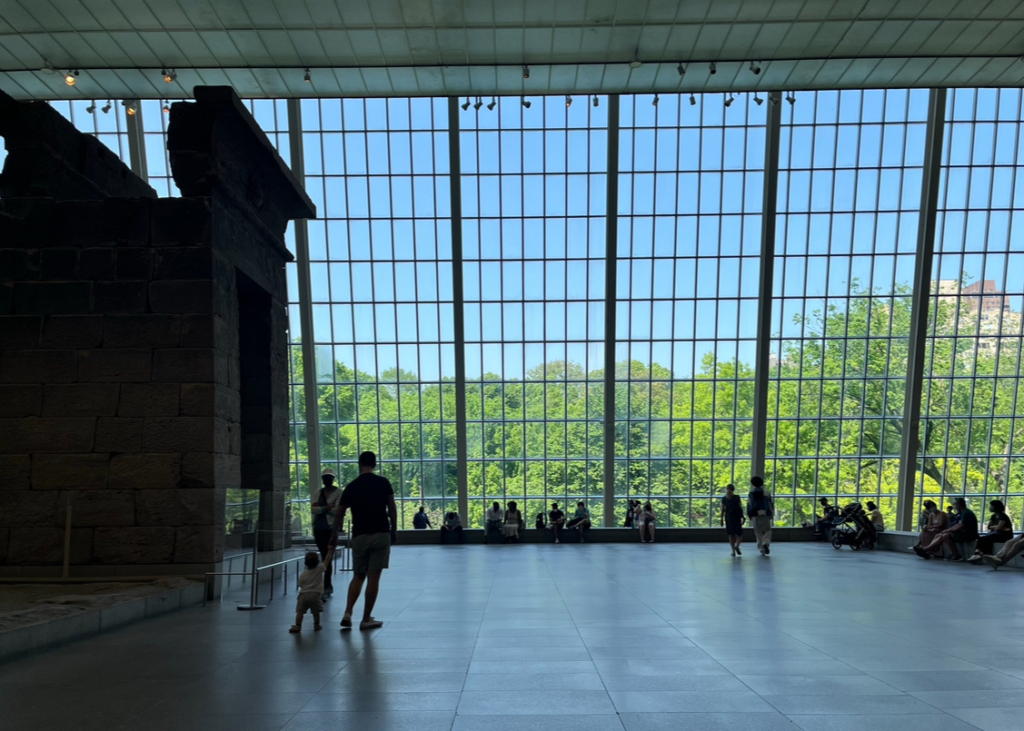
The Sackler support of the Temple of Dendur was over 20 years (and actually required the Met to take out a loan to support the cash flow of the project).
Former Sackler Gallery at the Met, NYC
What if we framed our own giving differently?
Instead of thinking about the one off gift, what if we thought about the multi-year commitment and the cumulative total. How we frame a gift is really important.
What if this new year you were asked to make a £5,000 commitment to a charity you cared about?
Your first reaction might be denial – I can’t afford that, that’s beyond me. But if we frame it differently – might you already be a £5,000 donor, £1,000 donor or more?
The £5 monthly donation you started 14 years ago makes you a £1,000 donor.
The £3 a month donation from 23 years ago is over £1,000.
Which charities are already in that bracket for you?
Hyperbolic discounting vs goal gradient
These small monthly donations add up. Fundraisers often try and make small regular gifts salient, and anchor people to the small number e.g. ‘for just the price of a coffee a week you could save a life’. This is hyperbolic discounting – we tend to discount events that happen in the future and prefer to take a small amount of pain now (paying is painful).
What if we focused more on the goal and the pride or sense of achievement of reaching it? Each monthly direct debit would take us nearer to our goal.
Start a £75 a month donation (plus Gift Aid) and in 4 years and 6 months I becomes £5,000
Or start a £20 a month donation (plus Gift Aid) today and in 3 years and 4 months you will have given £1,000.
How might we celebrate those milestones for our donors?
Some charities have special donor board that recognise cumulative gifts of £1m+, what if instead of celebrating the amount we celebrated the sustained duration of the gifts? A donor board celebrating those that have given consistently for over ten years, or a badge. Blood donation is brilliant at celebrating those anniversaries of donations made with certificates, badges and gifts to mark milestones.
Today was the 50th anniversary for my blood donation. The hospital gave me some memorial items. Of course, it's not my goal. I started donating my blood in 1995 when Hanshin Awaji huge earthquake occurred. As of now, I regret that I hadn't done it in my 30s due to my busy days. pic.twitter.com/AJsczkU4Yk
Can we celebrate donor anniversaries rather than our charity’s?
Taking the ‘they are not your donors, you are one of their charities’ mantra, do we need to think about it being their anniversary with your charity and not yours that matters. My anniversary as a donor is more significant to me than the fact your charity has been around for 50 years or 93. Celebrating that I have been giving £10 a month for 10 years recognises my loyalty and commitment and enhances it. It makes my identity as a donor stronger. It makes me feel special and valued, -rather than just another donor.
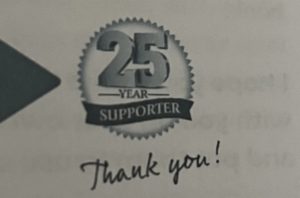
This is a great example from Lisa Sergeant used for a special segment of donors that had been supporting Trocaire for 25 years – by celebrating the donor identity they increased engagement, response rate and income in this mailing and it had ripple effects going forward.
Quoted in ‘Change for Better’
So in 2024, where might you give like BP or Sackler?
How can you think about your 5-10 year commitment to a charity and that adds up to and might do?
And how can you celebrate donors giving over a longer duration more?
https://marinajones.uk/wp-content/uploads/2023/12/IMG_9691.jpeg15121156adminhttps://marinajones.uk/wp-content/uploads/2022/12/f2b903e010104f5aa61ea1821a685913.pngadmin2024-01-03 07:55:102024-01-03 07:55:11Will you give like BP this year?
What was included in legacy brochures in the 1930s? How did charities speak to their supporters about legacies?
In the Salvation Army archives which I recently visited there were two examples of legacy brochures from the 1930s.
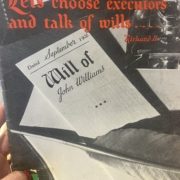
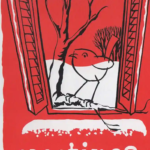
Let’s look at the covers.
We have quotes from Shakespeare (left) and Shelley (right). This clearly speaks of a general knowledge of literature amongst the Salvation Army soldiers (even the RSC does not quote Shakespeare on their legacy page today!)
Having the date and the name of the person writing the will written by hand makes it feel personal, more authentic and a nudge to complete your own. The quill is poised ready for you to pick up and write your will. It is positioned in the correct place for a right handed person (the majority of people) to start writing making it easy for our brains to understand what is expected of us.
(Although be great to test the impact of a personalised pack like this with the potential pledger’s name on the cover …)
What is included and what would we still include today?
Case studies and examples of what a legacy has done in the past – this serves two purposes – one it gives social proof that other people have done it and it is a normal thing for supporters to do. It also serves to give an example of the impact of what a legacy can do.
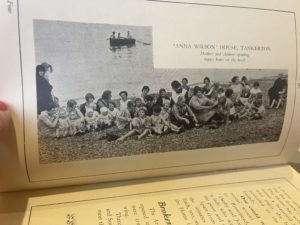
In the 1933 brochure a case study details the Anna Wilson House which was established thanks to a woman’s legacy and talks about the difference it was made ‘During the six years since then more than four thousand women and children have enjoyed the hospitality of the Home and the benefits of a seaside holiday!‘ It includes a picture of the women and children on the beach enjoying the experience.
Legacy brochures continue to tell the story of the impact of legacy gifts and what they achieve for the charity.
List of legacies – There is a list of legacies received with the names and amounts of their bequests. This is a way of commemorating the donors and recording their names for posterity. It is also useful to demonstrate that this is a normal thing for Salvation Army soldiers to do.
I am not sure we would list the amounts given nowadays. And the legacy donor credits would not be in the marketing brochure but on a wall, a plaque, a tree of life as leaves, a programme, a book of remembrance (physical or digital). Having a place where donors (and their families) know that they will be credited is an important addition.
The statement ‘we would advise you to consult your solicitor’ – this is similar to what we’d find now, as the fundraising team are not always legally trained, and a will ought to be executed by a professional solicitor.’
In the 1893 issue of The Officer (Salvation Army monthly magazine) there are detailed instructions about how to complete a legacy properly as there have been cases when the will has been insufficiently witnessed to be legally binding.
Statistics on impacts of the charity and its work. There are pages dedicated to the work of the Salvation Army and what it has achieved and the need for its work.
Clearly, back then, as now, talking about the impact of your work is important.
Foreword by the current General – the General was the most senior figure in the organisation and wrote the foreword to the brochure.
Often we use the most senior person in the organisation like the CEO or Chair of the Board to be the authority figure talking about the vision and the need. They are someone well known to supporters, respected and trusted to enact the legacy gift.
The acknowledgement that talking about death is not easy ‘It is a common mental attitude to think every one mortal but ourselves…. The very thought of making one’s Will, for instance is unwelcome to many people. They connect it with hastening, somehow, the inevitable dissolution’.
This links to terror management theory (which was only proposed as a formal theory in 2015) which says that reminders of our death kick in a self preservation instinct that makes us deny, delay or distract from any talk of death. This is one reason why people don’t have wills as they cannot bring themselves to acknowledge and deal with their ultimate demise.
Not many legacy brochures now tend to be so up front in acknowledgment of this – they tend to focus on a celebration of life and looking back, looking forwards and saying thank you.
During internal training and when getting organisational buy in to promoting legacy giving this uncomfortableness does appear for some. However, people for whom death is more salient can be very up front about talking about funerals, death and legacies – it can be a self imposed fear by fundraisers.
Choosing where your bequest goes – there are two forms that allow someone to make a gift to religious purposes or to the social work of the Salvation Army.
Many charities today allow your gift in will to be directed to the area of the charity’s work that is most meaningful to you. Can you give the donors the autonomy to decide where their gift goes? Many charities try and keep the bequest wording as wide as possible as they don’t know where it will be most needed at the time of the realisation of the gift – but can you direct it to broad areas of work (like the religious purposes of social purposes) with a non binding condition on it.
Keep drip feeding the message – the 1886 Salvation Army annual accounts statement includes the standard words for a bequest. It is important to g the information they need to enact their will. It is also important to drip feed the legacy message throughout communications with supporters as you never know when someone will be writing their will – most of the time they are not writing their will so the regular drip feeding of the message means they might get the subtle nudge and reminder at the right moment and act on it.
Today a pledger might just need a the registered charity number to take to their solicitor – interesting to note that this predates this legal structure and the bequest instruction reads “I give and bequeath unto William Booth, the General of the Salvation Army … or other General of the Army for the time being, his successor, the sum of ”
Where can you continue to talk about legacies and their impact – it may the annual accounts and reports (or this may be where you list and acknowledge the bequests received). Can you continue talking about legacies in newsletters and supporter magazines, as well as targeted correspondence and events?
Confidential correspondence –‘General Booth will always … treat any communications made to him on the subject as strictly private and confidential’.
Making a will is a private affair and many people do not want to talk about the details of their will with other people, The assurance of a confidential communication about this is important for donors – and many charities toady continue to offer this confidentiality guarantee.
Named contact – when talking about something so important and personal as a will it is important to have a named person to talk to. The General, William Booth is listed as the contact for soldiers wishing to consider making this gift.
Giving a name, personal email and phone number (and sometimes even photo) of the person who you will talk to about a bequest can reassure donors (rather than an anonymous legacies@charityname.org).
What is different?
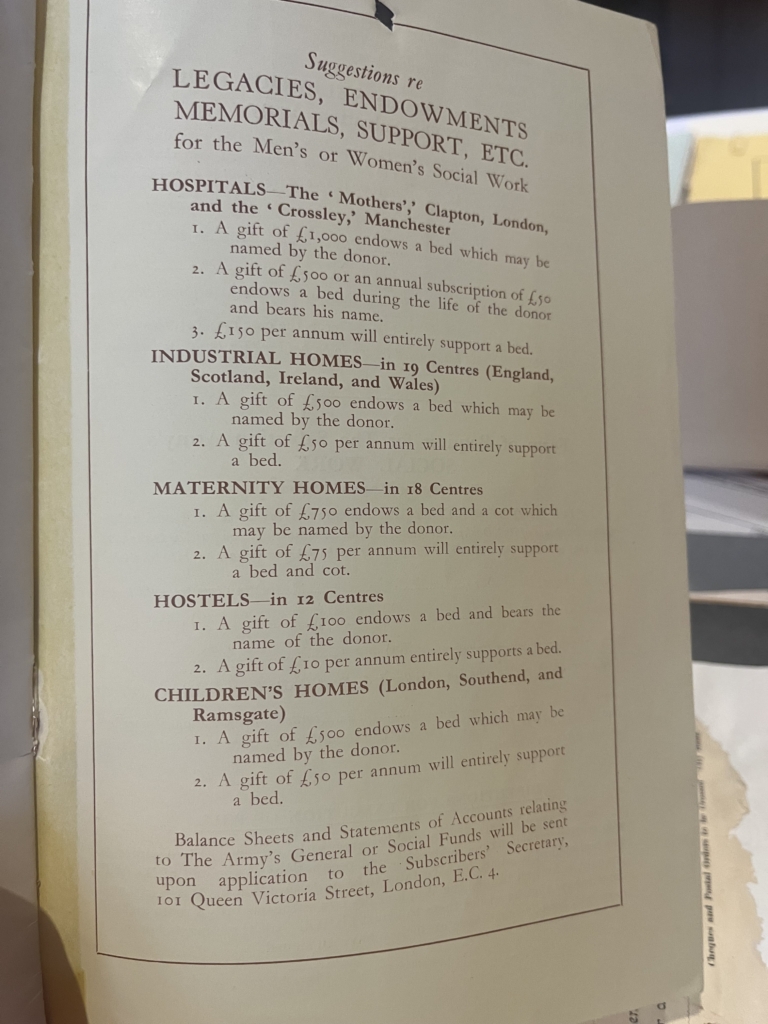
Suggesting the amount – The Salvation Army brochure lists amounts of bequests and what they would be endow in death.
Not many charities do this today – with rising costs of inflation it is hard to guarantee what a particular amount might do. Suggesting an amount could act as an anchor and make potential donors feel if they cannot give at that amount their gift would not be appreciated. The counter to that is that without any amount donors don’t know what a gift could do!
Pledger stories – research has shown that hearing from current pledgers who are alive and made a commitment to a gift in a will inspires us. We react to seeing people like us who have had similar experiences and connections to the charity making this commitment. Many legacy packs invite donors to share their story and memories.
No Contact form – we want donors to contact its and tell us that they have made a gift. So supporters are invited to get in touch with the charity and tell them they have left a gift (or even that they don’t and won’t and to stop asking).
No Legacy circles – there is no suggested ongoing contact with these pledgers in the 30s. There is no ‘let us thank you in your lifetime’. For some supporters this continued contact and acknowledgement is an important part of the gift and allows them to deepen their connection and meet other like minded supporters.
No codicil or letter of wishes – donors not have greater flexibility and ability to add (or remove) you from their will!
Legacy is the dominant word and phrasing here – the term gifts in wills is often preferred nowadays and the term bequest or dislike actively disliked by some donors.
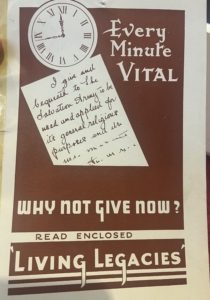
Living legacies – the 1933 brochure talks about living legacies. This seems to come in and out of fashion and is always a question for charity and the donor. When needs are so urgent and pressing it is best to have the money now? Is it best to give the money now and see the impact of the gift (and get thanked in your lifetime)? Or to wait until asets are realised on death and give then? With the climate emergency some donors are giving now to ensure that urgent action can take place?
The clock is set a 11.45 emphasising the ‘every minute vital’ message and that the clock is ticking. Often campaigns use the visual of a clock to reinforce the message that the time is running out to make a gift before a deadline. It acts as a powerful visual anchor.
Again like the legacy brochures at the top there is a handwritten note saying ‘I bequeath and give to the Salvation Army to be used and applied for its general religious purposes and …’ There is something about the handwritten notes which helps the donor imagine themselves into the situation and that it could be their will.
So not that much has changed in the last 90 years …
https://marinajones.uk/wp-content/uploads/2023/12/IMG_9411-1-scaled.jpeg25601920adminhttps://marinajones.uk/wp-content/uploads/2022/12/f2b903e010104f5aa61ea1821a685913.pngadmin2023-12-07 17:43:112024-01-09 13:16:22Legacy brochures from 90 years ago
So your email is probably bombarded with charities and various Christmas catalogues and ways you can support them through purchases gifts or Christmas cards.
The first Oxfam Charity Christmas card was in 1957 but the tradition goes back further than that
So a short festive look at some of the charity merch that you could have bought in times gone by and why it has an enduring appeal – for charities and donors.
Epistolary scandal novels (1799)
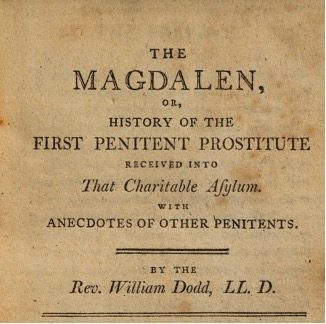
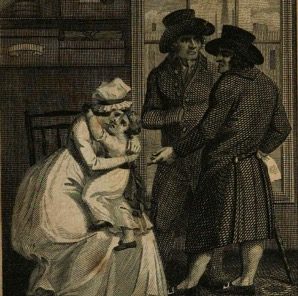
In the 1799, you could buy the sensational novel (price one shilling) entitled ‘The Magdalen or the History of the First Penitent Prostitute received into that charitable asylum with anecdotes of other penitents‘ (what a title!).
These were written in letter form and detailed the fallen women – in this case a clergy daughter seduced by a charming older man who finds herself abandoned. They perhaps veered a little towards the sensational and were enjoyed more for the scandal of the story than improving moral purpose.
You could also buy published popular sermons to support various causes.
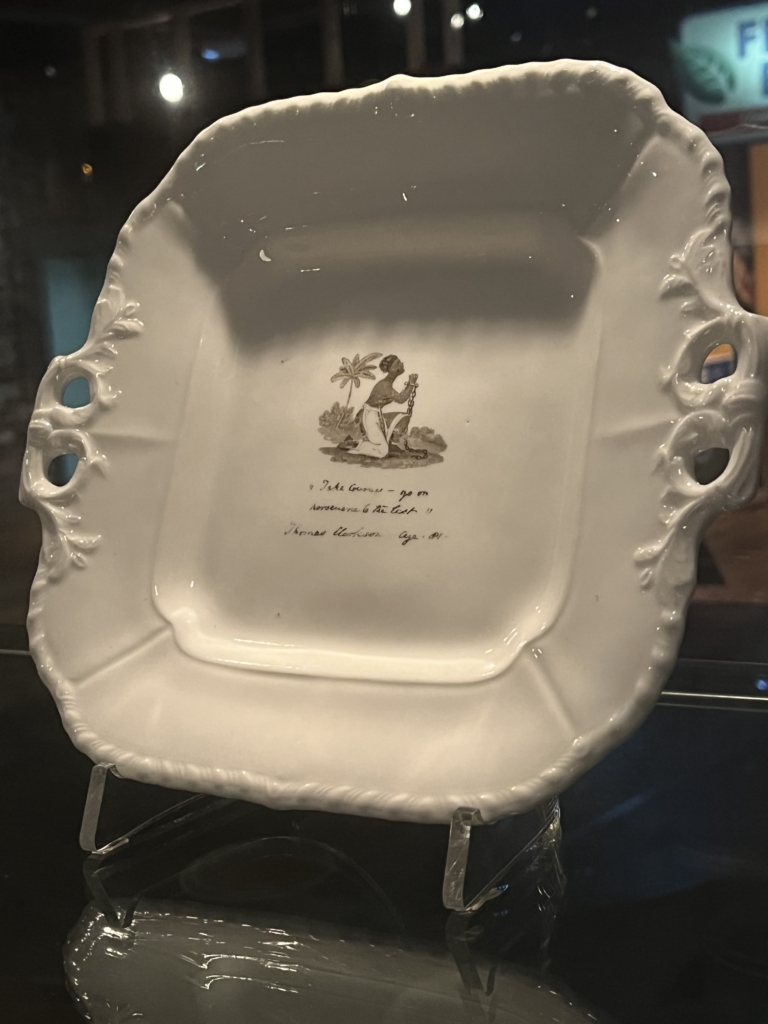
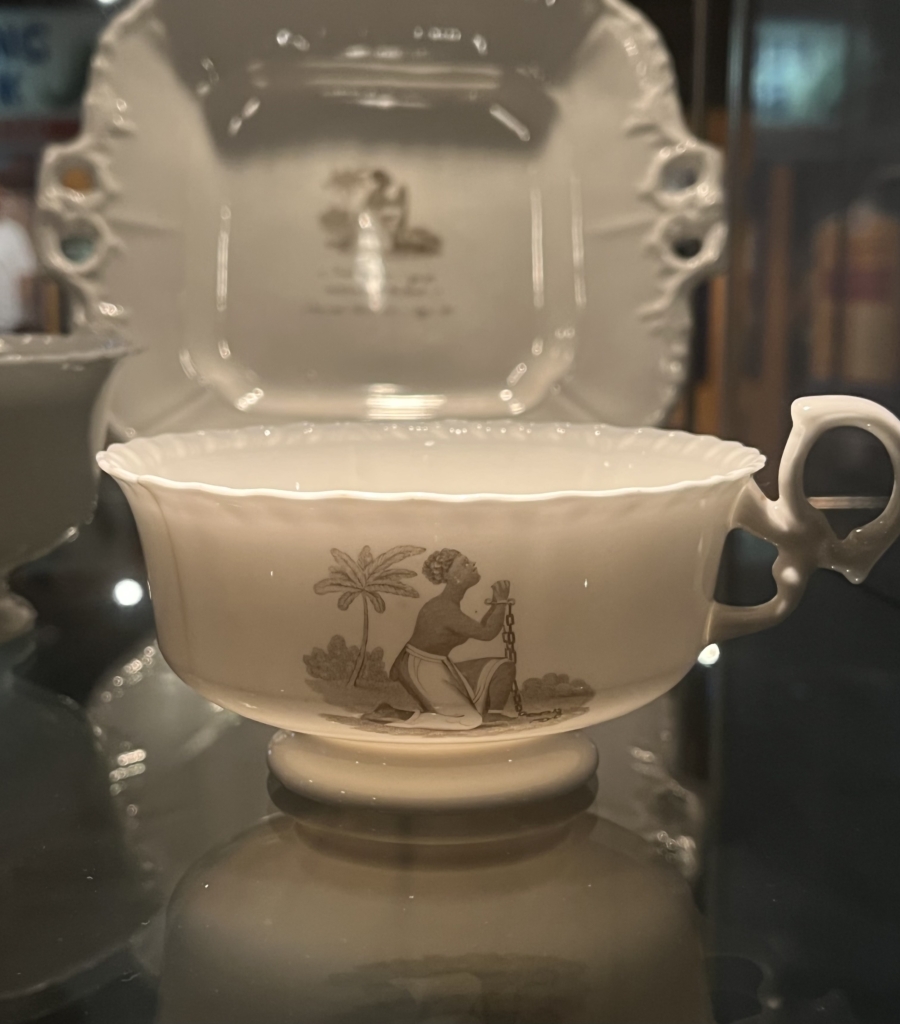
Abolitionist Plates and Medals (1780s)
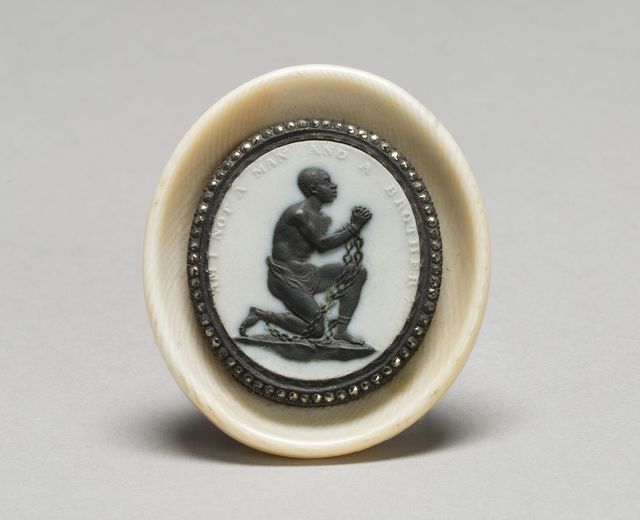
Abolitionist, industrial entrepreneur and potter Josiah Wedgewood created tableware to support the anti slavery movement. He also designed the anti slavery medallion which became a highly fashionable item to wear.
“ladies wore them in bracelets, and others had them fitted up in an ornamental manner as pins for their hair. At length the taste for wearing them became general, and thus fashion, which usually confines itself to worthless things, was seen for once in the honourable office of promoting the cause of justice, humanity and freedom”
The tableware and the medallion were sold to raise funds for the cause and Wedgewood donated directly to the cause himself.
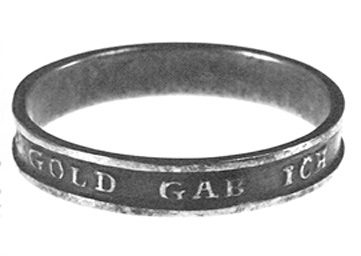
Iron for Gold (1813)
This item doesn’t have a price and sits somewhere between a charity merch item and a donor thank you. During the Napoleonic wars Princess Marianne of Prussia asked the nobility to give up gold and it they were given iron jewellery emblazoned with ‘I gave gold for iron‘ and became the fashion of the court.
Typewriter ribbons, lampshades and much more (1890s)
The Salvation Army used modern printing technology for the best advantage. They turned attractive soldiers (members of the Salvation Army not real soldiers), fundraising events in New Zealand, the famous officers of the day into postcards to sell to raise funds.
Postcards depicting self denial effortGeneral Booth on a postcard contributing to the Self Denial Effort
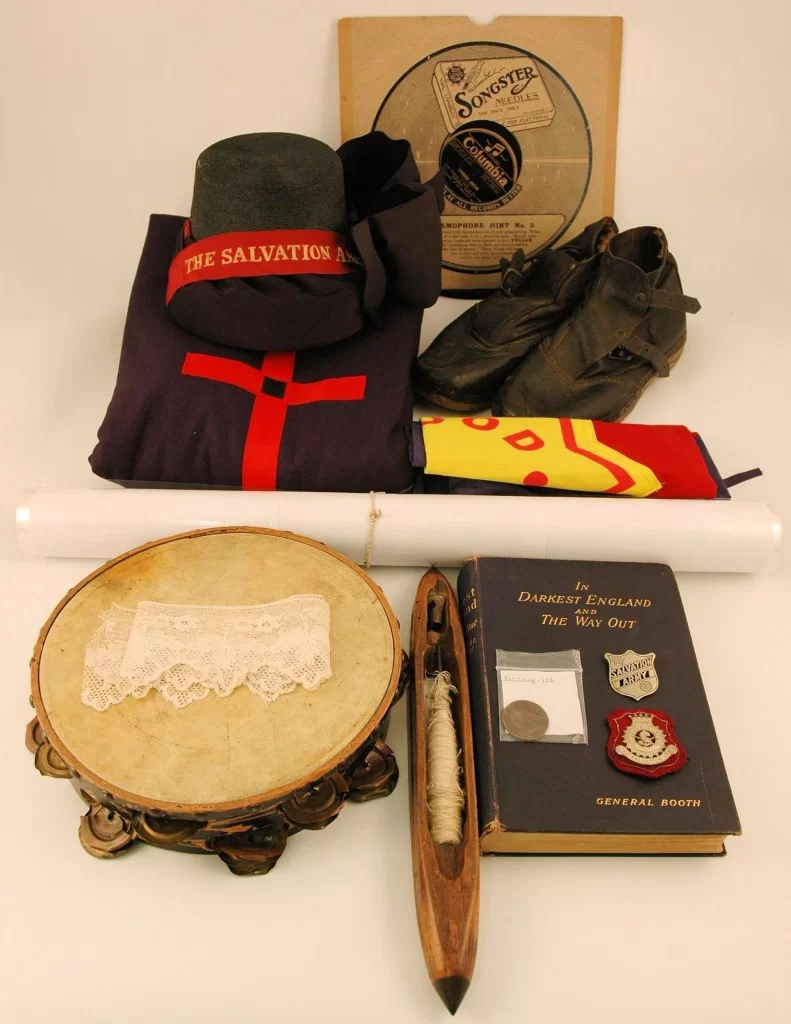
The leader of the Salvation Army was the General and the founding General – General William Booth. General Booth’s image was on tea cups, crockery, lampshades, playing cards, glue, typewriter ribbons and everyday items with all profits going to the Army. His voice was recorded on photograph and recordings of him sold.
Salvation Army plate depicting General BoothSalvation Army uniform and memorabilia including record of General Booth sold to raise funds
Sheet music, commemorative handkerchiefs and napkins (1899)
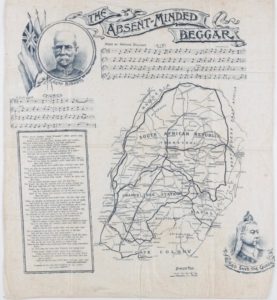
Rudyard Kipling’s poem The Absent Minded Beggar was set to music by Arthur Sullivan and became the UK’s first charity single raising for funds for soldiers returning from the Boer War. People bought the sheet music to support the war effort, but could also purchase the matching handkerchief (seen below).
Suffragette crockery (1909)
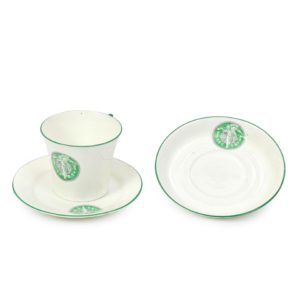
In 1909 The Women’s Exhibition used a suffragette tea service for the duration but then sold it to raise funds. Broaches and pins were also used to raise funds for support.
Why is charity merchandise so popular with us
For the charity it obviously raises funds and allows a donor to support in another (often additional) way. They may be a member but will also buy the tea towel, the mug, the baseball cap and the gin. It also offers the charity free advertising – if your donors are walking around with your tote bag or umbrella, or sending your Christmas cards.
But charity merch plays another very important role – from cups to typewriter ribbons or hankies it helps cement their supporter identity as part of your supporter tribe.Yes, the motive for the purchase may be blurred and they buy the item because it is pretty or practical but is also personal – a personal allyship with the cause. Like wearing a football shirt, a university scarf or a t-shirt with your favourite band on it – it is showing affinity and identity. Collecting and using the item reinforces their connection with your charity and a memory associated with it – perhaps with each use of the cup, the bag, the gin they are getting a microdose of dopamine (the happy chemical) and being reminded of the warm glow of giving to your charity.
For your supporter having your merchandise is a way of them signalling they are someone that cares about preserving art or fighting for justice – and literally have the t-shirt to prove it.
How can help your supporters literally wear the t-shirt of support?
https://marinajones.uk/wp-content/uploads/2023/11/cup-scaled.jpeg25602560adminhttps://marinajones.uk/wp-content/uploads/2022/12/f2b903e010104f5aa61ea1821a685913.pngadmin2023-12-02 16:53:042023-12-02 16:53:05A brief selection of charity merch from the archives
The Salvation Army Christmas red kettles are perhaps one of their most well known ways of raising money and especially at Christmas time – seen on Friends, When Harry Met Sally and countless other shows.
The famous Salvation Army red kettles first appeared in 1891 when a former sailor and Salvation Army Captain Joseph McFee was thinking about how to raise funds to provide the poor of California with a Christmas dinner. He remembered how when he was a sailor at Liverpool Docks there was an iron kettle called ‘Simpson’s Pot’ for donations for the poor. He used this idea to set up a kettle and with the slogan ‘Keep the Pot Boiling’ – a tradition was born that lasts to this day.
Looking back to when Joseph McFee came up with this idea we can see a whole wave of fundraising innovation and inspiration from the Salvation Army. I recently had a rather fundraising history geeky trip to their archives to see some of them for myself. And here are 10 fundraising fundamentals from the archives of the Salvation Army.
Background
Founded in 1865 as the East London Christian Mission by William and Catherine Booth. It sought to bring physical and spiritual salvation to the poor and destitute – and is often known for the 3Ss – Soup, Soap and Salvation. A radical reassessment of mission involved a rebrand turned the mission into the Salvation Army in 1878 when William Booth became the first General led to rapid growth and expansion with work staring in America and Australia in 1880. The reshaping of it into Army with a General as a leader, army officers and members as soldiers also involved a radical overhaul of its fundraising need as it expanded beyond its East London base and sought to bring that salvation to the world. The Salvation Army was one of the first international big brand charities. In 2023 it has over 1.7million members and is the largest non-governmental provider of social services in the US and is active in over 133 countries.
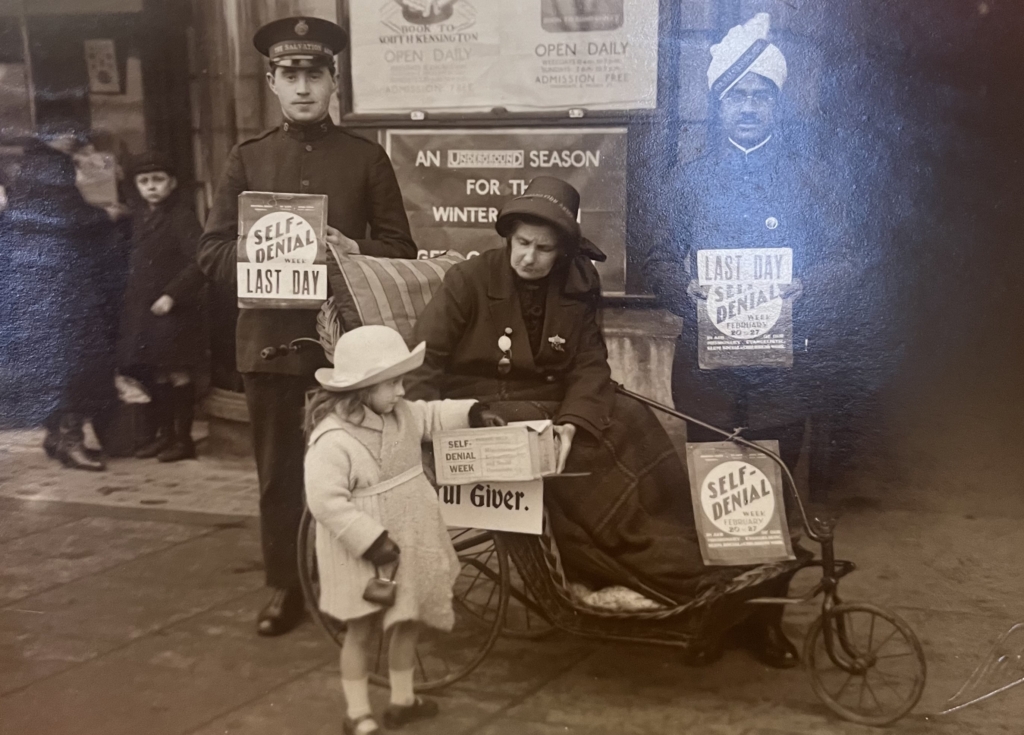
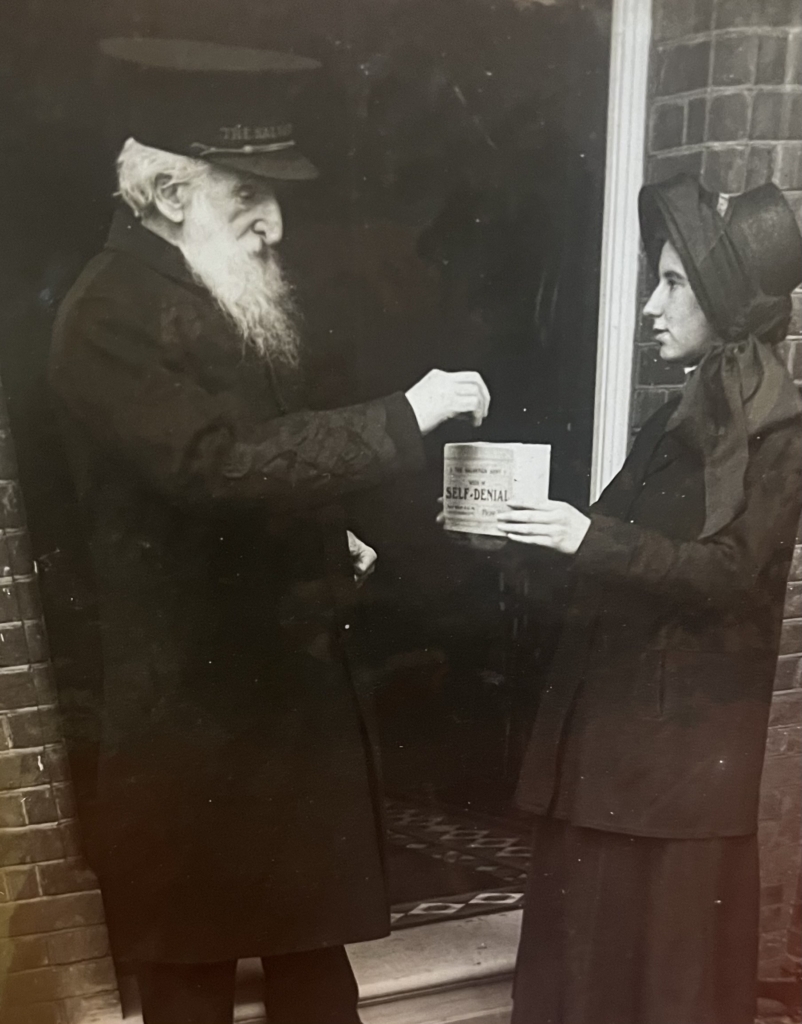
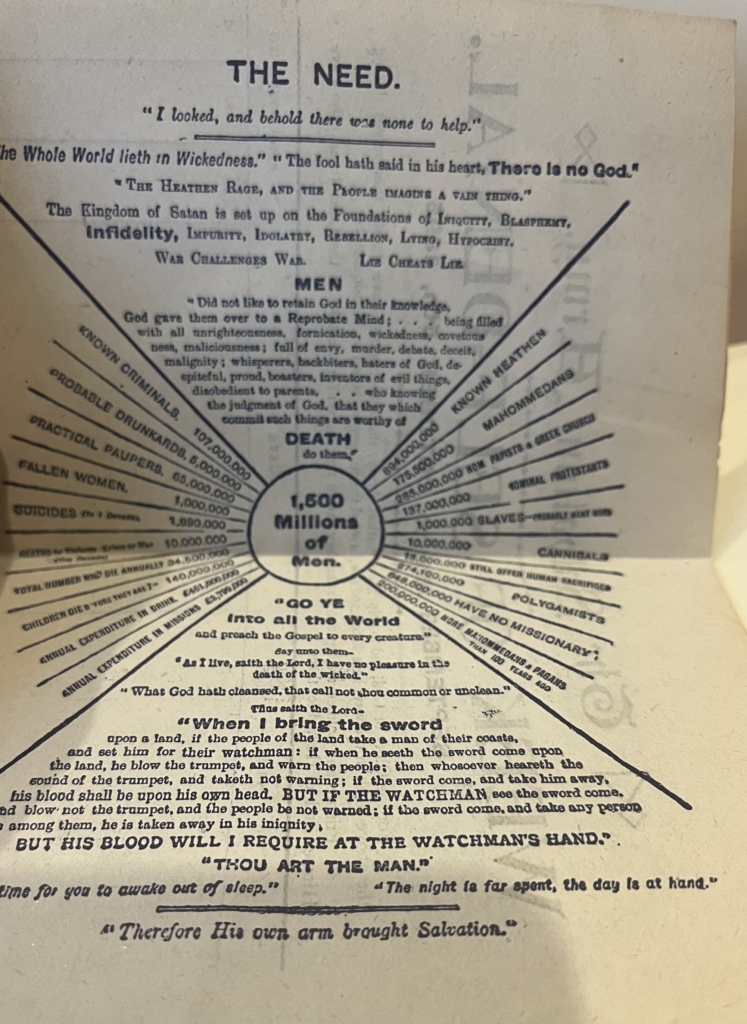
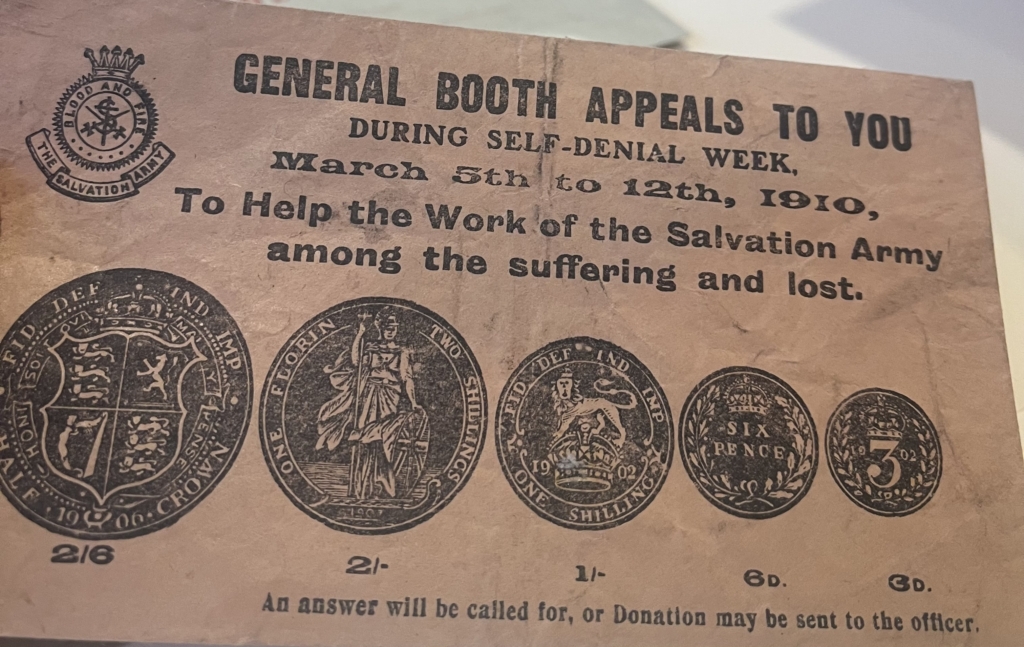
Alongside the red kettles the other most notable campaign is the annual Self Denial Fund. Which began in 1886, when John Aiken Carleton could not donate a big gift, but decided to give up puddings and donate the money saved to the Salvation Army. This became an annual campaign which all soldiers were asked to participate in and recruit others to donate to funds at the same time. And again, continues to this day.
What fundraising fundamentals do we see at work? Why do they work – now and then?
1. Use the latest technology
Fundraisers have always adopted and used the latest technologies to raise money in new and creative ways. So now we might be thinking about how AI, ChatGPT or the latest social media viral video can be used to gamify our fundraising.
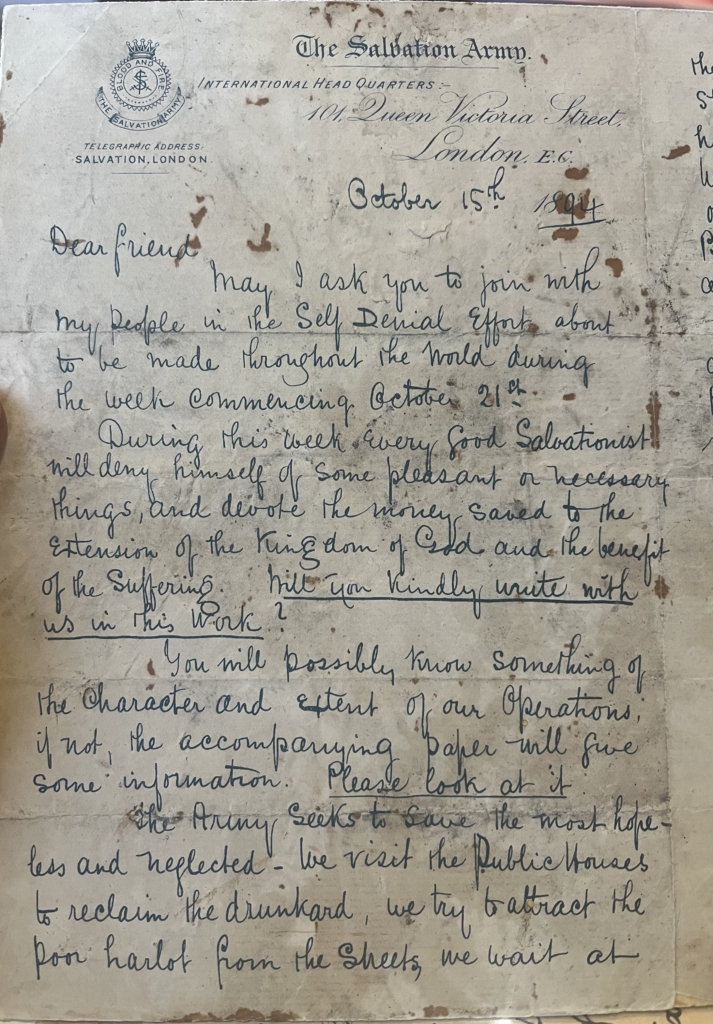
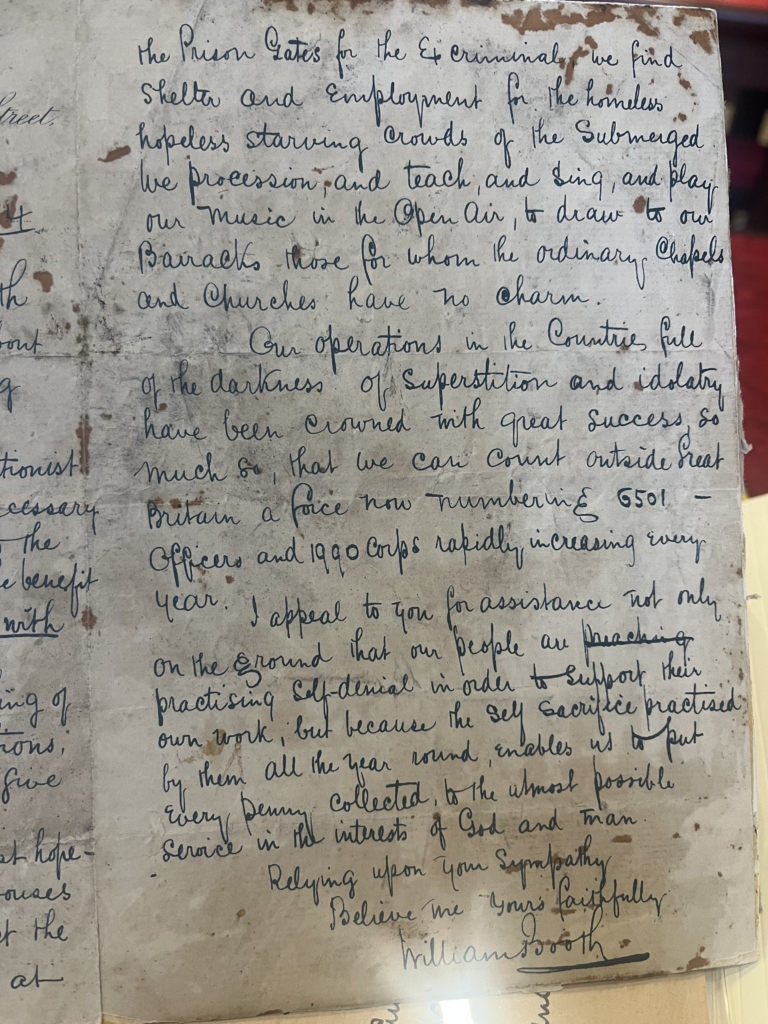
In Victorian times it was no different. The Salvation Army grabbed the opportunity presented by the new photolithography machine. Basically this was an early form of photocopying and it allowed you to make cheap and effective copies of appeal letters.
So that the appeal letters that they sent looked like they were handwritten to you from General and Catherine Booth, the two leaders of the Salvation Army.
General Booth 1894 Self Denial Fund appeal letter The photolithograph captures his handwriting and brings the personal touch
Seeing the copies of the letters in the archives it is hard to believe that they are not really handwritten – they are a blue inky colour (it is tempting – but I didn’t- to lick your finger and smudge it to see it is a really written in ink). So they do really look like a personal appeal.
We are all attracted by the novelty and using the latest technology can make our appeals go further and also entice donors to the cause.
We also pay more attention to handwriting rather than just printed text – it stands out and catches the eye and therefore the attention of our supporters.
Making a direct appeal letter stand out
Underline – emphasising something and making it stand out more for the reader. Like any good direct mail fundraiser General Booth uses it sparingly to add stress to phrases and sentences.
The lines Booth underlines in the 1894 appeal are ‘Will you unite with us in this work?’ and ‘Please look at it’ referring to the leaflet associated with it.
The use of the underline also helps make it easier for the reader to process the information. We tend to lazily scan words and the underline makes us pause and pay attention. It breaks up a big block of text.
2. Donor centric language – it is not about ‘we’ the charity but about ‘you’ the donor
General Booth was an early adopter of using donor centric language (perhaps he went through an earlier draft and changed the ‘we’s into ‘you’ as fundraisers are schooled to do).
The 1905 letter says
“But you are more than an heir of heaven and a traveller to the eternal city. You are a partner with me in the fight. You are a soldier of the cross …. You will not disappoint your general”
There are notably more ‘you’s in the copy than ‘we’.
Donor centric and emotive language that really draws on the reader’s religious and personal identity and connection to the cause. How do you make it about them? And why they should support you?
3. Cases for support: Appeal to the heart and the head
We all know you need a different case for support for each donor.
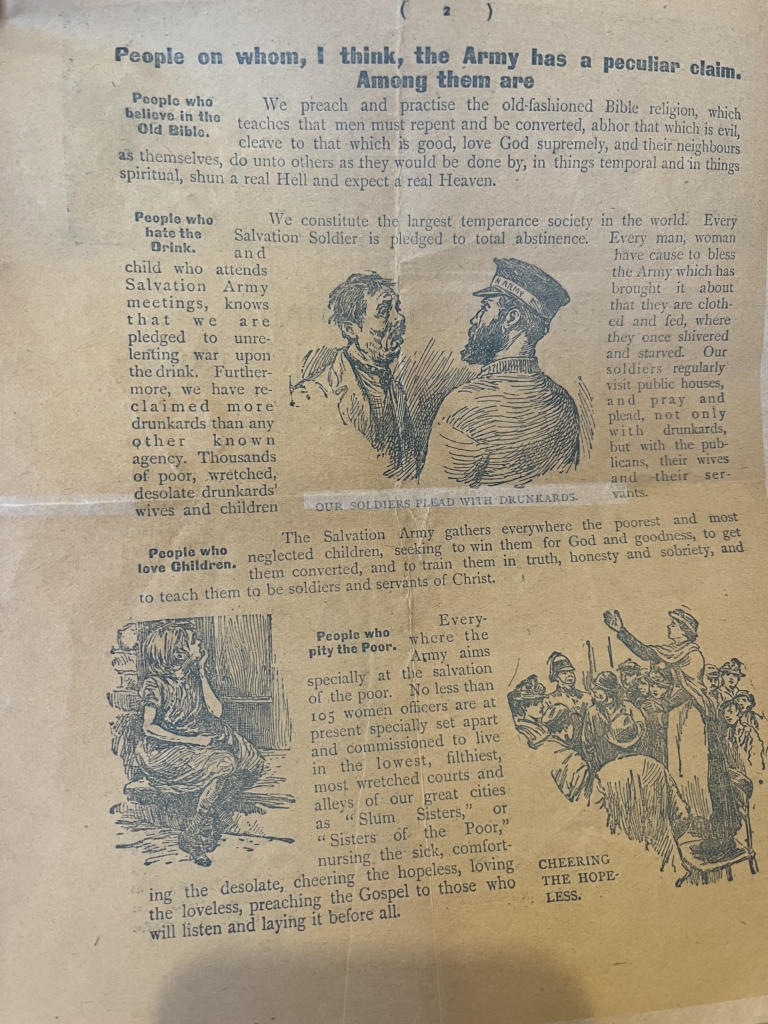
The Salvation Army Self Denial leaflet gets around this by printing each of the areas that you could be concerned about – ‘People who believe in the Old Bible’, ‘People who hate the Drink’,’ People who love Children’ and ‘People who pity the Poor’. Each of these then presents a case and detail of the work in that area.
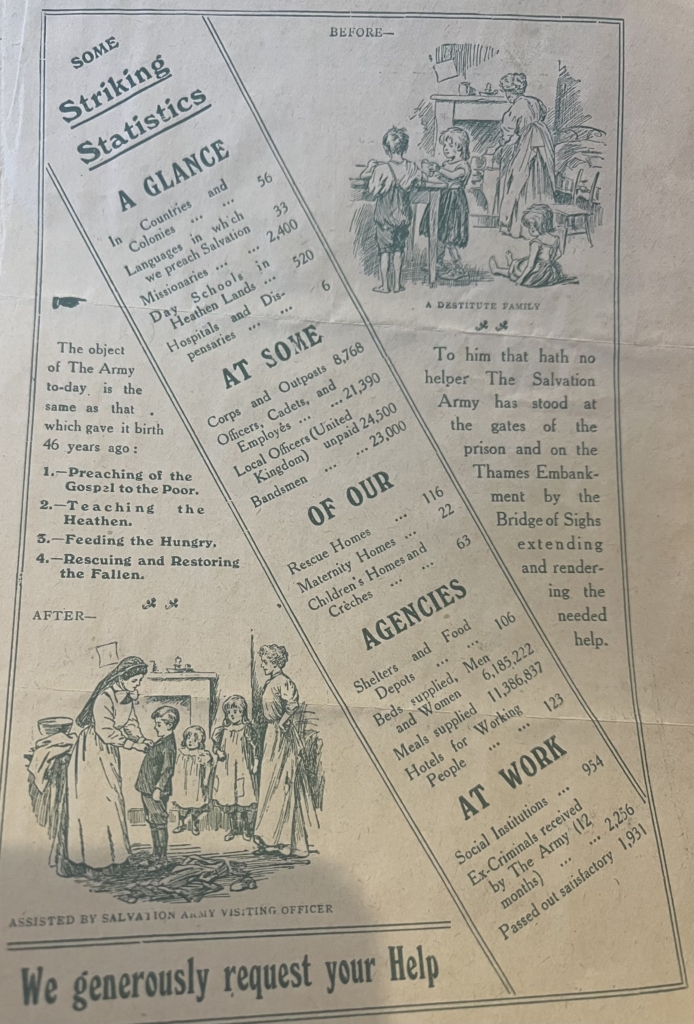
Cases for support Statistics and impact
If you are not so visual, or attracted by these cases, there are also detailed statements of impact, reach and numbers for the more quantitative data driven donor!
Sometimes you need to write a special case for supporter for a very distinct target market, in 1904 a female Salvation Army officer in Sweden wrote appeals in Latin to flatter her male undergraduate students
Cognosce te scopum forum
4. You want to run a good campaign – you’d better be organised
If any charity could organise with military precision it was the Salvation Army. They utilised their military structure, branches and publications to regularise, systemise and approach campaigns and fundraising with rigour.
The annual Self Denial Fund was the most dominant campaign which they through all their administrative might behind.
Be prepared with the print
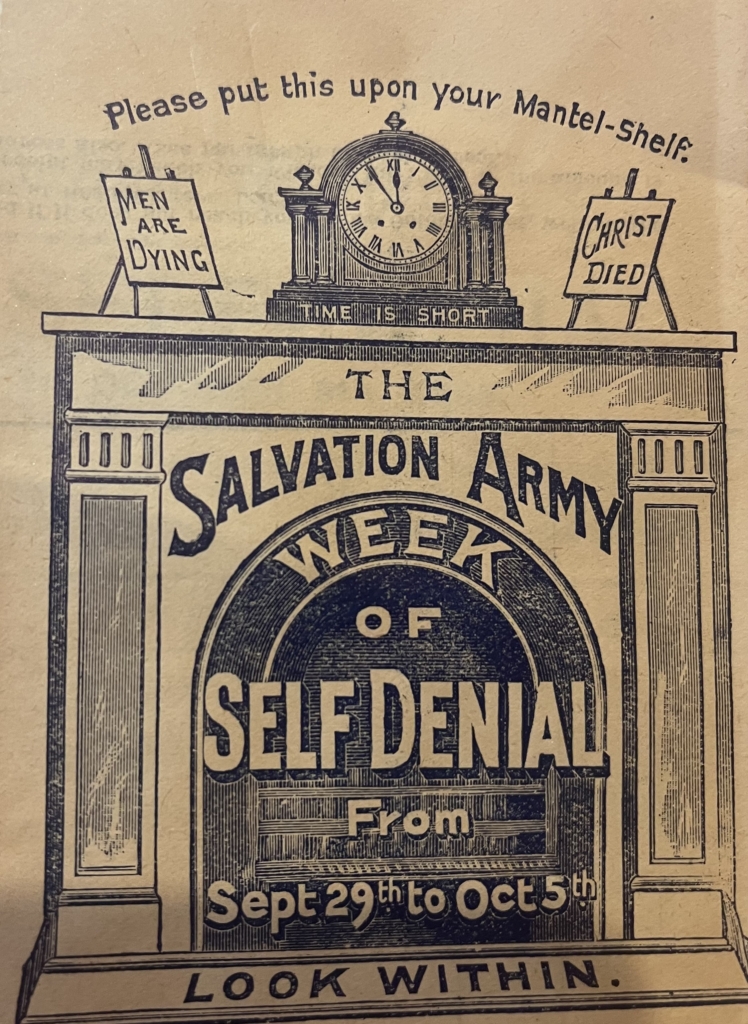
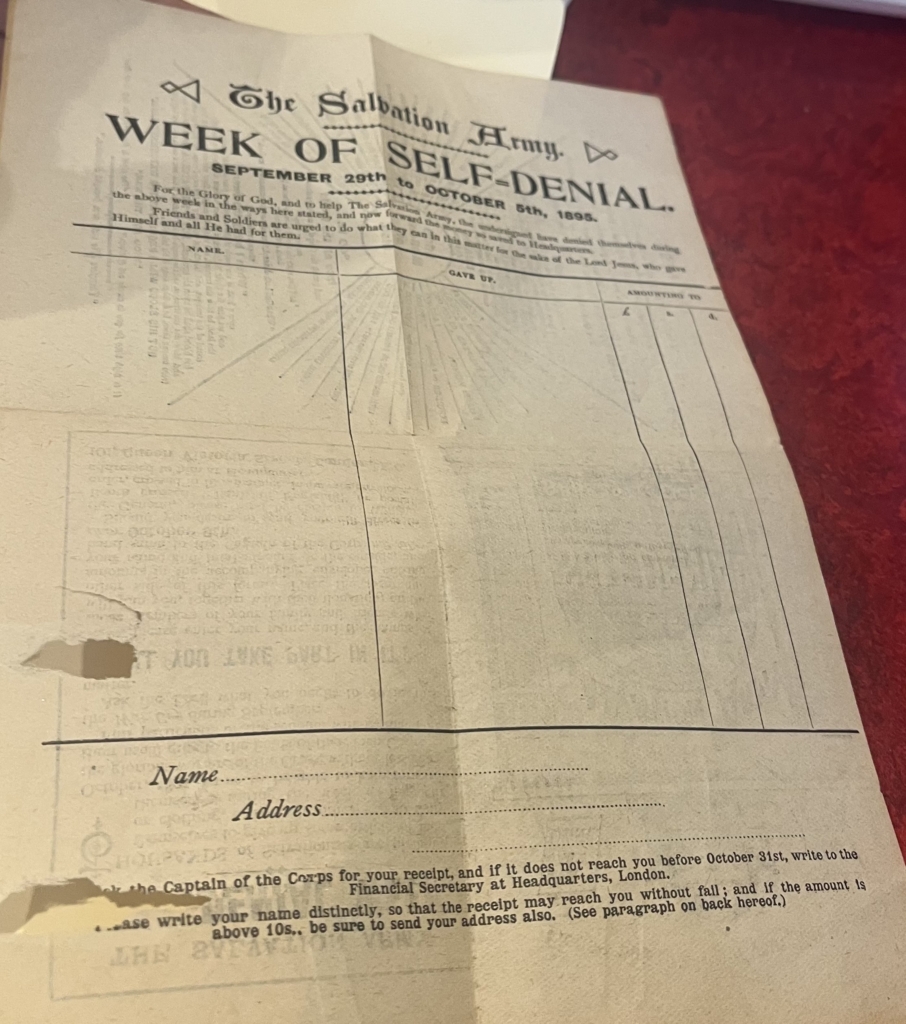
Self Denial Appeal 1895 Front CoverFold out inside to detail what given up and contribution Need and impact
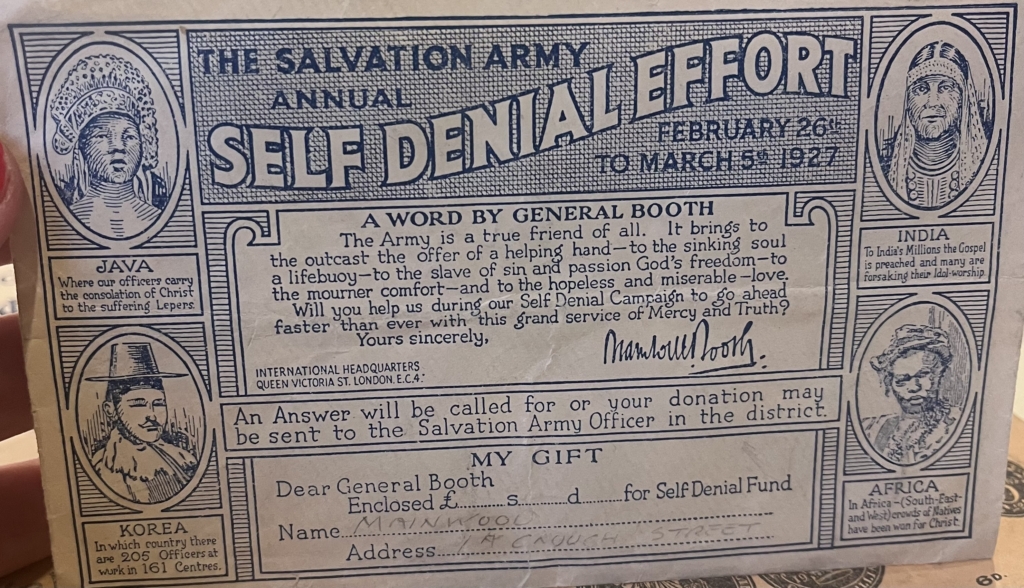
Printing had become cheap and easy so there is collateral for every part of the campaign. There were promotional leaflets for Self Denial Effort with attractive picture covers, printed forms inside to detail what had been given up and what raised and impact statements.These were supported by forms for fundraisers, envelopes and receipts.
Self Denial Fund envelope 1919Self Denial Fund envelope 1927
Have a campaign plan
Day by day guides were published in The Officer monthly magazine about how to prepare and what to do each day of Self Denial Week e.g. Thursday reads ‘The week is now drawing to a close. Look up weak ones, visit best friends, take out band with some novel contrivance’
There are strategic plans to draw up how much you will raise from each mechanism – envelopes, pictural receipt books, salary sacrifice. And suggestions to put the previous years total prominently on the wall so you can check in on how you are performing against target.
And even plans that divide up each road in each area and how many houses it had and how many collectors were needed for door to door collections in each road.
Promotion is key
The Officer is full of guidance of how to make the most of advertising your campaign. Deliberately borrowing from commercial marketing techniques suggestions include using empty shops, a hand cart, sandwich boards and sample press releases are included. They even suggest going to factories with a collecting tin on pay day to maximise donations.
5. Build the thank you into the campaign and make it memorable (or even collectable!)
We all know how important it is to say thank you to our donors for their support and leave them feeling appreciated.
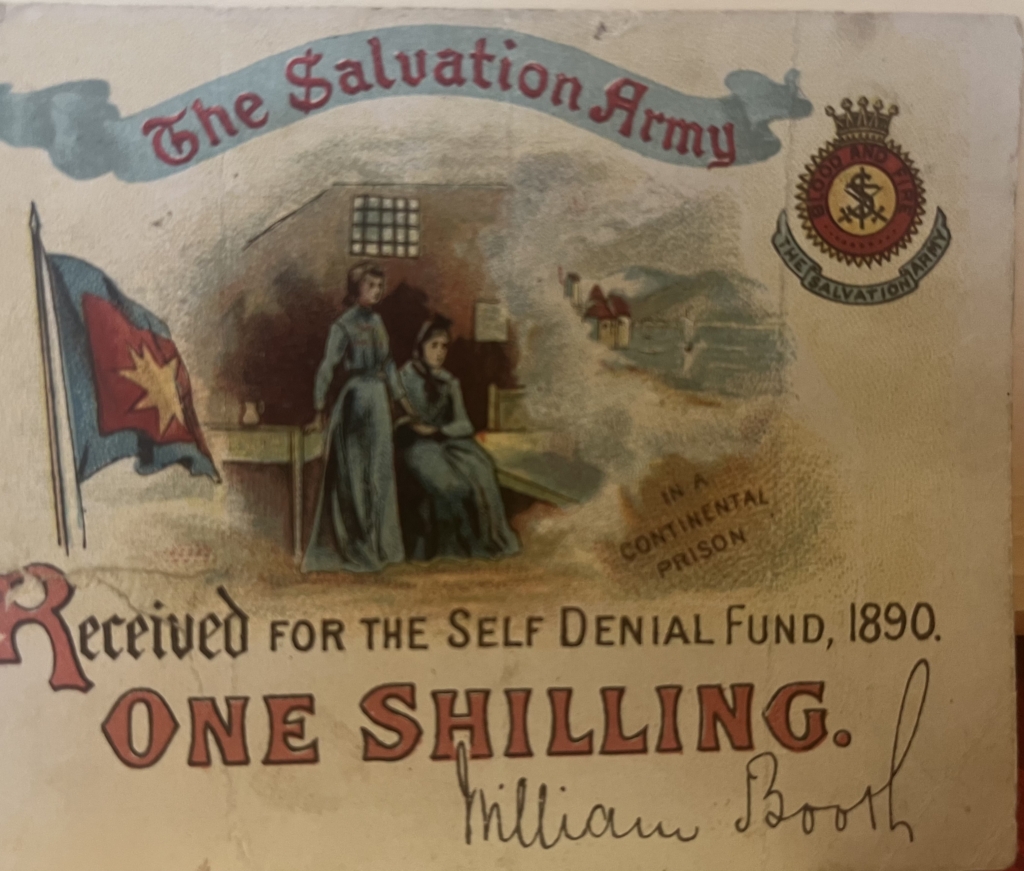
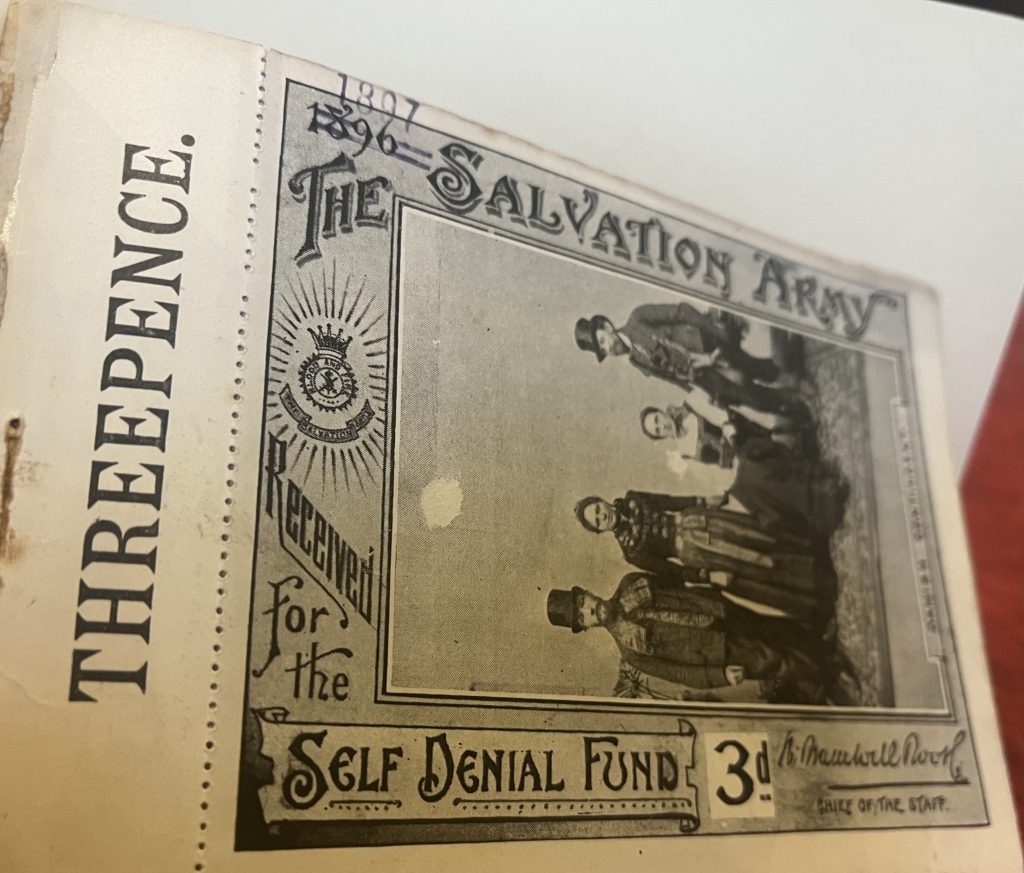
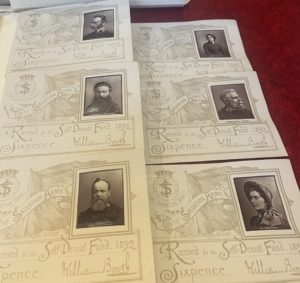
Each collector was armed with a receipt book that they could give on receipt of a donation – some were plain white receipts and some were pictural. Each year the images on the picture receipts varied. In 1892 the receipts all had a sticker that could be fixed on of the celebrated Salvationists – it feels a big like collecting football stickers or Lego cards that you need to get the whole set. Interesting to note the majority of these do not include the word ‘thank you’ – they just say ‘received one shilling’.
1890 ReceiptPicture receipt originally 1896 but crossed out and reused in 1897 1892 Receipts – collect your favourite Salvationist
(How dull most modern receipts are)
These receipts were replaced by thank you book marks which are described in the appeal packs as to be left with donors as their ‘medal for caring.’
How do you build the thank you into your campaign planning? How do you make it memorable? You can imagine these pictural receipts displayed in homes. How do we continue the joy of giving with the thank you?
6. Value every gift
The guidance for the Self Denial Fund recognises that not everyone can give cash. It suggests that soliciting fundraisers even accept postage stamps to support the campaign saying ‘Many will give one or two postage stamps when they will not give money’.
Every little helps.
How can you value any contribution to your work?
7. Don’t forget to ask those who you help
In 1891 an ‘Out of love’ campaign targeted former residents of Salvation Army homes, inviting them to give a one penny a week back to repay some of the ‘toil, the care, the love and the expense which has been so freely and gladly expended on them’. If they gave enough they were gifted a Bible and their name was inscribed on the roll of honour.
Often charities shy away from asking those that have benefitted from the charity’s work to be involved in supporting it (not so much in the arts where audiences are asked.) This provides a small but meaningful way for those that have been impacted by the work of the charity to help. Giving back and saying thank you are often strong motivations for giving.
Whose life has changed because of your charity’s work and how can they be invited to join the supporter family?
8. Make it easy for people to do what you want them to do
The concept of self denial can feel too vague for some, so in 1889 a ‘Special Hints for Self Denial’ pamphlet was produced listing all the practical ways that you could participate. Examples were given of donating one day’s salary, buying less expensive food, put off paying for new clothes, walk and not using public transport. The funds could then be donated to the Salvation Army. It makes it easier to do.
Vague concepts put an additional cognitive load on our over stretched and lazy brains and too much to think about decide stops action. Make it easy for your supporters to know how to help.
How can you make it easier for them to do what you want them to do?
9. Show don’t tell
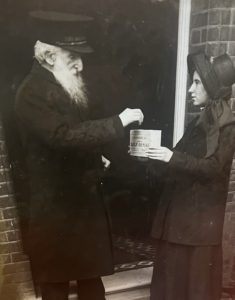
Postcard used to raise funds 1890s depicting General Booth making a Self Denial Fund donation
In an early ‘show don’t tell’ example we have a postcards of General Booth and other Salvation Army soldiers donating money into a Self Denial Fund box. Literally showing people what you want them to do.
(the earliest example of a self denial campaign was in 1209 when the canons of Angeirs Cathedral sacrificed the cost of feasts to support the capital campaign to build the cathedral)
How can you show your donors what you want them to do?
10. Mission matters but so does money
“there is nothing next to definite spiritual work, of greater importance that raising finance’
The Officer 1893
This mission is important but cannot be completed or attempted without the funds to back it up.
Has anything changed?
So from a 1891 idea for a red kettle that is still used today (hey, if it ain’t broke, don’t fix it).
Much in fundraising doesn’t change
The need for good planning
The importance of thank yous
It is about them – not about you the charity
Make it easy for your supporter to know what to do
Show don’t tell
Don’t forget those that benefit
You cannot do good without money to do it with
It all feels very modern, and the changes that were made in the late Victorian period are seen in many ways that we fundraise today and in the innovative spirit of fundraisers.
The Salvation Army saw itself in direct competition with consumer market and so used the same tools and marketed “compassionate consumption”(Roddy, Strange and Taithe). They, along with other emerging brand charities like Dr Barnado’s, certainly embraced the advances in technology and the rise in mass fundraising communications.
They themselves recognised in 1893 the change that they were part of
“.. few organisations have been so successful in raising money as ourselves. This has been largely because we have set about it in a systematic, methodical, businesslike manner …. Our methods for raising money have been and are almost innumerable, the military nature of our organisation enabling us to act together with a uniformity and precision which to others would be almost impossible”
The Officer, 189
This ‘systematic, methodical, businesslike manner’ has ripples today in how we approach fundraising. The approaches introduced by them and others like St Barnado’s advanced the professional practice of fundraisers and have been proved to be psychologically powerful and effective tools for persuading people to give money to support much needed work.
Did the ‘compassionate consumption’ approach mark a change in fundraising?
Did the adoption of commercial marketing and promotion raise more money?
Did the impacts of consumer culture, capitalism and technology change the essence of how fundraising was conducted? Away from the personal, dutiful gift, to a more mass produced and marketed machine which by its nature provided a more transactional (picture receipt anyone?) approach? Or in a industrial capitalist society were we always heading towards that?
Background on why this blog came about
After reading ‘The Charity Market and Humanitarianism in Britain 1870-1912’ by Sarah Toddy, Julie-Marie Strange and Betrand Taithe and learning all about all sort of interesting fundraising activities and methods I visited the Salvation Army archives in Denmark Hill. Interestingly the fundraising was all run from the Public Relations office and they have an archive of early fundraising examples from the 1880s through to more modern times. Fascinating to see. Like many archives it is a bit patchy and speaks to the issues of how we preserve and archive what is important.
Watching Lessons in Chemistry on TV after reading the Bonnie Garmus’ brilliant book last year, made me reflect on the importance of the scientific method and rigour in our fundraising when testing and exploring the behavioural science, heuristics and nudges that we use.
Elizabeth Zott demonstrates in her research the need to be constantly testing, learning, and refining what we do in order to strive to get better results. For Zott cooking is chemistry and on her TV programme Supper At Six she urges tells viewers ‘Don’t be afraid to experiment’ and ‘Take risks’
So what applying a scientific method that look like in fundraising using a decision science approach.
This is the traditional scientific enquiry method:
Ask a Question
Hypothesis – predict what the answer to the problem is and what your difference your intervention will make
Test with an experiment– design a test to confirm or disprove a hypothesis
Analyse your results – record what happened during the experiment
Conclusion – was my hypothesis correct? What have you learned?
Change a variable
Test again
Analyse again etc.,
So how might that work for a campaign?
Ask a Question – How can I encourage more supporters to leave a legacy?
Hypothesis – if I use a messenger with authority with the charity this will drive legacy pledgers and enquiries
Test with an experiment– design an appeal letter from this authority figure and test with a segment of your database
Analyse your results – look at the response rate, click through, open rate, enquiries
Conclusion – was my hypothesis correct? What have you learned
Change a variable and create a new hypothesis – if I use a messenger who is a peer like them will this drive legacy pledges
Test again & anaylse again & test again
Think about all the questions and tests that you can do
If I use messenger who is a peer and evoke a social norm and and add an incentive is that more or less effective?
If I use an authority messenger and the scarcity principles is that more or less effective?
If I use a beneficiary as a messenger to talk about legacies is that more or less effective?
If I use the reciprocity principle and give a gift to potential legacy supporters, is that more or less effective?
Remember to test one thing at a time, or with each segment of data so you can see which intervention is having an impact.
As well as invoking the scientific method, Elizabeth Zott’s other advice is:
Don’t be afraid to experiment
Take risks
Sometimes because our organisations are so reliant on fundraised income we can be afraid to try something different or take risks in our fundraising. Fundraisers cannot just rely on what has worked (or not) in the past, or what is perceived to work in their sector. Many of these tiny changes are small and easy (or free) to apply and test. And tests don’t have to be big – or don’t have to be with the whole appeal – they can just be with a small segment to give you some real world data of what works with your audiences.
So lessons from Elizabeth Zott for fundraising
Fundraising is chemistry
Take risks
Don’t be afraid to experiment
https://marinajones.uk/wp-content/uploads/2023/10/IMG_9016-scaled.jpeg25601920adminhttps://marinajones.uk/wp-content/uploads/2022/12/f2b903e010104f5aa61ea1821a685913.pngadmin2023-10-30 20:13:032023-10-31 08:08:04Lessons in Chemistry – Fundraising & Decision Science
“wills are not only legal documents but also personal stories and lasting legacies. They are personal narratives and direct instructions.”
Tyrone McKinley Freeman
Madam C J Walker was a noted philanthropist, activist and business entrepreneur becoming American’s first self-made female millionaire. Her will has often been used to discuss her attitude and approach to philanthropy, but the will only records the monetary gifts and her philanthropic approach was much broader than just giving donations – you can read more about her philanthropy here as “her life was her treatise on philanthropy”.
Looking through her will, here are ten things to think about in your legacy and in memory fundraising.
1. Giving as identity and looking back
When making a legacy gift to a charity, donors are often looking back over a lifetime and selecting the causes or charities that have been important, that have helped them and that they want to say thank you to and pay back in some way. The importance of family, faith and the causes Madam Walker supported in her life are well represented in the 19 charities that received charitable bequests in her will.
Supporting a charity in life is a strong indicator of where legacy supporters might choose to give gifts, but it is the ones that link with their personal story and life events that might be the stickiest. Madam C J Walker had been an orphan, widow and a poor washerwoman, supported fed and educated by a range of female led African American clubs and her in life and in death giving reflect these causes.
How do you connect with your donor’s life story? How can you empower to tell that story and connect their giving to you as part of their identity?
2. Looking forward – an extension of self
Legacy gifts are also about how someone wants to be remembered and the gifts in wills can be seen as “a desire to invest one’s substance in forms of life and work that will outlive the self” (Kotre, 1996) and extend the self forwards in the gifts being made. With the choice of charities to receive bequests Madam Walker was extending herself and her values forward.
What is your legacy vision? How are you helping a donor to extend themselves forward through the vision of your charity?
3. Wills – as public or private documents
In the UK we tend to think of wills as personal and private documents and do not ask legacy pledgers to disclose the details of what is in a will.
But a will tells a life story, and although a private document in life, on death it becomes more public and the contents known by the beneficiaries – family or charities.
Madam C J Walker knew that her will would be a public document and the distributions and gifts she chose to make public.
“women have historically used their wills to portray their respectability, honor and social status to society as well as to generate their public image”
Tyrone McKinley Freeman
There were deliberate choices about the charities and the bequests made that aligned with her approach to philanthropy and the causes that were important to her.
4. The power of codicil
When Madam Walker knew she was unwell in 1919, she amended her 1917 will with a codicil. She used this to add in additional pecuniary gifts to charities already supported but also to add in financial gifts to more charities especially those run by other African American women and less supported by other philanthropists.
Adding a codicil is a way to formally and legally add additional bequests to a will that reflect changes. It is useful for gifting money but not residual gifts (it messes up the maths!) As we can see from Madam Walker they reflect additional gifts to charities that she cared about in her life and how these evolved over her lifetime. Donors can also add a letter of wishes is a more informal way to capture the changes that they might wish to make. With either a codicil or a letter of wishes it might be a great way for a donor to add in a financial gift in their will.
5. Too much money can be an issue
Booker T Washington’s Tuskegee Institute received a legacy pledge but in her codicil she notes that because it is “so bountifully provided for” she will not add in another gift. At the time it had an endowment of $2million.
How can you show you need the money and will spend it wisely if you already have large endowments and funds?
6. You can’t always get what you want…
In her will, all of Madam Walker’s unallocated stocks and shares were gifted to create a Tuskegee Institute in Africa and if no such Institute existed at the time of her death then $100,000 was pledged to establish it. No such Institute did exist when she died and during probate this clause was deemed null and void because of it.
7. Ambition vs reality
Madam Walker wanted one third of her estate to go to charity but debts and Walker Company expenses meant that in the end only 10% went to the causes in the will.
Remember – you cannot count on the bequest gift until other items in the will have been given. With a residual gift this could work in your favour.
8. But if you try sometimes, you get what you need …
In her will she wanted to endow Villa Lewaro – her mansion – to be a “a monument to success” and give it to the NCAAP (National Association of the Advancement of Coloured People) as a memorial. Her will states she never wanted it to become an orphanage, old people’s home or school. The Villa was sold during the Depression due to rising costs and was actually used as an old people’s home. However, in 2018 Richelieu Dennis bought the villa and established an African American think tank there – Richelieu Dennis’s company Sundial had bought up the Walker Company.
Donors can sometimes suggest legacy gifts that cannot be honoured – if you can encourage discussions as they make your will you can discuss what might be possible and get them to work with legal representatives to look at how this is wording. Or you can work with executors after the will is enacted to find ways to honour the wishes and intentions and in keeping with the spirit of the gift.
9. Unknown futures
‘Mme Walker lives on in the organizations whose progress she forwarded’
Willard Ransom, Manager, Walker Comopany, 1952
When someone makes a legacy gift in their will they do not know what their gift will achieve or what will happen to the charity they support. At the time of her gifts her manager had concerns about her supporting the NAACP but she was believed in it. The Secretary of the NAACP Walter White said in the 1950s that ‘Madam Walker’s generosity virtually saved the NAACP in the dark days of depression.’
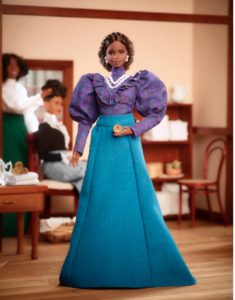
Madam Walker was immortalised as a Barbie
Sharing and celebrating what other legacy gifts have helped your charity to achieve can normalise legacy gifts and make people realise that it is usual to leave gifts to your charity. They can also demonstrate the impact that gifts like these can have way into the future.
10. In memory fundraising & donor recognition
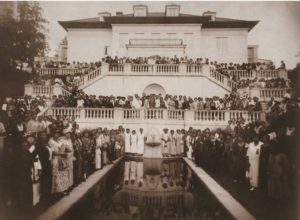
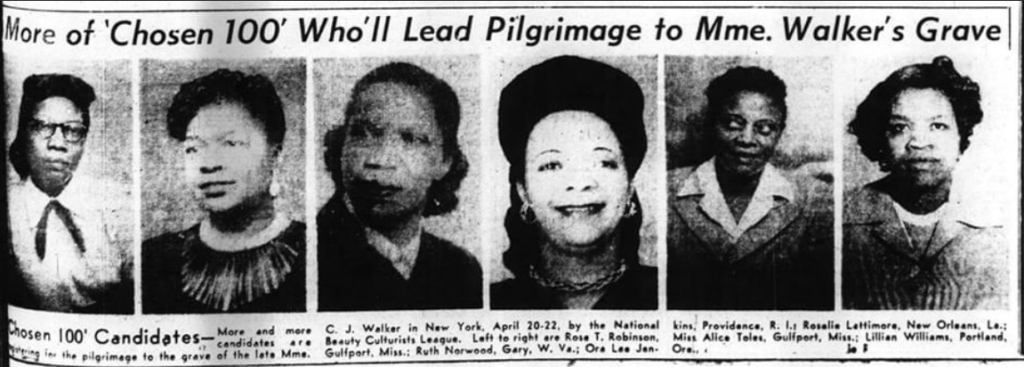
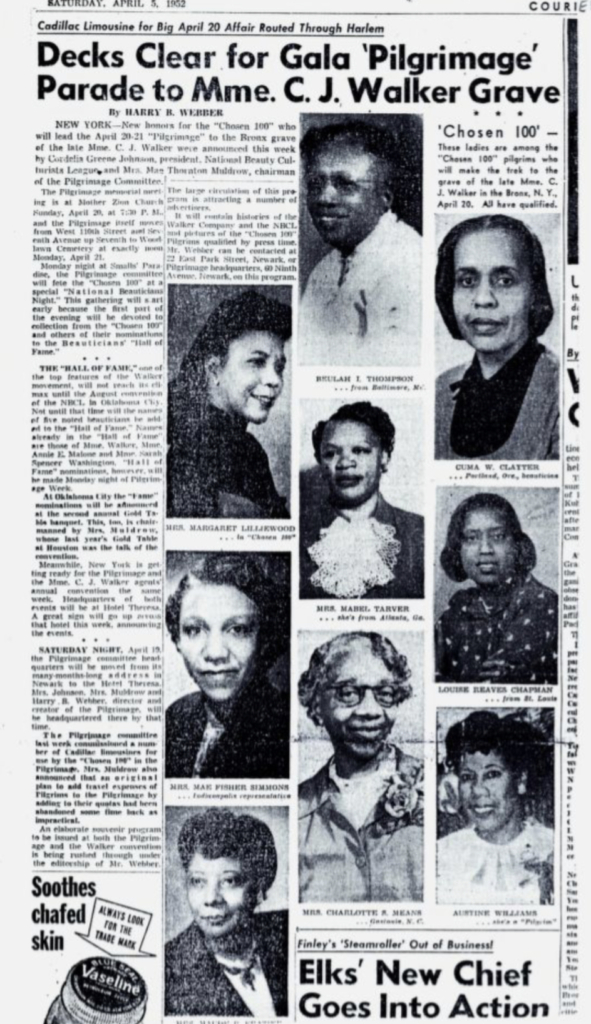
In 1952, 33 years after Madam C J Walker had died a 4 day celebration of her life and work took place with a pilgrimage to her grave. This memorial was in itself a fundraiser, and it had the aspiration to pay off the mortgage of the National Beauticians Home in Washington. At the front of the procession to the tomb were the ‘Chosen 100’. One hundred women who had raised at least $100 to support the event. They wore insignia and sashes – the more stars they had on the sashes the quicker they had raised the money. Following the Chosen 100 were the Platinum, Pearl, Diamond, Gold, Silver, Copper, Red and Blue divisions – all categorised by how much they had made.
Raising funds to complete a legacy associated project of a loved one can be a powerful inspiration.
33 years after Madam Walker’s death was not using the hook of an anniversary ending in a 0 or a 5 – but an opportunity to fulfil an ambition
How can you ignite the passion they have to do more and get involved?
How can you give you donors status and recognition?
How can you group them together as like-minded people? Is a legacy club a good idea?
Those that give in memory gifts for loved ones are more likely to make a gift in their own will how can you help donors celebrate memories of loved ones and bring them closer to what you do?
https://marinajones.uk/wp-content/uploads/2023/10/IMG_9008.jpeg950920adminhttps://marinajones.uk/wp-content/uploads/2022/12/f2b903e010104f5aa61ea1821a685913.pngadmin2023-10-27 10:19:172023-10-27 10:19:1710 things legacy and in memory fundraisers can learn from Madam C J Walker
So a few fundraising and philanthropy examples featuring or inspired by libraries, including:
Legacy gifts
Naming rights
Campaign publicity
Donor crediting
New funding models ensuring long term support
Early grant application forms
And inevitably Andrew Carnegie
Earliest library gift
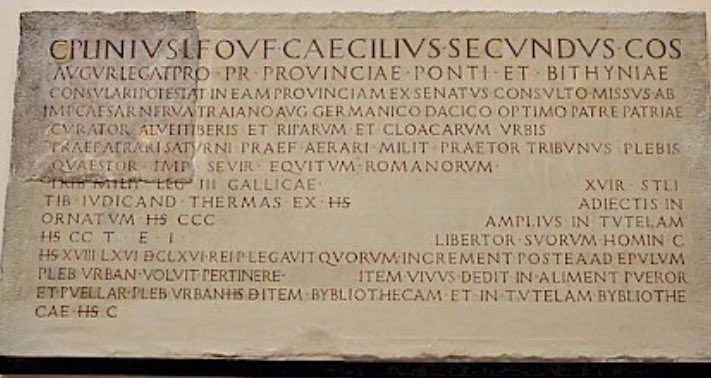
Pliny the Younger, a first century Roman letter writer, lawyer, author, magistrate and sometime philanthropist, is the first noted library donor. He donated over 1,600,000 sestertii to construct the library at Como with additional funds to maintain it. Like many funders, he paid in instalments with the largest 1,000,000 sestertii to fund the building but also made maintenance instalments (always important to convert capital donors into revenue ones.)
Pliny’s will details his bequests for the public good including gifts to the public baths and their upkeep (we like a legacy bequest that comes with maintenance costs.) In his will, he also supported Freemen of the city which included spend on an annual dinner. The will does not include another gift to the library but notes his life time gifts which included 100,000 sesterii for the upkeep of the library.
Copy of Pliny’s will
Naming rights
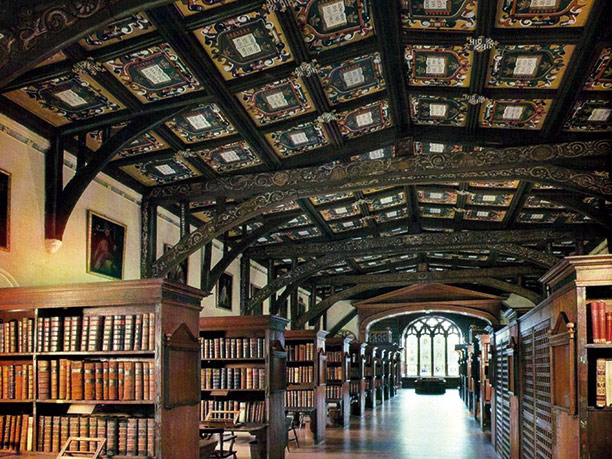
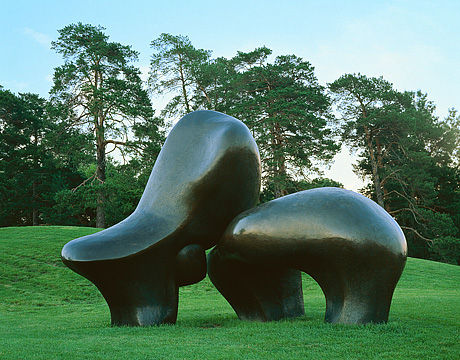
The Bodleian in Oxford is named after its founder and patron – Sir Thomas Bodley.
Sir Thomas re-founded the library in 1602. The first Oxford library had been founded by a 1327 legacy gift from Bishop of Worcester, Thomas Cobham. Through patchy patronage it was maintained for a century but in fell into disrepair until Sir Thomas offered to develop the library – with assistance from his recent fortune from a marriage to a wealthy widow, and Oxford dons the library was reinvigorated. Officially Bodley’s Library it became known as the Bodleian.
To secure support for the library, Bodley created an early form of a ‘Friends of’ with a Vellum bound book that was a ‘Register of Donations.’ This book was kept on prominent display so visitors could not miss it, but was also used to record all donors and their gifts. He wanted this register “to stir up other men’s benevolence to help furnish it with books”. He also used an element of fear in soliciting gifts – so soon after the Reformation and various book burnings – donating books to this new library was a way to keep them safe.
Bodley had the Librarian, Thomas James, greet all visitors and introduce hem to the Library which encouraged making a gift.
This personal welcome and the chance to have the donation recorded in the ‘Register of Donations’ proved so popular that he had to become a bit more selective about recording donors in the register – saying they would need to ‘better their gifts’ if they wanted inclusion.
Bodleian Library
Interestingly he also refused donations of ‘riff raff’ books which included ‘modern’ works such as Shakespeare!
When he died, his will also included a legacy gift of £7,000 gift towards the library – disappointing friends and family who had expected to be more kindly remembered.
(It is interesting to note that the founding of the library comes at the time of the new Statute of Charitable Uses of 1601 which codified charitable purposes especially for the ‘relief of aged, impotent and poor people’ – when so many were concerned with the poor it is interesting to see that Thomas Bodley focussed learning and a library – a criticism that was levelled at Carnegie and Rockefeller 300 years later!)
Running a campaign
In the 1731, American Founding Father Benjamin Franklin ran a public subscription scheme to fund the Library Company of Philadelphia. This was to be a subscription library where his literary set, the Junto – a group of “like minded aspiring artisans and tradesmen who hoped to improve themselves while they improved their community“.
Before he embarked on the fundraising campaign for the library, he used a newspaper publicity to raise awareness and educate the public.
He was also one of the first to use donor segments dividing his prospect pipeline up into – likely to give, might give, and others. He always wanted the person soliciting the gift to fade into the background and that gifts be seen “not as an act of mine but of some public spirited gentleman.”
Founding Fundraising
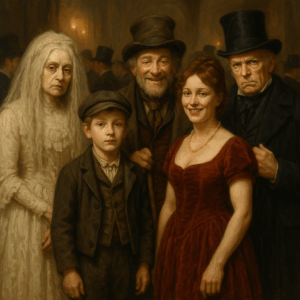
In 1872 to raise funds to found the Los Angeles Library a Dickens Party was held where participants dressed up as their favourite Dickens character. The funds raised purchased the first books of the library including Hints to Horse-keepers and On the Sheep Industry.
A ChatGPT created image of what a Dickens party might look like
Andrew Carnegie
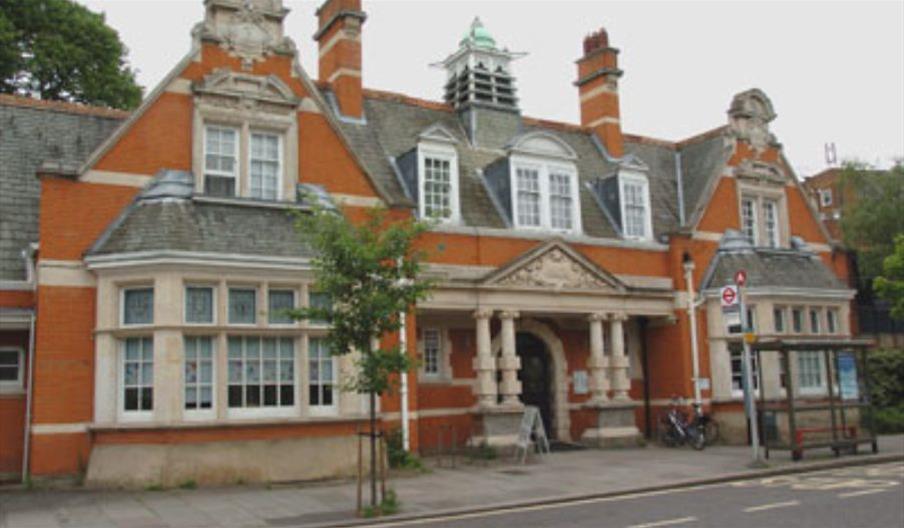
Hands up who had a Carnegie library in their home town? Here was my local.
Teddington Library – one of 2,500 Carnegie libraries built
There were over 2,500 built in the UK, US but also in New Zealand, Mauritius, Malaysia, Fiji, France, Belgium and Serbia.
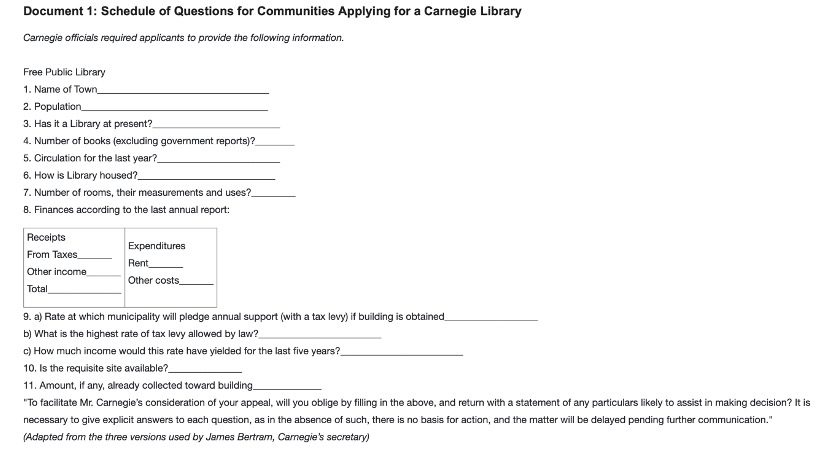
Carnegie invested over $56.2m into the construction of the libraries – but the funds were not just handed over to towns to create a library. Carnegie wanted the each recipient town to demonstrate the need for the library and commit to the ongoing cost of maintaining it. Towns who were interested in having a Carnegie library had to submit a proto grant application form with a schedule of questions to answer including demonstrating need, that they have a site ready for the library and can provide annually 10% of the cost of the library’s construction to support its operation.
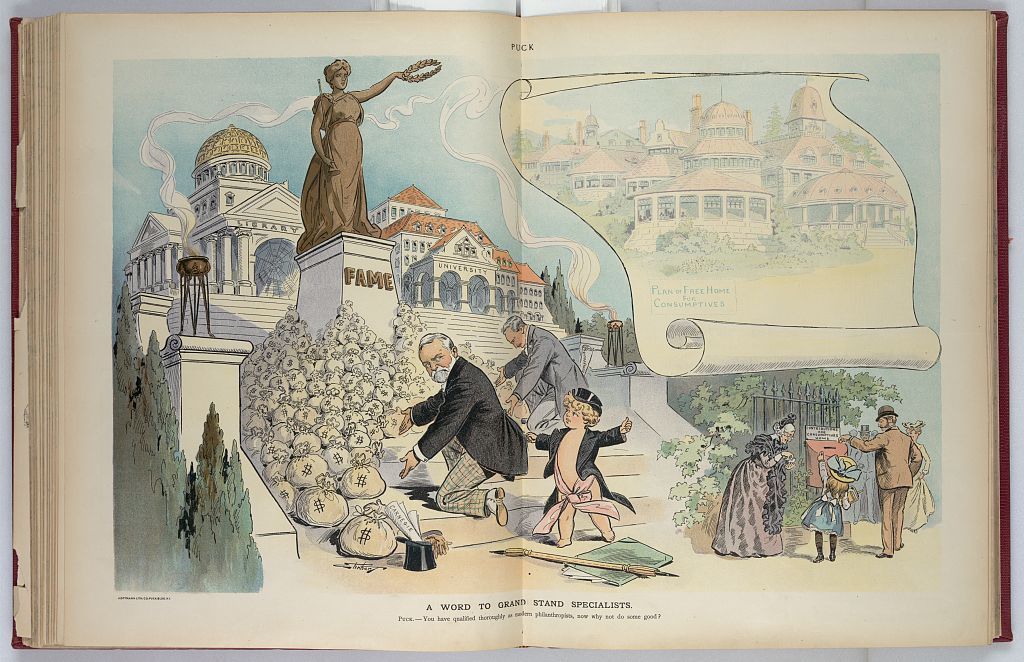
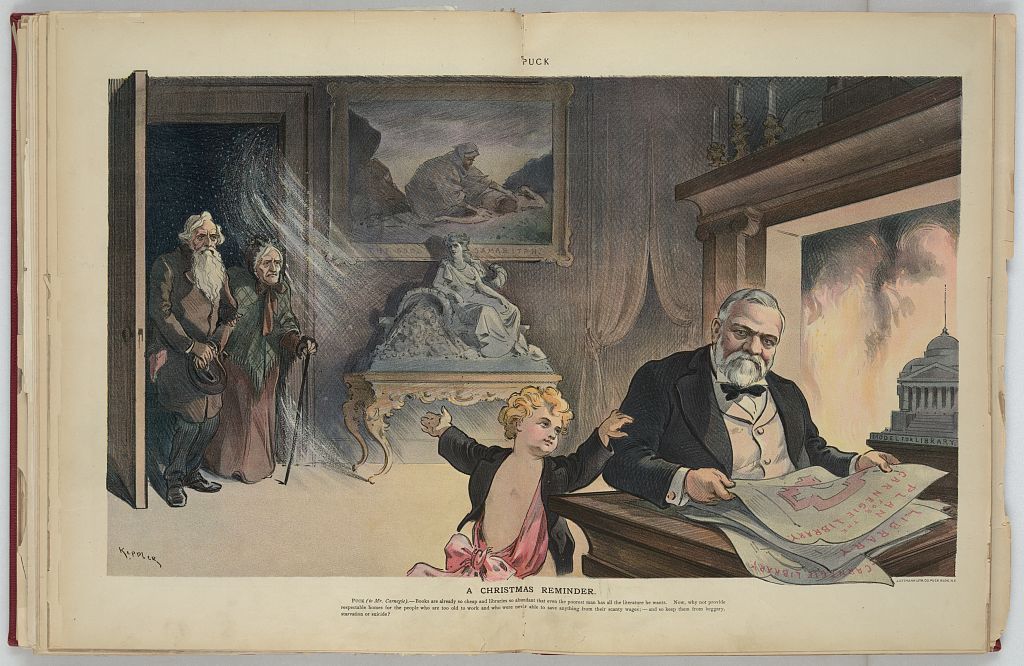
Carnegie was often criticised for prioritising libraries and building his philanthropic legacy over helping those that who were hungry and in desperate need. See these cartoons from Puck magazine:
Carnegie’s plans and approach led to libraries being municipally and state funded rather than private philanthropic institutes. Interesting to see the impact of mega philanthropy influencing the enactment of public policy.
The investment that Carnegie put into libraries is cited as the main reason for the growth of female librarians as they needed more library workers and it was considered an appropriate profession.
In 1997 Bill and Melinda Gates followed this lead and aimed to get every US library onto the internet – once they complete this in 2002 they expanded the programme globally, founding the Global Libraries Initiative in 2004. In 2014 the foundation shifted focus to health and science programmes and tapered down the grant giving in libraries ending in 2018.
Libraries receive donations
Libraries often received bequests – most of the two thousand scores in the Los Angeles Library came from bequests including 752 scores from the founder of the LA Philharmonic William Andrews Clark Jnr and Meredith Wilson (writer of The Music Man) gifted his sheet music.
Victory Book Campaign
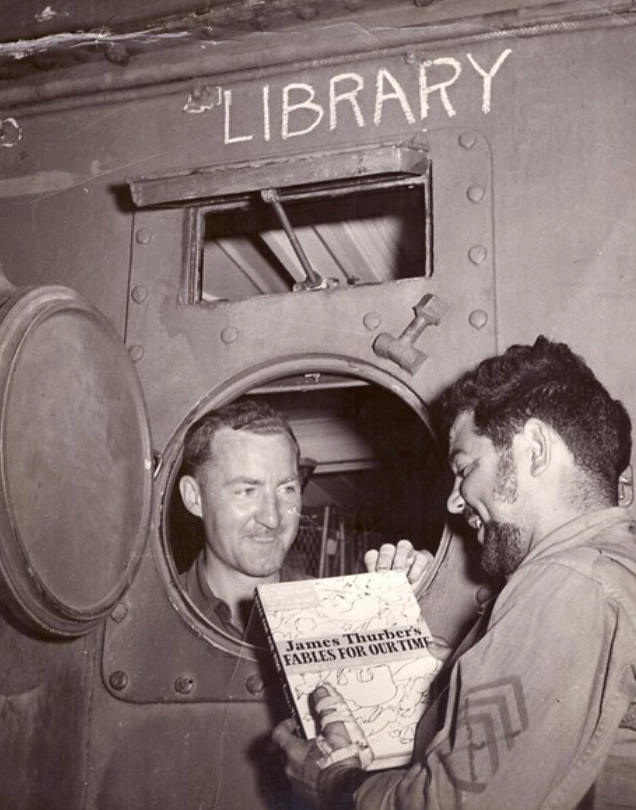
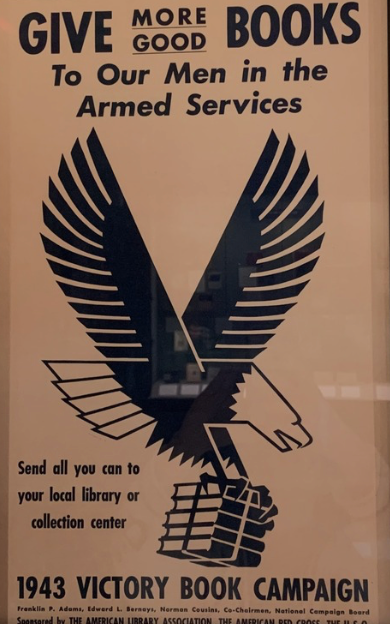
Throughout 1942/43 there was a Victory Book Campaign to send ‘Good Books’ to service men – they set a target of 10m and received over 17m (although not all were suitable). Read more about it here. The challenge with asking for donations like this is that they received unsuitable books – too many handbooks. too many people clearing out their shelves, too many beloved books that were not in the right condition to send abroad. We have a tendency to want to give stuff, and stuff that we care about when a tragedy strikes. Read more about our desire to give stuff not money here. As well as restorative and pleasant books to read, they also needed funds to purchase technical manuals – rare books that were donated were sold at auction to fund these purchases.
War is one of the worst things that can happen to books – an estimated 20m books burned in the UK or were ruined by water damage putting out fires. By the end of the war 1/3 of books in Germany were gone.
Researching the past
And libraries are also a fantastic place to find out about curious and not so curious bits of fundraising history.
Here are a few finds:
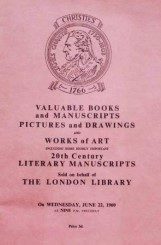
A celebrity and royal filled auction to save the London Library from bankruptcy in 1960. Items for the auction included
Barbara Hepworth painting
T S Eliot’s personally transcribed ‘The Waste Land’
Graham Greene & John Betjeman manuscripts
A silver coaster from the Queen Mother and a book from the Queen
£25,000 was raised at the auction at Christie’s to avert the crisis and clear their debts.
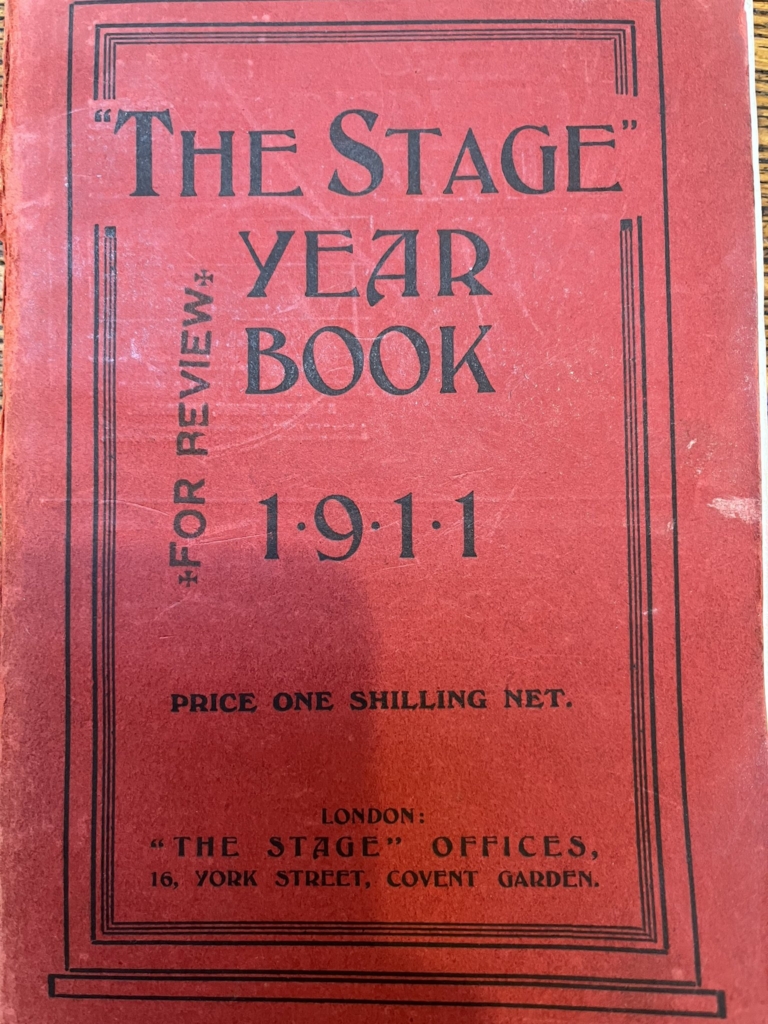
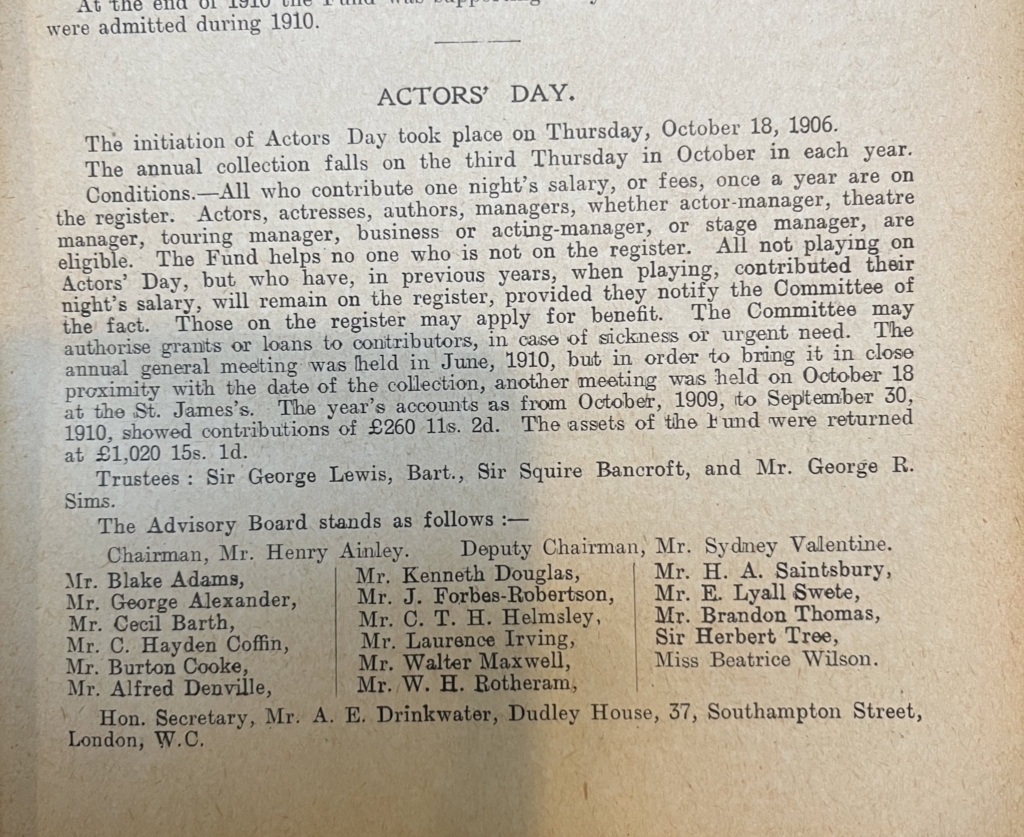
And discovered in the Bishopsgate Institute from The Stage Yearbook 1911 detailing Actors Day an annual day in October each year when actors, stage management and theatre administration donated one day’s wages to supporting others in the profession – a guild/mutual aid type of enterprise.
https://marinajones.uk/wp-content/uploads/2023/10/bodleian.jpg459612adminhttps://marinajones.uk/wp-content/uploads/2022/12/f2b903e010104f5aa61ea1821a685913.pngadmin2023-10-05 09:52:222025-07-26 21:35:12In praise of library fundraising & philanthropy
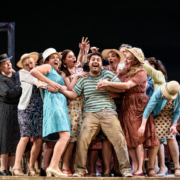
Then look no further that Donzetii’s gloriously fun and frothy opera L’elisir d’amore (The Elixir of Love)
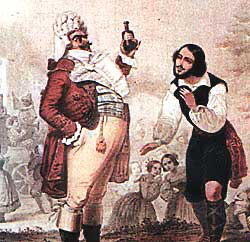
Would you buy a love potion from this man?
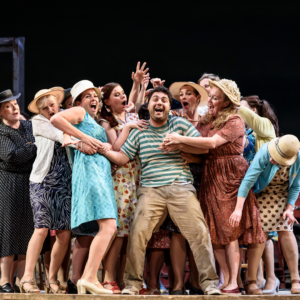
Could you fall in love with this one?
The plot begins …
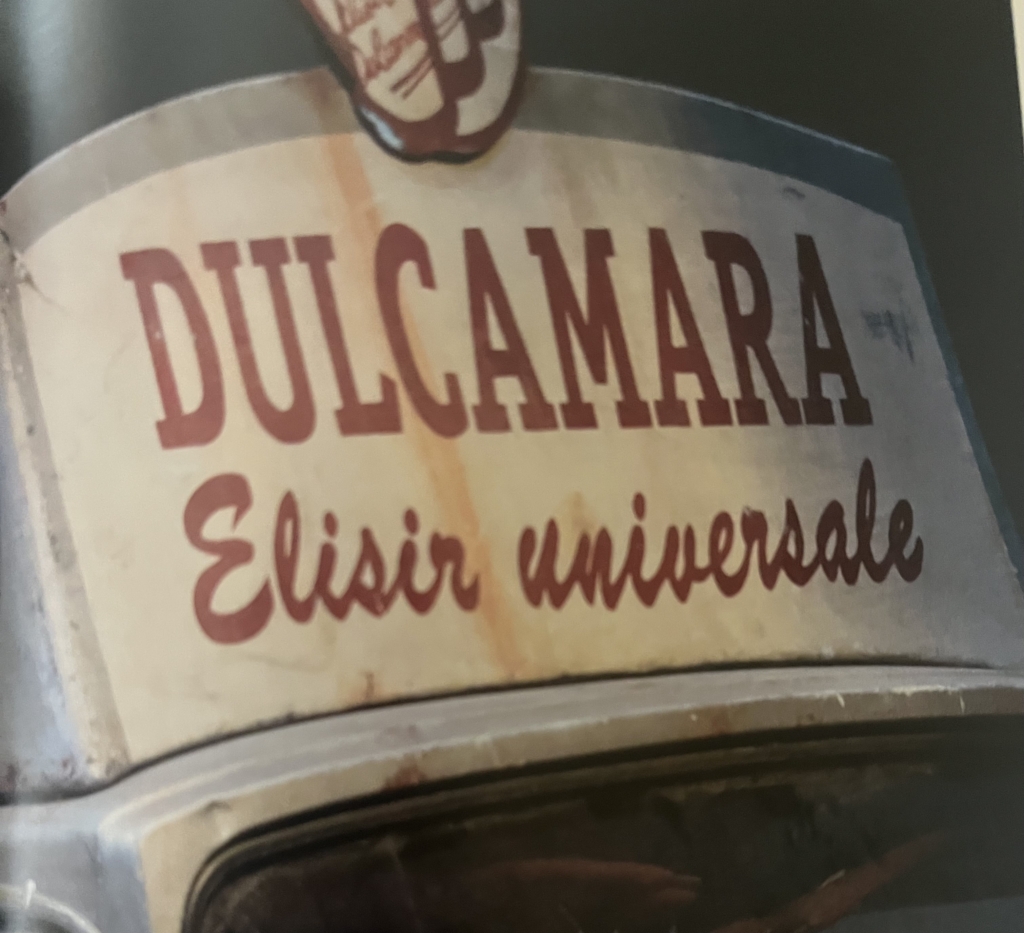
The opera tells the story of poor Nemerino who is desperately in love with wealthy landowner Adina who tells him she will never love him. The arrival of travelling salesman Dr Dulcamara and some universal elixir that promises to cure all ills and some cheap wine changes all of that.
Why is Dulcamara such a good salesperson?
Why does Adina fall for Nemerino?
Let’s explore some behavioural and decision science and psychological principles at work in the story and see how they could be applied to fundraising and communications.
(Now I appreciate that the centre of the Venn diagram of opera fans, Cialdini readers and behavioural psychology fans might be small, and this might be niche even for me, but there are some great heuristics at work that can be applied easily to communications and fundraising)
So lets start with Dulcamara – he is a travelling salesman who goes from town to town selling a universal potion that claims to cure all ills.
You can watch his sales pitch here – 4 mins long – (from the Royal Opera House’s production – ENO’s new production plays until 5 December 2024 and you can get tickets here)
So what makes Dulcamara so successful as a salesperson?
He employs some psychological nudges to improve his credibility, authority and make you like and trust him more including:
Authority – he assumes you have heard of him and ‘what a great doctor I am’. He has ‘certificates authentic, branded, touch and see’ for you to see as testimonials to his success – these work as powerful messengers to attest to the success of the elixir.
He celebrates his track record (‘because of me the hospitals are selling off their leases’) and lists all the diseases he can cure.
‘The asthmatics, asphitics, hysterics and diabetics, cures the tympanitis, scrofula and rickets and even liver trouble… wonderful for liver, cures the paralytic, heals the apopletic’
There are so many cures listed that everyone and anyone could see something they suffer with being improved by application of the potion.
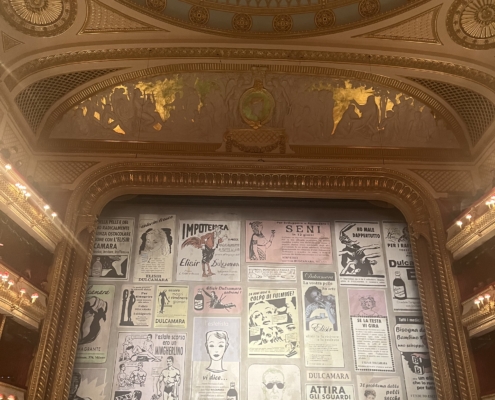
Front cloth of the current L’elisir d’amore at the Royal Opera House with 50s style adverts for all the cures that Dulamara can provide.
Anchoring and priming
‘Now you ask; what’s its price?
How much is it per bottle?
A hundred scudi ? … no.
Thirty? …. No.
Twenty? …. Now don’t be surprised’
This anchoring technique is a common sales technique used to influence the customer perception of the value of the item you want them to buy. Steve Jobs was clearly inspired by this technique when he announced the price of the newly launched iPad in 2010. He initially said the price was $999 before revealing that the price was only $499 – the high anchor made it seem like an expensive item and enhanced the perception of the quality and value of the item – the lower price makes it seem more affordable and reasonable.
Incentive – Dulcamara was also offering a scudi cash back on any purchase which further incentivises a purchase. It also excites the reciprocity principle that the offer already has a concession made it in and therefore the natural human response is to reciprocate to the concession and accept the offer.
Likability – Dulcamara seeks to let the crowd that he is like them and we like people who are more like us. He says all over Europe I sell for 9 lire “but as it is evident, I was born in the country, For three lire I grant you … ah warm homeland”. This again ignites the reciprocity principle as a concession, for being local, has already been made.
And what could you do to be more like Dulcamara?
(when we put aside the ethics of not overclaiming – your charity may be saving the world but you probably cannot claim to be a universal solution to all society’s ills)
Authority – what testimonials or awards have you for that enhance your credibility and speak of your successful track record? Awards or testimonials from others – industry leaders, participants or press – can act as powerful messengers.
Anchoring and priming – often supporters do not know what is appropriate to give so anchoring them and priming them with a number helps them know what to give. The Girl Guide cookie seller example if often cited with asking for thousands of dollars of cookie sales, which makes the follow up concession offer of $100 worth of cookies seem more reasonable and increases sales. How can you use larger numbers to help encourage bigger donations? Can you talk about the total cost of a programme, and then the cost of helping one child, one cat, save one square metre? The smaller number will seem more reasonable after the bigger number.
Likability– we like people who are like us. Highlighting his local connection makes Dulcamara more appealing. How can we show supporters that we are like them (or other people like them do this)? Fundraising research has shown in real world tests (with a public radio station in America) that if the person asking for money mentions the gender or location of the last donation e.g. when talking to a donor from Penzance saying, ‘I was just talking from someone from Penzance and she gave £50’ increases the donation rate. It highlights our identity – as a member of a place-based community – and also creates a powerful social norm of what people in our group, and our area do (one of the best ways to reduce electricity use was showing what other local people had already done). How can you highlight the local connection as a community?
Reciprocity – what gift or offer can you give your supporters before hand? Is it a free pen, a sticker, a postcard, bookmark or are there are non-tangible warm glow affects you can give them about the impact of their previous work that makes that want to return the favour and reciprocate with a philanthropic gift?
And the plot continues …
Nemerino is desperately in love with Adina and after she has dismissed his suit he approaches Dulcamara for a love potion that will transform her affections. Dulcamara sells him the potion – which is in fact a cheap bottle of claret – Nemerino believing it will work its magic on Adina’s affections drinks it all and is dismissive of her.
The wine is a placebo – Nemerino believes the potion is working so does not try desperately hard to impress. By taking action and using the potion Nemerino has got the illusion of control over the unrequited love situation he finds himself in. (more about placebos here)
Some more plot
Nemerino’s rich uncle dies and leaves all his money and land to Nemerino (he is unaware of this)– the town get word of this and suddenly all the women of the village see Nemerino with new eyes and want to dance and flirt with him.
Why does Adina fall in love with Nemerino?
Peer-suasian – once Adina sees all the women of the village finding Nemerino attractive and interesting she suddenly sees him in a new light. Humans are herd animals and seeing that everyone else thinks and reacts in a certain way has a powerful influence on us and our behaviours. Social ostracization is just as psychologically painful as physical pain so staying with the group is important. Adina becomes influenced by the others behaviours and questions her former apathy towards Nemerino.
FOMO – we fear on missing out on something good. Adina fears that someone else will get Nemerino. (He has also sold himself to the army to get enough money to buy more elixir and Adina buys him back but says if she cannot love him he will still go to war and the soldiers have been summoned to action – so she fears she may lose him that way as well.)
And so why does Adina fall in love with Nemerino?
Apart from the tenor’s ability to sing beautifully – a combination of the social proof that he is an attractive proposition and the fear of missing out.
So how could the implications of a love potion be used in fundraising?
Placebos – placebos are about trying to give the illusion of control – how can you more autonomy to your supporters about how they give, where they give, whether they give and when?
Peer-suasian – how can you show supporters that people like them (same age, location, demographic, gender) are supporting like you and that this is normal for people like that
Scarcity – how can a time limited match campaign or emergency situation galvanise that scarcity principles and drive action?
https://marinajones.uk/wp-content/uploads/2023/09/image-1.png10801080adminhttps://marinajones.uk/wp-content/uploads/2022/12/f2b903e010104f5aa61ea1821a685913.pngadmin2023-09-28 20:10:082024-11-10 13:57:52Want to drive attraction and sales and make supporters fall in love?
We may request cookies to be set on your device. We use cookies to let us know when you visit our websites, how you interact with us, to enrich your user experience, and to customize your relationship with our website.
Click on the different category headings to find out more. You can also change some of your preferences. Note that blocking some types of cookies may impact your experience on our websites and the services we are able to offer.
Essential Website Cookies
These cookies are strictly necessary to provide you with services available through our website and to use some of its features.
Because these cookies are strictly necessary to deliver the website, refusing them will have impact how our site functions. You always can block or delete cookies by changing your browser settings and force blocking all cookies on this website. But this will always prompt you to accept/refuse cookies when revisiting our site.
We fully respect if you want to refuse cookies but to avoid asking you again and again kindly allow us to store a cookie for that. You are free to opt out any time or opt in for other cookies to get a better experience. If you refuse cookies we will remove all set cookies in our domain.
We provide you with a list of stored cookies on your computer in our domain so you can check what we stored. Due to security reasons we are not able to show or modify cookies from other domains. You can check these in your browser security settings.
Google Analytics Cookies
These cookies collect information that is used either in aggregate form to help us understand how our website is being used or how effective our marketing campaigns are, or to help us customize our website and application for you in order to enhance your experience.
If you do not want that we track your visit to our site you can disable tracking in your browser here:
Other external services
We also use different external services like Google Webfonts, Google Maps, and external Video providers. Since these providers may collect personal data like your IP address we allow you to block them here. Please be aware that this might heavily reduce the functionality and appearance of our site. Changes will take effect once you reload the page.
Google Webfont Settings:
Google Map Settings:
Google reCaptcha Settings:
Vimeo and Youtube video embeds:
Other cookies
The following cookies are also needed - You can choose if you want to allow them:
Privacy Policy
You can read about our cookies and privacy settings in detail on our Privacy Policy Page.