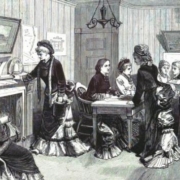
In 1912, William Harvey Allen the Director of the Bureau of Municipal Research and National Training School for Public Service examined 6,000 appeals sent to the philanthropist Mrs E H Harriman asking for $267,000,000 in charitable gifts.
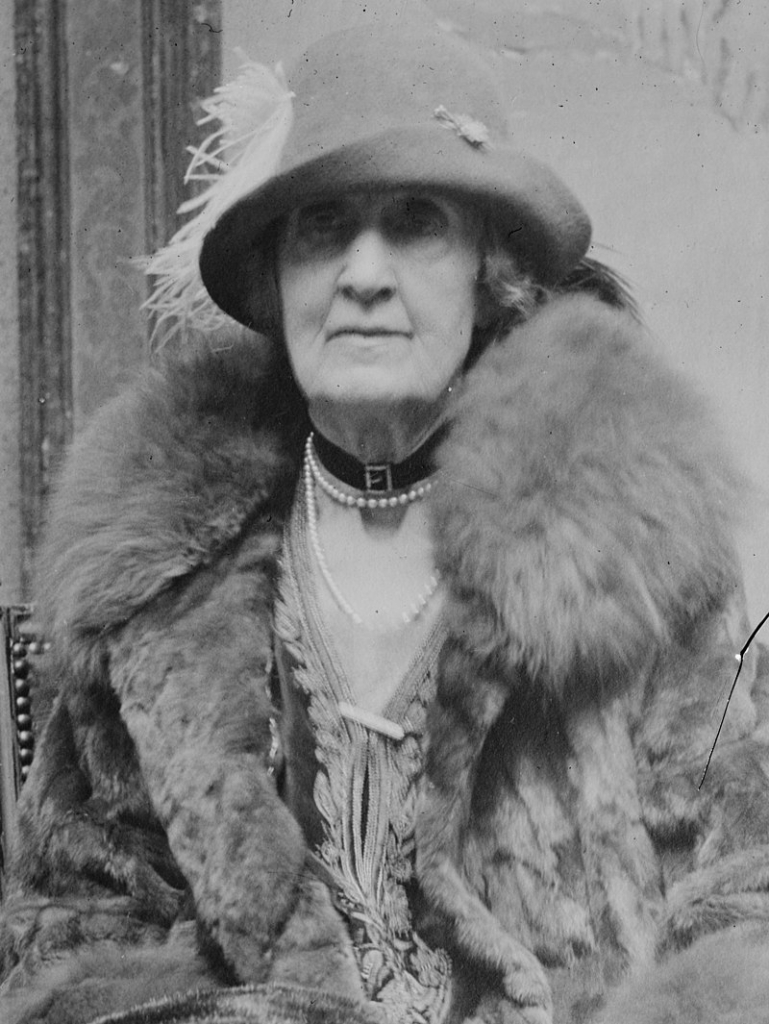
After the death of her husband, the railroad executive, Mrs Harriman became a noted and active philanthropist supporting a variety of causes. Read more about her here Mary Williamson Harriman – Wikipedia
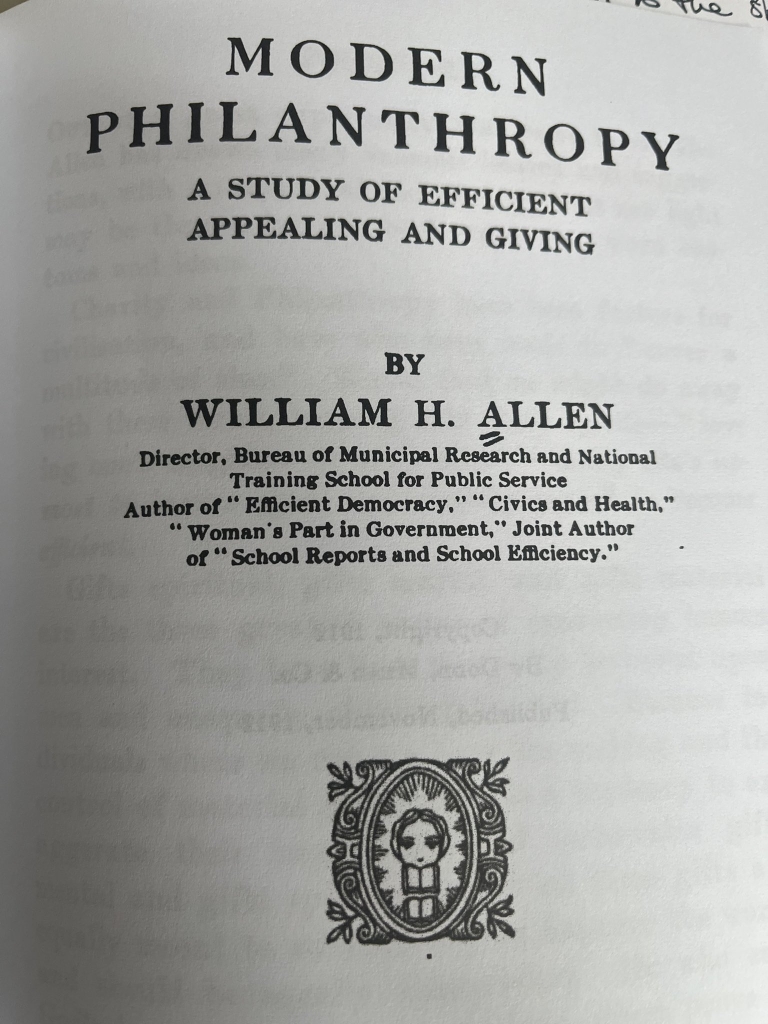
These are detailed in the book Modern Philanthropy A Study of Efficient Appealing and Giving
To give a bit of context in 1911, reports show that $270,000,000 worth of donations were given in the US of which $30,635,647 was bequeathed to charity in wills.
What do they show us about the concerns of the time that we still care about?
How advanced or not was fundraising?
What guidance did they have for the writer of appeals that we can apply to our fundraising today?
Has much changed or have we always worried about the same issues and made the same mistakes?
Philanthropy and what is deemed charitable is always based in time, place and culture. The vast majority of requests would still be deemed charitable today (health, disease, children, education) but there are a few more time specific ones – a national crusade against polygamy and celestial marriage (?!), home for aged Swedes and a museum of safety and sanitation.
So, what do the letters and an analysis of them show us about the concerns of the time that are still challenges for us today?
There is no way of finding where the money is most needed & who ought to fund what
In 1912, there was a lack of interconnectivity of what charities and agencies existed, and who is helping who. There are not clear distinctions over whether something should be funded by the state or philanthropy, and debates about the role of both in trying to provide solutions. The Bureau of Municipal Research often wrote back to petitioners with advice and guidance on the best place to get financial or practical help, for example, state provided support.
To provide greater efficiency about how decisions are made, the Bureau of Municipal Research suggests developing a central clearing house for the assessment of what is actually needed. This clearing house would be tasked with looking at duplications of provision, and signposting other appropriate services (both philanthropic and state). They wanted to create a directory of private philanthropy in each city to map what is provided and who is supporting each causal area.
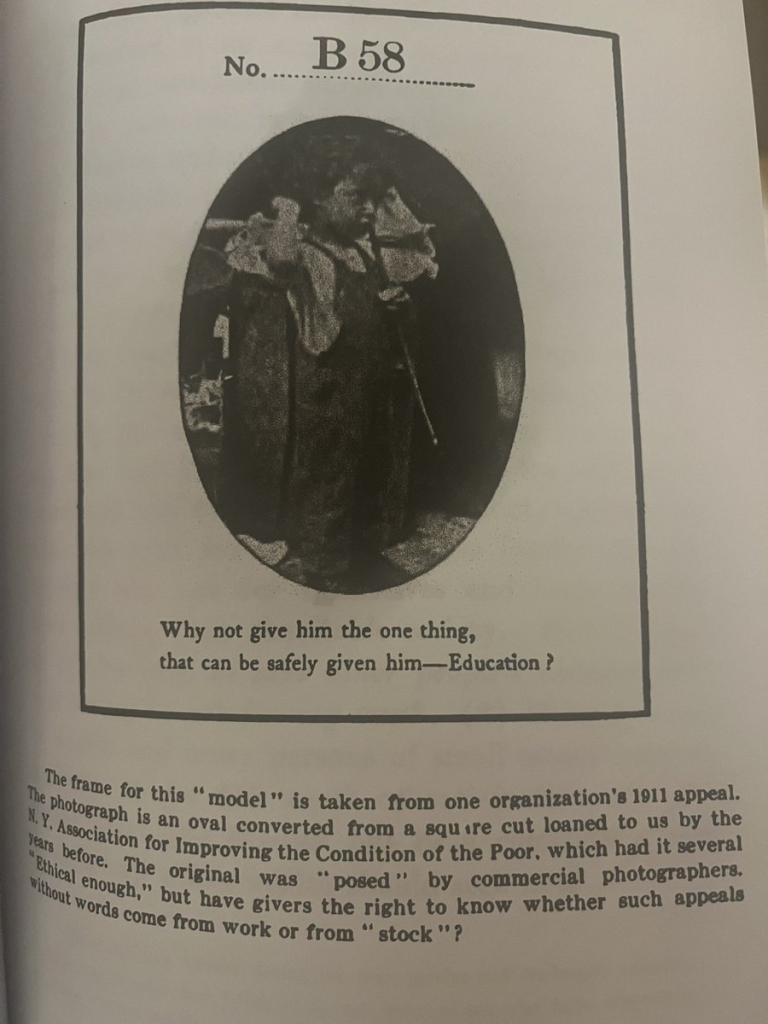
Questions about ethics of the images used in fundraising
There were concerns about the images used to generate sympathy and funds for the cause. The fact that the image below for an appeal for the New York Association for Improving the Condition of the poor was created in a photographer’s studio was questioned as it does not show the real beneficiaries or make clear that it is a created image.
These concerns have been mirrored more recently with questions about who and how beneficiaries ought to be depicted in an ethical. Some charities have started using AI to generate images for campaigns (see this article AI-generated images raise money for charity. What’s wrong? | The Star).
So the debate about the best way to represent visually those that need support continues to this day.
The challenge of core costs
It seems fundraisers have always shied away from talking about the core costs, the cost of raising the funds and running the charity as these quotes demonstrate:
“No appeals have stated what part of the gift would be used to pay for appealing”
“few agencies keep a careful record of the postage, stationary and printing of appeals”
Although ROI on appeals seems not to be noted as standard it does cite a 1910 New York Association for Improving the Condition of the Poor spent $1,500 on adverts in newspapers and got a return of $11,500.
Worries about donor fatigue
Concerns about donor and compassion fatigue are not just current ones it was cited in 1912 as a concern:
“unfortunately for the starvation-broken-leg-blind-widow-with-five-children appeal, our nervous system requires ever increasing doses of sympathy drug, beyond the capacity of the English language or human suffering to supply”
First do no harm
“Giving away money without wasting it and without harming anyone is pretty hard work”
There was a real concern about how unthoughtful philanthropic activity can end up harming those it tried to help. They describe this as ‘vagrant giving’ as without thought and giving in the wrong way more harm is done.
Why are philanthropists motivated to give
“The rich give for the same reason the near rich or the never rich give, because they like to or because they like it less than they dislike the alternatives presented”
“if our appeals aim at motives we shall get more money than if we aim at their money”
Instinct – save a baby’s life
Comfort – Fresh air contribution before leaving for mountain or seashore
Commerce – give or advertise trade discounts to orphan asylums
Anti nuisance – Give to an importunate appealer for a day nursery
Anti slum – Free vaccination for slum babies
Pro slum – House to house nursing for the babies’ sake
Recognition of rights – 100% of health protection for 100% of babies, not as a gift but as their right”
A century later Bekkers & Wiepking (2010) described eight major reasons why people donate to charity which are (1) awareness of need; (2) solicitation; (3) costs and benefits; (4) altruism; (5) reputation; (6) psychological benefits; (7) values; (8) efficacy. We can see some overlap between the two lists of motivations but the older ones has no recognition of the role of the fundraiser and that someone needs to make the ask.
Giving ought to be joyful and meaningful
“that those who give ‘without missing’ are sure to miss it in their giving”
Too often in society circles they see the “endless chain reaction” of “give me $25 today for my charity and tomorrow I will gladly give you $25 for yours”. (With certain sets of donors has much changed?)
But fundraisers have the opportunity to “delight [donors]in making others happy”
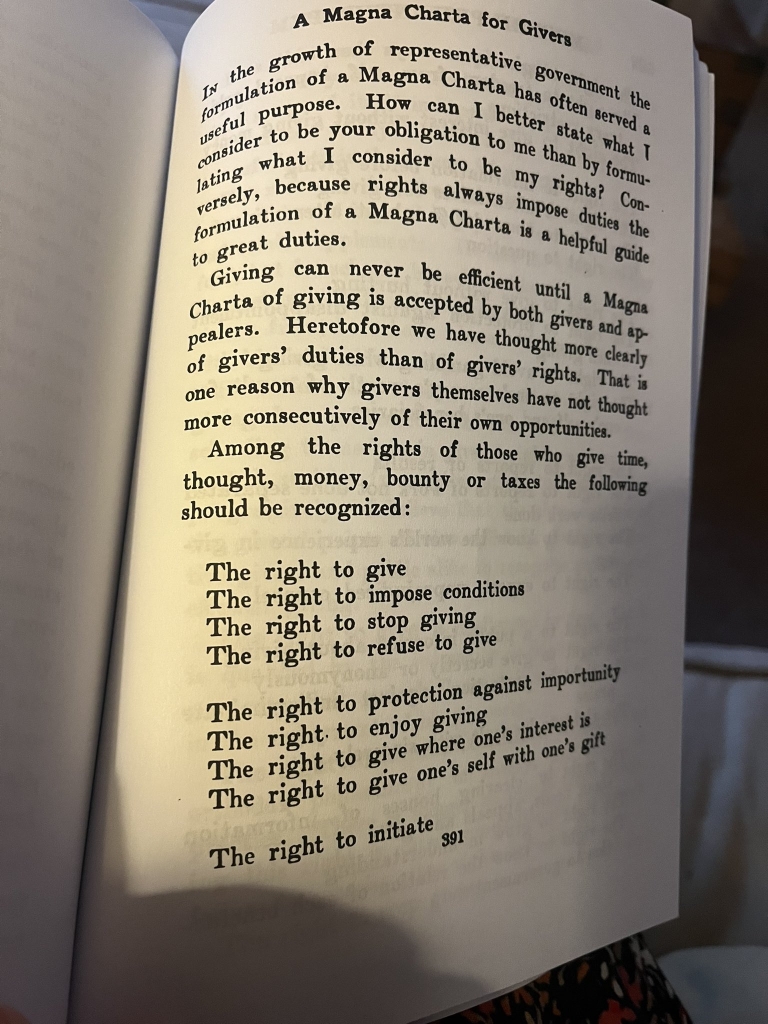
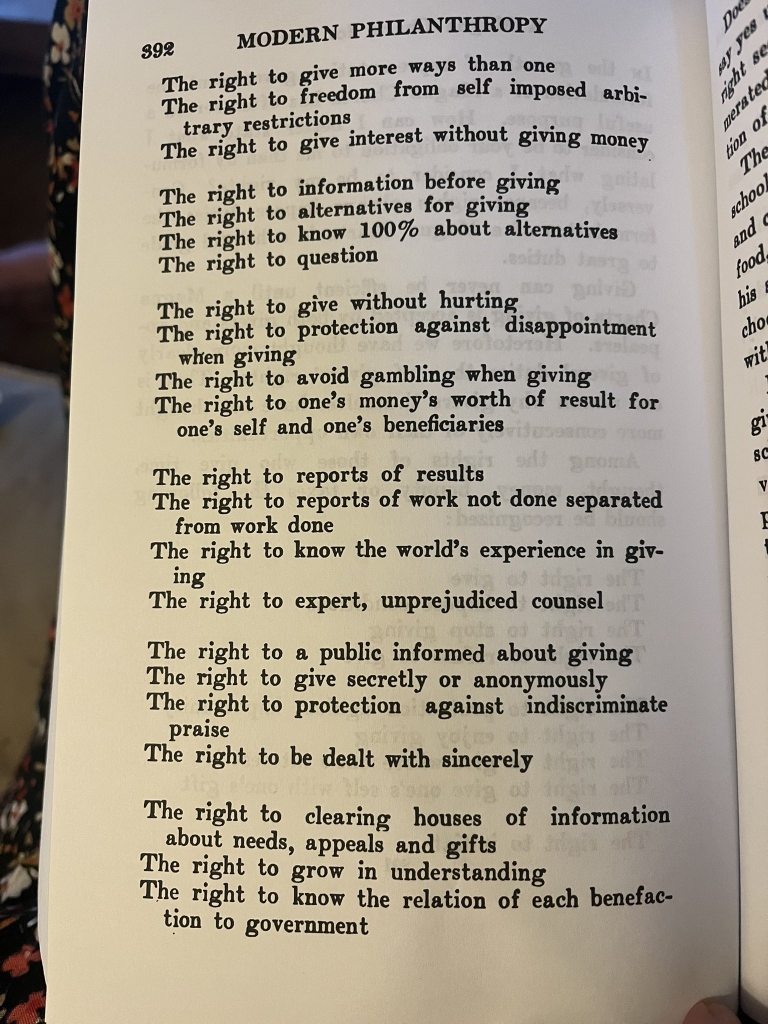
A charter for givers
William Harvey Allen, author of the book, proposes a Magna Carter for Givers about how those that are asked ought to look and give which includes
“guarantee a sympathetic reading of letters”
“organise and conduct a national museum that will do for the fields of efficient giving”
“– the right to give
– the right to enjoy giving
– the right to reports of results
– the right to grow in understanding“
The Garfield Weston Foundation has a Charter which is a modern foundation’s version of this.
Fundraising and the appeals we create do more than raise vitally needed funds they help us society to understand the challenges faced and why such conditions exist.
“Appeals have done more to teach this country sociology than have all the universities”
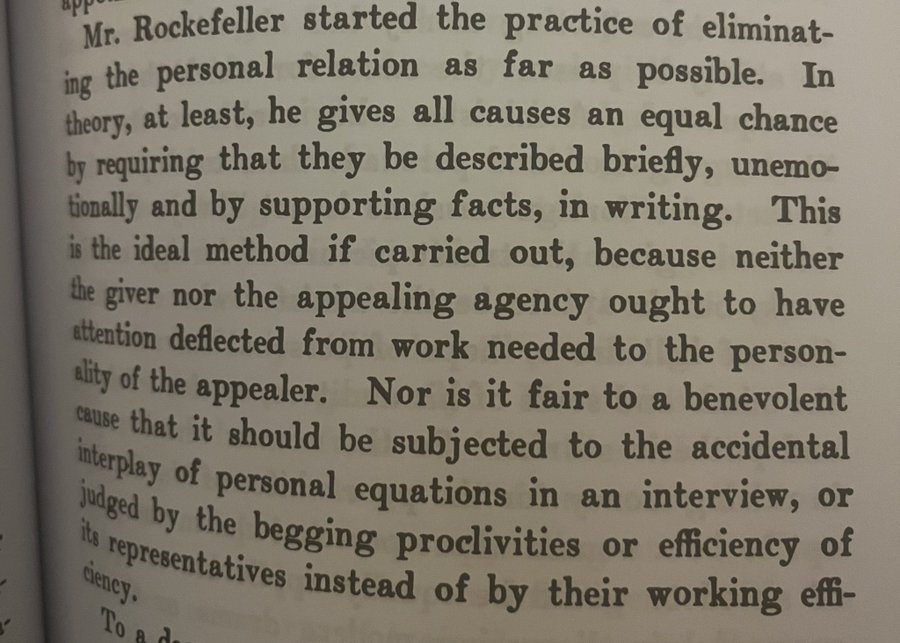
Introducing new trends– the first grant proposal form
Rockefeller is cited as introducing a new way of deciding on where funds are given – this could be the first grant application form?
“he gives all causes an equal chance by requesting that they be described briefly, unemotionally and by supportive facts in writing”
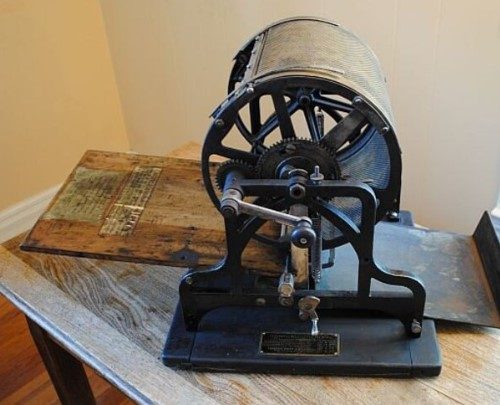
Embracing new technology
Fundraising always keeps up with new trends and embraces new technologies in its appeals. The same was true in 1912. and “like the largest and best organisations we have been compelled to adopt the mechanical follow up” The mimeograph was an early copying machine and they created multiple printed copies which were used as to follow up original appeal letters. There were concerns that this lacked the personal touch as letters would be hand addressed (Dear Mrs Harriman) with the rest a mimeograph.
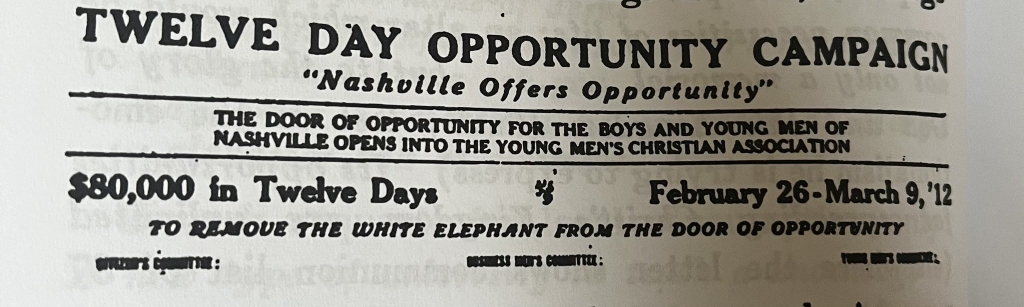
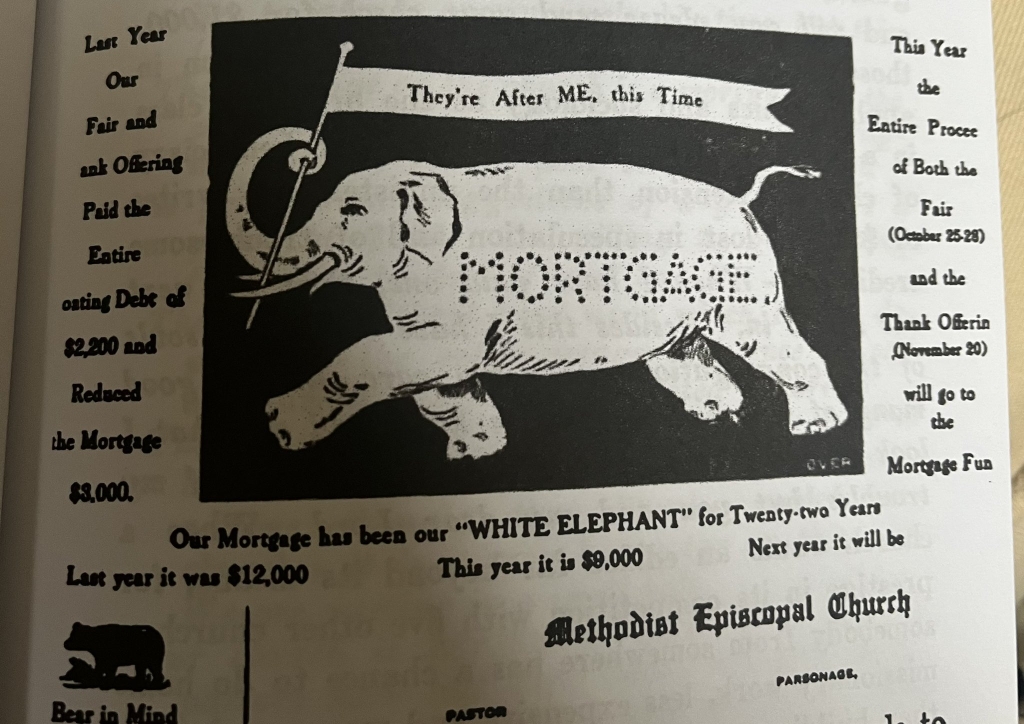
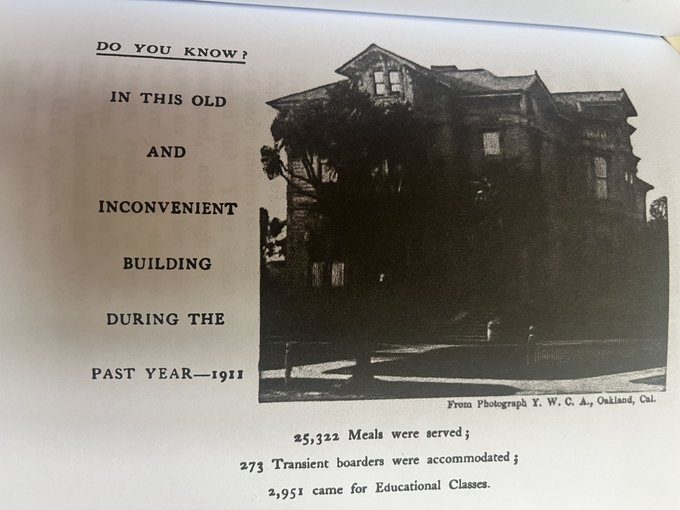
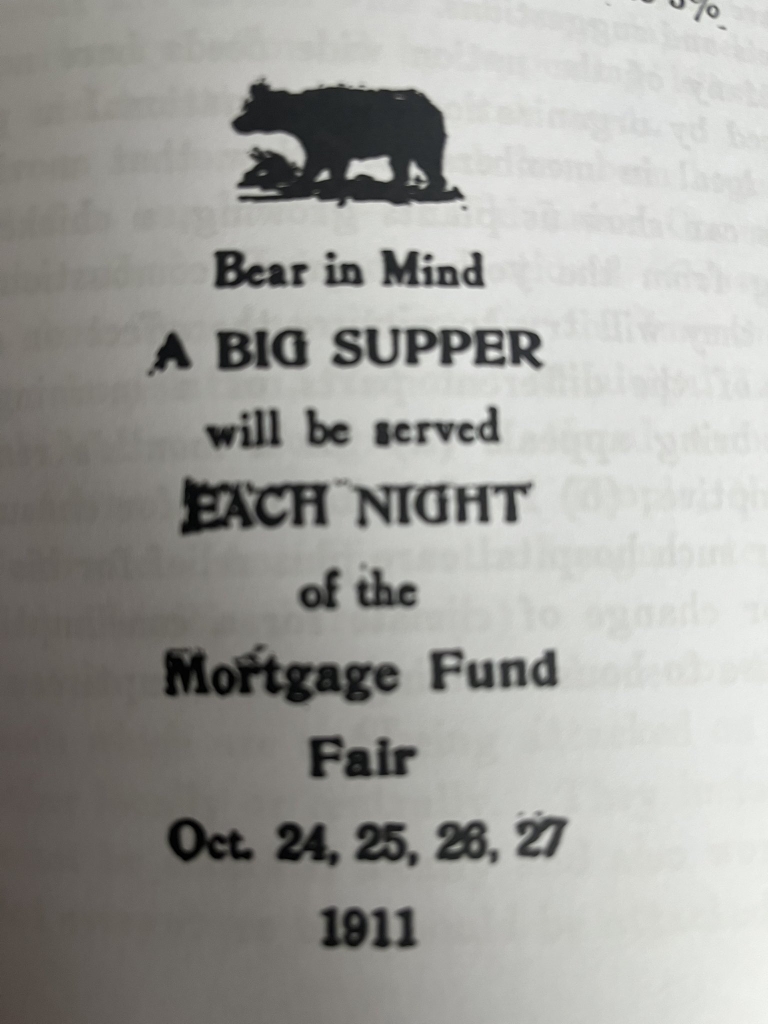
And finally a few examples of charity adverts from 1911
Reading Modern Philanthropy A Study of Efficient Appealing and Giving was a fascinating insight into the state and concerns around fundraising from over one hundred years ago and interesting to see how little has changed and how we continue to have the same issues and debates.
https://marinajones.uk/wp-content/uploads/2023/06/Charity-adverts3.jpg6142048adminhttps://marinajones.uk/wp-content/uploads/2022/12/f2b903e010104f5aa61ea1821a685913.pngadmin2023-07-02 19:38:432023-07-02 20:33:31What do 6,000 appeal letters show us about fundraising 100 years ago?
We may request cookies to be set on your device. We use cookies to let us know when you visit our websites, how you interact with us, to enrich your user experience, and to customize your relationship with our website.
Click on the different category headings to find out more. You can also change some of your preferences. Note that blocking some types of cookies may impact your experience on our websites and the services we are able to offer.
Essential Website Cookies
These cookies are strictly necessary to provide you with services available through our website and to use some of its features.
Because these cookies are strictly necessary to deliver the website, refusing them will have impact how our site functions. You always can block or delete cookies by changing your browser settings and force blocking all cookies on this website. But this will always prompt you to accept/refuse cookies when revisiting our site.
We fully respect if you want to refuse cookies but to avoid asking you again and again kindly allow us to store a cookie for that. You are free to opt out any time or opt in for other cookies to get a better experience. If you refuse cookies we will remove all set cookies in our domain.
We provide you with a list of stored cookies on your computer in our domain so you can check what we stored. Due to security reasons we are not able to show or modify cookies from other domains. You can check these in your browser security settings.
Google Analytics Cookies
These cookies collect information that is used either in aggregate form to help us understand how our website is being used or how effective our marketing campaigns are, or to help us customize our website and application for you in order to enhance your experience.
If you do not want that we track your visit to our site you can disable tracking in your browser here:
Other external services
We also use different external services like Google Webfonts, Google Maps, and external Video providers. Since these providers may collect personal data like your IP address we allow you to block them here. Please be aware that this might heavily reduce the functionality and appearance of our site. Changes will take effect once you reload the page.
Google Webfont Settings:
Google Map Settings:
Google reCaptcha Settings:
Vimeo and Youtube video embeds:
Other cookies
The following cookies are also needed - You can choose if you want to allow them:
Privacy Policy
You can read about our cookies and privacy settings in detail on our Privacy Policy Page.







Leave a Reply
Want to join the discussion?Feel free to contribute!