

Fundraising fundamentals – Red kettles, self denial & picture receipts
The Salvation Army Christmas red kettles are perhaps one of their most well known ways of raising money and especially at Christmas time – seen on Friends, When Harry Met Sally and countless other shows.
The famous Salvation Army red kettles first appeared in 1891 when a former sailor and Salvation Army Captain Joseph McFee was thinking about how to raise funds to provide the poor of California with a Christmas dinner. He remembered how when he was a sailor at Liverpool Docks there was an iron kettle called ‘Simpson’s Pot’ for donations for the poor. He used this idea to set up a kettle and with the slogan ‘Keep the Pot Boiling’ – a tradition was born that lasts to this day.

Looking back to when Joseph McFee came up with this idea we can see a whole wave of fundraising innovation and inspiration from the Salvation Army. I recently had a rather fundraising history geeky trip to their archives to see some of them for myself. And here are 10 fundraising fundamentals from the archives of the Salvation Army.
Background
Founded in 1865 as the East London Christian Mission by William and Catherine Booth. It sought to bring physical and spiritual salvation to the poor and destitute – and is often known for the 3Ss – Soup, Soap and Salvation. A radical reassessment of mission involved a rebrand turned the mission into the Salvation Army in 1878 when William Booth became the first General led to rapid growth and expansion with work staring in America and Australia in 1880. The reshaping of it into Army with a General as a leader, army officers and members as soldiers also involved a radical overhaul of its fundraising need as it expanded beyond its East London base and sought to bring that salvation to the world. The Salvation Army was one of the first international big brand charities. In 2023 it has over 1.7million members and is the largest non-governmental provider of social services in the US and is active in over 133 countries.
Alongside the red kettles the other most notable campaign is the annual Self Denial Fund. Which began in 1886, when John Aiken Carleton could not donate a big gift, but decided to give up puddings and donate the money saved to the Salvation Army. This became an annual campaign which all soldiers were asked to participate in and recruit others to donate to funds at the same time. And again, continues to this day.
What fundraising fundamentals do we see at work? Why do they work – now and then?
1. Use the latest technology
Fundraisers have always adopted and used the latest technologies to raise money in new and creative ways. So now we might be thinking about how AI, ChatGPT or the latest social media viral video can be used to gamify our fundraising.
In Victorian times it was no different. The Salvation Army grabbed the opportunity presented by the new photolithography machine. Basically this was an early form of photocopying and it allowed you to make cheap and effective copies of appeal letters.
So that the appeal letters that they sent looked like they were handwritten to you from General and Catherine Booth, the two leaders of the Salvation Army.
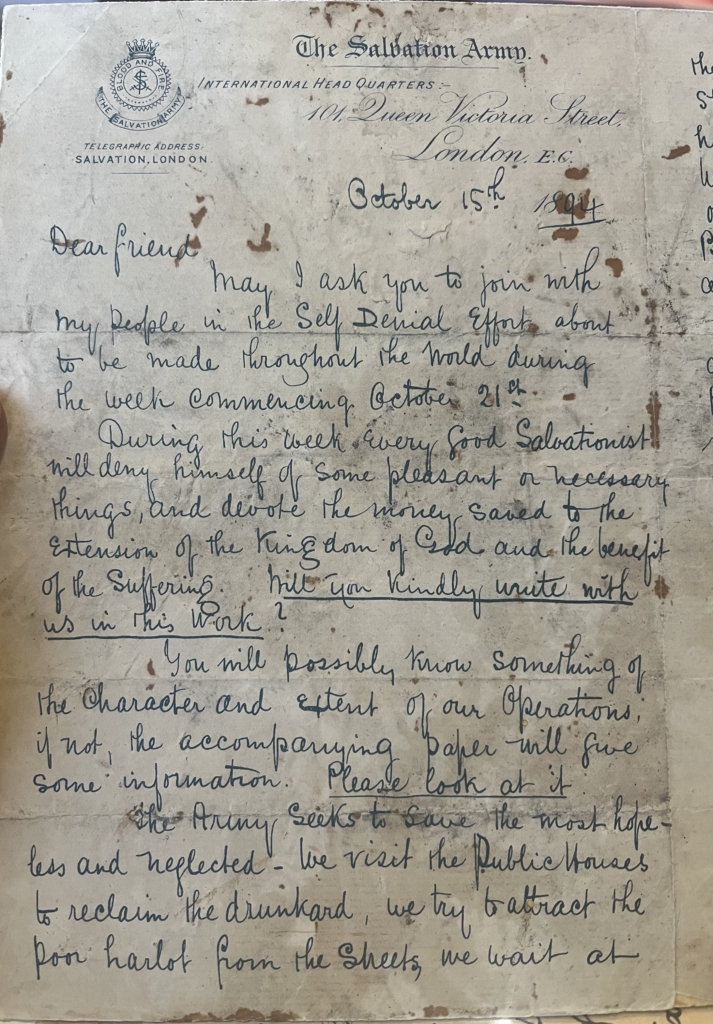
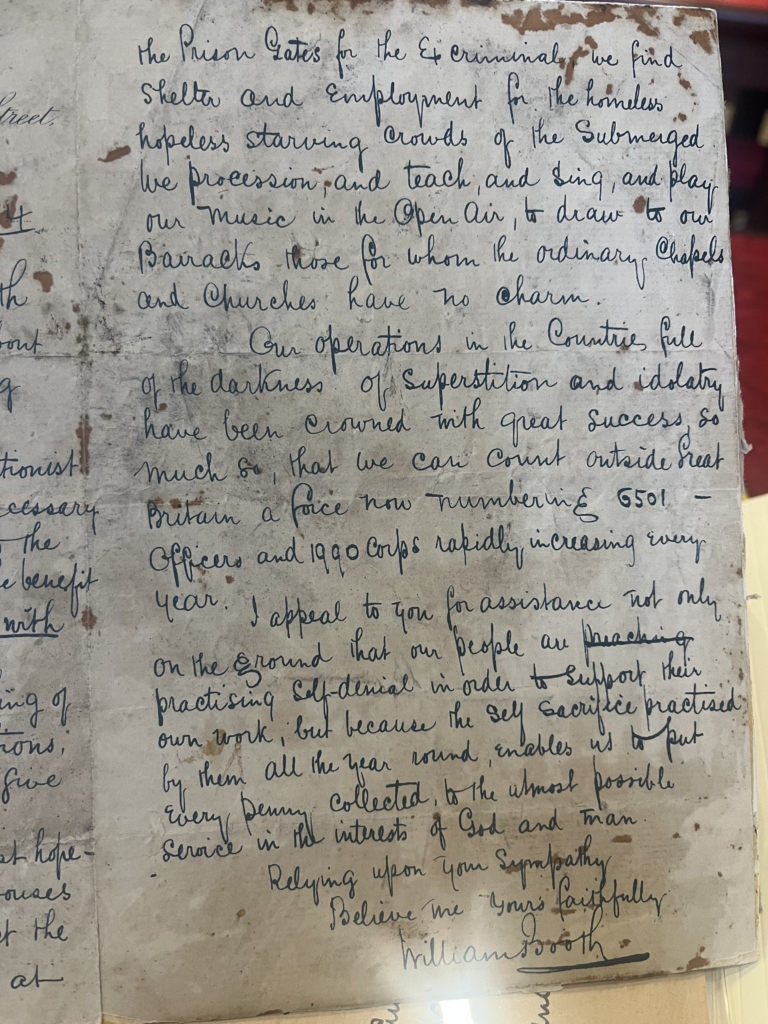
Seeing the copies of the letters in the archives it is hard to believe that they are not really handwritten – they are a blue inky colour (it is tempting – but I didn’t- to lick your finger and smudge it to see it is a really written in ink). So they do really look like a personal appeal.
We are all attracted by the novelty and using the latest technology can make our appeals go further and also entice donors to the cause.
We also pay more attention to handwriting rather than just printed text – it stands out and catches the eye and therefore the attention of our supporters.
Making a direct appeal letter stand out
Underline – emphasising something and making it stand out more for the reader. Like any good direct mail fundraiser General Booth uses it sparingly to add stress to phrases and sentences.
The lines Booth underlines in the 1894 appeal are ‘Will you unite with us in this work?’ and ‘Please look at it’ referring to the leaflet associated with it.
The use of the underline also helps make it easier for the reader to process the information. We tend to lazily scan words and the underline makes us pause and pay attention. It breaks up a big block of text.
2. Donor centric language – it is not about ‘we’ the charity but about ‘you’ the donor
General Booth was an early adopter of using donor centric language (perhaps he went through an earlier draft and changed the ‘we’s into ‘you’ as fundraisers are schooled to do).
The 1905 letter says
“But you are more than an heir of heaven and a traveller to the eternal city. You are a partner with me in the fight. You are a soldier of the cross …. You will not disappoint your general”
There are notably more ‘you’s in the copy than ‘we’.
Donor centric and emotive language that really draws on the reader’s religious and personal identity and connection to the cause. How do you make it about them? And why they should support you?
3. Cases for support: Appeal to the heart and the head
We all know you need a different case for support for each donor.
The Salvation Army Self Denial leaflet gets around this by printing each of the areas that you could be concerned about – ‘People who believe in the Old Bible’, ‘People who hate the Drink’,’ People who love Children’ and ‘People who pity the Poor’. Each of these then presents a case and detail of the work in that area.
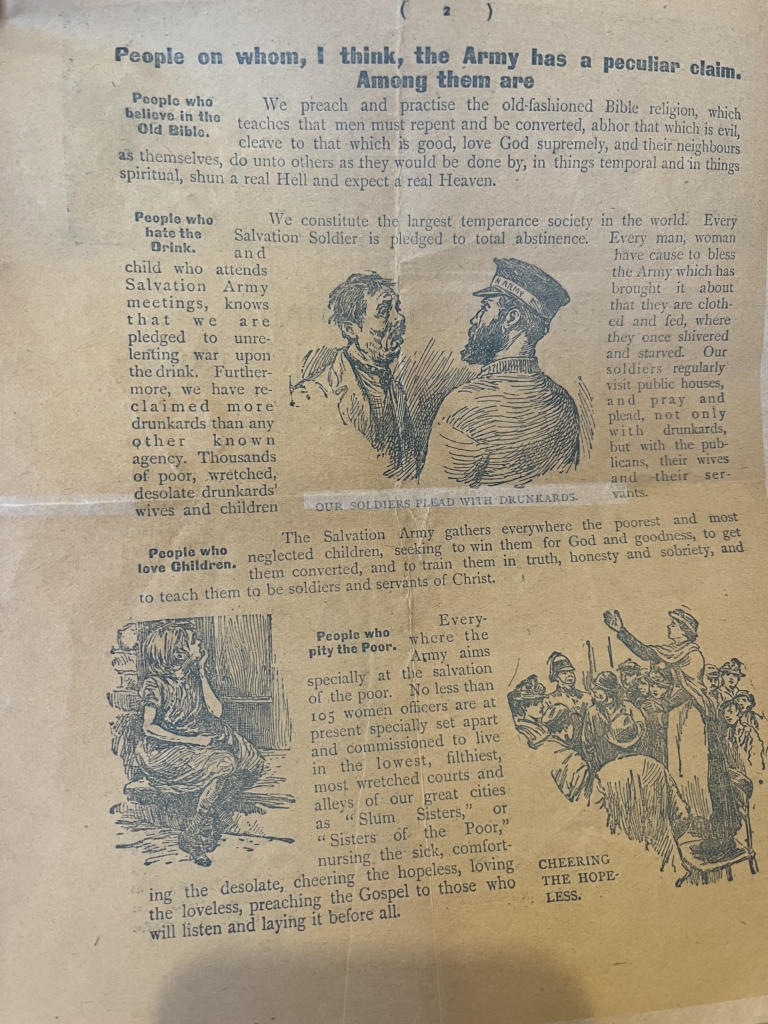
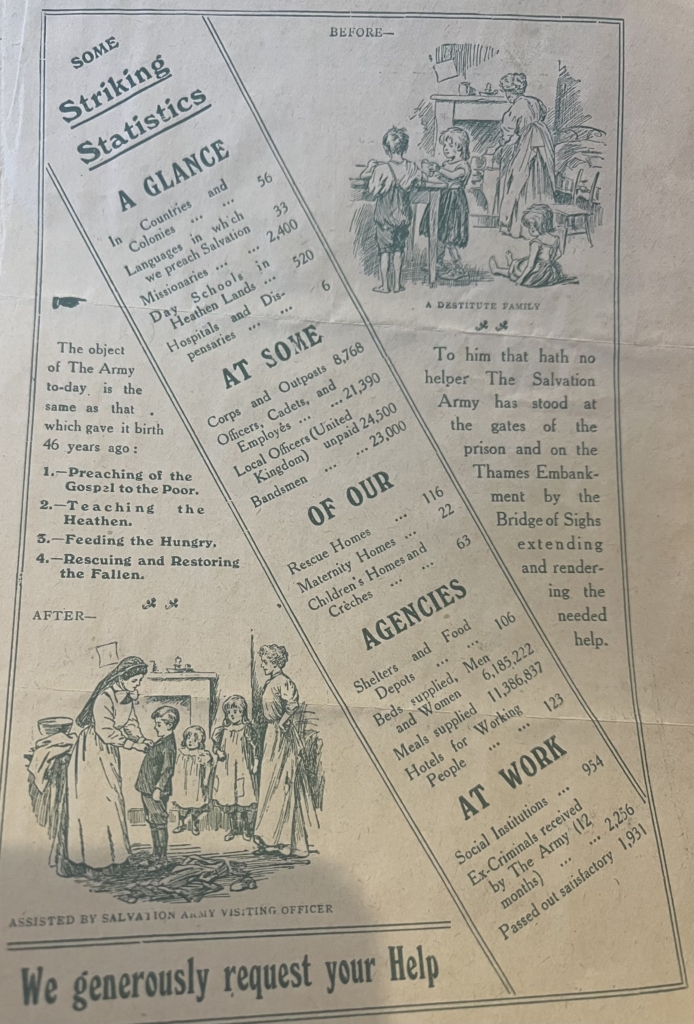
If you are not so visual, or attracted by these cases, there are also detailed statements of impact, reach and numbers for the more quantitative data driven donor!
Sometimes you need to write a special case for supporter for a very distinct target market, in 1904 a female Salvation Army officer in Sweden wrote appeals in Latin to flatter her male undergraduate students
Cognosce te scopum forum
4. You want to run a good campaign – you’d better be organised
If any charity could organise with military precision it was the Salvation Army. They utilised their military structure, branches and publications to regularise, systemise and approach campaigns and fundraising with rigour.
The annual Self Denial Fund was the most dominant campaign which they through all their administrative might behind.
- Be prepared with the print
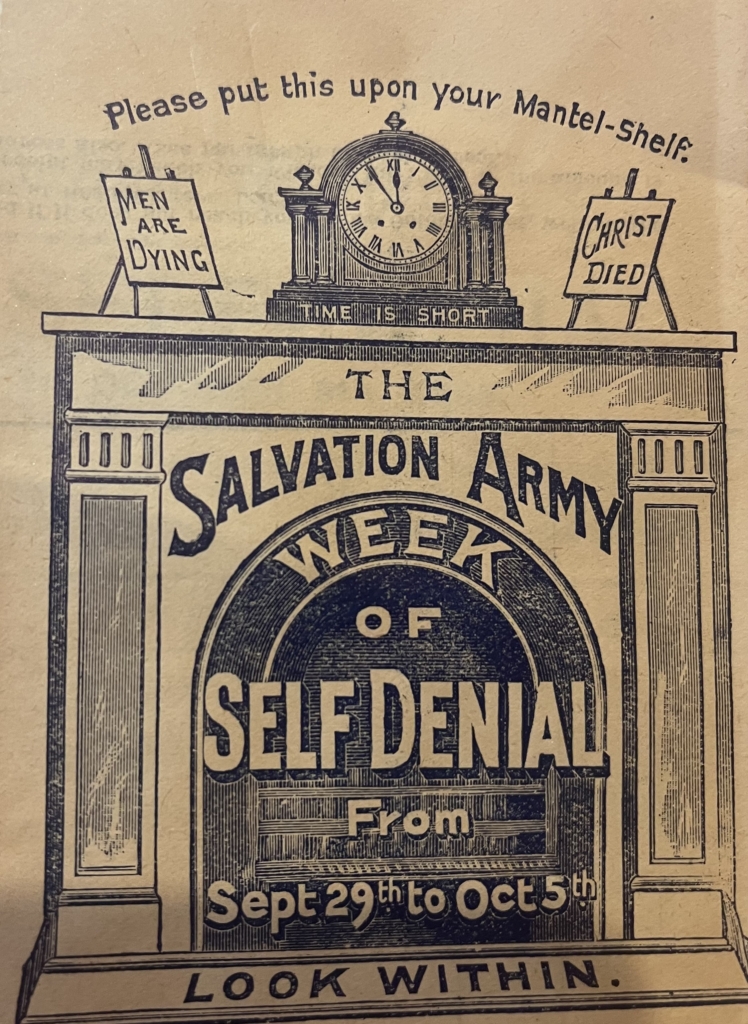
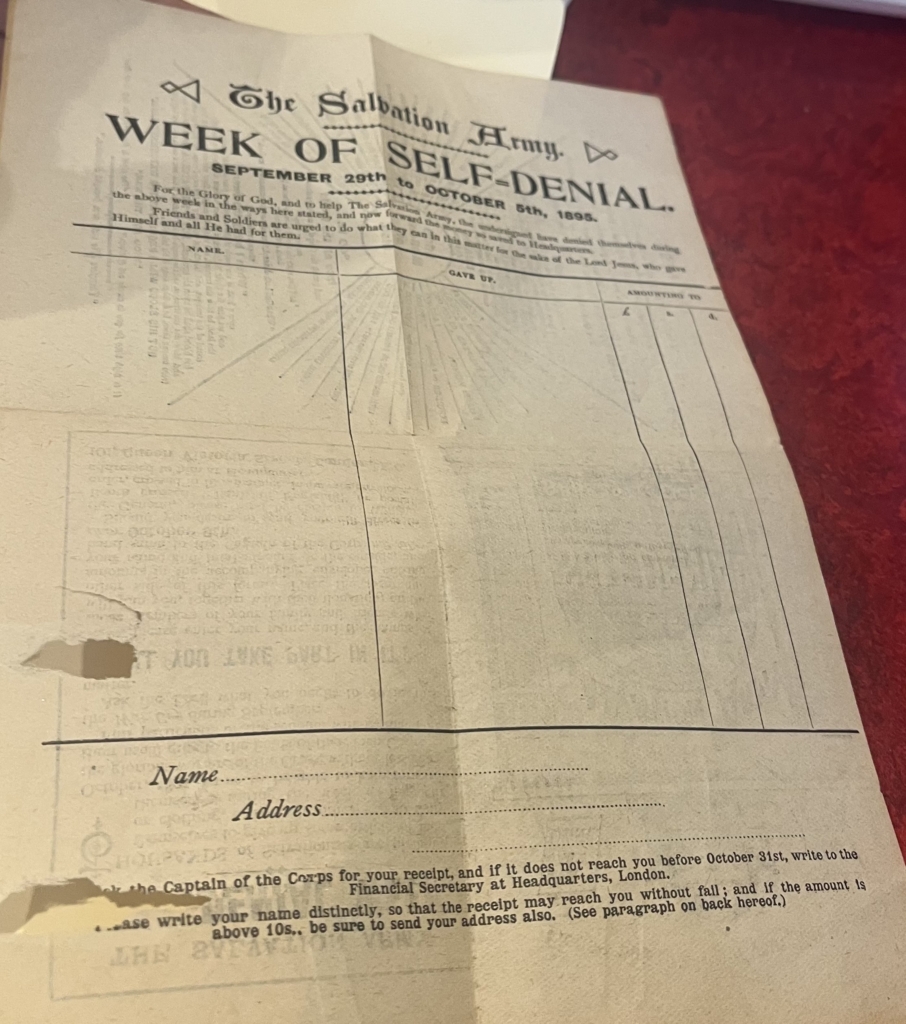
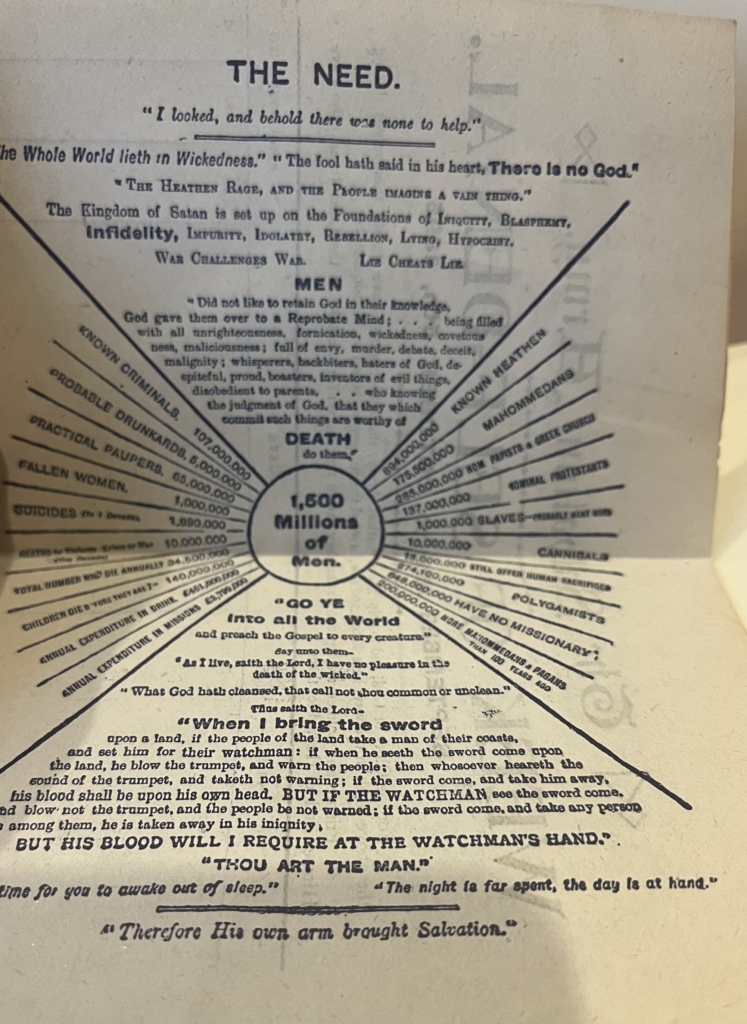
Printing had become cheap and easy so there is collateral for every part of the campaign. There were promotional leaflets for Self Denial Effort with attractive picture covers, printed forms inside to detail what had been given up and what raised and impact statements.These were supported by forms for fundraisers, envelopes and receipts.
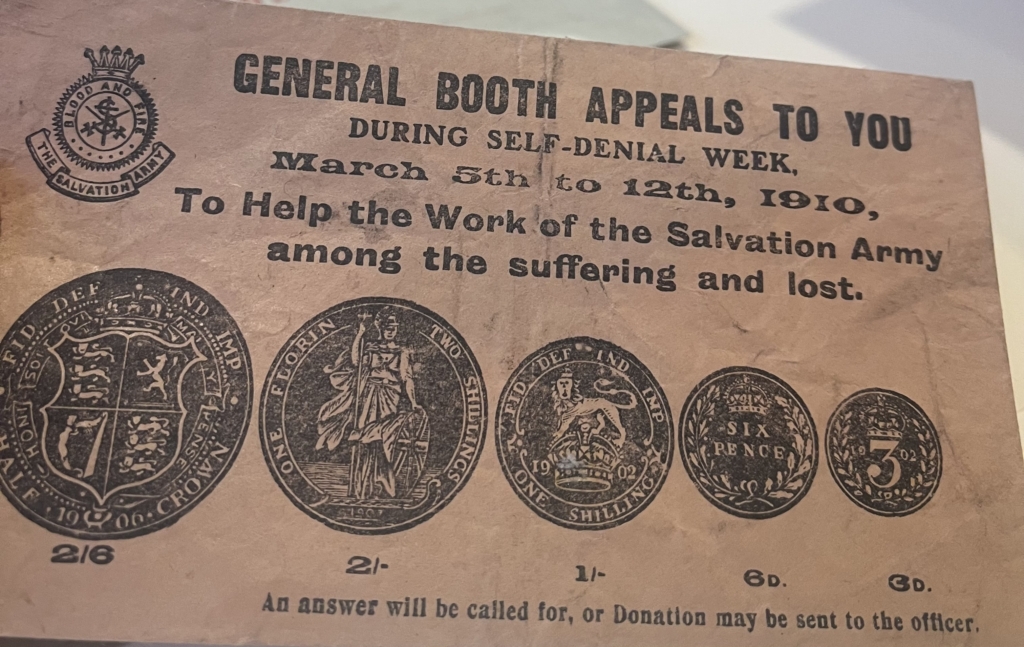
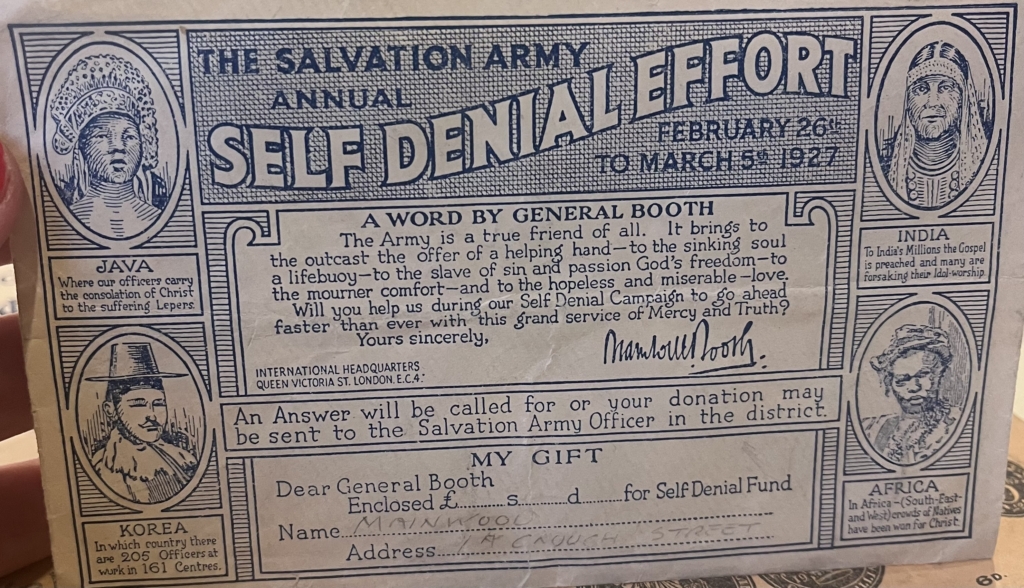
Have a campaign plan
Day by day guides were published in The Officer monthly magazine about how to prepare and what to do each day of Self Denial Week e.g. Thursday reads ‘The week is now drawing to a close. Look up weak ones, visit best friends, take out band with some novel contrivance’
There are strategic plans to draw up how much you will raise from each mechanism – envelopes, pictural receipt books, salary sacrifice. And suggestions to put the previous years total prominently on the wall so you can check in on how you are performing against target.
And even plans that divide up each road in each area and how many houses it had and how many collectors were needed for door to door collections in each road.
Promotion is key
The Officer is full of guidance of how to make the most of advertising your campaign. Deliberately borrowing from commercial marketing techniques suggestions include using empty shops, a hand cart, sandwich boards and sample press releases are included. They even suggest going to factories with a collecting tin on pay day to maximise donations.
5. Build the thank you into the campaign and make it memorable (or even collectable!)
We all know how important it is to say thank you to our donors for their support and leave them feeling appreciated.
Each collector was armed with a receipt book that they could give on receipt of a donation – some were plain white receipts and some were pictural. Each year the images on the picture receipts varied. In 1892 the receipts all had a sticker that could be fixed on of the celebrated Salvationists – it feels a big like collecting football stickers or Lego cards that you need to get the whole set. Interesting to note the majority of these do not include the word ‘thank you’ – they just say ‘received one shilling’.
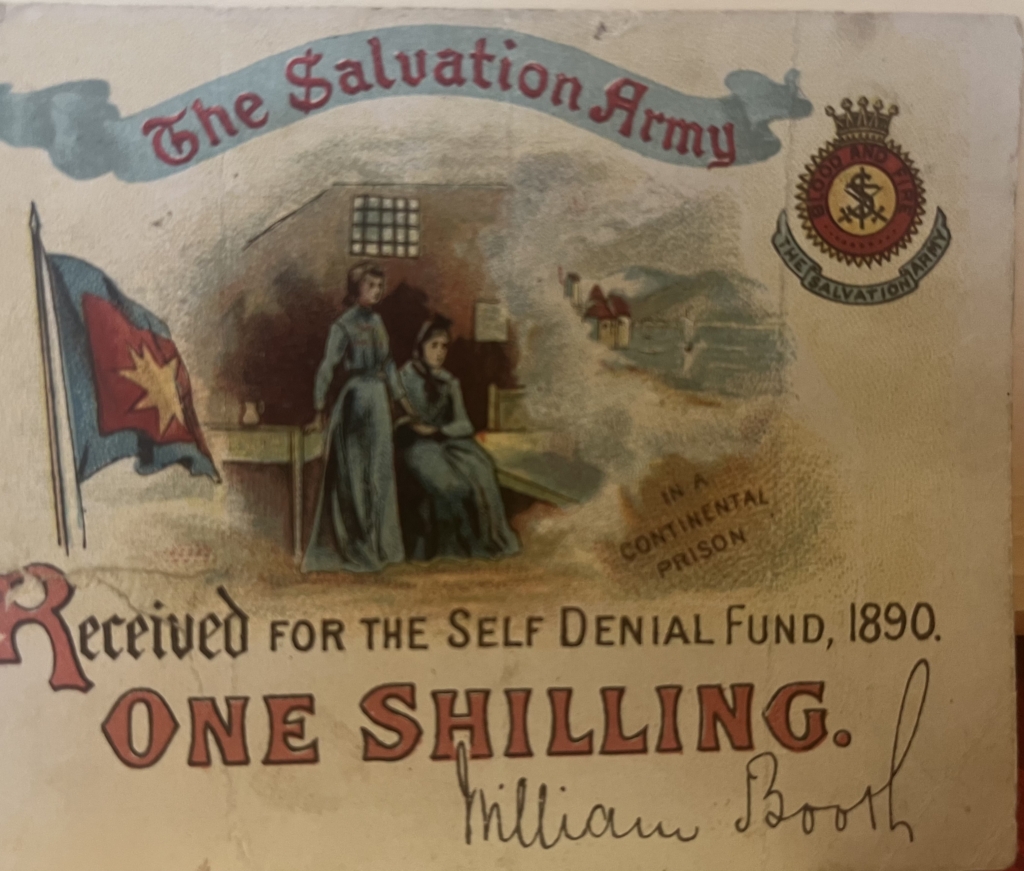
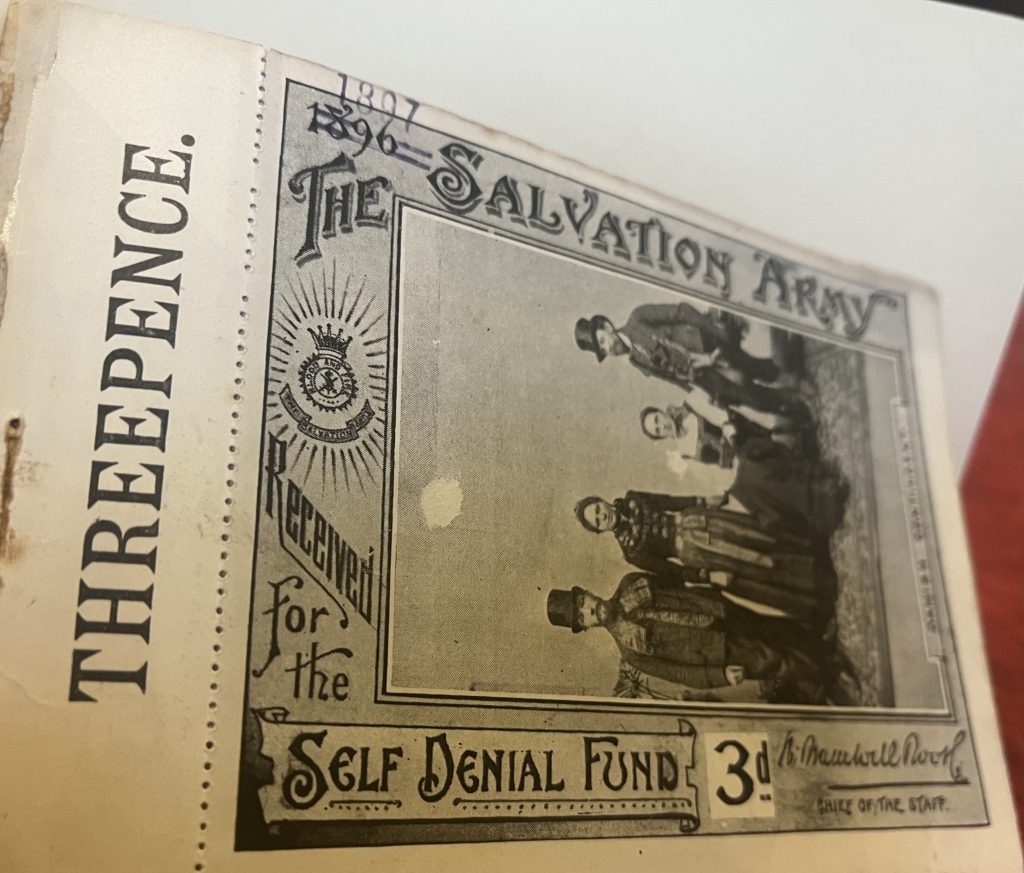
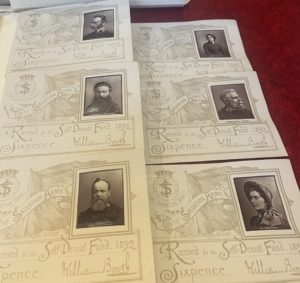
(How dull most modern receipts are)
These receipts were replaced by thank you book marks which are described in the appeal packs as to be left with donors as their ‘medal for caring.’
How do you build the thank you into your campaign planning? How do you make it memorable? You can imagine these pictural receipts displayed in homes. How do we continue the joy of giving with the thank you?
6. Value every gift
The guidance for the Self Denial Fund recognises that not everyone can give cash. It suggests that soliciting fundraisers even accept postage stamps to support the campaign saying ‘Many will give one or two postage stamps when they will not give money’.
Every little helps.
How can you value any contribution to your work?
7. Don’t forget to ask those who you help
In 1891 an ‘Out of love’ campaign targeted former residents of Salvation Army homes, inviting them to give a one penny a week back to repay some of the ‘toil, the care, the love and the expense which has been so freely and gladly expended on them’. If they gave enough they were gifted a Bible and their name was inscribed on the roll of honour.
Often charities shy away from asking those that have benefitted from the charity’s work to be involved in supporting it (not so much in the arts where audiences are asked.) This provides a small but meaningful way for those that have been impacted by the work of the charity to help. Giving back and saying thank you are often strong motivations for giving.
Whose life has changed because of your charity’s work and how can they be invited to join the supporter family?
8. Make it easy for people to do what you want them to do
The concept of self denial can feel too vague for some, so in 1889 a ‘Special Hints for Self Denial’ pamphlet was produced listing all the practical ways that you could participate. Examples were given of donating one day’s salary, buying less expensive food, put off paying for new clothes, walk and not using public transport. The funds could then be donated to the Salvation Army. It makes it easier to do.
Vague concepts put an additional cognitive load on our over stretched and lazy brains and too much to think about decide stops action. Make it easy for your supporters to know how to help.
How can you make it easier for them to do what you want them to do?
9. Show don’t tell
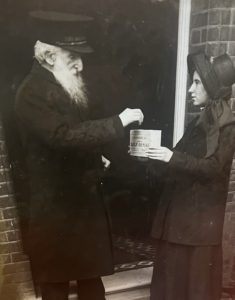
In an early ‘show don’t tell’ example we have a postcards of General Booth and other Salvation Army soldiers donating money into a Self Denial Fund box. Literally showing people what you want them to do.
(the earliest example of a self denial campaign was in 1209 when the canons of Angeirs Cathedral sacrificed the cost of feasts to support the capital campaign to build the cathedral)
How can you show your donors what you want them to do?
10. Mission matters but so does money
“there is nothing next to definite spiritual work, of greater importance that raising finance’
The Officer 1893
This mission is important but cannot be completed or attempted without the funds to back it up.
Has anything changed?
So from a 1891 idea for a red kettle that is still used today (hey, if it ain’t broke, don’t fix it).
Much in fundraising doesn’t change
- The need for good planning
- The importance of thank yous
- It is about them – not about you the charity
- Make it easy for your supporter to know what to do
- Show don’t tell
- Don’t forget those that benefit
- You cannot do good without money to do it with
It all feels very modern, and the changes that were made in the late Victorian period are seen in many ways that we fundraise today and in the innovative spirit of fundraisers.
The Salvation Army saw itself in direct competition with consumer market and so used the same tools and marketed “compassionate consumption”(Roddy, Strange and Taithe). They, along with other emerging brand charities like Dr Barnado’s, certainly embraced the advances in technology and the rise in mass fundraising communications.
They themselves recognised in 1893 the change that they were part of
“.. few organisations have been so successful in raising money as ourselves. This has been largely because we have set about it in a systematic, methodical, businesslike manner …. Our methods for raising money have been and are almost innumerable, the military nature of our organisation enabling us to act together with a uniformity and precision which to others would be almost impossible”
The Officer, 189
This ‘systematic, methodical, businesslike manner’ has ripples today in how we approach fundraising. The approaches introduced by them and others like St Barnado’s advanced the professional practice of fundraisers and have been proved to be psychologically powerful and effective tools for persuading people to give money to support much needed work.
- Did the ‘compassionate consumption’ approach mark a change in fundraising?
- Did the adoption of commercial marketing and promotion raise more money?
- Did the impacts of consumer culture, capitalism and technology change the essence of how fundraising was conducted? Away from the personal, dutiful gift, to a more mass produced and marketed machine which by its nature provided a more transactional (picture receipt anyone?) approach? Or in a industrial capitalist society were we always heading towards that?
Background on why this blog came about
After reading ‘The Charity Market and Humanitarianism in Britain 1870-1912’ by Sarah Toddy, Julie-Marie Strange and Betrand Taithe and learning all about all sort of interesting fundraising activities and methods I visited the Salvation Army archives in Denmark Hill. Interestingly the fundraising was all run from the Public Relations office and they have an archive of early fundraising examples from the 1880s through to more modern times. Fascinating to see. Like many archives it is a bit patchy and speaks to the issues of how we preserve and archive what is important.









Leave a Reply
Want to join the discussion?Feel free to contribute!