• Link to X
  • Link to Instagram
  • Link to LinkedIn
Marina Jones
  • My Thoughts
  • What I’m Reading
  • About Me
  • Contact Me
  • Home Page
  • Click to open the search input field Click to open the search input field Search
  • Menu Menu

Tag Archive for: Philanthropy

Gangster style fundraising

June 2, 2024/in What I'm Reading/by admin

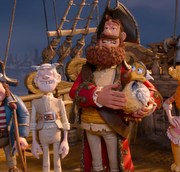
Before MrBeast and stunt philanthropy there was another stunt philanthropist on the scene – a gang of them in fact. Ferguson’s Gang – from the 1920s to the 1950s they fundraised for the National Trust.

But they didn’t just post a cheque with a donation. They wanted to make a splash with their donations so they always involved a stunt, often masked like gangsters, and helped generate publicity, and further funds.

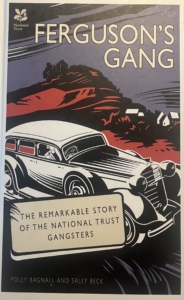
This was reported in The Guardian and I read the book detailing their activities, activism with more autobiographical details about the gang members – you can read for yourself.
Introduction to Ferguson’s Gang

In 1927, on a picnic the idea for the gang was formed to protect the natural world and historic houses from the ever expanding urbanisation and sprawl of London. They wanted to raise money to preserve the countryside and save beauty spots – England for them was Stonehenge not Whitehall.

The idea was formed by a group of women who decided that they would do this as a gang with gangster names – the gang names were:

  • Bill Stickers
  • Kate O’Brien The Nark
  • Red Biddy
  • Sister Agatha
  • Bludy Beershop

In total over their career, Ferguson’s Gang donated over £5,000 to the National Trust and preserved six properties including the Old Mill, Shalford, Trevescan Cliffs Sennon and Priory Cottages Stevenson.

So a little more about their approach and what is useful from a fundraising point of view.

Stunt philanthropy

Ferguson’s Gang recorded each donation as a ‘drop’ adopting the gangster argot.

Their first drop was in 1932. They had raised £100 but rather than a cheque or a banknote they used half crowns – half crowns were 1/8th of a British pound so this would be 800 coins. They put these coins in a gangster style swag bag.

So the first donation…

They arrived in a taxi, having stopped en route at luxury department store Harrods to purchase masks to hide their identity, rang the doorbell of the National Trust’s headquarters and handed over Ferguson’s Gang business card and were taken to see the Secretary of the National Trust. They were admitted and made their gift.

The novelty of the approach got them press coverage who reported ‘Some benevolent “gangsters” masked lady weighed down with swag”and encouraged others to make donations.

“Anonymity is a quality not unknown among donors of gifts to the National Trust, but rarely is generosity concealed by a disguise so mysterious that assumed by the benefactors … known as ‘Ferguson’s Gang’. … a masked lady, recently astonished officials of the Trust … Without lifting her mask she gave £100 in silver to the secretary”

The Times

Each ‘drop’ (except one) was reported in the paper.

The second drop involved Erb the Smasher (the brother of Bill Stickers) in a maskdelivering two £100 notes.

“Gangsters in England are not common but this is a type of gangster who ought to be encouraged”

Good Housekeeping

Sometimes however there stunts were a little risky and had the potential to go wrong. At the National Trust annual dinner in 1936 they made a drop – this time a £100 note was wrapped in a cigar and given to Lord Zealand of the National Trust. They then spent the evening in fear that he would light the cigar and destroy the gift! But luckily he realised in time.

The National Trust came to expect the drama of each drop and reported themselves disappointed when a Christmas Eve donation arrived in a sweet tin without the theatrics. Their acknowledgement to the Gang reports that ‘we didn’t think it up to standard.’

Their 1939 July drop at the National Trust’s AGM was perhaps their boldest.

With the threat of war and IRA activity in London, three masked figures burst into the meeting and presented the assembled National Trust leadership with what they feared was a bomb. It then became almost like a game of pass the parcel – it was handed to James Lee Milne, who passed it o Donald Macleod Matheson to Lord Zetland. Closer examination revealed that it was not a bomb but a large metal pineapple with the note

“Open this fruit and you will find a kernel greatly to your mind”

Inside was £100 note

This was widely reported in The Daily Telegraph as a ‘Benevolent Bomb.’

Aside – what would happen if Ferguson’s Gang made at a drop at your charity today?

A masked bandit arrives in reception with a business card and a swag bag, what would the response be?

  • sorry, we don’t take cash
  • sorry we don’t know the source of this wealth and need to go through due diligence processes
  • sorry we find the violent connotations of criminal gangs problematic and not aligned with our values
  • or would it become a viral TikTok sensation?

Power of cash

The ‘drops’ were always made using cash which is interesting to note.

With debates now on giving cash or contactless – physical money and for the gang coins were important. There is something more tangible about physical money – we can hold it, feel its weight and when we make a donation hear the sound it makes. When natural disasters happen, there is often a desire to give stuff not cash as we want to do something concrete and meaningful – you can read more about this here. When the ask is for cash there is something more meaningful and personal about cash rather than tapping a device. Cash can also be used to fund treats rather than traceable necessities which you can read more about here.

Before #FirstFiver there was another royal money fundraiser

#FirstFiver was set up in 2016 when the new banknotes were issued and it raised over £12 million when it was suggested by John Thompson that you donate your first fiver to charity.

Ferguson’s Gang had a novel way of raising some of their funds.
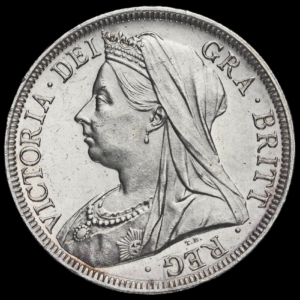
All coins they received with Queen Victorias head on had to go into the collection for their work. Queen Victoria had been dead for over twenty five years when they started collecting but evidently there were enough coins still in circulation to make this a good way of fundraising, but novel enough that it was not all the coins in their purse!

Let's hope round two of #FirstFiver is even more successful.

Spread the joy of giving by donating your first King Charles III £5 note from 5th June onwards 🙂@CIOFtweets @caf @NCVO @ACEVO #CharityTuesday https://t.co/bEBUJajslS pic.twitter.com/HQDj1Kad2s

— John Thompson, aka Johnny Five (@JTCHANGINGBIZ) May 28, 2024
  • In June 2024, the new Charles III banknotes are due out in the UK, who will you donate your #FirstFiver to?

Admin is important

Although an anarchic gang with bohemian tendencies administration was still important.

Ferguson’s Gang bought a stamp at stationers WHSmith with Ferguson’s signature to stamp on documents.

And at each ‘drop’ at the National Trust despite the clandestine nature of their operation they always waited for a receipt for the gift.

  • Even gangsters need receipts.

Identity – join the gang

One of the ways they raised their charitable funds was through subscription. When you joined as a subscribing member of the gang you got to choose your own gang name. This is a great way to show connection with the cause and identify as a supporter. Membership tier levels often have names themed to the charity.

  • How can you reinforce your supporters’ connection to your charity by giving them a linked name and identity?

Imitation is the sincerest form of flattery

In 1938 a copy cat gang called Black Atropine Sisters started who did some similar stunt philanthropy after The Daily Mail falsely reported that the gang has disbanded. It was reported in the paper that jealously of the new Sisters gang, reawakened the gang’s activities. The Black Atropine Sisters eventually joined up with Ferguson’s Gang on some stunts.

  • It can be great to learn from the best and adapt ideas from what you see working for other charities. But a word of warning, just because something works for one charity or gang, doesn’t necessarily mean it can work for you. You need to test what works for your donors.

How you can anonymously appear on the radio?

Ferguson’s Gang was invited to do the BBC Radio 4 charity appeal in 1935 for the National Trust.

How could they do that and retain their anonymity?

Bill Stickers’ brother, Erb the Smasher was roped in to do it on condition that the anonymity of the gang could be protected. So he delivered the message wearing a mask. He directly appealed for support for members (equating the membership fee to the same fee for a radio licence fee) and donations.

At this time, the National Trust was 40 years old with only 5,000 subscribers. The radio appeal resulted in a 20% increase in membership getting 300 new Associate Members at 2/6 and 600 members at 10/ a year. The largest donation was £100 and the smallest was 5d and £900 was raised.

(It also raises the question about those raising money on your behalf. Ferguson’s Gang were independent of the National Trust and could support or generate publicity and funds for any cause they chose to. Their unorthodox tactics generated a great deal of positive press coverage and added to support of the National Trust. The National Trust choosing them to front this appeal shows how connected they were. But there can be risks associated with unconnected people raising funds that could damage reputation (if a stunt had gone wrong….))

So how could you be more ‘benevolent gangster’ in your fundraising approach?
References

National Trust page on the gang

Ferguson’s Gang book

National Trust podcast on the Gang

https://marinajones.uk/wp-content/uploads/2024/05/mask2.jpeg 289 679 admin https://marinajones.uk/wp-content/uploads/2022/12/f2b903e010104f5aa61ea1821a685913.png admin2024-06-02 13:33:022024-06-02 13:33:03Gangster style fundraising

Donor journeys – medieval pilgrimage style

May 7, 2024/in Thoughts/by admin

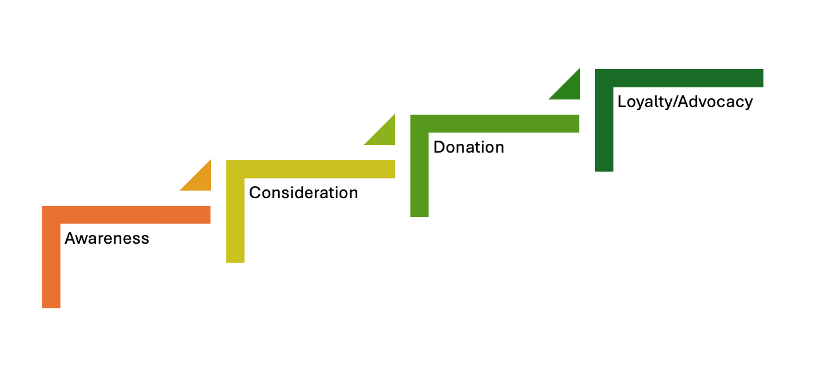
A donor journey is a map of how you reach donors and might in a simple form look like this:

Each charity has their own version (although they might call it something different) and it may have more, or fewer steps in it. 

And yes, it can be an oversimplified way to describe to a more complex and intricate process. But is a useful visual aid to think about the donor’s journey. 

How does it stack up when we apply it to the medieval pilgrimage & how they raised money? And, how does thinking about medieval pilgrims help us fundraise today?

Let’s take it one step at a time 

1. Awareness

How do people become aware of your charity? Your needs? And how you are trying to make the world a better place? 

Most donations come because someone was asked.

For medieval pilgrimages the pulpit was the place where awareness of pilgrimages was raised. Regular sermons would have told the people about the benefits, opportunities, and spiritual rewards of such a journey. 

There is a useful lesson for fundraisers here about repetition. It may not be every sermon that pilgrimages were mentioned, but the benefits were often repeated, and so awareness was raised and reinforced. 

Every second our brains are receiving millions of messages, but they can only hold a small number of facts at any one time. When something is repeated, we get better and quicker at processing it – our neurons rewire to process it faster as we become more familiar with it. This is called repetition priming, and it helps us process ideas better and more fluently.

Why else is repetition important?

Although you may very carefully craft your fundraising copy, or in the case of the pilgrimage – the sermon – people don’t read every word (sorry), or listen to every word you say. Repeating the message often makes sure that one of the repetitions get through. It should not be an exact word for word repetition, but a variation on the theme – as a different nuance, metaphor or example might be the thing that catches the eye, or ear, of heart of your potential donor. 

So, keep repeating your messages and your asks for support in your communications to make people aware of the need. The repeated exposure to your message will make it easier for your supporter to process what you need and what you are asking of them.

Repeat the message 

(did I say that already?) 

2. Consideration

After a donor is aware that you exist, they start considering and researching more about you – and to understand why they should give you their time and treasure.

For a pilgrim this might be talking to other pilgrims about the experience, a donor nowadays probably uses your website, the news, your social media feed.

Now embarking on a pilgrimage was an expensive undertaking it might take days (4 days walk from London to Canterbury where St Thomas A Beckett was murdered and buried), but pilgrimages to the Holy Land could take up to a year. So, you needed to be able to afford to get there (and back) and it would involve sacrifice, planning and thought.

Donor segmentation 

Certain pilgrimages routes attracted certain types of pilgrims.

In fundraising it is important to segment your donors and appeal to what appeals to them, to know your target market. The medieval church did the same and certain pilgrim sites were favoured by a subset of pilgrims – the shrine of St Foy was known for giving protection to French crusaders heading out to Spain, Walsingham in Norfolk for its royal visits with Henry III visiting twelve times (& every subsequent king of England visited including Henry VIII), whereas the Holy Rood of Bromham attracted more ordinary pilgrims. 

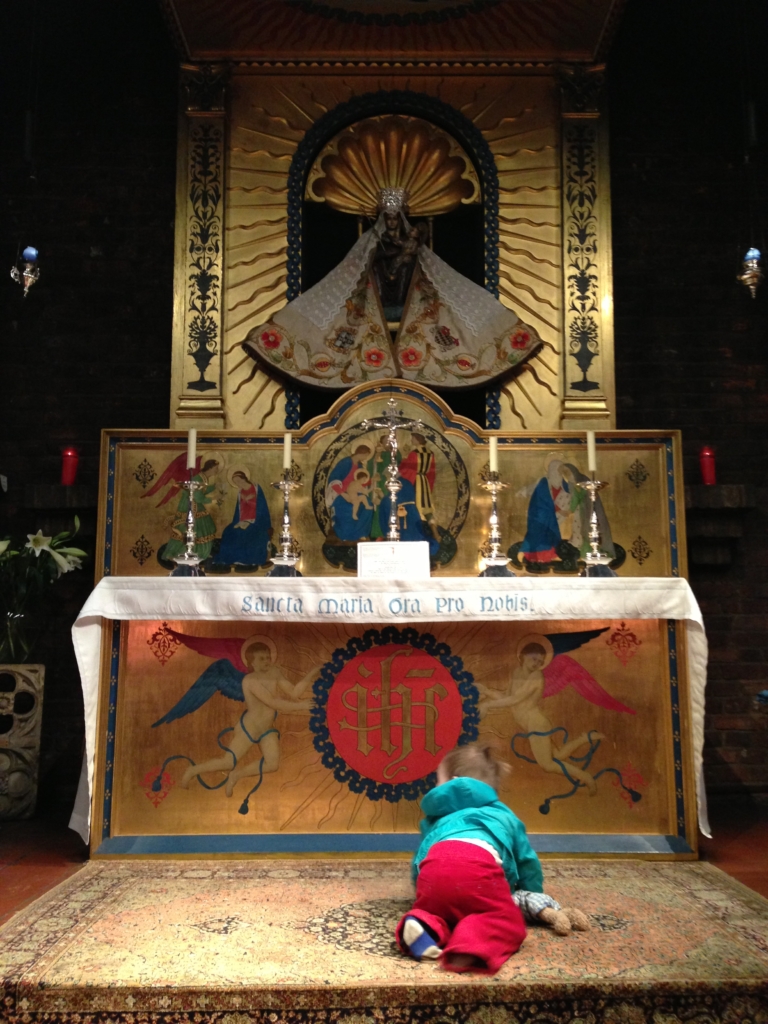
Our Lady of Walsingham (and my son)

Like deciding on the right pilgrimage and how long or expensive it might be, the donor needs to consider what is the right donation for them. In order to make a donation, your donor might need time to think about it and if it is a significant commitment then find, or save the resources necessary. 

  • How can you segment your donors, and your asks to suit their capacity and interests?

3. Donation 

By going on pilgrimage, you were committing to donate, and not just once but many times – on the journey as well as at the pilgrimage site.

The pilgrimage routes took you to, and through other churches and shrines, for example, Toulouse Cathedral made use of its location on the popular St James of Compostela pilgrimage route to maximise its donation opportunities and income. 

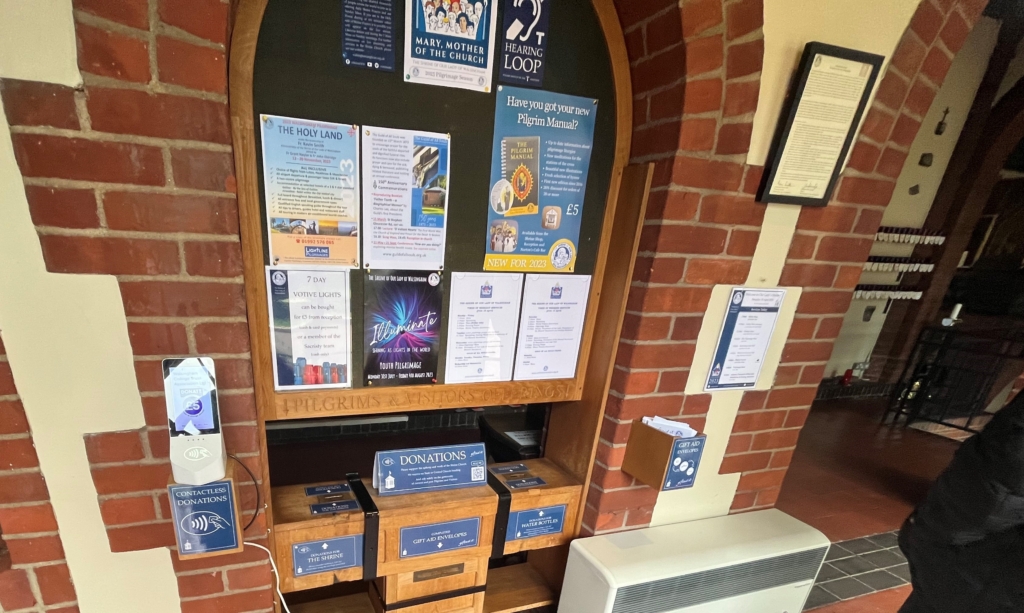
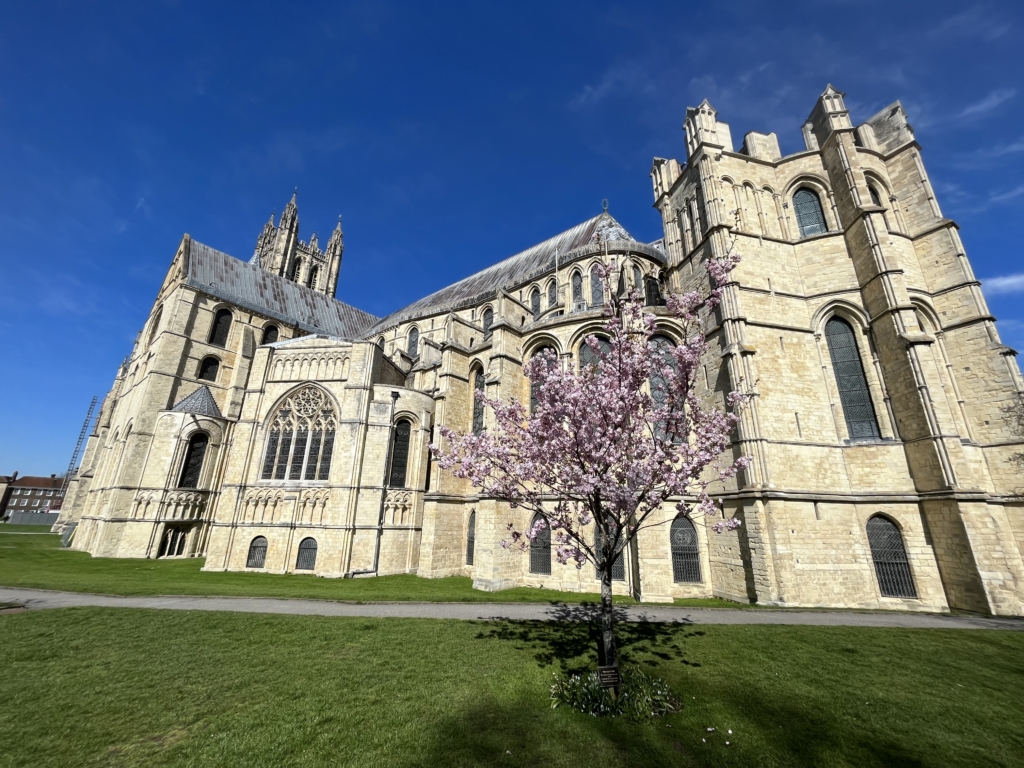
Once you reached the pilgrimage site there were plenty of opportunities and expectations to give. The East End of Canterbury cathedral had five donation boxes on the pilgrimage route around the cathedral (Again we see the importance of repetitions and mere exposure effect – we need to be reminded, repeatedly asked and exposed to the behaviours we want donors to adopt).

But also it is important to be asked for gifts and not just assume that the mere exposure effect will work – in Basel Cathedral a lay petitor would say in a loud voice when the cathedral opened ‘Donate to the construction of Our Lady and earn the great indulgence and great pardon’

  • How is your user journey or website reminding and giving repeated opportunities to give? 
A variety of donation boxes in Walsingham today

And how do you encourage more donations at the site?  

How we think about money – Mental accounting

One way to get your pilgrim to spend more money (on top of the donation) was through fairs where pilgrims could spend time, buy food and enjoy themselves. Events fundraising and paying a premium to be eating, drinking and supporting a good cause has been around for thousands of years. In 1248 there was a 15 day fair to accompany the moving of Edward the Confessor’s body to Westminster Abbey – to maximise the opportunity all other local fairs were banned (the importance of that exclusivity clause in your donor agreement!) 

We use mental accounting to allocate our money – our charitable gifts, our religious duty, our food expenditure or leisure and pleasure budgets. Whilst donations on the pilgrimage route, or in the church, may have come out of the religious duty or charity mental account – additional money spent at the fair would come out of leisure and pleasure account. So you get two bites of the cherry.

  • How can you provide different ways for donors to give that come from different mental accounts?

Social proof by testimony

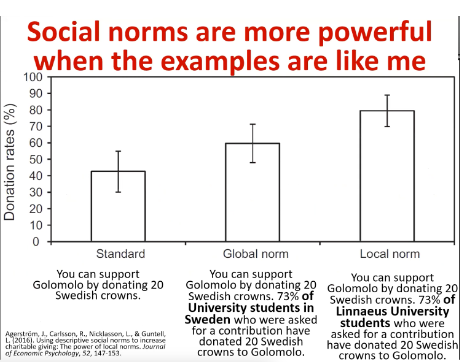
As part of the journey around the pilgrimage route around the shrine there were often individuals testifying to the power that the saints have made in their lives through cures or prayers answered. The person who delivers the story (fundraising or miraculous cure) has a huge power and influence  – if we see someone like us – the same gender, from the same place, with the same accent, the same age, the same profession or identity doing something – and they are a likeable and credible person – that encourages us to believe what they say, and do what they ask. This offers a strong social norm for us to follow and be shown to work effectively in fundraising. This example comes from academic research and shows the real power of social norms when ‘people like me’ are used  


If we match the messenger to the donor we will increase the success rate.

  • How can you tell the stories of the impact of donations to encourage more gifts?
  • How can we demonstrate that donors like them give?
Canterbury Cathedral

4. Loyalty/Advocacy 

Donors can be your best and most powerful advocates. 

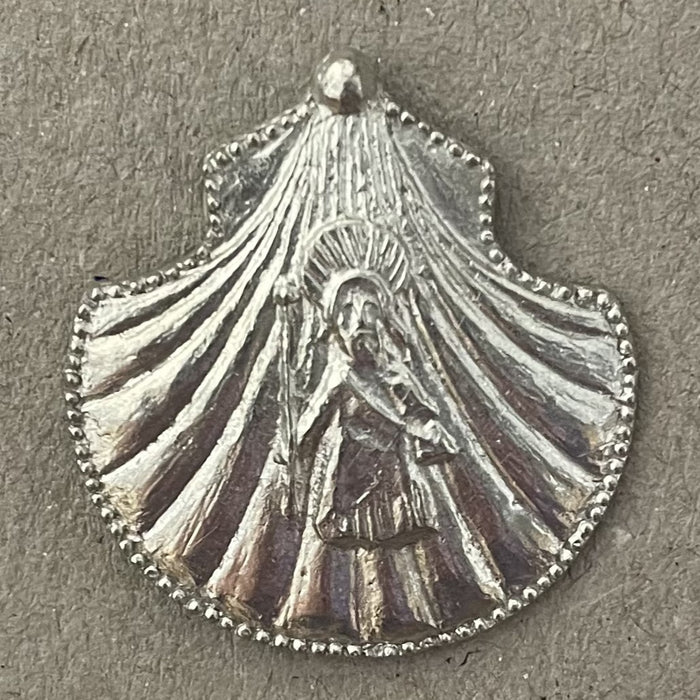
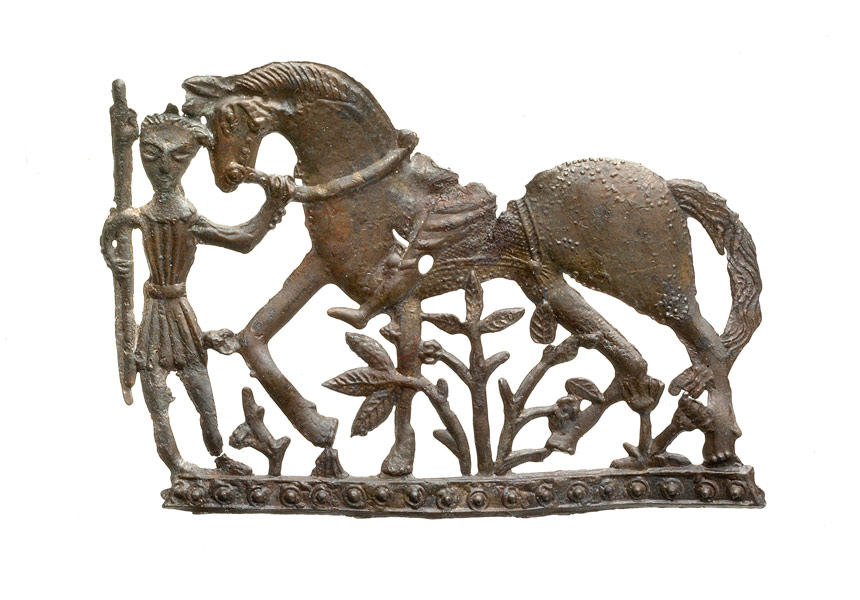
One way to help them demonstrate their loyalty and live out their identity as part of your tribe is through merchandise – and the medieval pilgrim market had this covered with pilgrim badges. These could be bought as souvenirs to demonstrate your identity as a pilgrim, to show you had been on pilgrimage and helped also raise additional funds (and come from a different mental account!) You wore them on your cloak or hat, put them in your prayer book or could nail them up at home. They showed to the world that they had been on pilgrimage and what tribe they belonged to. Each shrine had its own badges so you could collect them from various shrines demonstrating your piety and connection. 

Pilgrim badge from St James of Compestella
Pilgrim badge
  • How can you find ways for your donor tribe to demonstrate their loyalty?

By looking at medieval pilgrimages and how they raised funds, we can see some applications that can be used in our fundraising today. So

Repeat the message.

  • Segment your donors.
  • Target them with special offers.
  • Use powerful testimony of messengers like them.
  • Show the impact of gifts.
  • Provide opportunities for them to spend from different mental accounts.
  • Find ways for them to demonstrate their loyalty.
  • Repeat the message.

https://marinajones.uk/wp-content/uploads/2024/05/IMG_5520-scaled.jpeg 2560 1920 admin https://marinajones.uk/wp-content/uploads/2022/12/f2b903e010104f5aa61ea1821a685913.png admin2024-05-07 15:03:132025-07-25 16:37:57Donor journeys – medieval pilgrimage style

Hidden History of Fundraising – Podcast

March 24, 2024/0 Comments/in Thoughts/by admin

To listen to more about the history of fundraising you can listen to me on the Third Sector Podcast talking to news editor Andy Ricketts and senior multimedia reporter Lucinda Rouse on the development of the fundraising profession and perceptions of charity fundraisers through the ages.

You can hear about the parallels between contemporary fundraising methods and instances of their use centuries before, as well as past mistakes that could be avoided by better knowledge of fundraising history. It includes lots of examples of fundraising history, including a cathedral tower that was constructed by incentivising donors through a reprieve on a ban on eating butter during Lent.

You can listen here:

https://www.thirdsector.co.uk/third-sector-podcast-hidden-history-fundraising/fundraising/article/1866255

https://marinajones.uk/wp-content/uploads/2024/03/Sommet_de_la_tour_de_Beurre_de_la_cathedrale_de_Rouen.jpg 300 450 admin https://marinajones.uk/wp-content/uploads/2022/12/f2b903e010104f5aa61ea1821a685913.png admin2024-03-24 12:51:542024-03-24 12:51:55Hidden History of Fundraising – Podcast

Eat butter & get drunk: How to raise money for a cathedral

March 15, 2024/0 Comments/in Thoughts/by admin

Building, maintaining and rebuilding cathedrals and monasteries was an expensive and ongoing business.

Here are just some of the ways in which funds were raised from the tenth century to the fifteenth. Many of which we see today in various forms for capital campaigns, or other appeals, and others we can adapt.

  • Eat Butter

What have you given up for Lent?

If you had permission to break that in exchange for a donation would you?

During Lent, the faithful were to abstain from meats, dairy and eggs, which mean that the townspeople of Rouen could not enjoy Normandy butter. However, if they made a donation of 6 deniers Tournais to Archbishop Robert de Criosmare’s fabric fund for the cathedral they would be let off their Lenten discipline and permitted to eat butter.

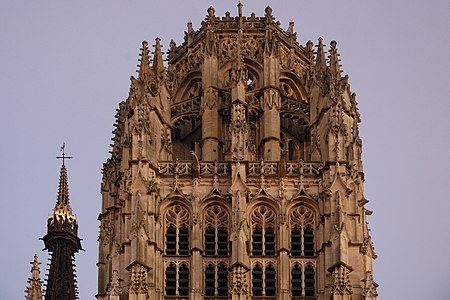
The fundraising by this exemption was so successful that it raised enough money for the tower of the cathedral – which is known to this day as the Tour de Beurre (Butter Tower) because of where the funds come from (and that is made of local yellow limestone that has a buttery hue!)

Butter Tower at Roeun
  • Sponsor a window, a pillar, a figure, a chapel, a candle, an arch, a day’s labour, a year’s labour

Basically you can sponsor anything.

We like to be able to know what our contribution did – to say to others or just to ourselves ‘I did that’. The options within cathedral buildings were endless – arches, windows, chapels, figures on a portal (at Notre Dame they originally planned to have 28 chapels but the popularity of chapel support locally meant they had over 50 chapels were installed – how’s that for donor dominance!).

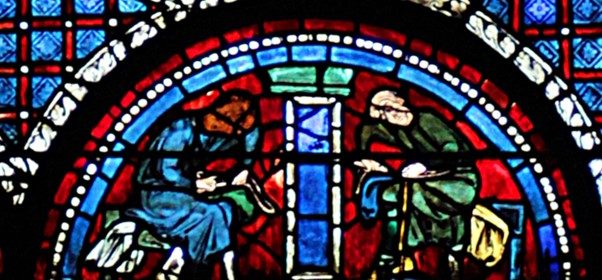
Windows proved to be one of the most popular ways that individuals or local trades could show their support and the sponsor is often shown in the window – so we see windows from fishmongers, clothshearers, leather dresses, masons and church builders.

Shoemakers guild contribution celebrated in stained glass at Chartres

(Although, the cathedral in Tournai complained about the ‘pompous trimmings’ of the excessive donor led art projects that supported additional decoration rather than the building of the cathedral – donor dominance even then!)

It was not just physical capital items that were supported. People also made donations to fund positions – for a day, for a week, for a year. Again demonstrating that every contribution can be attributed to part of the project. It is easier for our brains to process and understand – 3s pays for one day’s labour than to grasp the complexity and cost of a whole building project.

Nowadays capital campaigns allow people to do everything from name a building or a room, but also the smaller and more tangible items from a light switch to a toilet brush, well as supporting the salaries of posts.

And the church were creative and offered lots of opportunities to credit donors – from donor books, coats of arms on walls, pictures in painting and windows and many more. In Strasbourg each week they held an elaborate ceremony on Sunday after the high mass reading out the names of the donors to the fabric fund and writing their name in the Liber Donoatiorium (donation book) For more about donor recognition in churches see this earlier blog about donor recognition or the IWITOT (I wish I thought of that session) about donor recognition on SOFII’s website.

Although as well as crediting donors, these memorials could be used to name and shame. In the donor book of Milan it lists that ‘all the braiders of Milan except Giorgio Coiro‘. So poor Giorgio is forever immortalised as the one that did not pay (maybe don’t try this with your donors!)

Donating money to have the bells rung for the living or the dead could also grant you an indulgence. Indulgences could be offered, reducing the amount of time the donor spent in purgatory, and hence placing them nearer to heaven. But it was a core thing that needed to happen and be paid for – a great way of funding those core costs.

How can we chunk our campaigns into chunks so that people can know that they have supported a specific thing to happen?

How can we recognise and celebrate those gifts in creative and aligned ways?

  • Gamification and competition

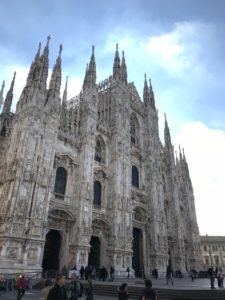
In Milan in the 1380s what galvanised the capital campaign for the cathedral was some healthy local competition. One local neighbourhood, the Porta Nuova gate started a weekly collection. The next week the Pavia Gate started, with the aim of being seen more generous than their neigbours. And the competition spread.

How can you introduce fun and friendly competition into your campaign?

  • Tap into supporter identity
Milan Cathedral

The competition between the Pavia Gate and the Port Nuova above highlights the importance of hyper local identity.

Every supporter has several identities that reflect who they are (or how they want to be seen as their ideal version of themselves) your fundraiser message can connect with these identities – as a Christian, as a Catholic, as a proud city resident. But identities go deeper and hyper local. In Milan there are dedications and donations from ‘the young men of the East Gate‘ – this is not just an affinity to the city, or to the cathedral, or saint, but to the local area –

Where are the identity triggers with your donors? How do you provide segments that reflect true and deep connections?

  • Calendar highlights

Church campaigns used high days and special holy days to enhance campaigns. For example, Assumption-tide was used as a way to galvanise campaigns. The relic quests (which you read more about here) often worked between Pentecost to Assumption (partly because of the weather).

Most religions have seasons when charitable giving is particularly encouraged like Ramadan or Lent, that can be used as times to encourage giving. Or anniversaries (of your founding, of a specific event) can be used as a hook for a campaign.

How can you use dates and moments in the year to bring life to your campaign?

  • Be organised

Milan cathedral had an organising committee of 12 nobles, 9 canons, 16 citizens and 3 lawyers (and 20 notaries were busy copying out the bishops letters to diocesan clergy requesting support). One hundred local citizens also oversaw the work being done checking the quality of materials and work being done. Fundraising is not a lone task of the fundraiser working away on their own or with their team it needs the whole organisation to be involved in supporting success. It also requires planning and strategy.

Milan was built relatively quickly there are other examples when fundraising stalled because of plague, war, the Crusades or other political upheavals. The most successful campaigns had a visionary champion who believed in the project and excited others and got them organised.

The Canterbury register of donors opened 8 years before the building began!

Have the structures and processes in place – budgets, targets, ROIs, LTVs are important and you need the staff infrastructure to support success.

Who are your champions that can excite your supporters and your staff?

  • Gifts in kind

As well as financial donations, gifts in kinds of bricks and stones from other were also welcomed.

“If I were a shepherd I would bring a lamb” (from the carol In the Bleak Midwinter)

Devotional gifts also included a horse, a basket of cherries and an egg.

How can you encourage gifts in kind of the things you need?

  • Authority figures

In 1171 the Bishop of Norwich sat on the cathedral entrance to accept donations from the faithful. We are influenced by the messengers that ask for gifts, but also get an extra warm glow from making the donation to someone important.

  • Leadership gifts

In a capital campaign you always want a leadership gift – a big gift from a significant person – with authority and integrity to lead the way for others to support. Often in the Middle Ages this would be the Bishop or the Cathedral chapter.

  • Going once, going twice ….

People donated and bequeathed items to the fabric funds and these were put up for public auction to raise funds. These included gowns, boots, towels. jewellery, furs, daggers, helmets, gauntlets, and silver slippers. These seem to have been sold at a commercial rate rather thank like an auction generating over the odds prices as a way to support the charity.

  • Employee involvement and the Ikea effect

The challenge for fundraisers can be finding an appropriate and useful way for partners to be involved in your project – it can be painting, gardening, volunteering at an event but it tends to be an important way that the employer can demonstrate their impact and charity credentials and build teams.

This was not a problem for our medieval counterparts, as using free labour was part and parcel of building a cathedral. Various guilds and confraternities would come and offer free labour for a day or a week.

As well as burly people to get the job done, this also has an added effect of creating a deeper senses of engagement and commitment to the cause. The Ikea effect means we value something more if we have been involved in its creation (like the flat pack furniture) – the involvement of the armourers or the drapers had a vested interest in the success and use of the cathedral by donating their time to building it.

How can you get people involved in the cause to make them feel more involved? They may not be able to dig a foundation but how can they feel connected to making things happen?

  • Donation boxes

Donation boxes are nothing new and recorded in the Temple in Jerusalem in the time of Jesus.

In Milan in the fourteenth century, a donation box was placed next to the work building the cathedral encouraging more donations.

There is always an argument about how effective they are for actually gathering donations, or whether they are more useful for the mere exposure effect of the need (and there is more about their power and persuadability here). Perhaps they were particularly effective on relic tours, when after an emotive sermon two trusted men would solicit donations.

  • In memory giving

Giving in memory of someone we love can elicit a bigger and more emotional gift. In Milan we see some early in memory giving for ‘by Francischino Carcano for the soul of Sempliciano Limit who formally resided with him‘.

How can we use the emotions we feel for other people (dead or alive) to inspire gifts?

  • Anonymity offered

Not all donors want their name, their guild or their crest displayed it is important to be able to offer donors the choice to be anonymous – this example from Milan ‘offered on the high altar by a certain illustrious and exalted lady who would not be named’

It is always a good option to allow your donor’s the choice to remain anonymous.

(But sometimes anonymous can be an excuse for even more credit and this clip from Curb Your Enthusiasm about anonymous donations)

  • Location, location, location

Toulouse Cathedral made use of its location on the route to the St James of Compostela pilgrimage route so its donation boxes did particularly well.

  • Use the power of celebrity

When Pope Innocent IV stayed in Lyon 1245-51, the lagging cathedral fabric fund had a huge boost. Using the power of celebrity can help increase donations to the campaign – with the pope you have a celebrity and an authority linked to your cause.

  • Make the most of bad things happening

Archbishop Richard le Scrope was executed in 1405 for his part in the Northern Uprisings. Pope Innocent VII excommunicated those that had been involved in his trial. He was buried at York and viewed as a saint and martyr by some. York had been lacking a saint, and the veneration of Scrope’s relics increased revenues and donations.

(As an aside – he is one of the traitors, along with Westmoreland, in Shakespeare’s Henry IV Part Two – where he is definitely a traitor not a saint)

  • Myth making and reality

There is an enduring myth that Henry II built Poitiers cathedral. He is depicted with his wife and children in the central Crucifixion window. In reality it was a much more communal effort with his contribution, the bishop, the chapter, other parishes, burghers and local craftspeople. After capital campaigns, certain myths develop about how it was funded and by who.

  • Questions over whether you can accept money from Prostitutes of Paris

Having a policy and concern for repetitional risk in accepting donations is nothing new – generally the church disapproved of usury (taking interest) but the clerics of Notre Dame had some interesting discussions about whether to accept donations from the guild of prostitutes – read more on concerns about tainted money below:

https://twitter.com/Philliteracy/status/1463986789757161476?s=20

Make sure you know who you will accept money from, and a have a plan on how you assess their suitability

  • Get drunk

From the tenth century at least the use of church ales was common place to help raise much needed funds. These were social occasions with much beer, dancing and games. Parishioners allocated members of the parish to brew the beer which was sold at a premium to raise funds. These ales were also used for raising support for members of the parish who had fallen on hard times and were a form of horizontal philanthropy and mutual aid. These ales were also used to help newly married couples – which is where the word ‘bridal’ (bride-ale) comes from.

Although this practice as open to abuse and sometimes people just got drunk and claimed it was ‘for charity’.

Social fundraising like gala dinners and balls continue to be a tried and tested way to raise funds with people paying over the odds/commercial rate to support a charity and/or enjoy the social time.

Make fundraising fun and social and create events where people can come together to support you

And some practices that we will not be adopting

  • Confiscating property of heretics and those of other faiths (especially Jews)
  • Enforced taxes and tithes and contributions from other parishes
  • Using the confessional (in Strasbourg) to stress the importance of donation
  • Priest needed to be at the drawing up of wills so the importance of gifts for salvation could be stressed (in Toulouse in the thirteenth century). In Strasbourg in 1283, the city stopped all bequests to the church because of the undue pressure put on the dying and the protestations by heirs.
  • Arresting donors that don’t pay up – Michel de Lucy (son of the King and Archbishop of Bourges) was compelled to pay to restore the cathedral by his father the king. When he did not pay, he was arrested in Paris and forced to pay.
  • In St Luke’s Gospel it says “for which of you desiring to build a tower, does not first sit down and count the cost, whether he has enough to complete it” – words not taken on board by many medieval cathedral builders!

In 1544, Emperor Charles V wanted to donate a new rose window to Utrecht cathedral but they had to refuse as they could not afford the installation costs.

So what can we learn from medieval cathedral building schemes

  • How can you get people involved in the cause to make them feel more involved? They may not be able to dig a foundation but how can they feel connected to making things happen?
  • How can we chunk our campaigns into chunks so that people can know that they have supported a specific thing to happen?
  • How can we recognise and celebrate those gifts in creative and aligned ways?
  • How can you use dates and moments in the year to bring life to your campaign?
  • Where are the identity triggers with your donors? How do you provide segments that reflect true and deep connections?
  • How can you encourage gifts in kind of the things you need?
  • Who is receiving the gifts?
  • How can we use the emotions we feel for other people (dead or alive) to inspire gifts?
  • Make sure you know who you will accept money from, and a have a plan on how you assess their suitability
  • Make fundraising fun and social and create events where people can come together to support you
  • Who are your champions that can excite your supporters and your staff?

References

‘How a Cathedral was Built in the fourteenth century’ by E Bishop (1898)

‘Two thousand years of disreputable history’ by Redmond Mullins

‘Gold Was the Mortar The Economics of Cathedral Building’ by Henry Kraus

‘Conviviality and Charity in Medieval and Early Modern England’ Judith M Bennett Past and Present 1992

‘Financing Catherdral Building in the Middle Ages the Generosity of the Faithful’ by Wim Vroom

https://marinajones.uk/wp-content/uploads/2023/04/shoemakers.jpg 280 602 admin https://marinajones.uk/wp-content/uploads/2022/12/f2b903e010104f5aa61ea1821a685913.png admin2024-03-15 21:09:482025-09-07 13:56:48Eat butter & get drunk: How to raise money for a cathedral

Murder on the Dance Floor – Extraordinary How Potent Cheap Music is 

January 24, 2024/0 Comments/in Thoughts/by admin

Saltburn ends with Barry Keoghan dancing to Sophie Ellis Bextor’s 2001 pop hit ‘Murder on the Dance Floor’ – for those that remember it from 23 years ago it will have specific associations and memories – a certain bar, lifestage or nightclub (and for some it may have completely passed you by).

Our brains are wired to emotionally respond to music which is why certain songs have a power to transport us physically and emotionally to a moment – a university bar, a crush, a city, a holiday, a road trip, childhood, someone we love. Familiar music, especially music with vocals, causes a psychological response (increased heart rate & blood pressure) – music is wired to our memory.

And our brains are constantly rewiring and making and remaking associations to music, so ‘Murder on the Dance Floor’ may become newly associated for you with Saltburn, as well as keeping a trace of the former memories.  

Sound is one of the most powerful senses we have, but one often under used in fundraising. 

Listening to music can give you thrills and produces endorphins and activates the brains reward circuits. 

“Music does a lot of things for a lot of people. It’s transporting, for sure. It can take you right back, years back, to the very moment certain things happened in your life. It’s uplifting, it’s encouraging, it’s strengthening.”

Aretha Franklin

The power and embodiment of music can be seen in this former ballet dancer with Alzheimer’s hearing Swan Lake and recreating the steps

At the Coliseum we recently had Marina Abramovic’s opera project 7 Deaths of Maria Callas which used seven famous arias of dying sopranos to explore the life of Maria Callas. The first one was from La traviata – the aria at the beginning of the final act where a dying Violetta is contemplating her imminent death. For me, this 6 minute aria, was like a concentrated experience of the opera. Despite just having this extract, and not seeing the previous two acts, every time I saw this aria it moved me to tears as I could feel and remember the emotions I would have experienced watching the whole piece, and knew where we had reached in the plot, and what was coming.

Mood music 

The cues music can give us are subliminal nudges, that can impact our mood, but also our behaviour, how fast and what we eat, and what we buy.

Music with a faster tempo makes us eat faster, and people tend to spend more money and eat slower when jazz or classical music is played. Think about the ambient background music you might have in a restaurant – fast and pop for somewhere that wants to turn tables, and more mellow and chilled for a restaurant that wants to encourage you to spend longer, spend more and enjoy the experience. (Although music can also be used as a deterrent, a Welsh branch of MacDonalds plays classical music after 17.00 to deter anti social behaviour)

This real life experiment in an East Midlands supermarket shows how the background music has more impact that we might think it would

  • When French music was played 75% bought French wine
  • When German music was played 73% bought German wine

When asked about their choice of wine, and whether the music had impacted their choice, only one of those surveyed noted the impact. (North, A. C., Hargreaves, D. J., & McKendrick, J. (1999))

What does your brand sound like?

Brands use sounds, known as sonic branding, to help us readily recognise them:-

MacDonalds has ‘I’m lovin’ it’ https://www.youtube.com/watch?v=tfhlEP8LT4k and Intel has the ping https://www.youtube.com/watch?v=-ihRPi4wcBY

Coca Cola used this image and the slogan ‘try not to hear this’ to evoke the sound of the fizz of the bubbles (there were also adverts showing a detailed close up of the ring pull being pulled back, and a bottle opener opening a bottle). The advert invites us to hear the remembered sound and trick our brains to almost hear it.

What does your charity brand sound like?

The RNIB has recently released  a sonic identity https://www.rnib.org.uk/about-us/sonic-logo/

But what has it got to do with fundraising?

We know sound (and taste/smell – think Proust and the madeleines) are some of the most powerful senses but unless you have the budget for a TV ad (or create a ‘scratch’n’sniff appeal) they can be underused in fundraising appeals (in direct mail or adverts.)

We know that we and our supporters receive information in many ways – that the words are only part of it, and that the real and imagined images we use have an impact – as does the weight of the paper, the design of the piece, the feel of appeal in the hand, the order we present information. We know that appealing to many of the donor’s senses can make our appeals more vivid and effective. So, we might appeal to donors to remember a sound (children crying) or imagine a future sound (children laughing), but we largely rely on the words and the visual of the design of the pack – letter, the lift letter, response mechanism, the call to action.

For someone working in opera and fundraising, the sounds created and remembered are key – the emotions they stir in audiences from the dopamine of anticipating what it will feel like to hear that music again, to the oxytocin of the emotional engagement with the story – music is so important. And not just the music, but the whole holistic and acoustic experience of the performance, of being together, with an audience, inside a theatre.  The hubbub in the bars before hand, the orchestra tuning up as you take your seats, the silent anticipation with the audience holding its breath before the curtain rises and the applause at the end.

How can we integrate soundscapes into an appeal?

  • How can we create appeals that bring more of the sound world – real, remembered or future created by the donor’s action into our appeals?
  • How can technology help us integrate and create an immersive sound world?
  • How could we use sound to provide a richer and deeper connection with our donors? To their memory? To their identity?
  • What segments of donors will this soundscape be most effective with?

I have some ideas that I am developing to try and find ways to test, gamify and play with sound in supporter communications and see if it can be used to enhance the communication and their connections.

https://marinajones.uk/wp-content/uploads/2024/01/fTlCNdgFhcW1V5-OO8UV6xT-xw1k-LGXcpTIN_sgpSY.jpg.webp 576 768 admin https://marinajones.uk/wp-content/uploads/2022/12/f2b903e010104f5aa61ea1821a685913.png admin2024-01-24 08:24:142024-01-24 08:24:14Murder on the Dance Floor – Extraordinary How Potent Cheap Music is 

Fundraising fundamentals – Red kettles, self denial & picture receipts

November 30, 2023/0 Comments/in Thoughts/by admin

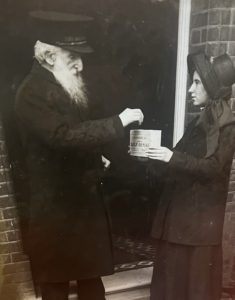
The Salvation Army Christmas red kettles are perhaps one of their most well known ways of raising money and especially at Christmas time – seen on Friends, When Harry Met Sally and countless other shows. 

The famous Salvation Army red kettles first appeared in 1891 when a former sailor and Salvation Army Captain Joseph McFee was thinking about how to raise funds to provide the poor of California with a Christmas dinner. He remembered how when he was a sailor at Liverpool Docks there was an iron kettle called ‘Simpson’s Pot’ for donations for the poor. He used this idea to set up a kettle and with the slogan ‘Keep the Pot Boiling’ – a tradition was born that lasts to this day. 

Looking back to when Joseph McFee came up with this idea we can see a whole wave of fundraising innovation and inspiration from the Salvation Army. I recently had a rather fundraising history geeky trip to their archives to see some of them for myself. And here are 10 fundraising fundamentals from the archives of the Salvation Army.

Background

Founded in 1865 as the East London Christian Mission by William and Catherine Booth. It sought  to bring physical and spiritual salvation to the poor and destitute – and is often known for the 3Ss – Soup, Soap and Salvation. A radical reassessment of mission involved a rebrand turned the mission into the Salvation Army in 1878 when William Booth became the first General led to rapid growth and expansion with work staring in America and Australia in 1880. The reshaping of it into Army with a General as a leader, army officers and members as soldiers also involved a radical overhaul of its fundraising need as it expanded beyond its East London base and sought to bring that salvation to the world.  The Salvation Army was one of the first international big brand charities.  In 2023 it has over 1.7million members and is the largest non-governmental provider of social services in the US and is active in over 133 countries. 

Alongside the red kettles the other most notable campaign is the annual Self Denial Fund. Which began in 1886, when John Aiken Carleton could not donate a big gift, but decided to give up puddings and donate the money saved to the Salvation Army. This became an annual campaign which all soldiers were asked to participate in and recruit others to donate to funds at the same time. And again, continues to this day. 

What fundraising fundamentals do we see at work? Why do they work – now and then?

1. Use the latest technology

Fundraisers have always adopted and used the latest technologies to raise money in new and creative ways. So now we might be thinking about how AI, ChatGPT or the latest social media viral video can be used to gamify our fundraising. 

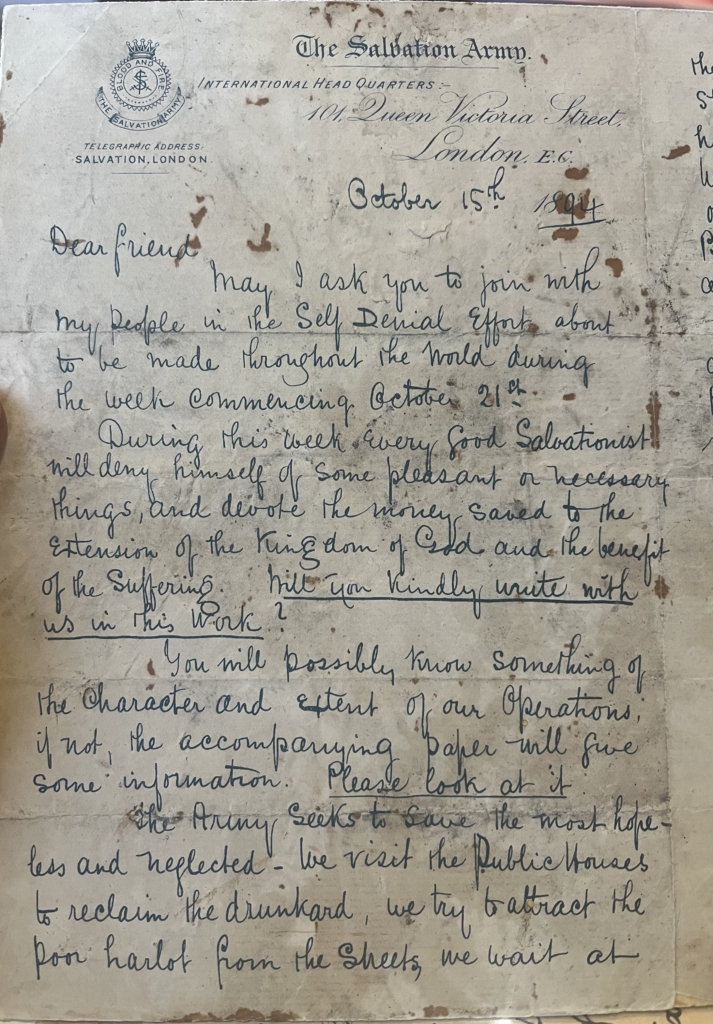
In Victorian times it was no different. The Salvation Army grabbed the opportunity presented by the new photolithography machine. Basically this was an early form of photocopying and it allowed you to make cheap and effective copies of appeal letters. 

So that the appeal letters that they sent looked like they were handwritten to you from General and Catherine Booth, the two leaders of the Salvation Army.

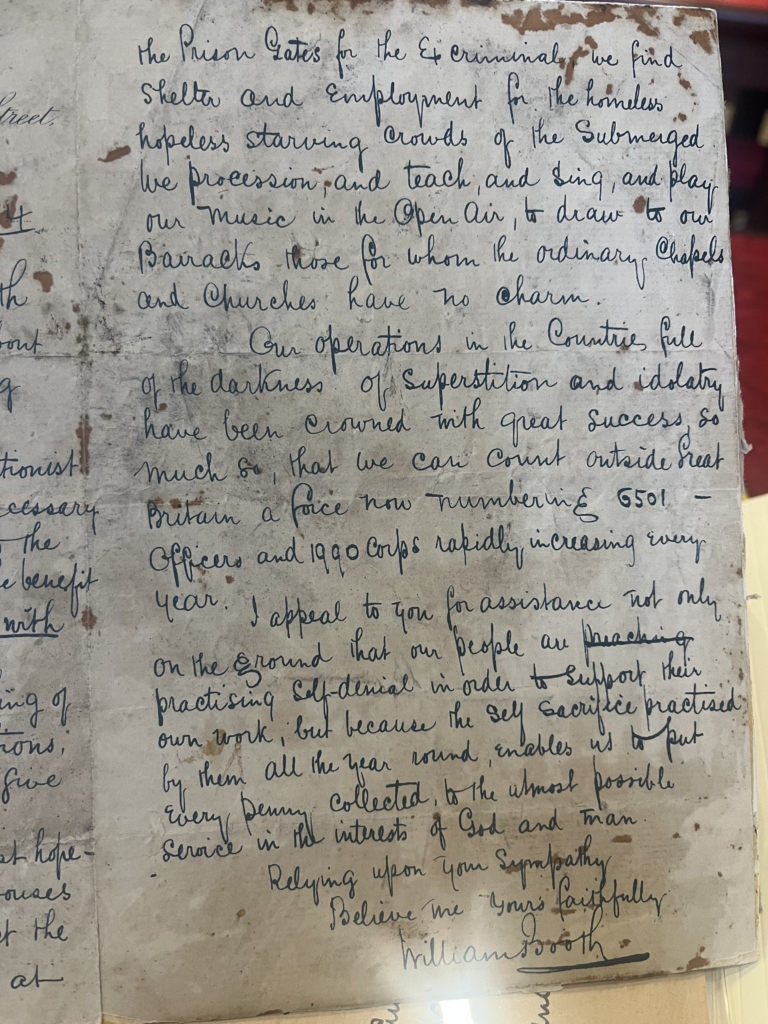
General Booth 1894 Self Denial Fund appeal letter
The photolithograph captures his handwriting and brings the personal touch

Seeing the copies of the letters in the archives it is hard to believe that they are not really handwritten – they are a blue inky colour (it is tempting – but I didn’t- to lick your finger and smudge it to see it is a really written in ink). So they do really look like a personal appeal. 

We are all attracted by the novelty and using the latest technology can make our appeals go further and also entice donors to the cause.

We also pay more attention to handwriting rather than just printed text – it stands out and catches the eye and therefore the attention of our supporters. 

Making a direct appeal letter stand out 

Underline – emphasising something and making it stand out more for the reader. Like any good direct mail fundraiser General Booth uses it sparingly to add stress to phrases and sentences. 

The lines Booth underlines in the 1894 appeal are ‘Will you unite with us in this work?’ and ‘Please look at it’ referring to the leaflet associated with it.

The use of the underline also helps make it easier for the reader to process the information. We tend to lazily scan words and the underline makes us pause and pay attention. It breaks up a big block of text.

2. Donor centric language – it is not about ‘we’ the charity but about ‘you’ the donor

General Booth was an early adopter of using donor centric language (perhaps he went through an earlier draft and changed the ‘we’s into ‘you’ as fundraisers are schooled to do).

The 1905 letter says 

“But you are more than an heir of heaven and a traveller to the eternal city. You are a partner with me in the fight. You are a soldier of the cross …. You will not disappoint your general”

There are notably more ‘you’s in the copy than ‘we’.

Donor centric and emotive language that really draws on the reader’s religious and personal identity and connection to the cause. How do you make it about them? And why they should support you?

3. Cases for support: Appeal to the heart and the head

We all know you need a different case for support for each donor. 

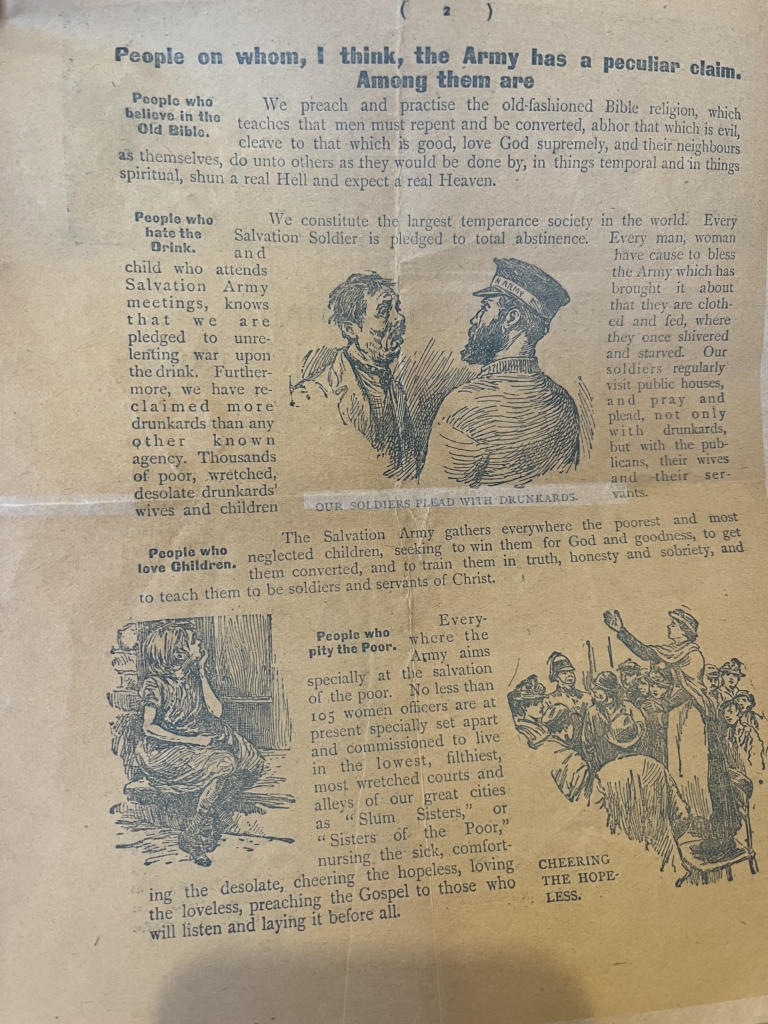
The Salvation Army Self Denial leaflet gets around this by printing each of the areas that you could be concerned about – ‘People who believe in the Old Bible’, ‘People who hate the Drink’,’ People who love Children’ and ‘People who pity the Poor’. Each of these then presents a case and detail of the work in that area. 

Cases for support
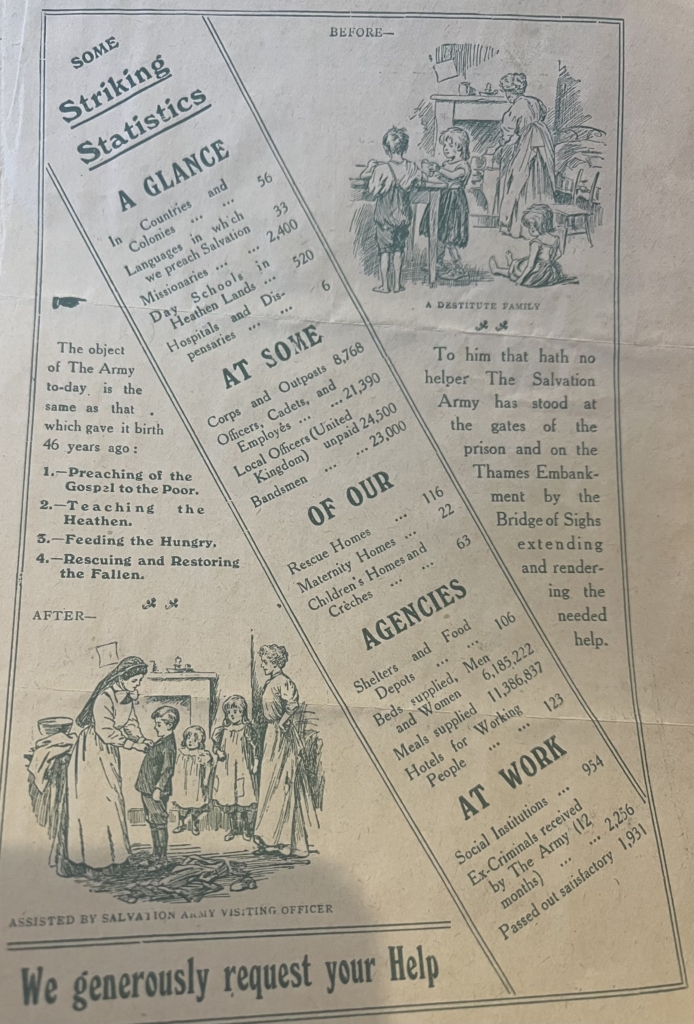
Statistics and impact

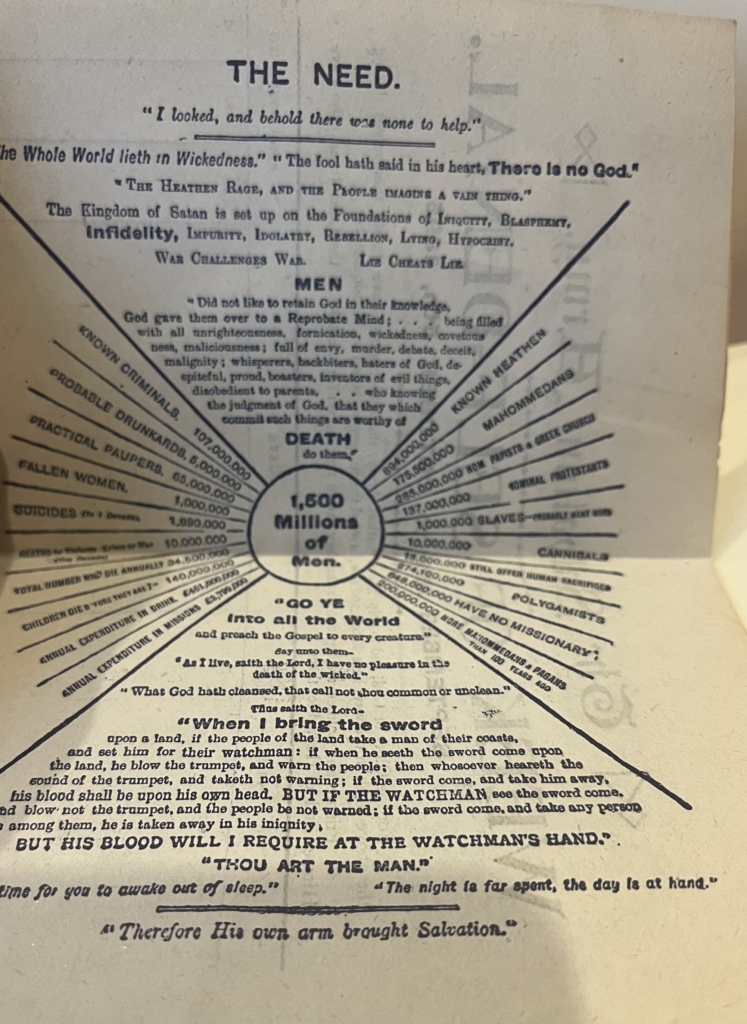
If you are not so visual, or attracted by these cases, there are also detailed statements of impact, reach and numbers for the more quantitative data driven donor!

Sometimes you need to write a special case for supporter for a very distinct target market, in  1904 a female Salvation Army officer in Sweden wrote appeals in Latin to flatter her male undergraduate students 

Cognosce te scopum forum

4. You want to run a good campaign – you’d better be organised

If any charity could organise with military precision it was the Salvation Army. They utilised their military structure, branches and publications to regularise, systemise and approach campaigns and fundraising with rigour. 

The annual Self Denial Fund was the most dominant campaign which they through all their administrative might behind.   

  • Be prepared with the print
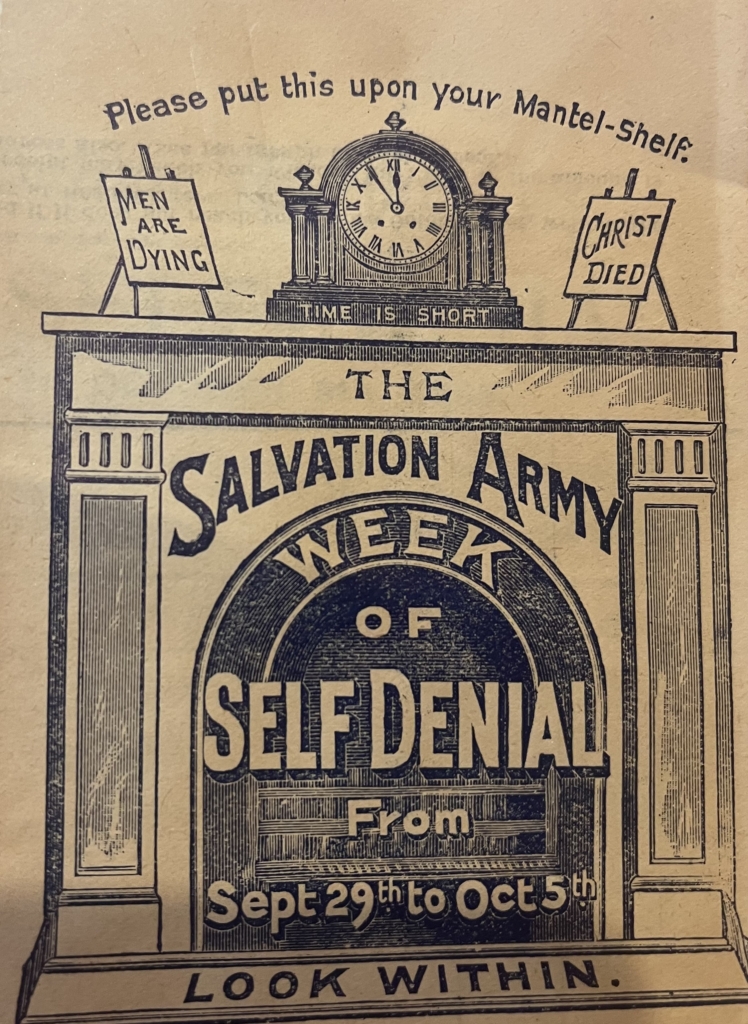
Self Denial Appeal 1895 Front Cover
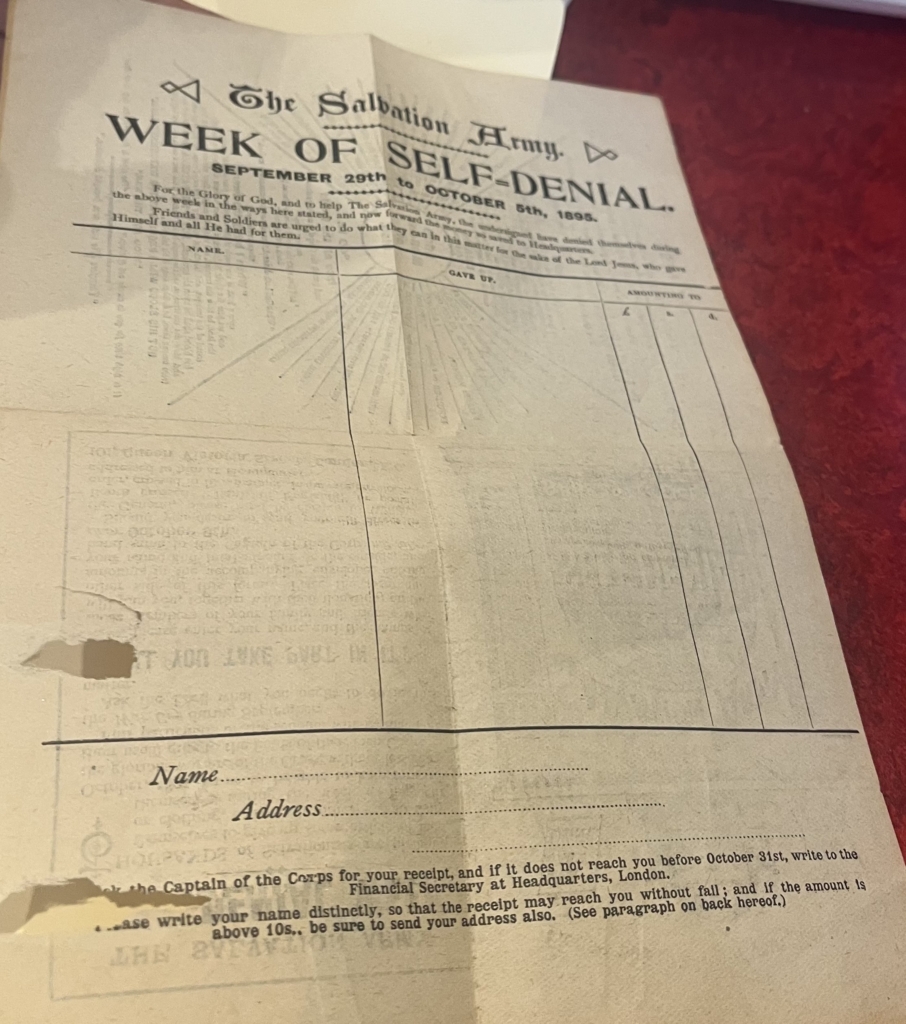
Fold out inside to detail what given up and contribution
Need and impact

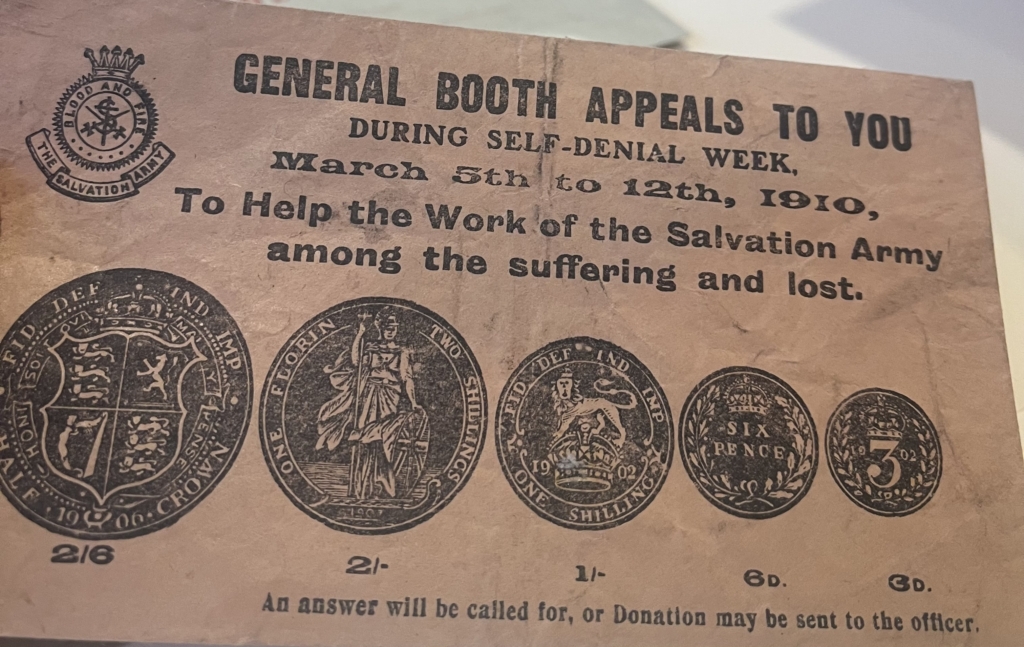
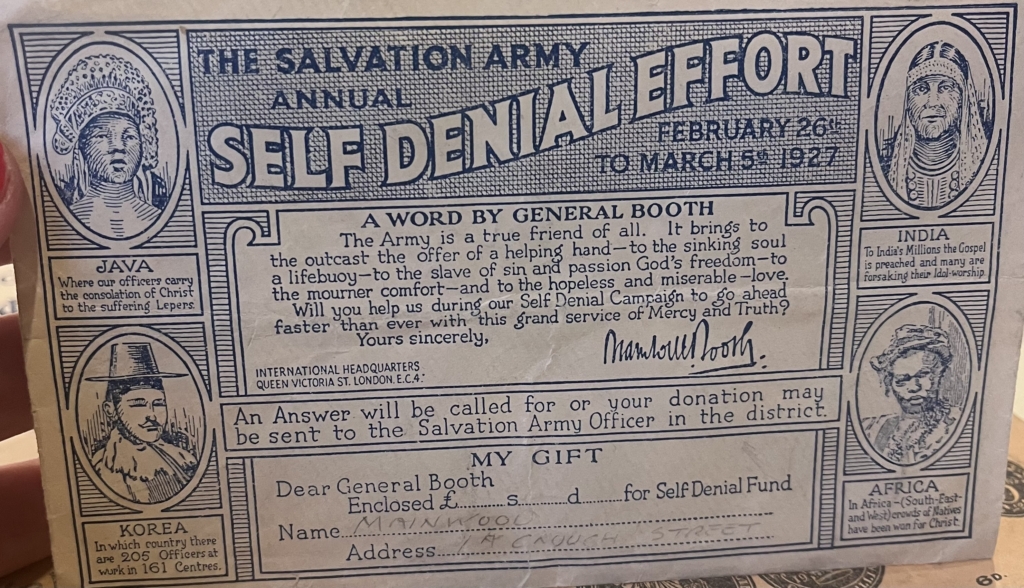
Printing had become cheap and easy so there is collateral for every part of the campaign. There were promotional leaflets for Self Denial Effort with attractive picture covers, printed forms inside to detail what had been given up and what raised and impact statements.These were supported by forms for fundraisers, envelopes and receipts.

Self Denial Fund envelope 1919
Self Denial Fund envelope 1927

Have a campaign plan

Day by day guides were published in The Officer monthly magazine about how to prepare and what to do each day of Self Denial Week  e.g. Thursday reads ‘The week is now drawing to a close. Look up weak ones, visit best friends, take out band with some novel contrivance’

There are strategic plans to draw up how much you will raise from each mechanism – envelopes, pictural receipt books, salary sacrifice. And suggestions to put the previous years total prominently on the wall so you can check in on how you are performing against target. 

And even plans that divide up each road in each area and how many houses it had and how many collectors were needed for door to door collections in each road.  

Promotion is key

The Officer is full of guidance of how to make the most of advertising your campaign. Deliberately borrowing from commercial marketing techniques suggestions include using empty shops, a hand cart, sandwich boards and sample press releases are included. They even suggest going to factories with a collecting tin on pay day to maximise donations.  

5. Build the thank you into the campaign and make it memorable (or even collectable!)

We all know how important it is to say thank you to our donors for their support and leave them feeling appreciated.

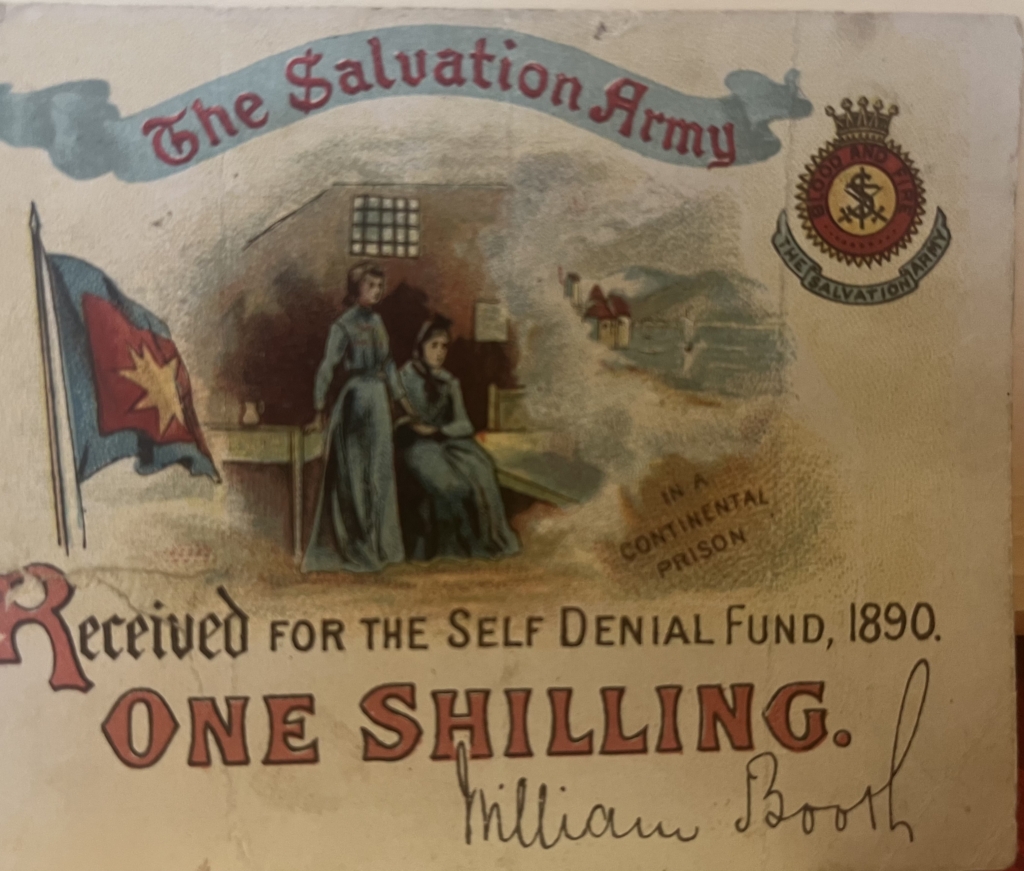
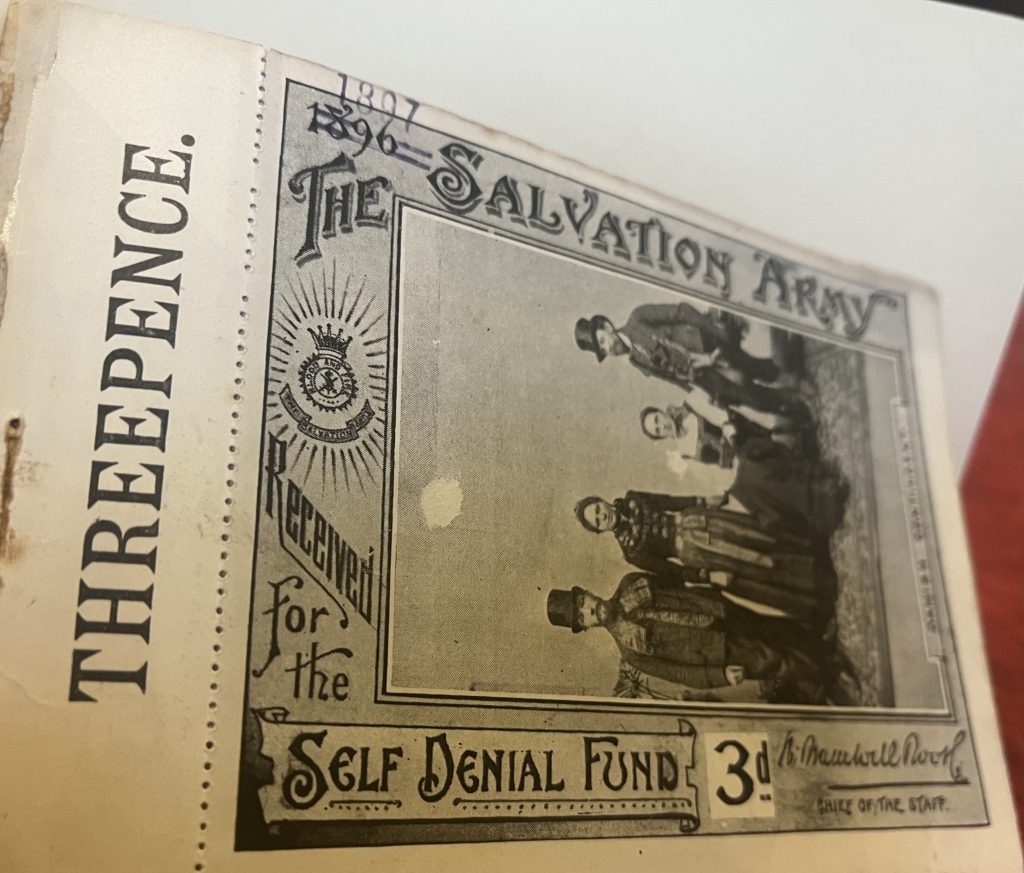
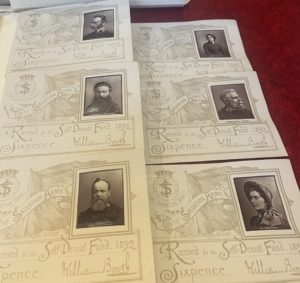
Each collector was armed with a receipt book that they could give on receipt of a donation – some were plain white receipts and some were pictural. Each year the images on the picture receipts varied. In 1892 the receipts all had a sticker that could be fixed on of the celebrated Salvationists – it feels a big like collecting football stickers or Lego cards that you need to get the whole set. Interesting to note the majority of these do not include the word ‘thank you’ – they just say ‘received one shilling’. 

1890 Receipt
Picture receipt originally 1896 but crossed out and reused in 1897
1892 Receipts – collect your favourite Salvationist

(How dull most modern receipts are)

These receipts were replaced by thank you book marks which are described in the appeal packs as to be left with donors as their ‘medal for caring.’

How do you build the thank you into your campaign planning? How do you make it memorable? You can imagine these pictural receipts displayed in homes. How do we continue the joy of giving with the thank you?

6. Value every gift

The guidance for the Self Denial Fund recognises that not everyone can give cash. It suggests that soliciting fundraisers even accept postage stamps to support the campaign saying ‘Many will give one or two postage stamps when they will not give money’. 

Every little helps.   

How can you value any contribution to your work?

7. Don’t forget to ask those who you help 

In 1891 an ‘Out of love’ campaign targeted former residents of Salvation Army homes, inviting them to give a one penny a week back to repay some of the ‘toil, the care, the love and the expense which has been so freely and gladly expended on them’. If they gave enough they were gifted a Bible and their name was inscribed on the roll of honour. 

Often charities shy away from asking those that have benefitted from the charity’s work to be involved in supporting it (not so much in the arts where audiences are asked.) This provides a small but meaningful way for those that have been impacted by the work of the charity to help. Giving back and saying thank you are often strong motivations for giving. 

Whose life has changed because of your charity’s work and how can they be invited to join the supporter family?

8. Make it easy for people to do what you want them to do 

The concept of self denial can feel too vague for some, so in 1889 a ‘Special Hints for Self Denial’ pamphlet was produced listing all the practical ways that you could participate. Examples were given of donating one day’s salary, buying less expensive food, put off paying for new clothes, walk and not using public transport. The funds could then be donated to the Salvation Army. It makes it easier to do. 

Vague concepts put an additional cognitive load on our over stretched and lazy brains and too much to think about decide stops action. Make it easy for your supporters to know how to help.

How can you make it easier for them to do what you want them to do?

9. Show don’t tell 

Postcard used to raise funds 1890s depicting General Booth making a Self Denial Fund donation

In an early ‘show don’t tell’ example we have a postcards of General Booth and other Salvation Army soldiers donating money into a Self Denial Fund box. Literally showing people what you want them to do. 

(the earliest example of a self denial campaign was in 1209 when the canons of Angeirs Cathedral sacrificed the cost of feasts to support the capital campaign to build the cathedral)

How can you show your donors what you want them to do?

10. Mission matters but so does money

“there is nothing next to definite spiritual work, of greater importance that raising finance’ 

The Officer 1893

This mission is important but cannot be completed or attempted without the funds to back it up.

Has anything changed? 

So from a 1891 idea for a red kettle that is still used today (hey, if it ain’t broke, don’t fix it). 

Much in fundraising doesn’t change 

  • The need for good planning
  • The importance of thank yous
  • It is about them – not about you the charity 
  • Make it easy for your supporter to know what to do
  • Show don’t tell
  • Don’t forget those that benefit
  • You cannot do good without money to do it with 

It all feels very modern, and the changes that were made in the late Victorian period are seen in many ways that we fundraise today and in the innovative spirit of fundraisers. 

The Salvation Army saw itself in direct competition with consumer market and so used the same tools and marketed “compassionate consumption”(Roddy, Strange and Taithe). They, along with other emerging brand charities like Dr Barnado’s, certainly embraced the advances in technology and the rise in mass fundraising communications. 

They themselves recognised in 1893 the change that they were part of  

“.. few organisations have been so successful in raising money as ourselves. This has been largely because we have set about it in a systematic, methodical, businesslike manner …. Our methods for raising money have been and are almost innumerable, the military nature of our organisation enabling us to act together with a uniformity and precision which to others would be almost impossible”

The Officer, 189

This ‘systematic, methodical, businesslike manner’ has ripples today in how we approach fundraising.  The approaches introduced by them and others like St Barnado’s advanced the professional practice of fundraisers and have been proved to be psychologically powerful and effective tools for persuading people to give money to support much needed work. 

  • Did the ‘compassionate consumption’ approach mark a change in fundraising? 
  • Did the adoption of commercial marketing and promotion raise more money? 
  • Did the impacts of consumer culture, capitalism and technology change the essence of how fundraising was conducted? Away from the personal, dutiful gift, to a more mass produced and marketed machine which by its nature provided a more transactional (picture receipt anyone?) approach?  Or in a industrial capitalist society were we always heading towards that?  
Background on why this blog came about 

After reading ‘The Charity Market and Humanitarianism in Britain 1870-1912’ by Sarah Toddy, Julie-Marie Strange and Betrand Taithe and learning all about all sort of interesting fundraising activities and methods I visited the Salvation Army archives in Denmark Hill. Interestingly the fundraising was all run from the Public Relations office and they have an archive of early fundraising examples from the 1880s through to more modern times. Fascinating to see. Like many archives it is a bit patchy and speaks to the issues of how we preserve and archive what is important. 

https://marinajones.uk/wp-content/uploads/2023/11/ETKNds2XgAErlJT.jpeg 414 649 admin https://marinajones.uk/wp-content/uploads/2022/12/f2b903e010104f5aa61ea1821a685913.png admin2023-11-30 21:04:032025-07-25 16:34:54Fundraising fundamentals – Red kettles, self denial & picture receipts

10 things legacy and in memory fundraisers can learn from Madam C J Walker

October 27, 2023/0 Comments/in Thoughts/by admin

“wills are not only legal documents but also personal stories and lasting legacies. They are personal narratives and direct instructions.”

Tyrone McKinley Freeman

Madam C J Walker was a noted philanthropist, activist and business entrepreneur becoming American’s first self-made female millionaire. Her will has often been used to discuss her attitude and approach to philanthropy, but the will only records the monetary gifts and her philanthropic approach was much broader than just giving donations – you can read more about her philanthropy here as “her life was her treatise on philanthropy”. 

Looking through her will, here are ten things to think about in your legacy and in memory fundraising.

1. Giving as identity and looking back

When making a legacy gift to a charity, donors are often looking back over a lifetime and selecting the causes or charities that have been important, that have helped them and that they want to say thank you to and pay back in some way. The importance of family, faith and the causes Madam Walker supported in her life are well represented in the 19 charities that received charitable bequests in her will.

Supporting a charity in life is a strong indicator of where legacy supporters might choose to give gifts, but it is the ones that link with their personal story and life events that might be the stickiest. Madam C J Walker had been an orphan, widow and a poor washerwoman, supported fed and educated by a range of female led African American clubs and her in life and in death giving reflect these causes. 

  • How do you connect with your donor’s life story? How can you empower to tell that story and connect their giving to you as part of their identity?

2. Looking forward – an extension of self

Legacy gifts are also about how someone wants to be remembered and the gifts in wills can be seen as  “a desire to invest one’s substance in forms of life and work that will outlive the self” (Kotre, 1996) and extend the self forwards in the gifts being made. With the choice of charities to receive bequests Madam Walker was extending herself and her values forward. 

  • What is your legacy vision? How are you helping a donor to extend themselves forward through the vision of your charity?

3. Wills – as public or private documents 

In the UK we tend to think of wills as personal and private documents and do not ask legacy pledgers to disclose the details of what is in a will. 

But a will tells a life story, and although a private document in life, on death it becomes more public and the contents known by the beneficiaries – family or charities.  

Madam C J Walker knew that her will would be a public document and the distributions and gifts she chose to make public. 

“women have historically used their wills to portray their respectability, honor and social status to society as well as to generate their public image” 

Tyrone McKinley Freeman

There were deliberate choices about the charities and the bequests made that aligned with her approach to philanthropy and the causes that were important to her. 

4. The power of codicil 

When Madam Walker knew she was unwell in 1919, she amended her 1917 will with a codicil. She used this to add in additional pecuniary gifts to charities already supported but also to add in financial gifts to more charities especially those run by other African American women and less supported by other philanthropists. 

  • Adding a codicil is a way to formally and legally add additional bequests to a will that reflect changes. It is useful for gifting money but not residual gifts (it messes up the maths!) As we can see from Madam Walker they reflect additional gifts to charities that she cared about in her life and how these evolved over her lifetime. Donors can also add a letter of wishes is a more informal way to capture the changes that they might wish to make. With either a codicil or a letter of wishes it might be a great way for a donor to add in a financial gift in their will. 

5. Too much money can be an issue

Booker T Washington’s Tuskegee Institute received a legacy pledge but in her codicil she notes that because it is “so bountifully provided for” she will not add in another gift. At the time it had an endowment of $2million.

  • How can you show you need the money and will spend it wisely if you already have large endowments and funds?

6. You can’t always get what you want…

In her will, all of Madam Walker’s  unallocated stocks and shares were gifted to create a Tuskegee Institute in Africa and if no such Institute existed at the time of her death then $100,000 was pledged to establish it. No such Institute did exist when she died and during probate this clause was deemed null and void because of it. 

7. Ambition vs reality 

Madam Walker wanted one third of her estate to go to charity but debts and Walker Company expenses meant that in the end only 10% went to the causes in the will. 

  • Remember – you cannot count on the bequest gift until other items in the will have been given. With a residual gift this could work in your favour.  

8. But if you try sometimes, you get what you need …

In her will she wanted to endow Villa Lewaro – her mansion – to be a “a monument to success” and give it to the NCAAP (National Association of the Advancement of Coloured People) as a memorial. Her will states she never wanted it to become an orphanage, old people’s home or school. The Villa was sold during the Depression due to rising costs and was actually used as an old people’s home. However, in 2018 Richelieu Dennis bought the villa and established an African American think tank there – Richelieu Dennis’s company Sundial had bought up the Walker Company. 

  • Donors can sometimes suggest legacy gifts that cannot be honoured – if you can encourage discussions as they make your will you can discuss what might be possible and get them to work with legal representatives to look at how this is wording. Or you can work with executors after the will is enacted to find ways to honour the wishes and intentions and in keeping with the spirit of the gift. 

9. Unknown futures

‘Mme Walker lives on in the organizations whose progress she forwarded’

Willard Ransom, Manager, Walker Comopany, 1952

When someone makes a legacy gift in their will they do not know what their gift will achieve or what will happen to the charity they support. At the time of her gifts her manager had concerns about her supporting the NAACP but she was believed in it. The Secretary of the NAACP Walter White said in the 1950s that ‘Madam Walker’s generosity virtually saved the NAACP in the dark days of depression.’

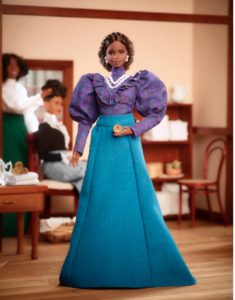
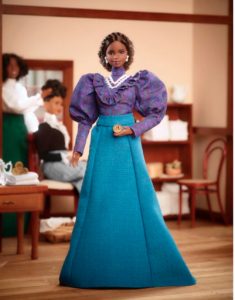
Madam Walker was immortalised as a Barbie
  • Sharing and celebrating what other legacy gifts have helped your charity to achieve can normalise legacy gifts and make people realise that it is usual to leave gifts to your charity. They can also demonstrate the impact that gifts like these can have way into the future.  

10. In memory fundraising & donor recognition 

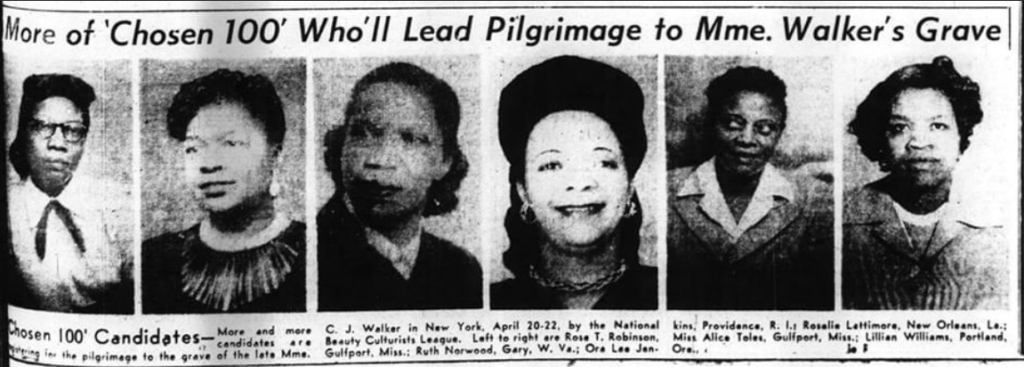
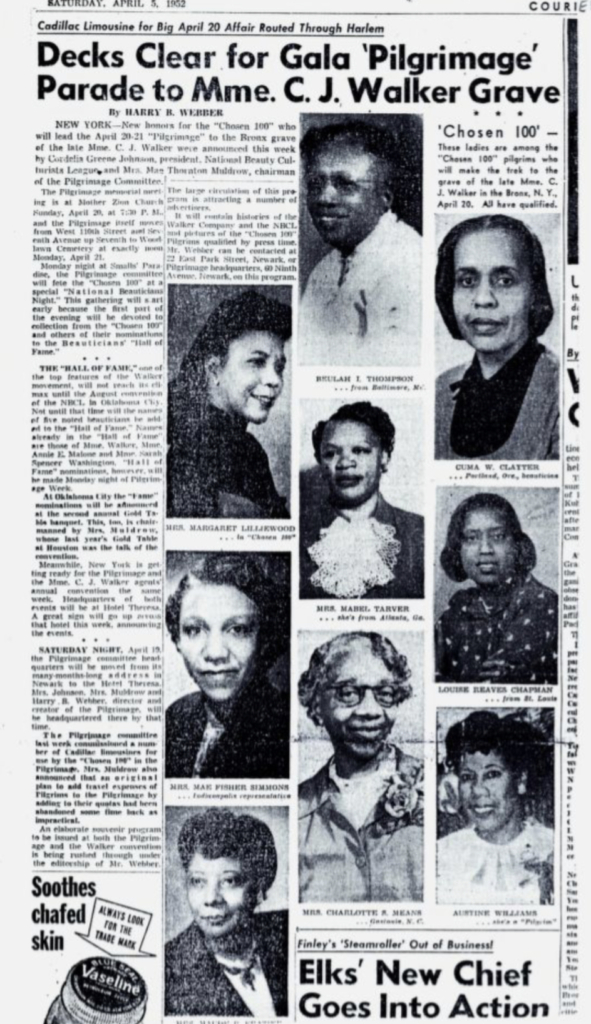
In 1952, 33 years after Madam C J Walker had died a 4 day celebration of her life and work took place with a pilgrimage to her grave. This memorial was in itself a fundraiser, and it had the aspiration to pay off the mortgage of the National Beauticians Home in Washington. At the front of the procession to the tomb were the ‘Chosen 100’. One hundred women who had raised at least $100 to support the event. They wore insignia and sashes – the more stars they had on the sashes the quicker they had raised the money. Following the Chosen 100 were the Platinum, Pearl, Diamond, Gold, Silver, Copper, Red and Blue divisions – all categorised by how much they had made.

Raising funds to complete a legacy associated project of a loved one can be a powerful inspiration. 

  • 33 years after Madam Walker’s death was not using the hook of an anniversary ending in a 0 or a 5 – but an opportunity to fulfil an ambition 
  • How can you ignite the passion they have to do more and get involved?
  • How can you give you donors status and recognition?
  • How can you group them together as like-minded people? Is a legacy club a good idea?
  • Those that give in memory gifts for loved ones are more likely to make a gift in their own will how can you help donors celebrate memories of loved ones and bring them closer to what you do?
https://marinajones.uk/wp-content/uploads/2023/10/IMG_9008.jpeg 950 920 admin https://marinajones.uk/wp-content/uploads/2022/12/f2b903e010104f5aa61ea1821a685913.png admin2023-10-27 10:19:172023-10-27 10:19:1710 things legacy and in memory fundraisers can learn from Madam C J Walker

In Celebration of Madam C J Walker – Philanthropist, fundraiser, activist, entrepreneur and so much more

October 24, 2023/0 Comments/in What I'm Reading/by admin

I have just finished Tyrone McKinley Freeman’s book Madam C J Walker’s Gospel of Giving Black Women’s Philanthropy during Jim Crow and thoroughly recommend it. I first heard about it on Rhodri Davies’ podcast with an interview with Tyrone McKinley Freeman. and was surprised that she was not more known and celebrated. Too often our knowledge of philanthropy reflects our own cultural biases. 

So a few reflections in celebration of Madam C J Walker. 

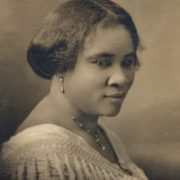
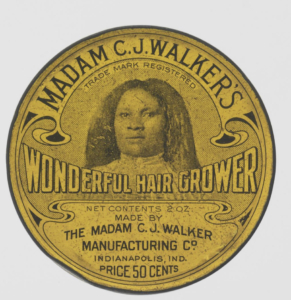
Madam C J Walker was a noted philanthropist, activist and business entrepreneur becoming American’s first self-made female millionaire. Her parents were slaves, and she was the first in her family to be freeborn. Orphaned at seven, widowed at twenty, with her young daughter she moved to St Louis and worked as a washerwoman. She suffered with severe dandruff and lost her hair. After working selling hair care products for a rival hair culturist, she moved to Denver and began her own hair care business, the Walker Company, selling products for African American women and trained an empire of agents to sell the products across the country.  Contemporary with Rockefeller and Carnegie, Madam C J Walker’s philanthropy came from and was lived out due to her experiences as an orphan, widow and African American woman.

The stereotype version of a philanthropist would be a probably bearded male industrialist who comes from relatively modest background, makes a fortune and then from their wealth and success begins a second career in philanthropy. Doing good and naming lots of buildings and creating a philanthropic empire to rival their business one. The female philanthropist is someone who inherits or marries into wealth and dabbles helping the poor or artists and is generally mentioned in a list of names and recognised by husband/father’s name. They are giving out of surplus wealth and their philanthropy is generally to others unknown to them.  

Madam C  J Walker was different. Her model for philanthropy blended Christian duty, activism, practical assistance as well as money and encompassed her whole approach to business. The ethos of the Walker Company was built on racial uplift by offering employment, independence and respectability to African American women. African American women were paid 60% less than white women, who were paid significantly less than men. Work at the Walker Company gave employment, pride and autonomy. 

There were not the clear lines between charity and business that are usually seen. In her philanthropic model, there is less distance between those helping and those needing assistance, and the assistance given might be practical or financial. Her approach offers a challenge to the traditional Western/WEIRD perceptions of philanthropist and philanthropy.  She deserves to be more well known and celebrated for her philanthropy – as well as her work for African American women. She has even been celebrated and immortalised as a Barbie.

She said of her philanthropy in 1914

“I am unlike your white friends who have waited until they were rich and then help but have in proportion to my success, I have reached out and helped others.”

Tyrone McKinley Freeman says 

“In the African American experience, philanthropy did not originate in wealth but rather in resourceful efforts to meet social needs in the face of overwhelming societal constraints and impositions.”

Perhaps a great illustration of this is found in the woman’s club movement which started in the 1790s (the first recorded African American branch dates from 1793 and was the Female Benevolent Society of St Thomas in Philadelphia.)  Clubs of women gathered to try and improve society and drive change – some focussing on temperance or library creation. African Americans were excluded from the white female clubs, so they developed their own model answering their specific communities’ needs such as women’s suffrage or anti lynching. In 1900, 30,000 African American women were members of these clubs.  Charity was inherent in the clubs DNA with an expectation, that as members, they would make the world a better place – not just for the members paying subscription, but for all.  Weekly subscriptions were due, and they provided mutual aid, financial assistance and scholarships but also actively ran orphanages and old people’s homes. 

The widow’s mite

Madam Walker was involved with several of these clubs, including the Missionary Mite Society. The title of this comes from the Bible and Mark’s gospel. Jesus is seated in The Temple watching people make contributions. A poor widow came and put two small coins in and “this poor widow put in more than all the other contributors to the treasury. For they have all contributed out of their surplus wealth, but she, from her poverty, has contributed all she had”. As a widow herself Walker was giving according to her ability and not out of her surplus wealth. Giving for Walker and many of these clubwomen was “grounded in the fierce urgency of the times and the lifeblood of generosity itself.” (Tyrone McKinley Freeman)

Madam Walker’s daughter received education and was cared for at an orphanage run and funded by the clubwomen, this allowed Walker to earn a living by working. 

“Through her giving, Walker expressed her greatest aspiration for herself, her race and her gender” 

Tyrone McKinley Freeman

She gave lead financial gifts for major capital campaigns, donated fees from her lecture tours, ran collections at lectures, donated regular smaller amounts of $5 and $10 to local charities, created Christmas food baskets and supported the unemployable by employing them (for example, an 85 year old mute woman) 

The test gift

Sometimes donors like to give a small test gift to see how the relationship goes and how the charity delivers on its promise. 

Madam Walker offered $50 of the $98 scholarship fees for students at Booker T Washington’s Tuskegee Institute. This was partly as it was all she could afford to do, and she was giving in proportion to what she had. But it also came with the offer that if the gift was well used there would be more money. 

How can we help donors make these gifts? And value gifts even if they cannot fund the whole amount? 

Joy of giving

After reading about an elderly man in need, Madam Walker organised a financial collection from friends and neighbours. The newspaper reported that she was:

“so pleased with the joy manifest by giving that she felt herself not only well paid in this instance, but well enough to enlist her future sympathy she felt it was her duty to do even more for the poor people spoken of”

Giving is a joy and a habit – how we can make it joyful and habitual for our supporters?

Everyone a Fundraiser at the Walker Company 

Fundraisers are always charged with creating a culture of philanthropy within their organisations and inspiring and getting all members of the charity to understand the role and impact of philanthropy. For Madame Walker, giving and being involved in the community were inherent in the nature of her work and her business, and through her work training agents to work for the Walker Company the expectations around philanthropy were indoctrinated and instilled within the teams. 

“Madam Walker envisaged her agents performing charitable work in their communities as they sold products and advanced beauty products” 

Tyrone McKinley Freeman

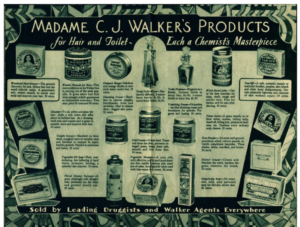
To become a Walker agent you had to enrol in a $25 correspondence course. Philanthropy was on the curriculum and “The curriculum emphases philanthropy and the expectation that agents would continue Walker’s legacy of generosity and racial uplift”. You learned how to use the products, received a starter set of products, uniform and a certificate. But were also taught the expectations of a ‘women’s duty to women’ to be actively raising money and supporting the community as they sold products.

[Aside – How many inductions would place the culture of philanthropy and need to give so high?]

The 1920 publication The Ritual for the Local Bodies of the Natural Beauty Culturalists and Benevolent Association of Madam C J Walker Agents Inc detailed the format of a meeting which included starting exactly on time, wearing badges, gavel banging, singing an ‘Ode to Hairdressers’ to the tune of Onward Christian Soldiers

“Onward Walker Hair Dressers

Outward to the fray

Have your combs all sterilised”

They also read psalms and collectively recited a poem called ‘The Secret to a Happy Life’ on their Christian duty to help others. The subscription would include gifts to charity as well as sickness benefits and burial insurance. Charity work included care for the sick, funding furniture for black colleges, raising money for Christmas baskets, Christmas carolling or supporting the NCAAP financially. Madam Walker rewarded the most charitable clubs – both the volume of gifts (a penny a day per member scheme) and the value.

Helping create the world you want to see 

Philanthropy is often about the moral imagination of the donor and the world that they want to see and how their donations can help create that world. A great deal of Madam Walker’s philanthropy focussed on racial uplift through her business ethos and providing work, dignity, autonomy for African American women, but also through her work directly as an activist in the causes she supported and practical support she provided (accommodation for those on marches). In 1919, Madam Walker give $1000 to an anti-lynching conference and then $5000 towards legal battles.

In 1918, Madam Walker donated the final $500 needed to buy Cedar Hill the former house of abolitionist Frederick Douglas. This was a symbolic purchase and motivated by the desire to own this house and to celebrate black success. It also highlights something useful about the psychology of giving – donors like to be the first or the last to make a gift. People are keen to give at the start of the campaign and then donations pick up as you near your goal and people are incentivised to help you complete the task. 


And in a wonderful piece of donor recognition and theatre. Madam C J Walker got to burn the mortgage papers as celebration of the achievement. 

What would today’s equivalent be? How can we celebrate the final gift that achieves the campaign goal? 

Final thoughts

As we seek to explore more about the history of fundraising, figures like Madam Walker and her approach to philanthropy should be explored and celebrated more. 

Too often the historical examples that we find are wealthy white men and we need to actively seek out more stories of women, of global majority fundraisers and philanthropists and challenge our preconceptions about what it means to be a philanthropist. Madam Walker’s approach offers a broader and more blended approach for trying to make the world a better place. Other cultural understanding of philanthropy are broader and more integrated and less top down, this can be seen in the African word and concept of unbuntu which can be defined as humanity to others. 

The term philanthropist even today conjures up and usually refers to the mega wealthy (McKenzie Scott or Gates or Buffett) but it could have more universal application. How would you answer if someone asked if you were a philanthropist? Prevaricate, talk about helping where and when you can? 

Maybe if we all leant into Madam Walker’s approach and give in proportion to what we have (which many of us do), encourage others to be joyful givers, work to support the causes we care about, mutual aid to those in need (foodbanks) and organise our business and income on ethical lines, then we could more proudly claim the title philanthropist? Maybe we all need to be a little more Madam Walker. 

Want to read more …

Then read Tyrone McKinley Freeman’s book

You can read more about what Madam CJ Walker’s will said and how that could help you with your legacy and in memory fundraising here.

https://marinajones.uk/wp-content/uploads/2023/10/IMG_9007.jpeg 1049 927 admin https://marinajones.uk/wp-content/uploads/2022/12/f2b903e010104f5aa61ea1821a685913.png admin2023-10-24 20:44:052023-10-27 10:23:57In Celebration of Madam C J Walker – Philanthropist, fundraiser, activist, entrepreneur and so much more

In praise of library fundraising & philanthropy

October 5, 2023/0 Comments/in Thoughts/by admin

So a few fundraising and philanthropy examples featuring or inspired by libraries, including:

  • Legacy gifts
  • Naming rights
  • Campaign publicity
  • Donor crediting
  • New funding models ensuring long term support 
  • Early grant application forms
  • And inevitably Andrew Carnegie 
  • Earliest library gift

Pliny the Younger, a first century Roman letter writer, lawyer, author, magistrate and sometime philanthropist, is the first noted library donor. He donated over 1,600,000 sestertii to construct the library at Como with additional funds to maintain it. Like many funders, he paid in instalments with the largest 1,000,000 sestertii to fund the building but also made maintenance instalments (always important to convert capital donors into revenue ones.)

Pliny’s will details his bequests for the public good including gifts to the public baths and their upkeep (we like a legacy bequest that comes with maintenance costs.) In his will, he also supported Freemen of the city which included spend on an annual dinner. The will does not include another gift to the library but notes his life time gifts which included 100,000 sesterii for the upkeep of the library.

Copy of Pliny’s will
  • Naming rights 

The Bodleian in Oxford is named after its founder and patron – Sir Thomas Bodley. 

Sir Thomas re-founded the library in 1602. The first Oxford library had been founded by a 1327 legacy gift from Bishop of Worcester, Thomas Cobham. Through patchy patronage it was maintained for a century but in fell into disrepair until Sir Thomas offered to develop the library – with assistance from his recent fortune from a marriage to a wealthy widow, and Oxford dons the library was reinvigorated. Officially Bodley’s Library it became known as the Bodleian.

To secure support for the library, Bodley created an early form of a ‘Friends of’ with a Vellum bound book that was a ‘Register of Donations.’ This book was kept on prominent display so visitors could not miss it, but was also used to record all donors and their gifts. He wanted this register “to stir up other men’s benevolence to help furnish it with books”. He also used an element of fear in soliciting gifts – so soon after the Reformation and various book burnings – donating books to this new library was a way to keep them safe.

Bodley had the Librarian, Thomas James, greet all visitors and introduce hem to the Library which encouraged making a gift.

This personal welcome and the chance to have the donation recorded in the ‘Register of Donations’ proved so popular that he had to become a bit more selective about recording donors in the register – saying they would need to ‘better their gifts’ if they wanted inclusion. 

Bodleian Library

Interestingly he also refused donations of ‘riff raff’ books which included ‘modern’ works such as Shakespeare!  

When he died, his will also included a legacy gift of £7,000 gift towards the library – disappointing friends and family who had expected to be more kindly remembered. 

(It is interesting to note that the founding of the library comes at the time of the new Statute of Charitable Uses of 1601 which codified charitable purposes especially for the ‘relief of aged, impotent and poor people’ – when so many were concerned with the poor it is interesting to see that Thomas Bodley focussed learning and a library – a criticism that was levelled at Carnegie and Rockefeller 300 years later!) 

  • Running a campaign

In the 1731, American Founding Father Benjamin Franklin ran a public subscription scheme to fund the Library Company of Philadelphia. This was to be a subscription library where his literary set, the Junto – a group of “like minded aspiring artisans and tradesmen who hoped to improve themselves while they improved their community“.

Before he embarked on the fundraising campaign for the library, he used a newspaper publicity to raise awareness and educate the public.

He was also one of the first to use donor segments dividing his prospect pipeline up into – likely to give, might give, and others. He always wanted the person soliciting the gift to fade into the background and that gifts be seen “not as an act of mine but of some public spirited gentleman.”

  • Founding Fundraising

In 1872 to raise funds to found the Los Angeles Library a Dickens Party was held where participants dressed up as their favourite Dickens character. The funds raised purchased the first books of the library including Hints to Horse-keepers and On the Sheep Industry.

A ChatGPT created image of what a Dickens party might look like

  • Andrew Carnegie

Hands up who had a Carnegie library in their home town? Here was my local.

Teddington Library – one of 2,500 Carnegie libraries built

There were over 2,500 built in the UK, US but also in New Zealand, Mauritius, Malaysia, Fiji, France, Belgium and Serbia. 

Carnegie invested over $56.2m into the construction of the libraries – but the funds were not just handed over to towns to create a library. Carnegie wanted the each recipient town to demonstrate the need for the library and commit to the ongoing cost of maintaining it. Towns who were interested in having a Carnegie library had to submit a proto grant application form with a schedule of questions to answer including demonstrating need, that they have a site ready for the library and can provide annually 10% of the cost of the library’s construction to support its operation.  

Carnegie was often criticised for prioritising libraries and building his philanthropic legacy over helping those that who were hungry and in desperate need.  See these cartoons from Puck magazine:

Carnegie’s plans and approach led to libraries being municipally and state funded rather than private philanthropic institutes. Interesting to see the impact of mega philanthropy influencing the enactment of public policy.

The investment that Carnegie put into libraries is cited as the main reason for the growth of female librarians as they needed more library workers and it was considered an appropriate profession.

In 1997 Bill and Melinda Gates followed this lead and aimed to get every US library onto the internet – once they complete this in 2002 they expanded the programme globally, founding the Global Libraries Initiative in 2004. In 2014 the foundation shifted focus to health and science programmes and tapered down the grant giving in libraries ending in 2018.

  • Libraries receive donations

Libraries often received bequests – most of the two thousand scores in the Los Angeles Library came from bequests including 752 scores from the founder of the LA Philharmonic William Andrews Clark Jnr and Meredith Wilson (writer of The Music Man) gifted his sheet music.

  • Victory Book Campaign

Throughout 1942/43 there was a Victory Book Campaign to send ‘Good Books’ to service men – they set a target of 10m and received over 17m (although not all were suitable). Read more about it here. The challenge with asking for donations like this is that they received unsuitable books – too many handbooks. too many people clearing out their shelves, too many beloved books that were not in the right condition to send abroad. We have a tendency to want to give stuff, and stuff that we care about when a tragedy strikes. Read more about our desire to give stuff not money here. As well as restorative and pleasant books to read, they also needed funds to purchase technical manuals – rare books that were donated were sold at auction to fund these purchases.

War is one of the worst things that can happen to books – an estimated 20m books burned in the UK or were ruined by water damage putting out fires. By the end of the war 1/3 of books in Germany were gone.

  • Researching the past

And libraries are also a fantastic place to find out about curious and not so curious bits of fundraising history. 

Here are a few finds:

A celebrity and royal filled auction to save the London Library from bankruptcy in 1960. Items for the auction included

  • Barbara Hepworth painting
  • T S Eliot’s personally transcribed ‘The Waste Land’
  • Graham Greene & John Betjeman manuscripts
  • A silver coaster from the Queen Mother and a book from the Queen

£25,000 was raised at the auction at Christie’s to avert the crisis and clear their debts.

And discovered in the Bishopsgate Institute from The Stage Yearbook 1911 detailing Actors Day an annual day in October each year when actors, stage management and theatre administration  donated one day’s wages to supporting others in the profession – a guild/mutual aid type of enterprise.


https://marinajones.uk/wp-content/uploads/2023/10/bodleian.jpg 459 612 admin https://marinajones.uk/wp-content/uploads/2022/12/f2b903e010104f5aa61ea1821a685913.png admin2023-10-05 09:52:222025-07-26 21:35:12In praise of library fundraising & philanthropy

Pirate ransoms and fundraisers

September 19, 2023/0 Comments/in Thoughts/by admin

Did you know that in the sixteenth and seventeenth century people used to raise charitable funds to pay pirates’ ransom?

It raised questions in society of who ought to pay this fee – was it for the government and the king to pay on behalf of the nation? Or should it be funded by the family and friends? Or more generally from collected charitable funds?

Pirates and brigands in Algiers and the Barbary coast would attack and capture sailors and then send demands home. Without a ransom being paid the sailors would be enslaved and made to work. Pirates often targeted those that they thought of as wealthy to get a better result.

How much was a ransom? Between 200-500 ducats.

The government refused to negotiate with pirates, so it was up to the family and friends to raise the funds to pay the ransom. But wondering from town to town asking for support could have you imprisoned for vagrancy in England so a solution was found in crown and church supported ‘briefs’ which the families of kidnapped sailors could apply for. The brief detailed the case and allowed you to petition in various locations – it is an early form of funding regulation and licence. They could then beg alms to pay the ransom – and also receive charitable donations to support their own upkeep.

There was a suspicion that these briefs were open to abuse and not really issued to those who needed them, or sold on for ready cash so these petitions could be refused.

The cause was popular in maritime towns and local authorities. Livery companies, royal decrees, legacies, published sermons and church collections also supported the impacted individuals raising funds.

Some examples:

  • 1567 the Bishop of London, Edmund Grindal, supported a brief on behalf of the captives in Algiers.
  • 1570s – £70-£100 a year raised by London livery companies to support the rescues.
  • 1568 2 shillings were given by the churchwardens at Ashburton in Devon ‘to one that gathered them for them that be in Turkey’ in response to a brief
  • 1619 – 9d given by County Durham Churchwardens for ransom and 12d for the maintenance of the wife of the ransomed sailor
  • 1636 – a series of Charles FitzGeffrey’s sermons were published to raise funds to save enslaved and captured sailors – saying it was their Christian duty to free the captives as Jesus has redeemed mankind from the bondage of sin.
  • 1669 – £100 a year forever was left in Alice, Duchess Dudley’s will to free captives (I wonder what happened to that)
  • 1686 – £3000 left in the will of former Admiralty officer Sir William Coventry to redeem captives.
  • 1683 – £1 towards the £100 ransom was raised when widow Elizabeth Newman appealed directly to the Earl of Bedford

What is charitable and what you can raise and do raise money for is historically and culturally situated and evolves over time.

What might happen with a pirate’s ransom now? A crowdfunder?

https://marinajones.uk/wp-content/uploads/2023/09/pirates-band-of-misfits.png 172 400 admin https://marinajones.uk/wp-content/uploads/2022/12/f2b903e010104f5aa61ea1821a685913.png admin2023-09-19 15:54:422024-12-05 16:06:14Pirate ransoms and fundraisers
Page 2 of 3123
Tweets by meenamtj
All content © Marina Jones 2023
  • Link to X
  • Link to Instagram
  • Link to LinkedIn
Scroll to top Scroll to top Scroll to top

This site uses cookies. By continuing to browse the site, you are agreeing to our use of cookies.

Accept settingsHide notification onlySettings

Cookie and Privacy Settings


How we use cookies

We may request cookies to be set on your device. We use cookies to let us know when you visit our websites, how you interact with us, to enrich your user experience, and to customize your relationship with our website.

Click on the different category headings to find out more. You can also change some of your preferences. Note that blocking some types of cookies may impact your experience on our websites and the services we are able to offer.

Essential Website Cookies

These cookies are strictly necessary to provide you with services available through our website and to use some of its features.

Because these cookies are strictly necessary to deliver the website, refusing them will have impact how our site functions. You always can block or delete cookies by changing your browser settings and force blocking all cookies on this website. But this will always prompt you to accept/refuse cookies when revisiting our site.

We fully respect if you want to refuse cookies but to avoid asking you again and again kindly allow us to store a cookie for that. You are free to opt out any time or opt in for other cookies to get a better experience. If you refuse cookies we will remove all set cookies in our domain.

We provide you with a list of stored cookies on your computer in our domain so you can check what we stored. Due to security reasons we are not able to show or modify cookies from other domains. You can check these in your browser security settings.

Google Analytics Cookies

These cookies collect information that is used either in aggregate form to help us understand how our website is being used or how effective our marketing campaigns are, or to help us customize our website and application for you in order to enhance your experience.

If you do not want that we track your visit to our site you can disable tracking in your browser here:

Other external services

We also use different external services like Google Webfonts, Google Maps, and external Video providers. Since these providers may collect personal data like your IP address we allow you to block them here. Please be aware that this might heavily reduce the functionality and appearance of our site. Changes will take effect once you reload the page.

Google Webfont Settings:

Google Map Settings:

Google reCaptcha Settings:

Vimeo and Youtube video embeds:

Other cookies

The following cookies are also needed - You can choose if you want to allow them:

Privacy Policy

You can read about our cookies and privacy settings in detail on our Privacy Policy Page.

Privacy Policy
Accept settingsHide notification only