

Apprentice & Anchors
The Apprentice and Anchors
Apprentice: So we were thinking of coming in at sort of the 35% mark on commission”
Seller: Sounds extremely generous. I’m not sure I’m feeling that generous today
Apprentice: What sort of price mark are you feeling today
Seller: I’m feeling 2%-ish. Ok?
Apprentice: How about 12%?
Seller: I can do 10%
Apprentice: Ok we’ll take it
Claude: Obviously starting at 35, they knew that was absurd … but I think in the end they did a deal

On The Apprentice candidates are negotiating and making business deals. They start their negotiation with a high number– higher than they expect to make the deal on – and often seem to pluck an arbitrary number out of the air. So, they go into a negotiation seeking a 35% profit share with the business. 35% is not the deal that they will settle for but just a start of the negotiation. This 35% is set deliberately high to try and get them a better deal. Starting with a higher number works as a subconscious nudge, to try and get the best deal. If they started at 15% or 5% they have less wiggle room to negotiate.
So what – this seems normal business and negotiation. And it is. But is also an anchor – a behavioural science concept that we can also use in fundraising.

So what is an anchor?
Anchoring is a concept in behavioural science when one piece of information, usually a number, imprints, or is anchored in our mind. Subconsciously this number, or image, impacts on subsequent decisions we make.
Kahneman and Tverseky (founding fathers of behavioural science) showed how anchors worked in an experiment in 1974. They asked participants to spin a rigged wheel of fortune that stopped at either 10 or 65. Then they asked the participants to say whether they believed the % of African countries in the UN was lower of higher than the number on the wheel. They then asked them to estimate the actual number. The number on the wheel had no relation to the answer, but the number acted as an anchor and impacted the results.
- When the number was 10 on the rigged wheel of fortune participants guessed 25% of African countries belonged to the UN.
- When it landed on a higher anchor (65) they guessed 45% of African countries belonged to the UN
This irrelevant piece of information had anchored a number in people’s minds, and subconsciously influenced how people behaved afterwards.
Countless other experiments have shown that numbers (spoken or even just seen in the background) influence how we then behave, especially when we have no reference point – any given number acts as a reference point and imprints in our mind and influences future actions.
How does that work for fundraising?
Supporters don’t always know what an appropriate gift size is so an anchor number can be used to help them. This might be in a direct mail response mechanism or online donation form.
I have tested the anchoring effect on online donations in an emergency appeal during lockdown in 2020. With an A / B test over a month with half of supporters getting treatment A and half treatment B.
Test A
Invited supporters to make a gift and put the ask string in this order
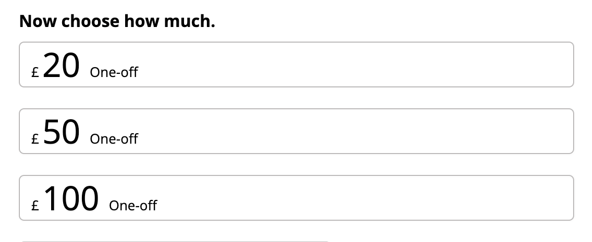
In test A, the first number acts as the anchor, in this case £20.
Test B
Used exactly the same ask, but reversed the order of the ask string:
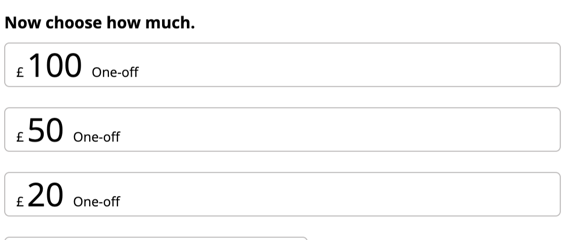
Here the first number and anchor number is £100.
And which performed better?
You guessed it. Test B – having the gift string anchored to a higher first number (£100) increased the average donation by 40%.
So anchoring works in fundraising and influences the gifts that supporters make.
However, testing is important to establish what works in your setting and how many options are optimal. By giving supporters too many choices, you can make it harder to process what to do and reduce conversion rates.
Other nudges can be layered on top of anchored amounts – for example you could
- use a default and highlight one of the responses and pre-select it – make it easier for supporters to know what you want them to do
- create a social norm – highlight one giving amount and write ‘most people give at this level’
- use an amount salient to the campaign rather than a round number – £21 for our 21st birthday
With behavioural science it is important to have a base line data set before you make an intervention. You can then test what impact your nudge has on the results. It is always useful to have a hypothesis on what the impact of the nudge will be e.g. if I use a higher number as an anchor it will increase the average donation amount (which was proved correct in the above test). Once you have a base line, and a hypothesis, you can then rigorously test the theory over a period of time and see how each intervention impacts on the behaviour of your supporters (and in the test above although Test B treatment increased donations 40% – another later tests for even better results – but that’s for another blog).
Even when you have tested it you need to keep refining and learning – as campaigns evolve and supporters move.
So back to The Apprentice…
But what is particularly interesting with the candidates on The Apprentice is the way the anchor works on the candidates themselves – and not just part of the business deal.
At the end of the task, the candidates inevitably bicker about the success and failures of the task and where fault lies. During these arguments the imprinted anchored number – which remember was a nudge number not the desired outcome – is fixed in their mind. ‘We went it at 35% and we should have got 35% if we negotiated better’
The anchored number becomes ‘sticky’ – subconsciously we think it is the number it should have been.
We tend to think of the impact of the anchor to those we are trying to influence to action – and not on ourselves.
What are your personal anchors in fundraising?
Just like squabbling Apprentice candidates – there is another side to this anchoring and that is how it works on fundraisers emotionally. Anchors are sticky and we absorb them internally – whether that is the overall campaign target or the amount that we are requesting a supporter to consider. So, when we get a £100 donation rather than a £150, we can feel disappointment that the number we have anchored on was not reached (or alternatively thrilled when we get £200 when we hoped for £150).
As shown in this example from the 1947 film The Bishop’s Wife with Cary Grant and David Niven. The eponymous bishop is troubled by fundraising for a new cathedral and like all fundraisers has assigned a target amount (an anchor) to each donor – when a cheque comes in for the $15 there is disappointment as she was in the gift table as a $10,000 prospect.
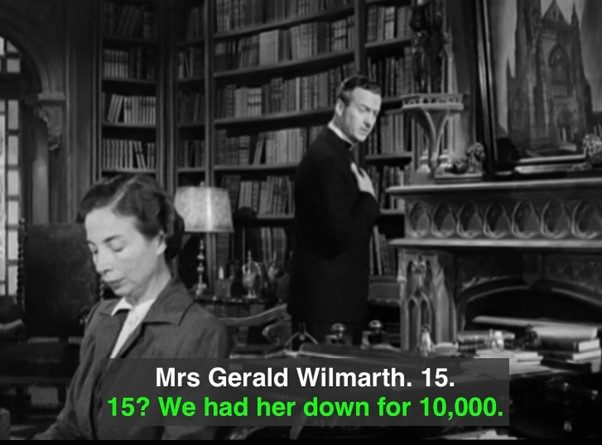
(Like the 35% starting anchor they can often be arbitrary amounts – although they can also be derived from thorough planning and strategy about the capacity and motivation of donors to support our work)
There are three things to remember
- Anchors can be used to nudge effectively.
- When testing behavioural sciences sometimes the results are unexpected and that is why testing is so important – sometimes the counterintuitive or seemingly irrational nudges and that is why it is so important to have a base line (before you made a change) and then see the impact of the change.
- Sometimes we need to remember that the anchors we have used with supporters have become our anchors too. We can then reframe to shift our thinking and rather than fixating on the anchored number, we can look at what else we are measuring, testing and learning. and think about what metrics we are measuring and why. Are we anchored to the total gift rather than other impacts like:
- Repeat donors (second and third gifts)
- Retained donors
- New donors
Rather than like The Apprentice candidates falling back on the number that we have anchored on.
When we use behavioural science to impact and nudge the communications we make – we need to be aware of how it is impacting ourselves. These anchors are sticky to a reason.
We need to remember the power of these anchors on ourselves and not just on those we are trying to influence.







Leave a Reply
Want to join the discussion?Feel free to contribute!