

Extraordinary How Potent Cheap Music is – sensory priming
Our brains are wired to emotionally respond to music which is why certain songs have a power to transport us physically and emotionally to a moment – a university bar, a crush, a city, a holiday, a road trip, childhood, someone we love. Familiar music, especially music with vocals, causes a psychological response (increased heart rate & blood pressure) – music is wired to our memory.
Sounds can prime our moods and emotions. Research has shown that listening to ‘Hakuna Matata’ from The Lion King primed a good mood and people were more generous.
Working in opera I often ask audiences to remember a particular musical moment, or their favourite moments in communications.
Sound is one of the most powerful senses we have, but one often under used in fundraising.
Listening to music can give you thrills and produces endorphins and activates the brains reward circuits.
“Music does a lot of things for a lot of people. It’s transporting, for sure. It can take you right back, years back, to the very moment certain things happened in your life. It’s uplifting, it’s encouraging, it’s strengthening.”
Aretha Franklin
The power and embodiment of music can be seen in this former ballet dancer with Alzheimer’s hearing Swan Lake and recreating the steps
Mood music
The cues music can give us are subliminal nudges, that can impact our mood, but also our behaviour, how fast and what we eat, and what we buy.
Music with a faster tempo makes us eat faster, and people tend to spend more money and eat slower when jazz or classical music is played. Think about the ambient background music you might have in a restaurant – fast and pop for somewhere that wants to turn tables, and more mellow and chilled for a restaurant that wants to encourage you to spend longer, spend more and enjoy the experience. (Although music can also be used as a deterrent, a Welsh branch of MacDonalds plays classical music after 17.00 to deter anti social behaviour)
This real life experiment in an East Midlands supermarket shows how the background music has more impact that we might think it would
- When French music was played 75% bought French wine
- When German music was played 73% bought German wine

When asked about their choice of wine, and whether the music had impacted their choice, only one of those surveyed noted the impact. (North, A. C., Hargreaves, D. J., & McKendrick, J. (1999))
What does your brand sound like?
Brands use sounds, known as sonic branding, to help us readily recognise them:-
MacDonalds has ‘I’m lovin’ it’ https://www.youtube.com/watch?v=tfhlEP8LT4k and Intel has the ping https://www.youtube.com/watch?v=-ihRPi4wcBY
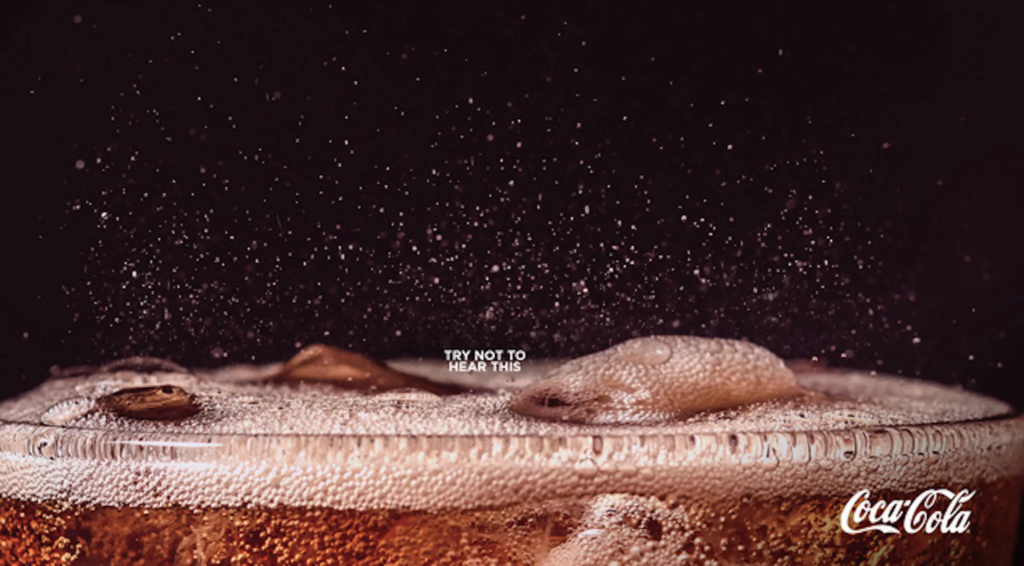
Coca Cola used this image and the slogan ‘try not to hear this’ to evoke the sound of the fizz of the bubbles (there were also adverts showing a detailed close up of the ring pull being pulled back, and a bottle opener opening a bottle). The advert invites us to hear the remembered sound and trick our brains to almost hear it.
What does your charity brand sound like?
The RNIB has recently released a sonic identity https://www.rnib.org.uk/about-us/sonic-logo/
But what has it got to do with fundraising?
We know sound (and taste/smell – think Proust and the madeleines) are some of the most powerful senses but unless you have the budget for a TV ad (or create a ‘scratch’n’sniff appeal) they can be underused in fundraising appeals (in direct mail or adverts.)
We know that we and our supporters receive information in many ways – that the words are only part of it, and that the real and imagined images we use have an impact – as does the weight of the paper, the design of the piece, the feel of appeal in the hand, the order we present information (touching something soft primes us to be kinder). We know that appealing to many of the donor’s senses can make our appeals more vivid and effective. So, we might appeal to donors to remember a sound (children crying) or imagine a future sound (children laughing), but we largely rely on the words and the visual of the design of the pack – letter, the lift letter, response mechanism, the call to action.
For someone working in opera and fundraising, the sounds created and remembered are key – the emotions they stir in audiences from the dopamine of anticipating what it will feel like to hear that music again, to the oxytocin of the emotional engagement with the story – music is so important. And not just the music, but the whole holistic and acoustic experience of the performance, of being together, with an audience, inside a theatre. The hubbub in the bars before hand, the orchestra tuning up as you take your seats, the silent anticipation with the audience holding its breath before the curtain rises and the applause at the end.
How can we integrate soundscapes into an appeal?
- How can we create appeals that bring more of the sound world – real, remembered or future created by the donor’s action into our appeals?
- How can technology help us integrate and create an immersive sound world?
- How could we use sound to provide a richer and deeper connection with our donors? To their memory? To their identity?
- What segments of donors will this soundscape be most effective with?






Leave a Reply
Want to join the discussion?Feel free to contribute!