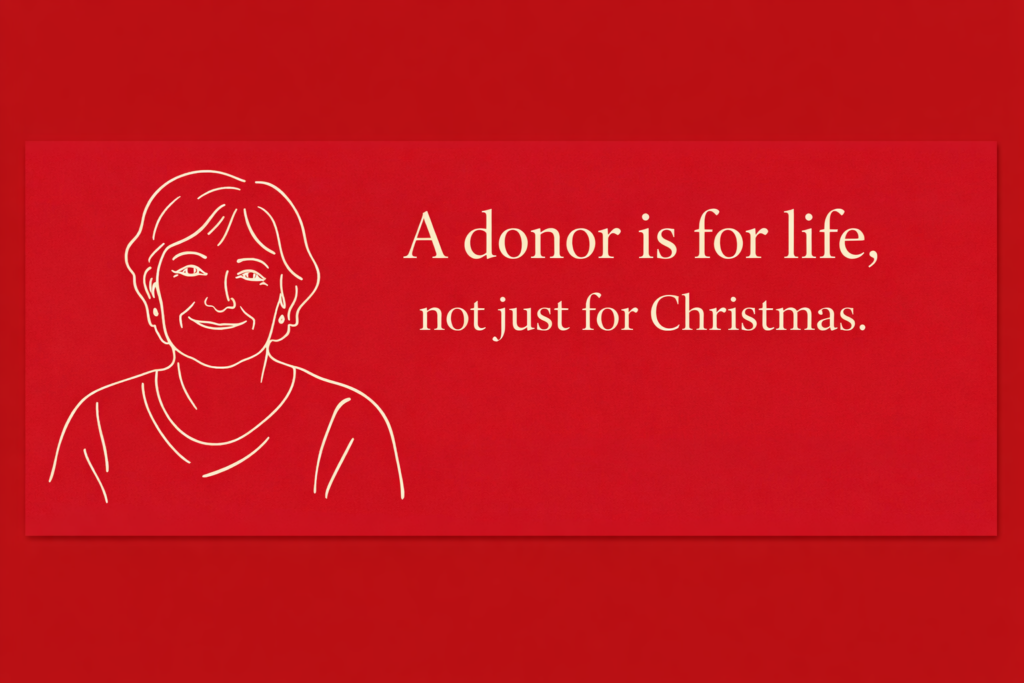
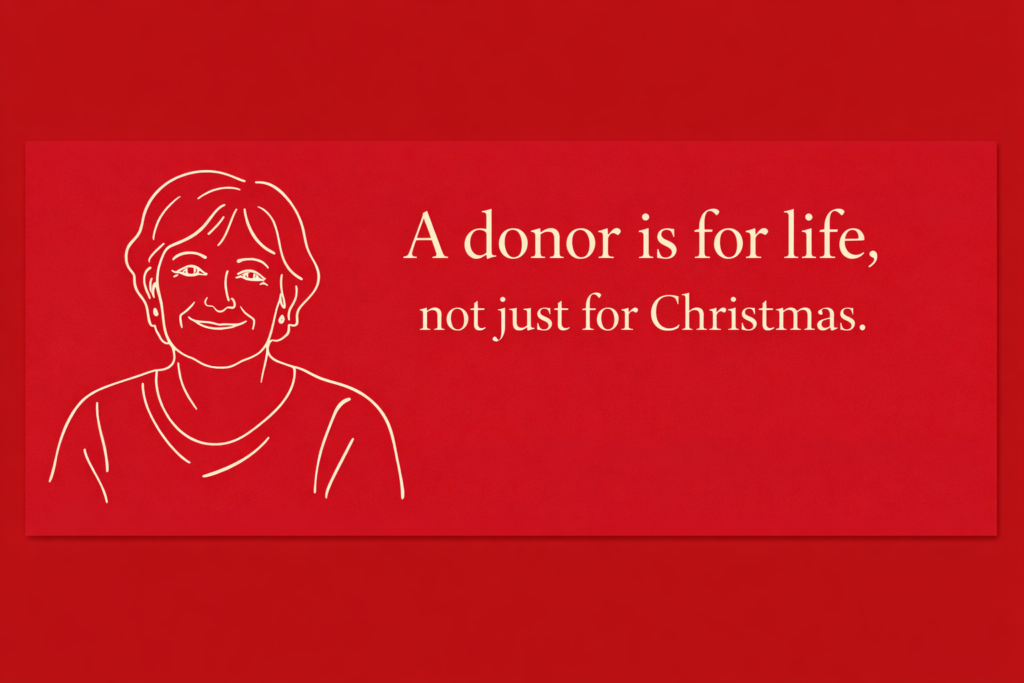
A donor is for life, not just for Christmas…
So, as it is twelfth night and Epiphany the Christmas tree, cribs and the decorations have been put away for another year. The cards taken down and recycled (and some up-cycled into new cards as part of a church fundraising project).
Taking down the cards, made me wonder, how many cards of our Christmas cards were charity Christmas cards? And for what causes? And, as I received several from charities I support, and we always send out cards to donors? Why do charities send them? And is it effective?
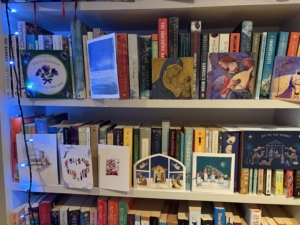
Why do we give gifts at Christmas?
The wise men bring the gifts to the baby Jesus so it is to remember the gold, frankincense and myrrh.
It is also to honour and remember St Nicholas (third century bishop of Myra) and the inspiration behind Father Christmas was notorious for delivering secret kind gifts. He put coins in shoes of poor sailors. St Nicholas threw bags of gold down the chimney of a house to rescue three daughters from being sold into prostitution as they had no dowry, with one landing in a stocking drying by the fire. This is where the tradition of stockings by fire allegedly comes from, and oranges in stockings to represent that bag of gold, and candy canes according to some sources represent bishop’s croziers.
So, gift giving has long been associated with Christmas and with that giving to those less fortunate than ourselves. This was revised with the publication of ‘A Christmas Carol‘ by Charles Dickens and its focus on giving to the poor at Christmas.
Today, there is a noted boost in giving in December for those with faith and those without Evidence shows that this December giving has a hangover into January, perhaps as we seek to maintain the Christmas spirit (or in a Dickensian way named the Carol Philosophy – ‘to honour Christmas in my heart and to keep it the whole year round’).
When was the first Christmas card?
The first commercial mass-produced Christmas card was in 1843 from civil servant Sir Henry Cole. It includes an image of celebrating but also shows giving to the poor at Christmas.
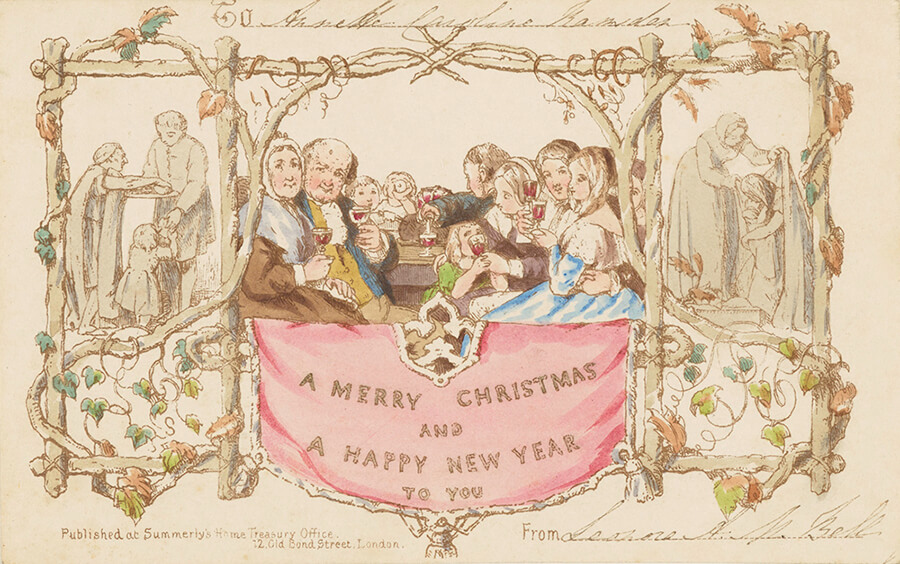
Today 60% cards sold in UK are Christmas cards
And the first charity Christmas card?
The first charity Christmas card was in 1898 for RSPB and sold 4,500 copies, the RSPB now sell 2.5m cards a year
How much do charity Christmas cards raise?
Upwards of £50m+ is raised for charity.
Reports vary on how much of the revenue goes to the charity – with some suggesting that 80% goes to the charity if you buy their cards to less than 5% if bought through third parties like supermarkets.
Why charities send you cards at Christmas?
- Another way to say thank you
- Strengthen donor relationship
- Feel seen, known appreciated
- Another way to share the impact of your gift or invite another gift.
Planning for Christmas cards begins months in advance for many fundraising teams and can be an epic undertaking for a charity – ensuring that the data is up to date and the ‘right’ people receive or sign the card. Do we segment by type of gift, amount, relationship, potential? One fundraiser recently told me that since she had signed so many donor cards she had stopped sending her own.
Why a physical card?
Physical materials are more real to the brain. It has a meaning, and a place. The cards have been displayed and seen daily – even subconsciously whilst celebrating. These cards ought to be better connected to memory, the physical connects to emotional processing.
The impact of real paper-based marketing is from a study sponsored by Canada Post and performed by Canadian neuromarketing firm TrueImpact. The study compared the effects of paper marketing (direct mail pieces, in this case) with digital media (email and display ads). Using EEG wave measurement and eye tracking software they analysed cognitive load (ease of understanding), motivation (persuasiveness), and attention (how long subjects looked at the content). Physical pieces are processed faster and recalled better.
So a physical card vs a digital card will be better remembered. (Most, but not all, charities that I support also sent digital festive greetings and/or thanks)
Hand signing vs printed?
Most charity cards I received were pre-printed. Even having a pre-printed signature feeds into the labour illusion – a decision science heuristic – that means we value something more if we feel someone has spent time and effort on it. Even though we know it is a mass-produced card the signatures tap into this effect.
The ones that are hand signed further enhance that connection of the effort taken to appreciate me the donor.
Half had images clearly associated with the charity and its work – only one detailed the projects that were supported. Clearly these are being used to highlight and enhance the relationship rather than clearly link to the work done, or as an opportunity to ask.
However, it did make me question whether this is a good use of time and resources?
For a few of these charities I do not consider myself a major donor and would be an average supporter. Having a hand signed card made me question whether this is a good use of time and resource for the fundraiser – who I have never met –– to be signing all these hundreds or thousands of cards. For me it moves away from an instinctive (system one) how lovely they have sent a card, to a system two, why have they wasted time and resource on sending me one?
Are Christmas cards going to be generational? And should we send them to Boomers and older? Or those we deem have the best life time potential, or legacy value? (yikes is that how I am being profiled?)
Does it matter? Will it impact?
To paraphrase a saying – donors are for life and not just for Christmas – how will the continued engagement throughout the year connect with me and make me seen and valued and know that my gift is having impact in the world?
One charity I support, the wonderful SOFII (Showcase of Fundraising Inspiration and innovation) sends a Valentine card. Each year Trustees across the world send hand signed cards to thank supporters (my husband raised questions of who was sending a card from Amsterdam!). During the pandemic we sent Valentine’s to all our supporters and people appreciated the novelty – what ways can you find to make your donors feel thanked and appreciated beyond the thank you at the time of the gift? What events in their life, or seasonal events can give you an excuse to creatively thank and send them a card?
And the scores on the doors? 68% were from charities (43% from charities, and 25% from multiple charities/supermarkets), 13% were purely commercial and 9% were commissioned especially from an individual/family. Of the ones from a single charity the local Hospice was the most frequent cause, followed by the British Library and the National Gallery (there were over 20 individual charities). The others were handmade, from schools, and from charities I support.
References:
https://www.sciencedirect.com/science/article/abs/pii/S0167268118301811
https://www.forbes.com/sites/rogerdooley/2015/09/16/paper-vs-digital