• Link to X
  • Link to Instagram
  • Link to LinkedIn
Marina Jones
  • My Thoughts
  • What I’m Reading
  • About Me
  • Contact Me
  • Home Page
  • Click to open the search input field Click to open the search input field Search
  • Menu Menu

Tag Archive for: fundraising history

Look! Fundraisers on the Bayeux Tapestry

March 11, 2024/0 Comments/in Thoughts/by admin

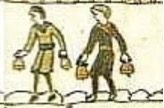
This scene depicts the funeral procession of Edward the Confessor (later a saint) on the way to Westminster Abbey. Look closely and underneath his funeral cortege are two men carrying what appear to be collecting bags for donations.
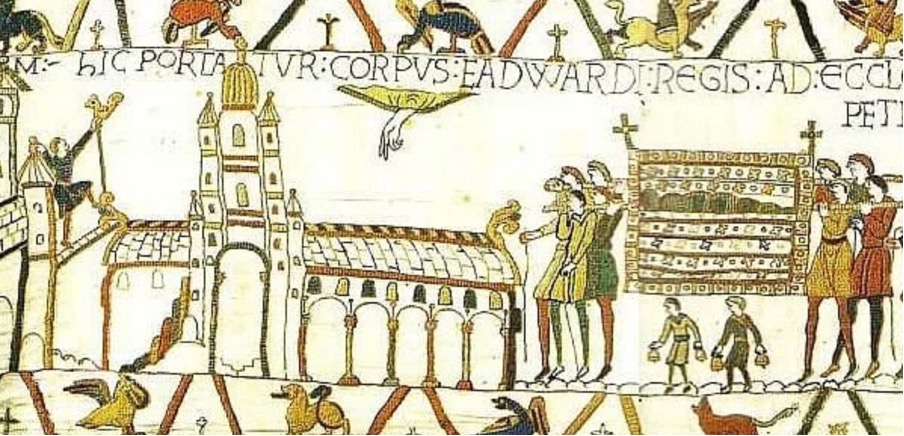
It was common from the tenth century onwards to tour saint’s relics to raise money for cathedral fabric funds, and for two men to collect the money from the crowds who had worshipped and venerated the relics and listened to emotive and inspiring sermons. Hence, the translation of Edward the Confessor’s body to the Abbey could have been used to raise funds for building his shrine and the enhancing his saintly reputation.  Therefore, academics have suggested that this is fundraising in action – and in tapestry form!
What was a relic quest?

A relic quest was a reverse pilgrimage – instead of pilgrims travelling to see the saint’s relics – the saint was toured to them. The relic quest usually involved:- 

  • The relics of a saint being toured locally, regionally, nationally or internationally in a reliquary (a specially designed ornate receptacle)
  • Veneration of the relics by the local people
  • Stories of the miracles performed by the the saint and/or their relics
  • A stirring sermon detailing the power of the saint, sinful nature of humanity, need for repentance and penance, and the need for funds and the project (often a cathedral or monastery building project after a fire or another disaster) 
  • In exchange for donations to the cause, indulgences could be offered, reducing the amount of time the donor spent in purgatory, and hence placing them nearer to heaven

From the Council of Rome in 1078 there was a duty for all the faithful to donate at mass, on feast days, pilgrimages and other holy days. There was a Christian duty to give alms; the care for  Christ’s body on earth, the church, was an important area where alms were encouraged.
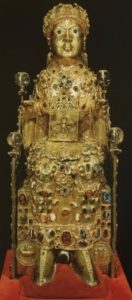
Reliquary of St Foy

Although fundraising was the primary purpose of these tours, they were also used to cement the reputation of the saint locally. Depending on the needs they could be time limited to secure funds to (re)build the cathedral or monastery or become annual calendar events.

Who did this fundraising?

Those on these tours were given the title questor seeking alms (donations) for religious purposes – this is one of the earliest titles for fundraisers. Originally these questors were canons or friars associated with the church or monastery conducting the building project, but as early as 1094 there were specially paid priests (unconnected with the institution) for these fundraising expeditions. 

The preaching and collecting donations model was so popular that in the eleventh century, there were special preachers employed to raise funds for other areas of work, notably for the hospitals run by the cathedral or monastery – special preachers known as vulganter vociarus pardoner had special permission to preach and collect one Sunday a year for hospital funds. 

They were contracted by the Bishop or Chapter and made contracts about how the funds earned were donated – 1/3 to the pardoner and 2/3 to the cause was common. But some times (as today) these contracts were subcontracted out.

Antonies, raising funds for the hospital of St Anthony the Abbot in the 1200s received contracts to cross diocesan boundaries to raise money. St Anthony Abbot is often shown with a pig, a Tau cross and a bell on a stick – the bell was there to attract donations.

When relic quests began they were mainly focussed on church building and conducted by canons and friars. By the fourteenth century, given their success at raising funds they were used for raising funds for hospitals, the poor, bridges, lights and a wider variety of causes areas. (For example, St Anthony’s Hospital in London received £500 of its £550 income from questors.) This could be seen as mission creep, or the success of the mechanism and the nascent professionalisation of fundraising. With this those asking for the funds stopped being ordained ministers or from the clerical class and laymen were recruited to collect. Then as now, good questors (fundraisers) were hard to find, but they were paid for their work. There were serval models – some were paid an annual fee and others were paid up to a third of the collection. Questors as a profession ran in families and they were expected to police the behaviour of other collectors.

1215 – Regulation of how fundraising could be done 
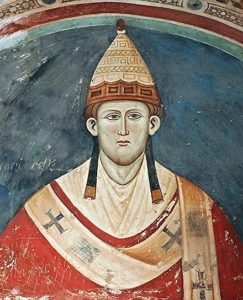
Innocent III

These relic quests became a popular way to raise funds but there were concerns about abuses of power (and fake fundraisers) so in 1215 at the Lateran Council IV, Pope Innocent III decreed that all questors needed a licence from the pope and permission from the local diocesan bishop or king to hold a relic tour. These licences generally lasted a year.

Instead of stirring emotional sermons, questers had to read out a set letter as they solicited alms. This meant that the letters got longer (from 500 words to 2,000+) which included multiple asks for alms and donations. The letter would be read out and two worthy men would collect the funds (as we see above in the Bayeux tapestry).

It also included stipulations on what the questors ought to be wearing and how they ought to behave! No taverns, modest behaviour and clean and tidy dark clothes – they should not dress like wealthy people. 

The Lateran IV Council also tried to limit the indulgences that could be offered in exchange for donations – setting specific amounts of days remittance in purgatory for donations.  Indulgences worked as a powerful incentive for donations, but are definitely more at the transactional/ self interested end of the giving spectrum – rather than altruistic. Indulgences were pardons for sins, giving reduced time in purgatory for those that truly repented. Although indulgences did not strictly require payment, the physical paper proof of forgiveness of sines was proof of the transaction. Their use increased and became increasingly problematic throughout the centuries  (This is a gross oversimplification of a complicated and nuanced topic but to give a summary of the challenges and evolution of the issue and its problem.) By the fifteenth century the questors became known as pardoners (and the Pardoner can be seen and is mocked in Chaucer’s Canterbury Tales)

It was ever thus … a few medieval issues that we still see today

  • Repeat the ask – the twelfth century sermon preached at Amiens with a relic tour includes four asks for funds in the sermon. Repetition helps our brains process things more easily. The more repetition the faster we process. The more the ask is repeated – the more we are being primed to give – so it is important for our appeals to repeat the ask multiple times. Remember, donors are not paying super close attention to what we write or say – they skim read/selective hear, so a repeated message helps convey what we want them to do.
  • Not everyone agrees about charitable priorities, Bernard of Clairvaux said that the church collections and relic quests were too focussed on beautiful church buildings and not the poor in need (‘She dresses her stones in gold and lets her sons go naked’). There are still debates today about how philanthropic money should be spent and where it is most needed.
  • Fundraising is not always successful – in 1086 the Benedictine monks toured St Eusebia’s relics and lost money on the tour 
  • Fundraising is based in time and place and what is charitable and acceptable evolves. In the tenth century, indulgences were an unproblematic way to offer a spiritual reward to donors, but as the practice evolved they become more transactional, less philanthropic and much more controversial (A few decades ago, a charity sixth form slave auction that might have run as a fundraiser, or accepting a collection from the local hunt (which the RNLI recently turned down), but what is socially, morally and ethically acceptable changes and evolves with societal norms). Fundraising for pirates ransoms used to be common – see more here. Fundraising practice, like what is charitable, evolves with time and place.
  • Who you take money from – the church would not take money that had been earned in certain ways particularly from usury (taking interest on loans) and prostitution. Nowadays your acceptance of gifts policy might meant that oil, tobacco, fur or arms dealers are not acceptable to your charity. What is ethically acceptable, like fundraising methods, evolve over time, but reputational risk has always been a concern….
  • Need for a strategy – Bernard of Clairvaux was concerned that church building projects should not be started unless the relevant funds were in place to complete the project.

Bernard of Clairvaux

What did these sermons say

Set words of a sermon for the reading out for alms from Amiens (blame Google translate, my school girl Latin is not what it was)

For as the Apostle says, we shall all stand before the judgment seat. We must receive Christ according to what we have done in our bodies, whether it has been good or bad the extreme mercy of the Messiah to prevent the works and to sow eternal ones in the earth, which By returning to the Lord with a multiplied fruit, we must collect in the heavens, firm hope and confidence holding, because he who sows sparingly also reaps sparingly, and he who sows in blessings, the blessings and reaps eternal life. Since then, for the support of the brothers who were in need of such things. At the confluence hospital, the facilities are not properly available, we advise your university and we are exhorted in the Lord and we have commanded you to forgive your sins, as far as good things a contributing to God, give them pious alms and acceptable charitable support, as by subsidizing them. Let your own poverty be consulted, and you through this and other goods which the Lord inspires having done this, you can reach eternal joys’.

And the Reformation changed all these practices.

So happy questing fundraisers!

Coming next … relic quests were just one way that cathedrals and churches were financed – find out how butter helps build a cathedral. Read more here https://marinajones.uk/butter/

References:

‘Relic Tours in England and France’ by Cristine Oakland (which includes quotes from my former professor)

https://kar.kent.ac.uk/77090/1/39Relic%20Tours%20in%20England%20and%20France%20%28c.1050-c.1350%29.pdf  
https://marinajones.uk/wp-content/uploads/2024/03/detail1.jpg 304 362 admin https://marinajones.uk/wp-content/uploads/2022/12/f2b903e010104f5aa61ea1821a685913.png admin2024-03-11 12:31:322025-07-25 16:38:04Look! Fundraisers on the Bayeux Tapestry

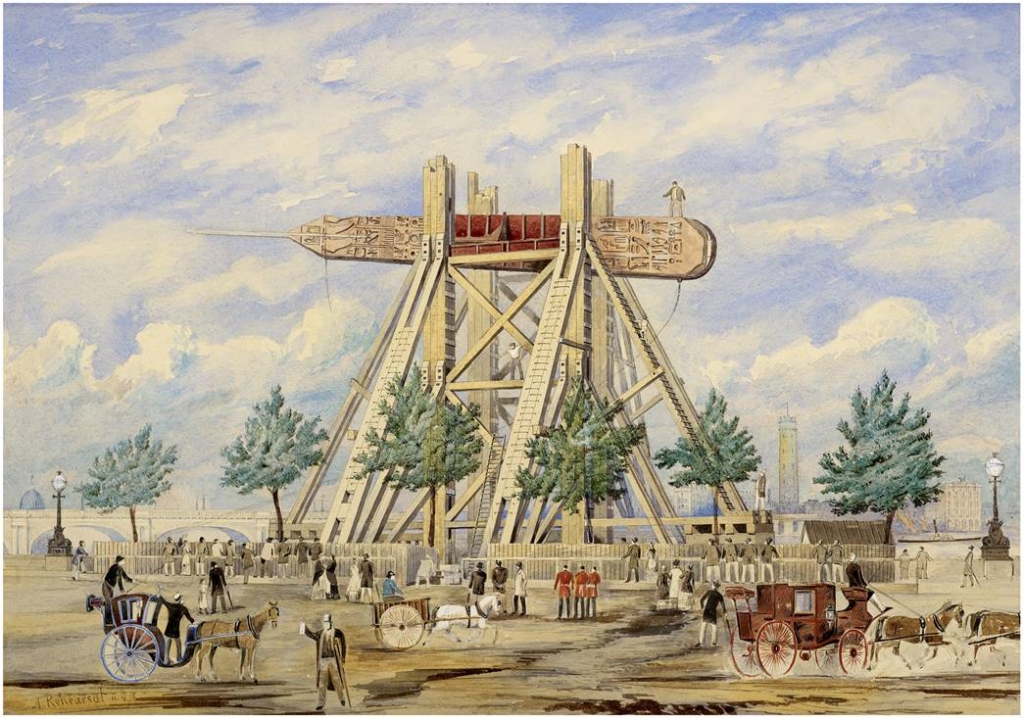
Cleopatra’s needle and donor pyramids

February 1, 2024/0 Comments/in Thoughts/by admin

Fundraising challenge: You have a donor willing to give you something you want, but you cannot afford costs associated with the project.

It’s happened for many of us – in order to secure the thing you want – you need another fundraising campaign.
This is what happened with Cleopatra’s Needle.

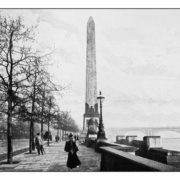
In 1819 when Muhammad Ali Pasha gifted the UK the obelisk known as Cleopatra’s Needle (which has very little to do with Cleopatra).

For 58 years the obelisk remained in Egypt, but then the land where the obelisk was stored was threatened, something had to be done. So a fundraising campaign was planned to finally bring it to England.

The negative risk of not doing something is a useful tool for any campaign – using the urgency of needing the funds before it is too late to drive action.

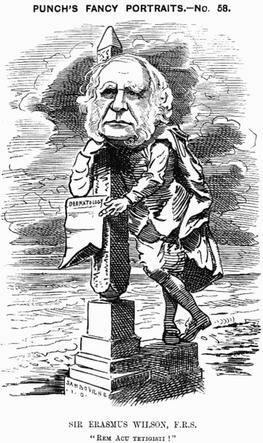
The major funding came from one individual – Sir William James Erasmus Wilson (a very solid Victorian name!) – a well-to-do dermatologist with a passion for Egypt. He contributed £10,000 of the £15,000 needed to bring Cleopatra’s Needle to London.

The remaining £5,000 was raised through a public campaign – made up of lots of small donations.

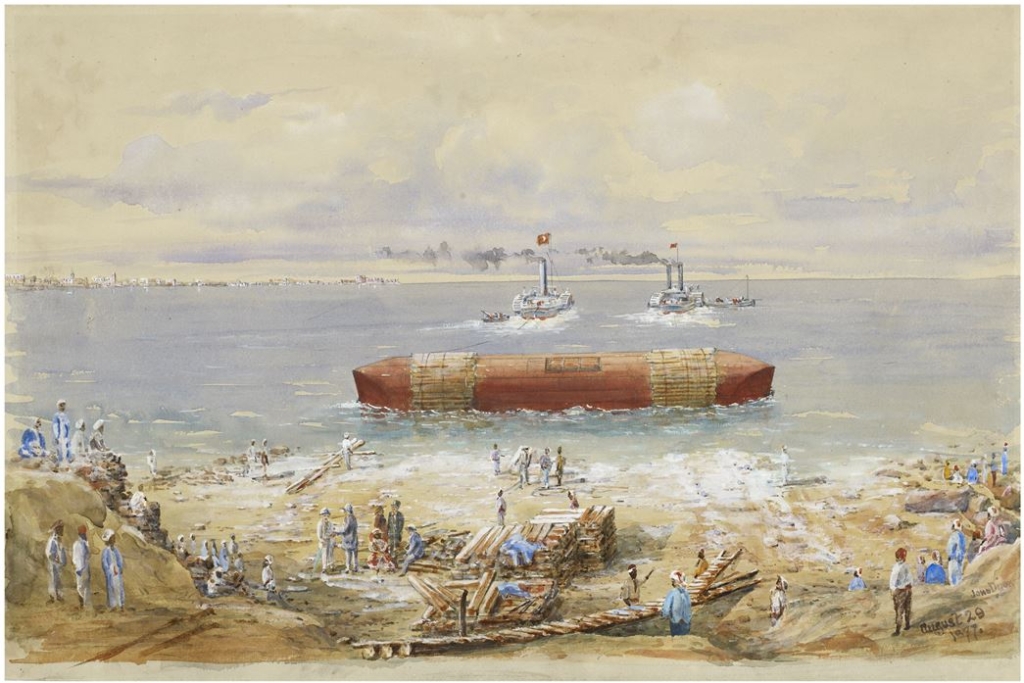
The main costs were needed to ship Cleopatra’s needle from Egypt to London and this was done in a 18 metre cigar shaped pontoon called The Cleopatra. On the journey during a storm the pontoon was cut loose to save the crew and floated around the Bay of Biscay for 60 hours before being rescued and delivered back.

Cleopatra’s Needle has now been on the north side of the Thames for 146 years – and Wilson’s contribution is recognised by a plaque which recognises his ‘patriotic zeal’ in bringing it to London but does not mention his financial contribution.

Donor Pyramids

Fittingly for an Egyptian artefact, the fundraising campaign conforms to the standard donor pyramid model. The model sees large lead gifts at the top of the pyramid, supported by many smaller gifts at the base of the pyramid. The Pareto Principle says that 80% of your gifts ought to come from 20% of your donors. In this case 75% from just one donor!

You want to secure the majority of your fundraising target and leadership gifts in this first private phase of the campaign. With a leadership gift of £10,000 in this private phase, you give confidence to the wider audience that the project will happen when your project becomes public.

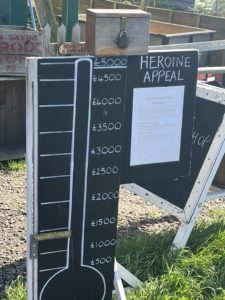
This campaign represents a rather a top heavy pyramid with an over reliance on one major leadership gift. A more typical donor pyramid might look something like this:-

It is important to have lots of people you can ask – as not everyone will say yes (or say yes at the level that they are asked to support).

Being near completion also incentivises the public phase to help complete the target – when you get nearer your target and people have confidence it will be achieved, the speed of gifts often increase.

And did you know?

Inside the pedestal of the obelisk is a time capsule including a set of 12 photographs of the best looking English women of the day, a box of hairpins, a box of cigars, a baby’s bottle, a hydraulic jack and some samples of the cable used in the erection of the Needle, a portrait of Queen Victoria and a Bradshaw Railway Guide!

References

http://topicaltens.blogspot.com/2014/09/12th-september-cleopatras-needle.html

https://www.theguardian.com/news/2020/apr/08/weatherwatch-the-perilous-sea-journey-of-cleopatras-needle

https://www.museumoflondon.org.uk/discover/victorian-cravat-pins-and-cleopatras-needle

https://en.wikipedia.org/wiki/Cleopatra%27s_Needle,_London

https://marinajones.uk/wp-content/uploads/2024/01/celo.jpeg 497 703 admin https://marinajones.uk/wp-content/uploads/2022/12/f2b903e010104f5aa61ea1821a685913.png admin2024-02-01 23:27:232024-02-02 08:24:10Cleopatra’s needle and donor pyramids

5 More fundraising firsts and fundamentals from the Salvation Army archives

January 18, 2024/0 Comments/in Thoughts/by admin

1. Challenge events – raise a minimum to participate

You may have thought that raising £5,000 to walk the Great Wall of China or bungee jump off a bridge were newer inventions but it is something fundraisers have done for over a hundred years.

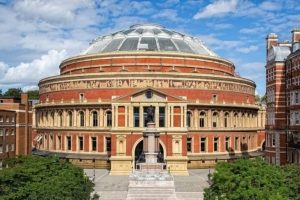
In 1902 the Young Helpers League of the Salvation Army had to fundraise and then present a purse with a minimum donation to attend an event at the Royal Albert Hall. 

2. Mircodonations before microdonations were a thing 

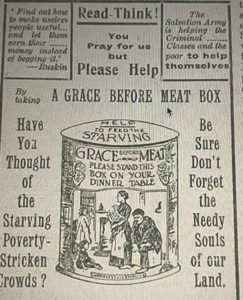
‘Grace before meat’ boxes encouraged small and regular donations throughout the day with a penny before each meal with grace.

Like rounding up at the till at the supermarket, or other shopping experiences, they offer a gentle and frequent opportunities to give.

3. Give yourself if you want to ask 

‘Make some definite sacrifice yourself as your soldiers are sure to reflect your conduct’

The Officer, 1893

The peer to peer ask is a powerful one – when someone like you asks you to join them in also making a gift it invokes a social norm and shows that they are committed to it too. 

If you want to be asking other people be a donor yourself. If you don’t care enough to give, in some small way, why should anyone else?

Also, being a donor to your charity (in whatever way you can) allows you to better understand the donor journey and what it feels like to be part of the supporter group, track the appeal and see when the letter or magazine lands on the doorstep and how quick and effective the thanking process really is.

4. Ethical products can also support mission 

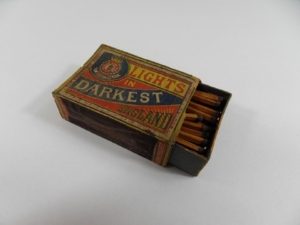
In 1891, playwright George Bernard Shaw and Fabian Society member Annie Besant were amongst others were campaigning against the Bryant and May match factories and their use of phosphorus in match production. The match girls went on strike to protest working conditions and the use of phosphorus in matches which resulted in ‘Phossy Jaw’ (a painful deterioration of the jaw and teeth caused by the phosphorus used in the match production process). 

The Salvation Army created a new match factory that did not use phosphorus and produced matches with better pay and processes – these were called Lights in Darkest England and were more expensive to purchase than other matches. They were promoted as a way of supporting the ethical production but the factory closed down after a year.  

So not everything works – and it is important to fail fast if a new idea doesn’t work stop doing it.

How else can you give supporters a chance to live out and align with your values with other purchases?

5. Issues of ready cash & when to ask

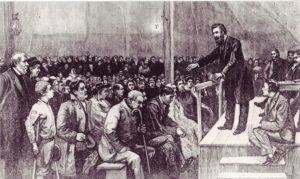
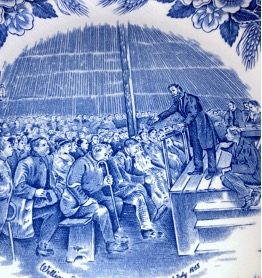
William Booth preaching at a meeting

We might think the challenges are of cash giving are a modern problem. Post pandemic many shops and charitable donations only offer contactless donation opportunities.

But 140 years ago fundraisers were worrying about donors having cash on them and their ability to give at collection time.

“Well-to-do people seldom carry much money with them in their purses, and yet the best time to touch their hearts is under the mellowing influences of a meeting, when they will often give twice as much as they would when they get home, or under other ordinary circumstances’ 

The Officer, 1893

For more on the challenges of cash read here

How can we make it easy for people to donate if they don’t have cash on them? Or if they only have cash is only accepting contactless donations stopping them giving?

This also speaks to the best time to make the ask – when they are emotionally engaged and warm to the ask, when they have been inspired by your cause.

When do you ask donors for a gift? When you have ‘touch[ed] their heart’ are really inspired them or when they are in ‘other ordinary circumstances’?

(To read more about Salvation Army fundraising fundamentals and innovations read this article https://marinajones.uk/salvationarmy/)

https://marinajones.uk/wp-content/uploads/2023/11/IMG_9403-3-scaled.jpeg 1838 2560 admin https://marinajones.uk/wp-content/uploads/2022/12/f2b903e010104f5aa61ea1821a685913.png admin2024-01-18 09:11:232024-01-18 10:21:015 More fundraising firsts and fundamentals from the Salvation Army archives

Legacy brochures from 90 years ago

December 7, 2023/0 Comments/in Thoughts/by admin

What was included in legacy brochures in the 1930s? How did charities speak to their supporters about legacies?

In the Salvation Army archives which I recently visited there were two examples of legacy brochures from the 1930s.

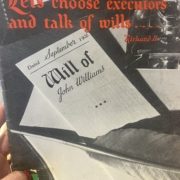
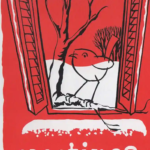
Let’s look at the covers.

We have quotes from Shakespeare (left) and Shelley (right). This clearly speaks of a general knowledge of literature amongst the Salvation Army soldiers (even the RSC does not quote Shakespeare on their legacy page today!)

Having the date and the name of the person writing the will written by hand makes it feel personal, more authentic and a nudge to complete your own. The quill is poised ready for you to pick up and write your will. It is positioned in the correct place for a right handed person (the majority of people) to start writing making it easy for our brains to understand what is expected of us.

(Although be great to test the impact of a personalised pack like this with the potential pledger’s name on the cover …)

What is included and what would we still include today?

  • Case studies and examples of what a legacy has done in the past – this serves two purposes – one it gives social proof that other people have done it and it is a normal thing for supporters to do. It also serves to give an example of the impact of what a legacy can do.

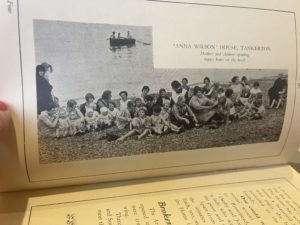
In the 1933 brochure a case study details the Anna Wilson House which was established thanks to a woman’s legacy and talks about the difference it was made ‘During the six years since then more than four thousand women and children have enjoyed the hospitality of the Home and the benefits of a seaside holiday!‘ It includes a picture of the women and children on the beach enjoying the experience.

Legacy brochures continue to tell the story of the impact of legacy gifts and what they achieve for the charity.

  • List of legacies – There is a list of legacies received with the names and amounts of their bequests. This is a way of commemorating the donors and recording their names for posterity. It is also useful to demonstrate that this is a normal thing for Salvation Army soldiers to do.

I am not sure we would list the amounts given nowadays. And the legacy donor credits would not be in the marketing brochure but on a wall, a plaque, a tree of life as leaves, a programme, a book of remembrance (physical or digital). Having a place where donors (and their families) know that they will be credited is an important addition.

  • The statement ‘we would advise you to consult your solicitor’ – this is similar to what we’d find now, as the fundraising team are not always legally trained, and a will ought to be executed by a professional solicitor.’

In the 1893 issue of The Officer (Salvation Army monthly magazine) there are detailed instructions about how to complete a legacy properly as there have been cases when the will has been insufficiently witnessed to be legally binding.

  • Statistics on impacts of the charity and its work. There are pages dedicated to the work of the Salvation Army and what it has achieved and the need for its work.

Clearly, back then, as now, talking about the impact of your work is important.

  • Foreword by the current General – the General was the most senior figure in the organisation and wrote the foreword to the brochure.

Often we use the most senior person in the organisation like the CEO or Chair of the Board to be the authority figure talking about the vision and the need. They are someone well known to supporters, respected and trusted to enact the legacy gift.

  • The acknowledgement that talking about death is not easy ‘It is a common mental attitude to think every one mortal but ourselves…. The very thought of making one’s Will, for instance is unwelcome to many people. They connect it with hastening, somehow, the inevitable dissolution’.

This links to terror management theory (which was only proposed as a formal theory in 2015) which says that reminders of our death kick in a self preservation instinct that makes us deny, delay or distract from any talk of death. This is one reason why people don’t have wills as they cannot bring themselves to acknowledge and deal with their ultimate demise.

Not many legacy brochures now tend to be so up front in acknowledgment of this – they tend to focus on a celebration of life and looking back, looking forwards and saying thank you.

During internal training and when getting organisational buy in to promoting legacy giving this uncomfortableness does appear for some. However, people for whom death is more salient can be very up front about talking about funerals, death and legacies – it can be a self imposed fear by fundraisers.

  • Choosing where your bequest goes – there are two forms that allow someone to make a gift to religious purposes or to the social work of the Salvation Army.

Many charities today allow your gift in will to be directed to the area of the charity’s work that is most meaningful to you. Can you give the donors the autonomy to decide where their gift goes? Many charities try and keep the bequest wording as wide as possible as they don’t know where it will be most needed at the time of the realisation of the gift – but can you direct it to broad areas of work (like the religious purposes of social purposes) with a non binding condition on it.

  • Keep drip feeding the message – the 1886 Salvation Army annual accounts statement includes the standard words for a bequest. It is important to g the information they need to enact their will. It is also important to drip feed the legacy message throughout communications with supporters as you never know when someone will be writing their will – most of the time they are not writing their will so the regular drip feeding of the message means they might get the subtle nudge and reminder at the right moment and act on it.

Today a pledger might just need a the registered charity number to take to their solicitor – interesting to note that this predates this legal structure and the bequest instruction reads “I give and bequeath unto William Booth, the General of the Salvation Army … or other General of the Army for the time being, his successor, the sum of ”

Where can you continue to talk about legacies and their impact – it may the annual accounts and reports (or this may be where you list and acknowledge the bequests received). Can you continue talking about legacies in newsletters and supporter magazines, as well as targeted correspondence and events?

  • Confidential correspondence – ‘General Booth will always … treat any communications made to him on the subject as strictly private and confidential’.

Making a will is a private affair and many people do not want to talk about the details of their will with other people, The assurance of a confidential communication about this is important for donors – and many charities toady continue to offer this confidentiality guarantee.

  • Named contact – when talking about something so important and personal as a will it is important to have a named person to talk to. The General, William Booth is listed as the contact for soldiers wishing to consider making this gift.

Giving a name, personal email and phone number (and sometimes even photo) of the person who you will talk to about a bequest can reassure donors (rather than an anonymous legacies@charityname.org).

What is different?

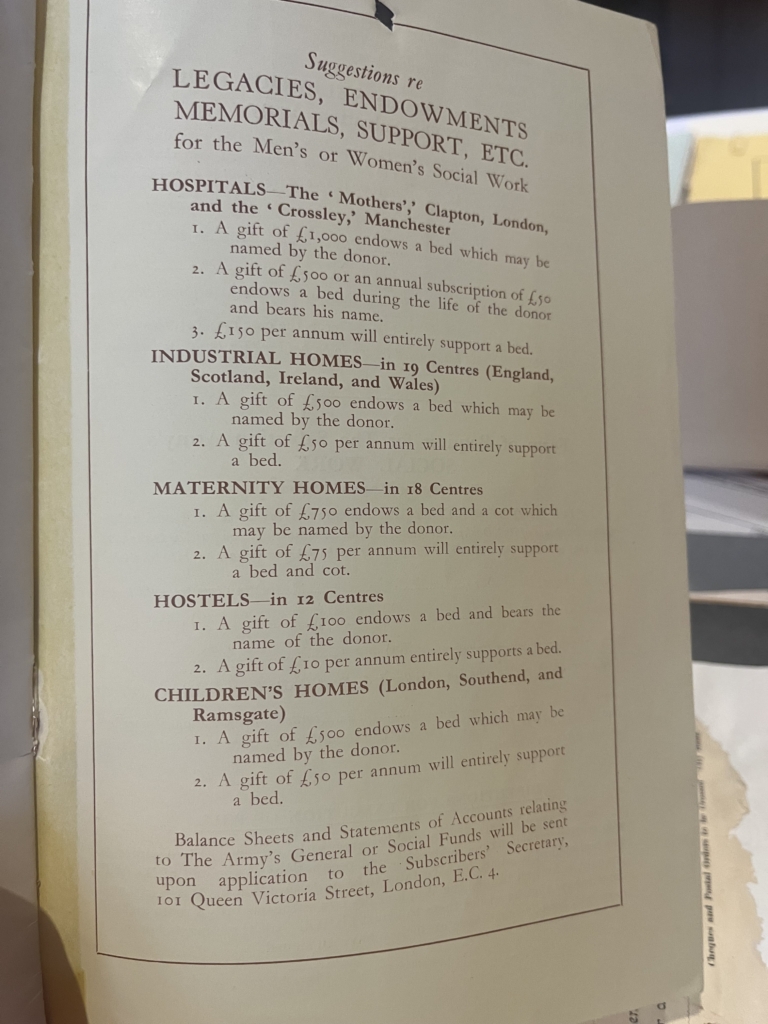
  • Suggesting the amount – The Salvation Army brochure lists amounts of bequests and what they would be endow in death.

Not many charities do this today – with rising costs of inflation it is hard to guarantee what a particular amount might do. Suggesting an amount could act as an anchor and make potential donors feel if they cannot give at that amount their gift would not be appreciated. The counter to that is that without any amount donors don’t know what a gift could do!

  • Pledger stories – research has shown that hearing from current pledgers who are alive and made a commitment to a gift in a will inspires us. We react to seeing people like us who have had similar experiences and connections to the charity making this commitment. Many legacy packs invite donors to share their story and memories.
  • No Contact form – we want donors to contact its and tell us that they have made a gift. So supporters are invited to get in touch with the charity and tell them they have left a gift (or even that they don’t and won’t and to stop asking).
  • No Legacy circles – there is no suggested ongoing contact with these pledgers in the 30s. There is no ‘let us thank you in your lifetime’. For some supporters this continued contact and acknowledgement is an important part of the gift and allows them to deepen their connection and meet other like minded supporters.
  • No codicil or letter of wishes – donors not have greater flexibility and ability to add (or remove) you from their will!
  • Legacy is the dominant word and phrasing here – the term gifts in wills is often preferred nowadays and the term bequest or dislike actively disliked by some donors.
  • Living legacies – the 1933 brochure talks about living legacies. This seems to come in and out of fashion and is always a question for charity and the donor. When needs are so urgent and pressing it is best to have the money now? Is it best to give the money now and see the impact of the gift (and get thanked in your lifetime)? Or to wait until asets are realised on death and give then? With the climate emergency some donors are giving now to ensure that urgent action can take place?

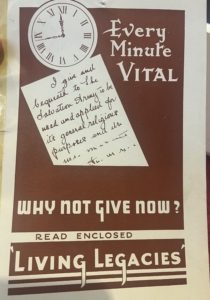
The clock is set a 11.45 emphasising the ‘every minute vital’ message and that the clock is ticking. Often campaigns use the visual of a clock to reinforce the message that the time is running out to make a gift before a deadline. It acts as a powerful visual anchor.

Again like the legacy brochures at the top there is a handwritten note saying ‘I bequeath and give to the Salvation Army to be used and applied for its general religious purposes and …’ There is something about the handwritten notes which helps the donor imagine themselves into the situation and that it could be their will.

So not that much has changed in the last 90 years …

https://marinajones.uk/wp-content/uploads/2023/12/IMG_9411-1-scaled.jpeg 2560 1920 admin https://marinajones.uk/wp-content/uploads/2022/12/f2b903e010104f5aa61ea1821a685913.png admin2023-12-07 17:43:112024-01-09 13:16:22Legacy brochures from 90 years ago

A brief selection of charity merch from the archives

December 2, 2023/0 Comments/in Thoughts/by admin

So your email is probably bombarded with charities and various Christmas catalogues and ways you can support them through purchases gifts or Christmas cards.

The first Oxfam Charity Christmas card was in 1957 but the tradition goes back further than that

Designed by Leslie Durham

So a short festive look at some of the charity merch that you could have bought in times gone by and why it has an enduring appeal – for charities and donors.

Epistolary scandal novels (1799)

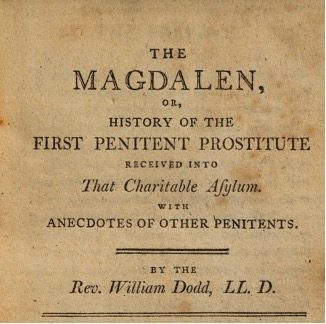
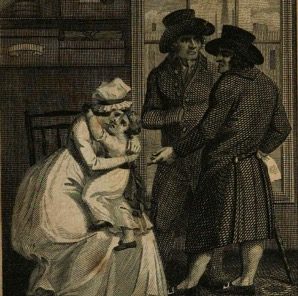
In the 1799, you could buy the sensational novel (price one shilling) entitled ‘The Magdalen or the History of the First Penitent Prostitute received into that charitable asylum with anecdotes of other penitents‘ (what a title!).

These were written in letter form and detailed the fallen women – in this case a clergy daughter seduced by a charming older man who finds herself abandoned. They perhaps veered a little towards the sensational and were enjoyed more for the scandal of the story than improving moral purpose.

You could also buy published popular sermons to support various causes.

Abolitionist Plates and Medals (1780s)

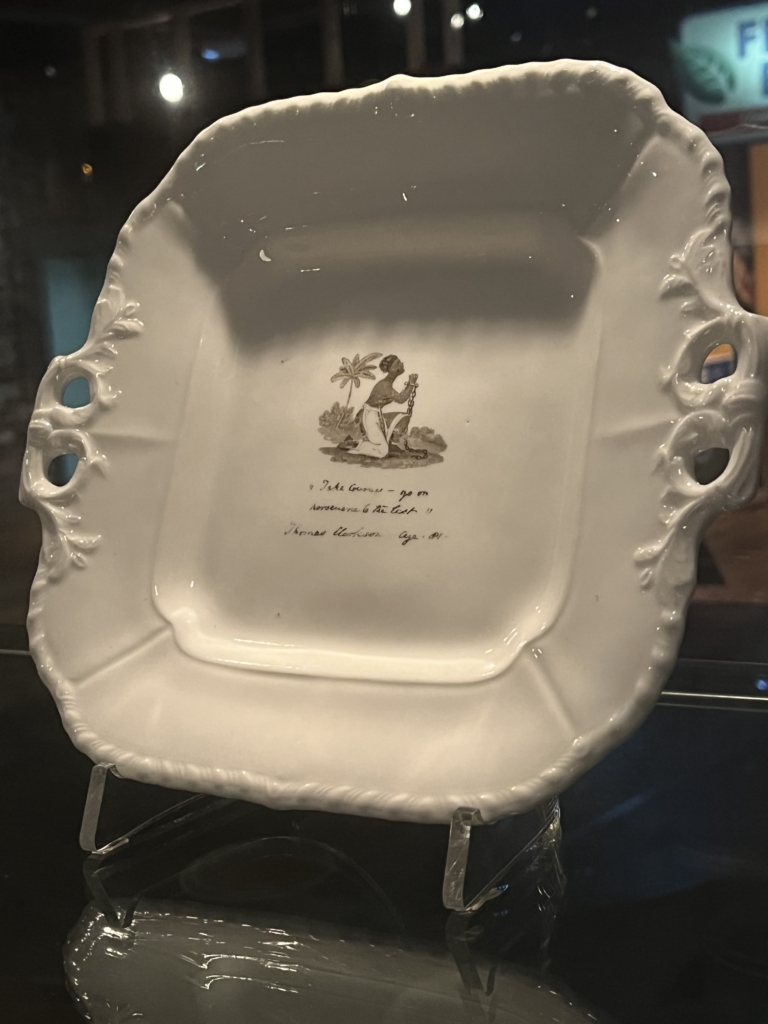
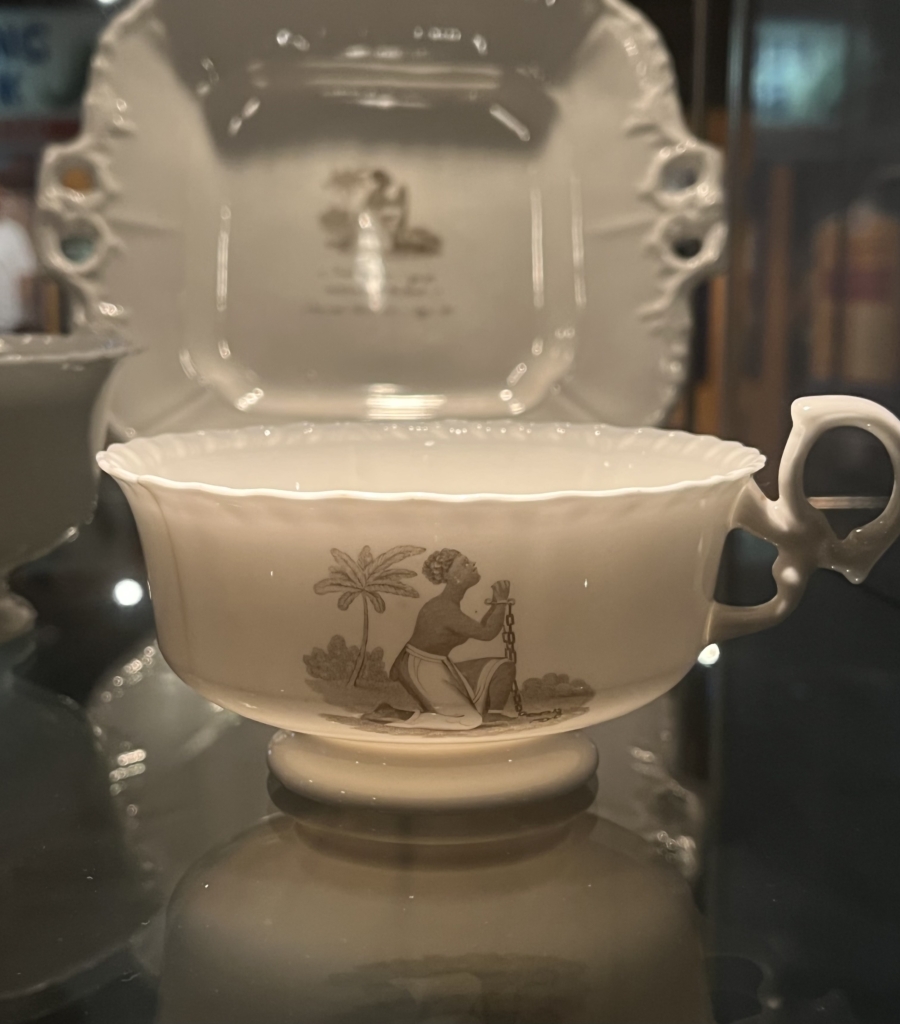
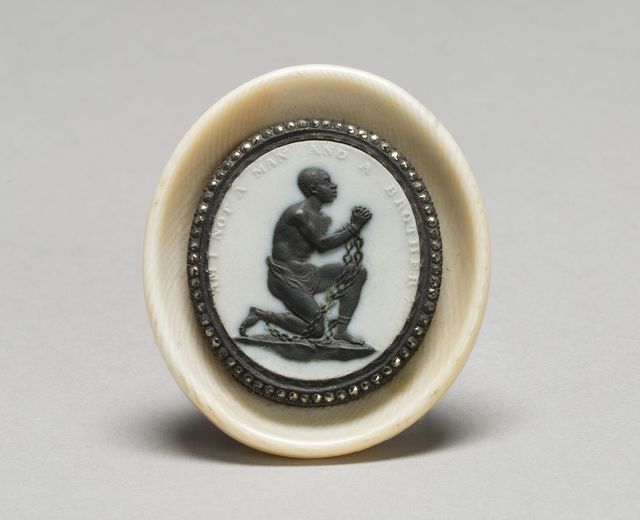
Abolitionist, industrial entrepreneur and potter Josiah Wedgewood created tableware to support the anti slavery movement. He also designed the anti slavery medallion which became a highly fashionable item to wear.

“ladies wore them in bracelets, and others had them fitted up in an ornamental manner as pins for their hair. At length the taste for wearing them became general, and thus fashion, which usually confines itself to worthless things, was seen for once in the honourable office of promoting the cause of justice, humanity and freedom”

The tableware and the medallion were sold to raise funds for the cause and Wedgewood donated directly to the cause himself.

Iron for Gold (1813)

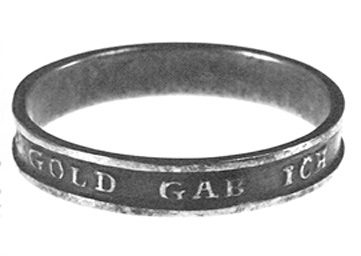
This item doesn’t have a price and sits somewhere between a charity merch item and a donor thank you. During the Napoleonic wars Princess Marianne of Prussia asked the nobility to give up gold and it they were given iron jewellery emblazoned with ‘I gave gold for iron‘ and became the fashion of the court.

Typewriter ribbons, lampshades and much more (1890s)

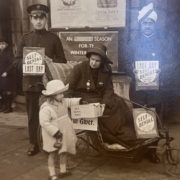
The Salvation Army used modern printing technology for the best advantage. They turned attractive soldiers (members of the Salvation Army not real soldiers), fundraising events in New Zealand, the famous officers of the day into postcards to sell to raise funds.

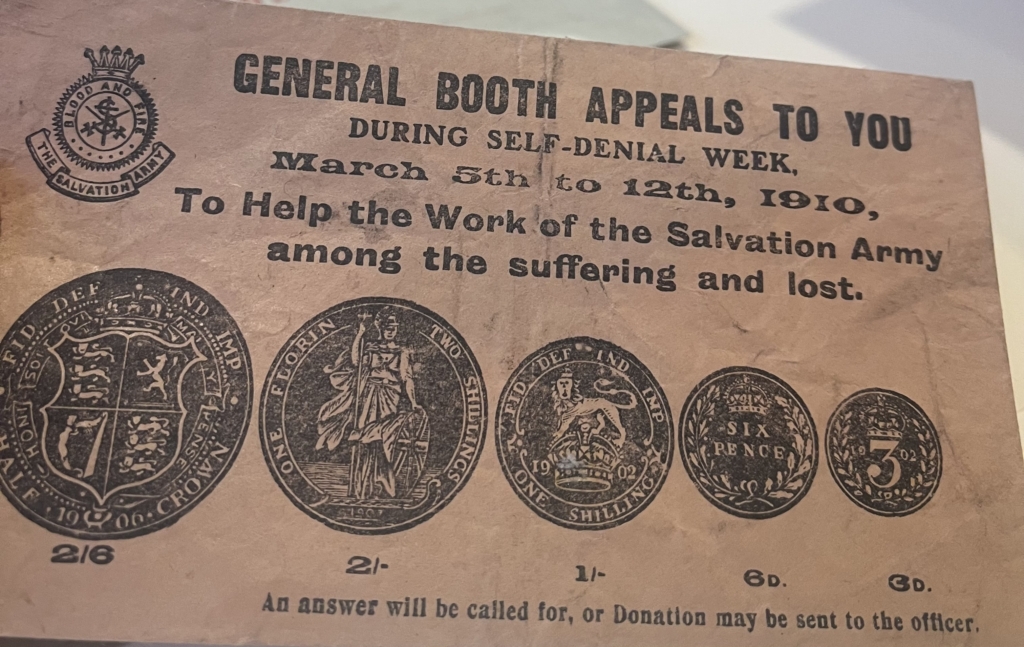
Postcards depicting self denial effort
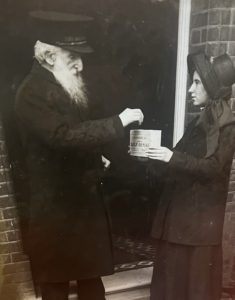
General Booth on a postcard contributing to the Self Denial Effort

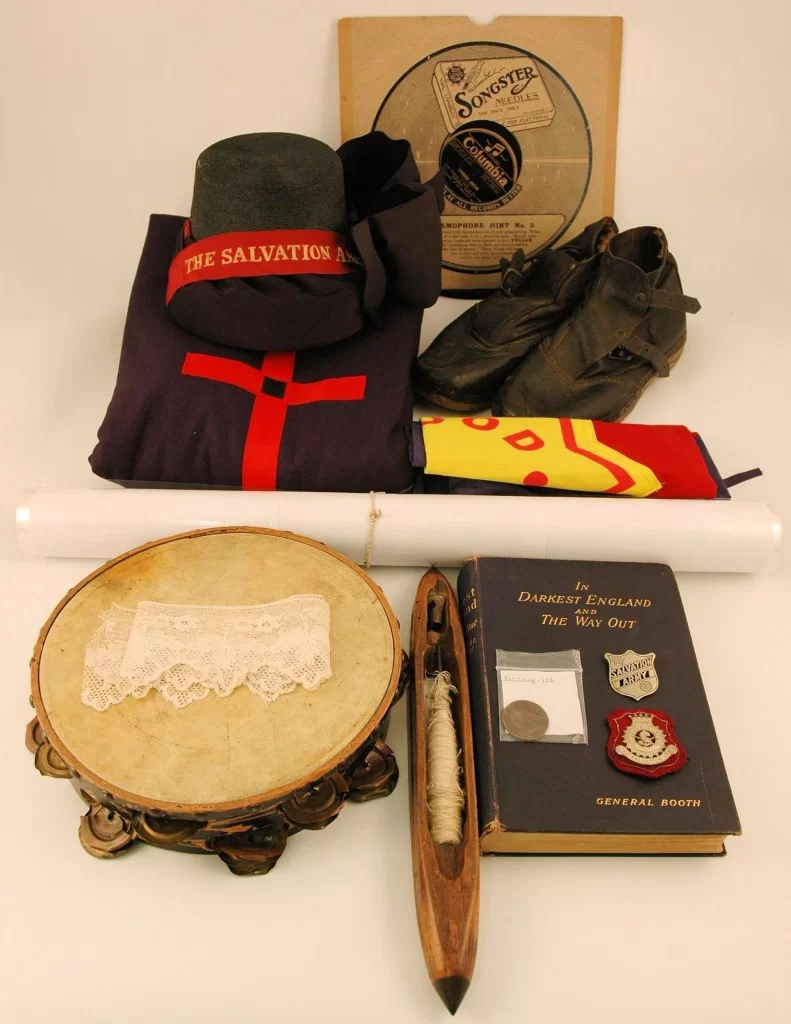
The leader of the Salvation Army was the General and the founding General – General William Booth. General Booth’s image was on tea cups, crockery, lampshades, playing cards, glue, typewriter ribbons and everyday items with all profits going to the Army. His voice was recorded on photograph and recordings of him sold.

Salvation Army plate depicting General Booth
Salvation Army uniform and memorabilia including record of General Booth sold to raise funds

Sheet music, commemorative handkerchiefs and napkins (1899)

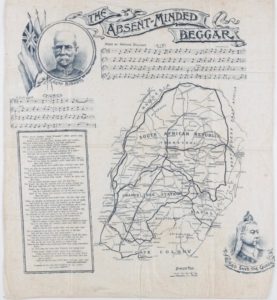
Rudyard Kipling’s poem The Absent Minded Beggar was set to music by Arthur Sullivan and became the UK’s first charity single raising for funds for soldiers returning from the Boer War. People bought the sheet music to support the war effort, but could also purchase the matching handkerchief (seen below).

Suffragette crockery (1909)

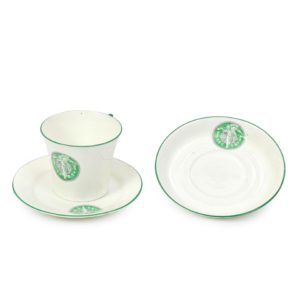
In 1909 The Women’s Exhibition used a suffragette tea service for the duration but then sold it to raise funds. Broaches and pins were also used to raise funds for support.

Why is charity merchandise so popular with us

For the charity it obviously raises funds and allows a donor to support in another (often additional) way. They may be a member but will also buy the tea towel, the mug, the baseball cap and the gin. It also offers the charity free advertising – if your donors are walking around with your tote bag or umbrella, or sending your Christmas cards.

But charity merch plays another very important role – from cups to typewriter ribbons or hankies it helps cement their supporter identity as part of your supporter tribe.Yes, the motive for the purchase may be blurred and they buy the item because it is pretty or practical but is also personal – a personal allyship with the cause. Like wearing a football shirt, a university scarf or a t-shirt with your favourite band on it – it is showing affinity and identity. Collecting and using the item reinforces their connection with your charity and a memory associated with it – perhaps with each use of the cup, the bag, the gin they are getting a microdose of dopamine (the happy chemical) and being reminded of the warm glow of giving to your charity.

For your supporter having your merchandise is a way of them signalling they are someone that cares about preserving art or fighting for justice – and literally have the t-shirt to prove it. 

How can help your supporters literally wear the t-shirt of support?

https://marinajones.uk/wp-content/uploads/2023/11/cup-scaled.jpeg 2560 2560 admin https://marinajones.uk/wp-content/uploads/2022/12/f2b903e010104f5aa61ea1821a685913.png admin2023-12-02 16:53:042023-12-02 16:53:05A brief selection of charity merch from the archives

Fundraising fundamentals – Red kettles, self denial & picture receipts

November 30, 2023/0 Comments/in Thoughts/by admin

The Salvation Army Christmas red kettles are perhaps one of their most well known ways of raising money and especially at Christmas time – seen on Friends, When Harry Met Sally and countless other shows. 

The famous Salvation Army red kettles first appeared in 1891 when a former sailor and Salvation Army Captain Joseph McFee was thinking about how to raise funds to provide the poor of California with a Christmas dinner. He remembered how when he was a sailor at Liverpool Docks there was an iron kettle called ‘Simpson’s Pot’ for donations for the poor. He used this idea to set up a kettle and with the slogan ‘Keep the Pot Boiling’ – a tradition was born that lasts to this day. 

Looking back to when Joseph McFee came up with this idea we can see a whole wave of fundraising innovation and inspiration from the Salvation Army. I recently had a rather fundraising history geeky trip to their archives to see some of them for myself. And here are 10 fundraising fundamentals from the archives of the Salvation Army.

Background

Founded in 1865 as the East London Christian Mission by William and Catherine Booth. It sought  to bring physical and spiritual salvation to the poor and destitute – and is often known for the 3Ss – Soup, Soap and Salvation. A radical reassessment of mission involved a rebrand turned the mission into the Salvation Army in 1878 when William Booth became the first General led to rapid growth and expansion with work staring in America and Australia in 1880. The reshaping of it into Army with a General as a leader, army officers and members as soldiers also involved a radical overhaul of its fundraising need as it expanded beyond its East London base and sought to bring that salvation to the world.  The Salvation Army was one of the first international big brand charities.  In 2023 it has over 1.7million members and is the largest non-governmental provider of social services in the US and is active in over 133 countries. 

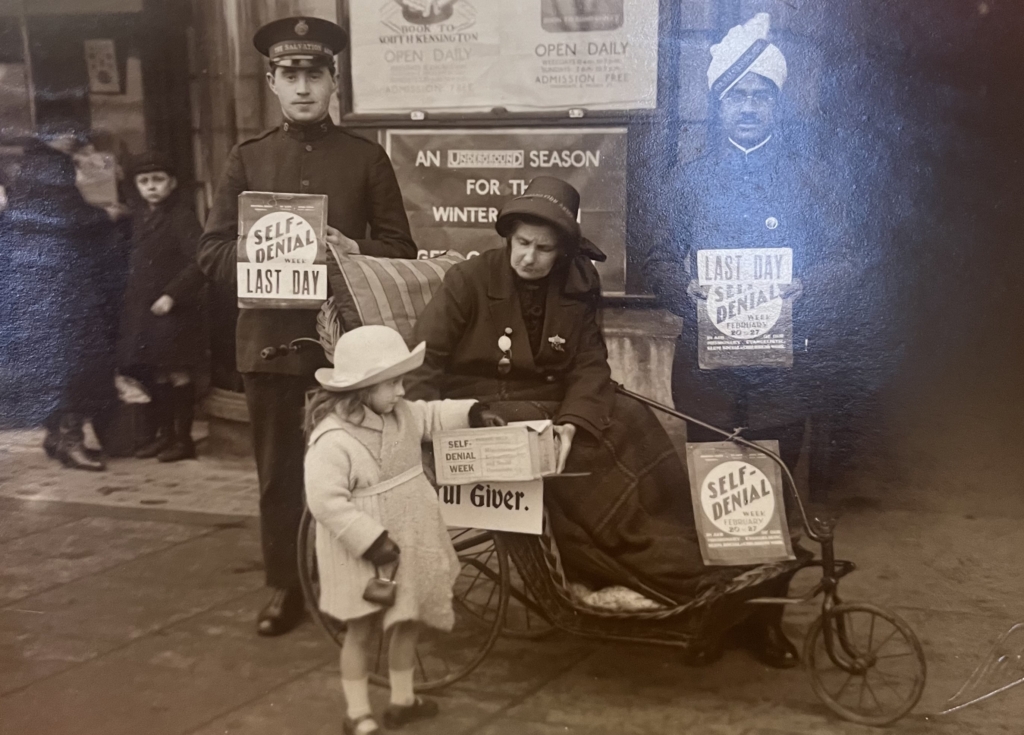
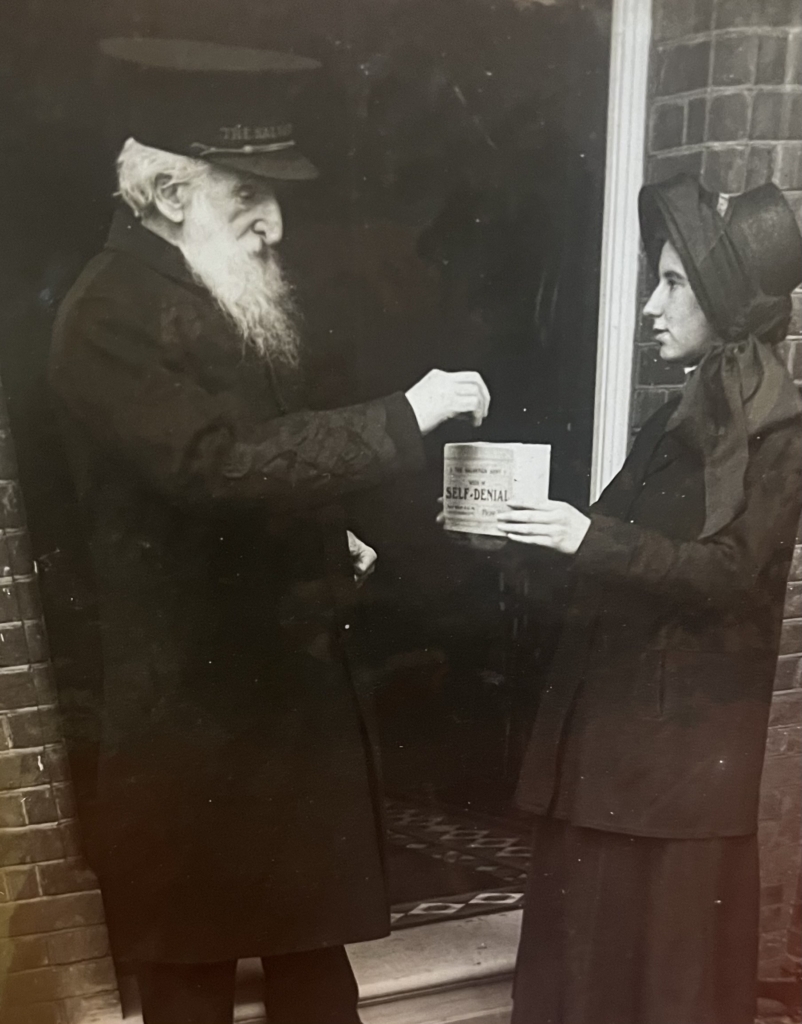
Alongside the red kettles the other most notable campaign is the annual Self Denial Fund. Which began in 1886, when John Aiken Carleton could not donate a big gift, but decided to give up puddings and donate the money saved to the Salvation Army. This became an annual campaign which all soldiers were asked to participate in and recruit others to donate to funds at the same time. And again, continues to this day. 

What fundraising fundamentals do we see at work? Why do they work – now and then?

1. Use the latest technology

Fundraisers have always adopted and used the latest technologies to raise money in new and creative ways. So now we might be thinking about how AI, ChatGPT or the latest social media viral video can be used to gamify our fundraising. 

In Victorian times it was no different. The Salvation Army grabbed the opportunity presented by the new photolithography machine. Basically this was an early form of photocopying and it allowed you to make cheap and effective copies of appeal letters. 

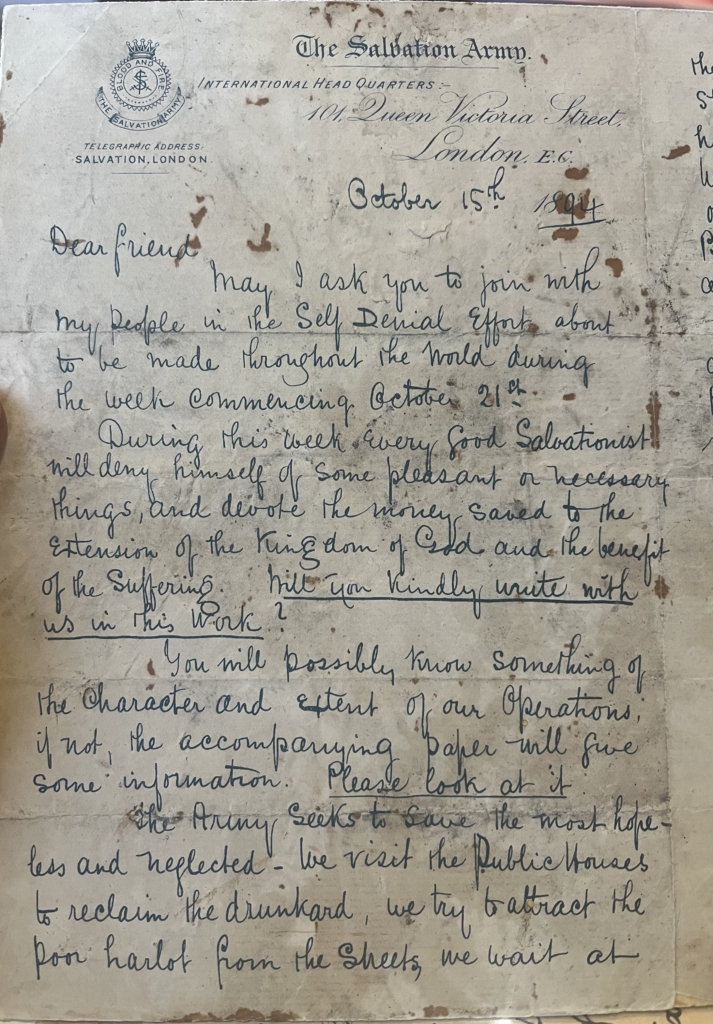
So that the appeal letters that they sent looked like they were handwritten to you from General and Catherine Booth, the two leaders of the Salvation Army.

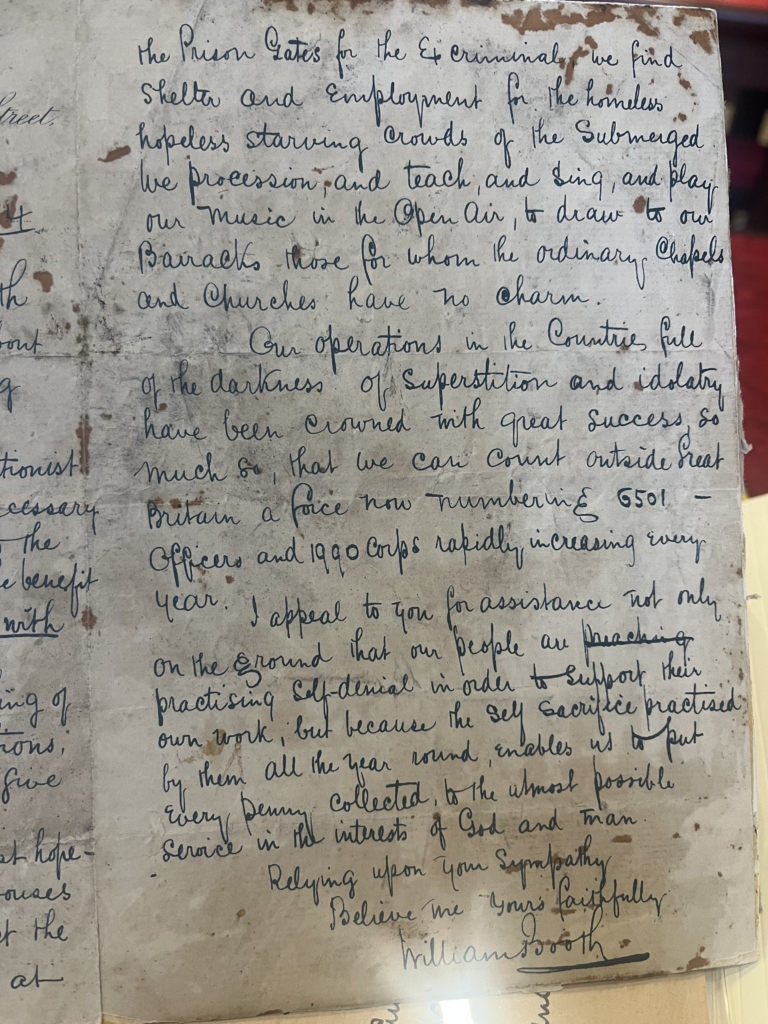
General Booth 1894 Self Denial Fund appeal letter
The photolithograph captures his handwriting and brings the personal touch

Seeing the copies of the letters in the archives it is hard to believe that they are not really handwritten – they are a blue inky colour (it is tempting – but I didn’t- to lick your finger and smudge it to see it is a really written in ink). So they do really look like a personal appeal. 

We are all attracted by the novelty and using the latest technology can make our appeals go further and also entice donors to the cause.

We also pay more attention to handwriting rather than just printed text – it stands out and catches the eye and therefore the attention of our supporters. 

Making a direct appeal letter stand out 

Underline – emphasising something and making it stand out more for the reader. Like any good direct mail fundraiser General Booth uses it sparingly to add stress to phrases and sentences. 

The lines Booth underlines in the 1894 appeal are ‘Will you unite with us in this work?’ and ‘Please look at it’ referring to the leaflet associated with it.

The use of the underline also helps make it easier for the reader to process the information. We tend to lazily scan words and the underline makes us pause and pay attention. It breaks up a big block of text.

2. Donor centric language – it is not about ‘we’ the charity but about ‘you’ the donor

General Booth was an early adopter of using donor centric language (perhaps he went through an earlier draft and changed the ‘we’s into ‘you’ as fundraisers are schooled to do).

The 1905 letter says 

“But you are more than an heir of heaven and a traveller to the eternal city. You are a partner with me in the fight. You are a soldier of the cross …. You will not disappoint your general”

There are notably more ‘you’s in the copy than ‘we’.

Donor centric and emotive language that really draws on the reader’s religious and personal identity and connection to the cause. How do you make it about them? And why they should support you?

3. Cases for support: Appeal to the heart and the head

We all know you need a different case for support for each donor. 

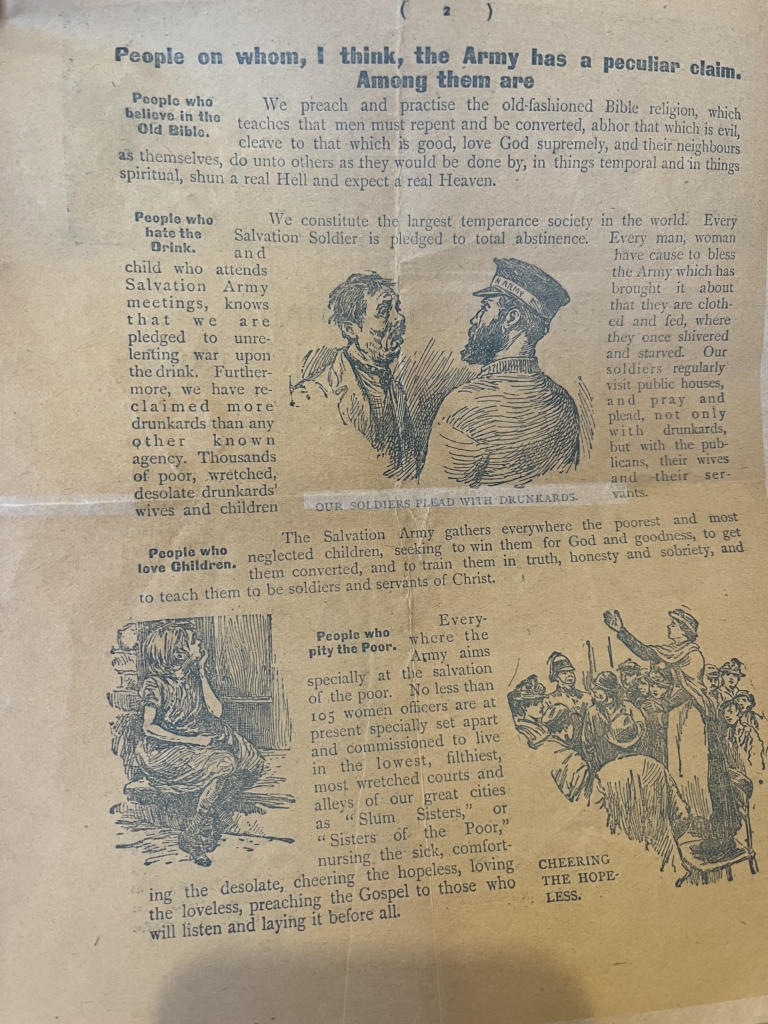
The Salvation Army Self Denial leaflet gets around this by printing each of the areas that you could be concerned about – ‘People who believe in the Old Bible’, ‘People who hate the Drink’,’ People who love Children’ and ‘People who pity the Poor’. Each of these then presents a case and detail of the work in that area. 

Cases for support
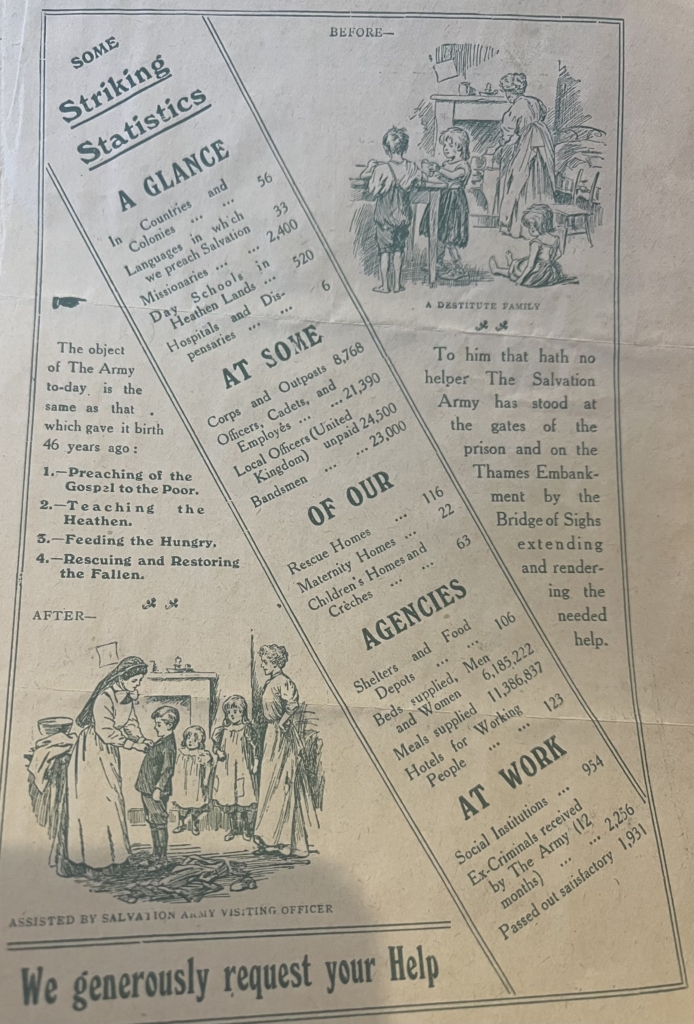
Statistics and impact

If you are not so visual, or attracted by these cases, there are also detailed statements of impact, reach and numbers for the more quantitative data driven donor!

Sometimes you need to write a special case for supporter for a very distinct target market, in  1904 a female Salvation Army officer in Sweden wrote appeals in Latin to flatter her male undergraduate students 

Cognosce te scopum forum

4. You want to run a good campaign – you’d better be organised

If any charity could organise with military precision it was the Salvation Army. They utilised their military structure, branches and publications to regularise, systemise and approach campaigns and fundraising with rigour. 

The annual Self Denial Fund was the most dominant campaign which they through all their administrative might behind.   

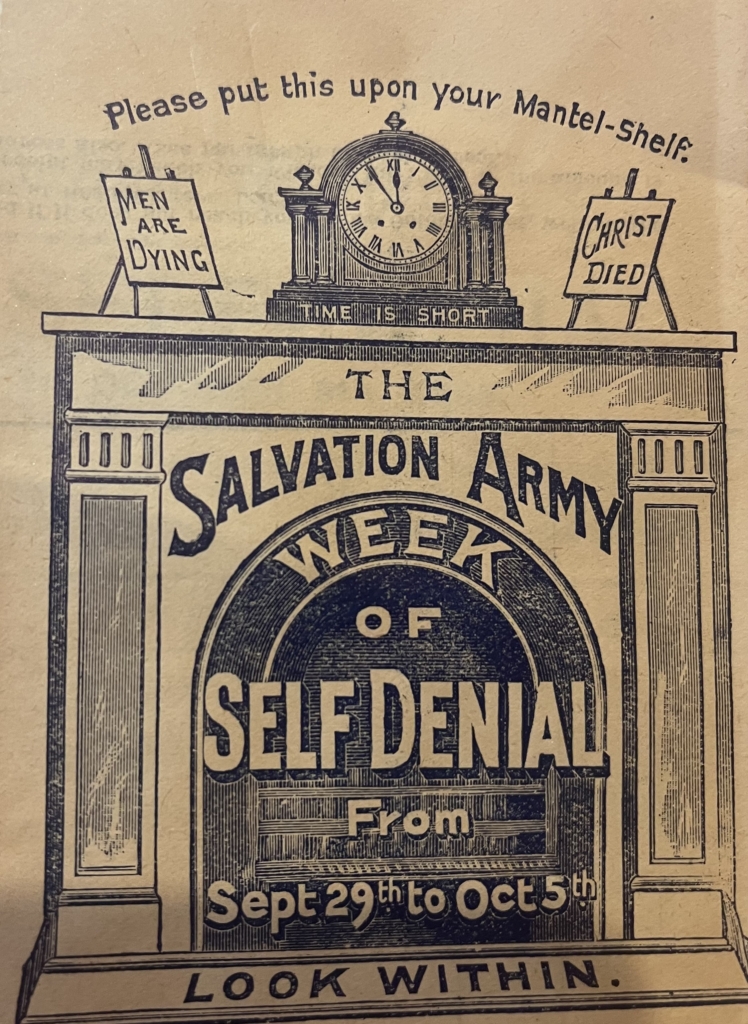
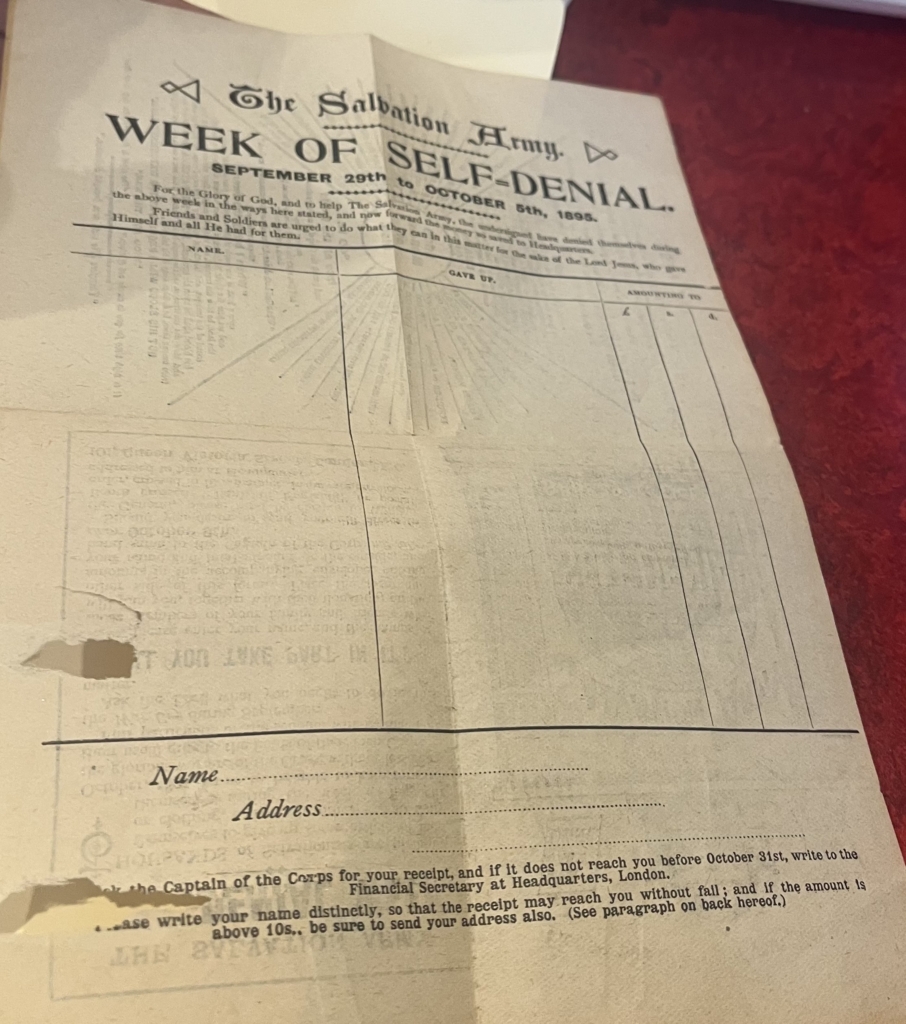
  • Be prepared with the print
Self Denial Appeal 1895 Front Cover
Fold out inside to detail what given up and contribution
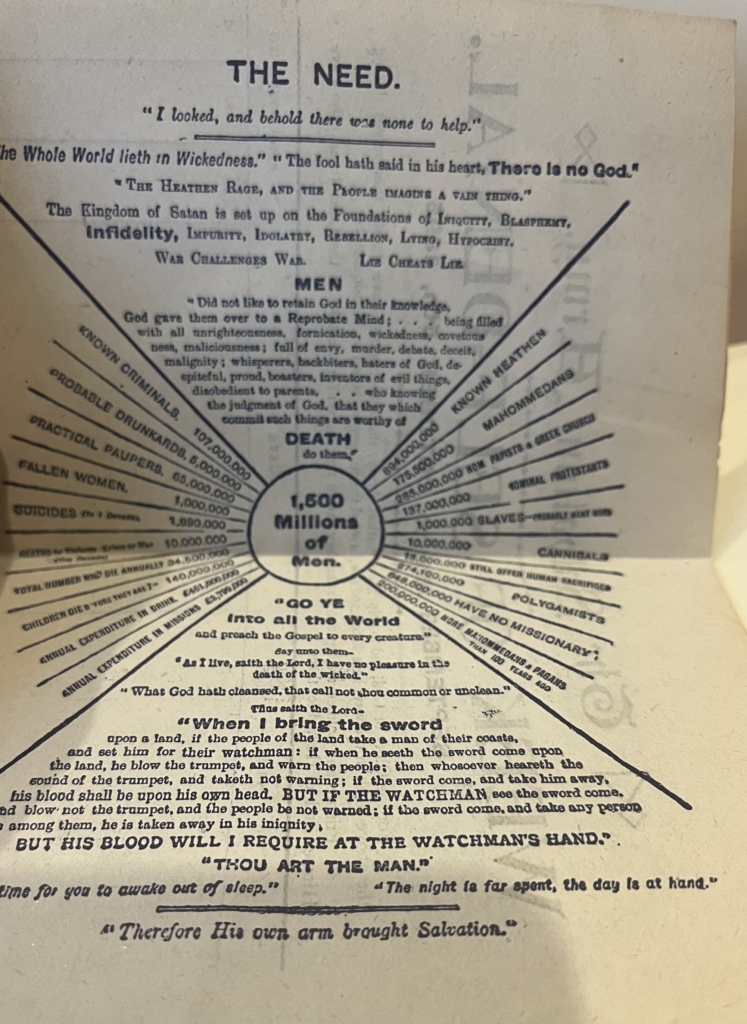
Need and impact

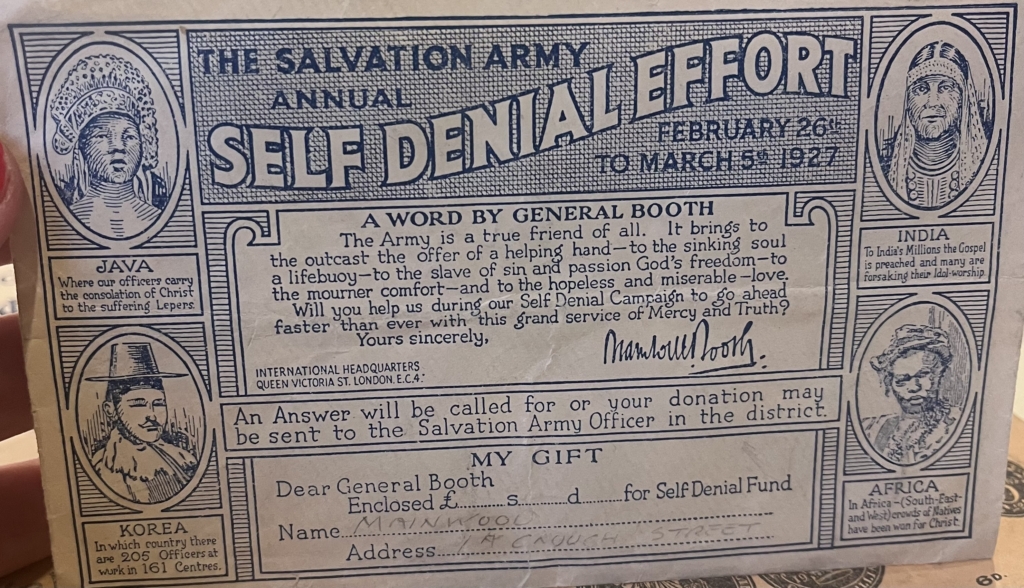
Printing had become cheap and easy so there is collateral for every part of the campaign. There were promotional leaflets for Self Denial Effort with attractive picture covers, printed forms inside to detail what had been given up and what raised and impact statements.These were supported by forms for fundraisers, envelopes and receipts.

Self Denial Fund envelope 1919
Self Denial Fund envelope 1927

Have a campaign plan

Day by day guides were published in The Officer monthly magazine about how to prepare and what to do each day of Self Denial Week  e.g. Thursday reads ‘The week is now drawing to a close. Look up weak ones, visit best friends, take out band with some novel contrivance’

There are strategic plans to draw up how much you will raise from each mechanism – envelopes, pictural receipt books, salary sacrifice. And suggestions to put the previous years total prominently on the wall so you can check in on how you are performing against target. 

And even plans that divide up each road in each area and how many houses it had and how many collectors were needed for door to door collections in each road.  

Promotion is key

The Officer is full of guidance of how to make the most of advertising your campaign. Deliberately borrowing from commercial marketing techniques suggestions include using empty shops, a hand cart, sandwich boards and sample press releases are included. They even suggest going to factories with a collecting tin on pay day to maximise donations.  

5. Build the thank you into the campaign and make it memorable (or even collectable!)

We all know how important it is to say thank you to our donors for their support and leave them feeling appreciated.

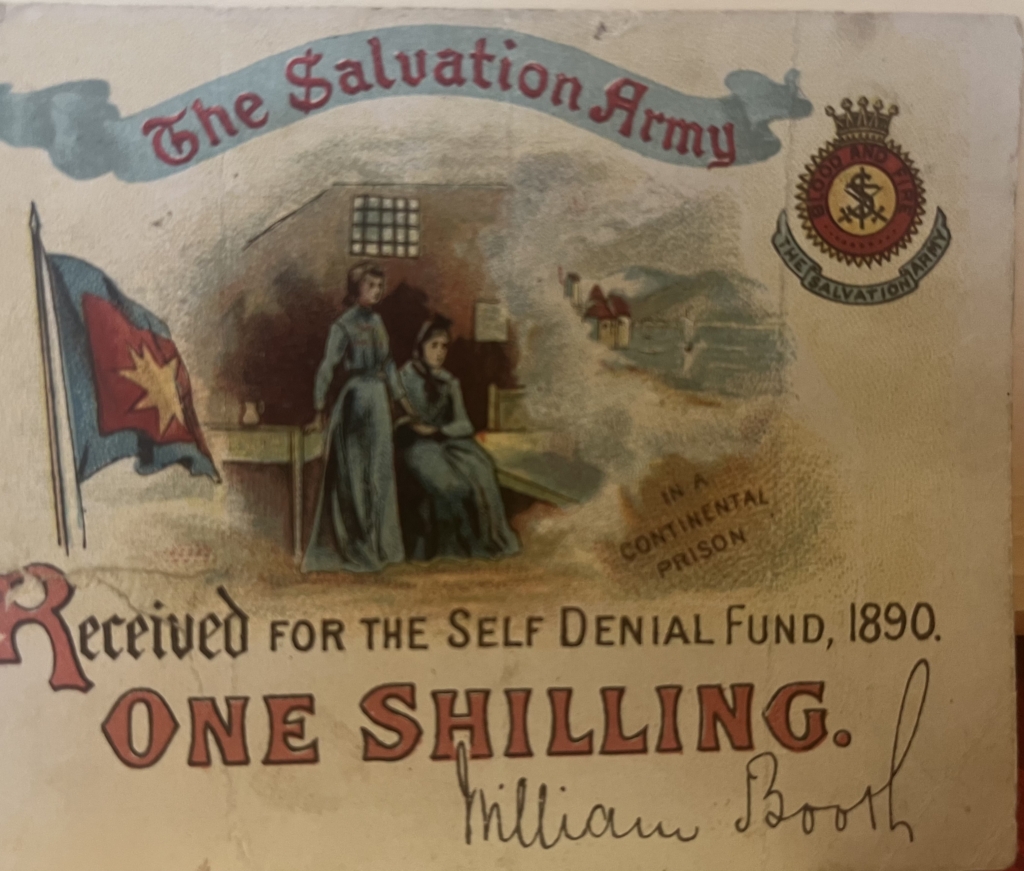
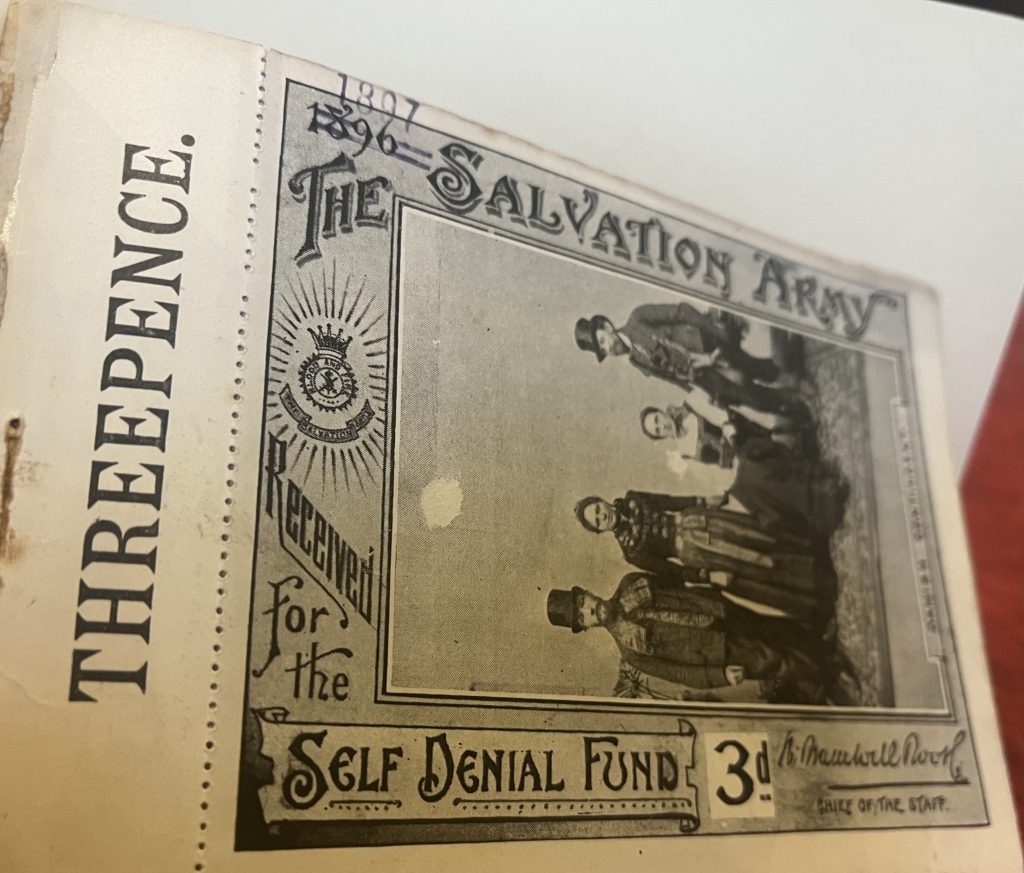
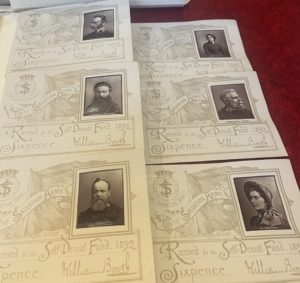
Each collector was armed with a receipt book that they could give on receipt of a donation – some were plain white receipts and some were pictural. Each year the images on the picture receipts varied. In 1892 the receipts all had a sticker that could be fixed on of the celebrated Salvationists – it feels a big like collecting football stickers or Lego cards that you need to get the whole set. Interesting to note the majority of these do not include the word ‘thank you’ – they just say ‘received one shilling’. 

1890 Receipt
Picture receipt originally 1896 but crossed out and reused in 1897
1892 Receipts – collect your favourite Salvationist

(How dull most modern receipts are)

These receipts were replaced by thank you book marks which are described in the appeal packs as to be left with donors as their ‘medal for caring.’

How do you build the thank you into your campaign planning? How do you make it memorable? You can imagine these pictural receipts displayed in homes. How do we continue the joy of giving with the thank you?

6. Value every gift

The guidance for the Self Denial Fund recognises that not everyone can give cash. It suggests that soliciting fundraisers even accept postage stamps to support the campaign saying ‘Many will give one or two postage stamps when they will not give money’. 

Every little helps.   

How can you value any contribution to your work?

7. Don’t forget to ask those who you help 

In 1891 an ‘Out of love’ campaign targeted former residents of Salvation Army homes, inviting them to give a one penny a week back to repay some of the ‘toil, the care, the love and the expense which has been so freely and gladly expended on them’. If they gave enough they were gifted a Bible and their name was inscribed on the roll of honour. 

Often charities shy away from asking those that have benefitted from the charity’s work to be involved in supporting it (not so much in the arts where audiences are asked.) This provides a small but meaningful way for those that have been impacted by the work of the charity to help. Giving back and saying thank you are often strong motivations for giving. 

Whose life has changed because of your charity’s work and how can they be invited to join the supporter family?

8. Make it easy for people to do what you want them to do 

The concept of self denial can feel too vague for some, so in 1889 a ‘Special Hints for Self Denial’ pamphlet was produced listing all the practical ways that you could participate. Examples were given of donating one day’s salary, buying less expensive food, put off paying for new clothes, walk and not using public transport. The funds could then be donated to the Salvation Army. It makes it easier to do. 

Vague concepts put an additional cognitive load on our over stretched and lazy brains and too much to think about decide stops action. Make it easy for your supporters to know how to help.

How can you make it easier for them to do what you want them to do?

9. Show don’t tell 

Postcard used to raise funds 1890s depicting General Booth making a Self Denial Fund donation

In an early ‘show don’t tell’ example we have a postcards of General Booth and other Salvation Army soldiers donating money into a Self Denial Fund box. Literally showing people what you want them to do. 

(the earliest example of a self denial campaign was in 1209 when the canons of Angeirs Cathedral sacrificed the cost of feasts to support the capital campaign to build the cathedral)

How can you show your donors what you want them to do?

10. Mission matters but so does money

“there is nothing next to definite spiritual work, of greater importance that raising finance’ 

The Officer 1893

This mission is important but cannot be completed or attempted without the funds to back it up.

Has anything changed? 

So from a 1891 idea for a red kettle that is still used today (hey, if it ain’t broke, don’t fix it). 

Much in fundraising doesn’t change 

  • The need for good planning
  • The importance of thank yous
  • It is about them – not about you the charity 
  • Make it easy for your supporter to know what to do
  • Show don’t tell
  • Don’t forget those that benefit
  • You cannot do good without money to do it with 

It all feels very modern, and the changes that were made in the late Victorian period are seen in many ways that we fundraise today and in the innovative spirit of fundraisers. 

The Salvation Army saw itself in direct competition with consumer market and so used the same tools and marketed “compassionate consumption”(Roddy, Strange and Taithe). They, along with other emerging brand charities like Dr Barnado’s, certainly embraced the advances in technology and the rise in mass fundraising communications. 

They themselves recognised in 1893 the change that they were part of  

“.. few organisations have been so successful in raising money as ourselves. This has been largely because we have set about it in a systematic, methodical, businesslike manner …. Our methods for raising money have been and are almost innumerable, the military nature of our organisation enabling us to act together with a uniformity and precision which to others would be almost impossible”

The Officer, 189

This ‘systematic, methodical, businesslike manner’ has ripples today in how we approach fundraising.  The approaches introduced by them and others like St Barnado’s advanced the professional practice of fundraisers and have been proved to be psychologically powerful and effective tools for persuading people to give money to support much needed work. 

  • Did the ‘compassionate consumption’ approach mark a change in fundraising? 
  • Did the adoption of commercial marketing and promotion raise more money? 
  • Did the impacts of consumer culture, capitalism and technology change the essence of how fundraising was conducted? Away from the personal, dutiful gift, to a more mass produced and marketed machine which by its nature provided a more transactional (picture receipt anyone?) approach?  Or in a industrial capitalist society were we always heading towards that?  

Background on why this blog came about 

After reading ‘The Charity Market and Humanitarianism in Britain 1870-1912’ by Sarah Toddy, Julie-Marie Strange and Betrand Taithe and learning all about all sort of interesting fundraising activities and methods I visited the Salvation Army archives in Denmark Hill. Interestingly the fundraising was all run from the Public Relations office and they have an archive of early fundraising examples from the 1880s through to more modern times. Fascinating to see. Like many archives it is a bit patchy and speaks to the issues of how we preserve and archive what is important. 

https://marinajones.uk/wp-content/uploads/2023/11/ETKNds2XgAErlJT.jpeg 414 649 admin https://marinajones.uk/wp-content/uploads/2022/12/f2b903e010104f5aa61ea1821a685913.png admin2023-11-30 21:04:032025-07-25 16:34:54Fundraising fundamentals – Red kettles, self denial & picture receipts

The history of fundraising is more complex than our simple narratives  suggest 

November 9, 2023/0 Comments/in Uncategorized/by admin

Fundraisers and historians have at least one thing in common. They both love a story. For the fundraiser, stories allow them to get a case across simply and effectively – eliciting sympathy, driving action, empathy, and action preferably in monetary, form.  

Conferences are full of workshops on how to tell better and more compelling stories. We know it can be more effective to keep the story simple, info-lite, and negative-but-solvable. Yet the complexity of the needs that our charities try to address, and the efficacy of the solutions offered, do not fit into a neat narrative or case study. Too much information can overwhelm supporters, slow down the decision-making processes, and make our asks less effective. The donor can be placed in the centre of the story as the hero who can provide the solution so we keep it simple, and focus on the story.  

For the historian, stories are about condensing complex social, cultural and political movements of people, power and place into compelling narratives. We want a narrative arc. We want to link an assassination here with a coup there (wider history not fundraising history), or we want to trace the origins of this war in the peace treaty 20 years beforehand. We know it is more complex, and that correlation is not causation, but to make it understandable we tell it as a shorthand of events and moments. As the Cambridge history professor  John H Arnold  says: “History is to society what memory is the to the individual.”  

“When we come to explore to the history of fundraising, we often grasp for the unusual – the fundraising ‘firsts’ – and try to weave them into a narrative arc (the fundraiser’s need for a story dominates!).” 

Both fundraisers and historians stitch together the elements of the available facts that serve the story’s purpose – to raise funds; to try and tell us what has happened and how we got there.  

Is it any wonder, then, that the history of fundraising to date has hooked on to a ‘great story’ – the origin myth of the evolution of fundraising being led by Charles Sumner Ward as the modern father of fundraising. And if you want a recap/reminder (from our  timeline of the 20th and 21st centuries): 

Charles Sumner Ward (1858-1929) is widely credited as the founding father of modern fundraising. In 1900 he was general secretary of a YMCA branch in Michigan, where he spent much of his time fundraising using what we would recognise as standard major donor practices. However, in 1905, given the task of raising $90,000 for a new YMCA building in Washington DC, he decides to achieve this through an ‘intensive’, or ‘whirlwind’ mass appeal public fundraising appeal. He masterminds and oversees many other similar appeals for other cities, using what became known as the ‘Ward Plan’. He repeats his success in England, and throughout World War One he repeats this campaign model for the American Red Cross and United War Works. In 1920 he founds the fundraising firm Ward, Dreshman and Reinhardt in New York. 

Even when we do not have a coherent historical narrative to tell (as is arguably the case with fundraising), we nonetheless like to have a story to tell – both as fundraisers and humans. Stories are stickier and easier to remember. Perhaps that is why the Sumner Ward story has stuck.  

But as with all history, the history (or histories) of fundraising is not that simple. Is there a different story we can tell? 

An alternative historical narrative – women to the fore 

In 1893, it was estimated that there were half a million women working semi-professionally in a full-time capacity in auxiliary societies in the UK. Around 20,000 were paid officials supporting fundraising and soliciting funds. Auxiliary societies were democratic voluntary associations that worked together to finance philanthropic work (from missions to temperance movements). The auxiliary was a regional branch  of a large ‘parent’ society and members paid subscriptions to support the work and additionally raised funds to support the cause they cared about. In America, 30,000 African-American women were active in church-associated clubs similar to auxiliaries.  

Tyrone McKinley Freeman’s book looks at the role of African-American women through a fundraising lens – one of the few to do so. 

The limited scholarly exploration and the glimpses that we see gives a richer, more nuanced and more female-led approach to raising funds and running charities. This extensive involvement of women in the fundraising in the 18thand 19th centuries calls into question the standard origin myth of modern fundraising as having been driven by a few ‘great men’, such as Charles Sumner Ward and Lyman Pierce, in the early 20th century. 

The alternative historical narrative that emerges from the second fundraising timeline we have constructed as part of  Rogare’s fundraising history/historiography project  (covering the period 1500-1899) shows the much more active role of women to raise funds – as evidenced by the charity bazaar movement (see the entry for 1685) and that the first charity shop was established to sell goods made by women (see 1859). 

Collating entries for this second fundraising history timeline has revealed a much more nuanced, sophisticated and complex fundraising practice existing in the UK and the US. Many of the methods attributed to as firsts by Pierce and Sumner Ward had been used in other campaigns throughout the 18th and 19th centuries by active fundraising professionals in the UK and the US, including segmentation, mass publicity campaigns, short-focused appeals raising big gifts for capital projects, utilising mass printing of pamphlets, and mass mailing.  

As an aside from someone who has been involved in several major capital projects, the level of excitement, size of gift, and ‘noise’ that capital campaigns make may have aided Sumner Ward’s success. Capital projects create physical buildings that come with naming rights and are different to the ongoing and continuing revenue/business-as-usual funding requests. 

“By 1893, there were half a million women working in auxiliary societies in Victorian England – a huge number that bears repeating: Half a million! And 20,000 of them were working and supporting themselves as semi-professional fundraisers.” 

And as with the study of philanthropy, the same is true of fundraising – money talks! We tend to bias our attention towards the major amounts fundraised and the philanthropists who gave those amounts, and ignore the hundreds and thousands of smaller gifts from hundreds and thousands of donors who were asked to give by thousands of fundraisers. Campaigns preceding the major YMCA appeals and British Red Cross of Ward and Pierce were incredibly successful and widely supported (which does not to dismiss or diminish the success of Sumner Ward and his evolution of campaigns and establishment of practice). 

Now to return to the half a million women working in auxiliary societies in Victorian England – a huge number that bears repeating: Half a million! And 20,000 of them were working and supporting themselves as semi-professional fundraisers.  

The challenge with the history of fundraising, as Beth Breeze pointed out in her 2017 book The New Fundraisers, is that too often it is only the fruits of the labour of fundraising are known and recorded – the ultimate outcomes such as the laws changed and the votes won – but not the fundraisers. But this dismisses the work to feed, clothe, educate, and care for those in need, and the lives saved or transformed. 

There are also wider questions of what, and who, has archived this knowledge, and where we can find the evidence for it.  

Suffragettes Annie Kenney and Christabel Pankhurst. It has been argued that well-organised women-led fundraising at the start of the 19th century paved the way for the suffrage movement. 

The substantial literatures on the suffrage movement, the education reform bill, the temperance movement, or the anti-corn law movement have been studied as history and politics, informing us about our political, social and cultural past. But that same literature has not been as systematically studied for what it tells us about the history of fundraising. And that’s despite renowned British social historian Frank Prochaska arguing that the sophisticated organisation of female-led charity collections in the early 19th century paved the way for the suffrage movement.  

Fundraising is seen perhaps an adjunct, a means to an end, and not the focus of the academic or scholarly work to date on this archive. We need to use these well-archived areas to explore our fundraising history.  

But to keep and develop an archive you need to have the power and resources to store and keep records. In the USA, the so-called  Jim Crow Laws banned the right of association, restricted education and curtailed literacy for African Americans. This had a huge impact on the records that were kept about African-American clubwomen, and their role, influence and legacy has been under-explored and under-valued as a result. 

Some of these records of the clubwomen have been explored through the lens of Black studies, women’s studies, and economics, but an explicit fundraising lens or academic practise has not been established or analysed (although that is changing – do read of Tyrone McKinley Freeman’s  Madam CJ Walker’s Gospel of Giving – Black Women’s Philanthropy during Jim Crow). 

One of the reasons for creating the timelines of the histories of fundraising as a first step in Rogare’s  history of fundraising project  is to highlight these missing stories. The stories that are not documented. The stories that are not archived. Issues of intersectionality further enhance the discrepancy of what is recorded and studied.  

As with all historians gathering information, we are drawn to what is novel (the parrot taught to ask for donations in the collecting box), our own time interest, cultural understanding of philanthropy and the importance of philanthropists, and so we find what we were looking for.  

As a result, when we come to explore to the history of fundraising, we often grasp for the unusual – the fundraising ‘firsts’ – and try to weave them into a narrative arc (the fundraiser’s need for a story dominates!).   

Yet it would be as easy to create another timeline of all the under-researched and unknown aspects of fundraising – the missing stories, the lost, the hidden, the non-literate, those working in secret or fearing persecution. This of course includes the aspects of women’s active role in fundraising, which we are trying to correct. But often we lack the points of entry to that research by our own limits and biases, or what has previously been recorded and studied. As Tyrone McKinley Freeman of the Lilly Family School of Philanthropy says: “There is so much more to them and the history they give us access to if we can ask deeper and more historical questions.” 

Embrace the historical complexity 

As we publish the second part of the history of fundraising timeline, it is important to acknowledge its inadequacies and the cultural absences and silences. The short version you can see is only a snapshot, and the whole ever-growing timeline runs to hundreds of entries. It will be shared so you can see it (including the parrot example), and add your own items.  

We’ll continue to include those fundraising firsts – because they are interesting in their own right. But, as we continue exploring our histories of fundraising, let us find ways to find more points of entry to finding these stories. Let’s not shy away from the complexity of these stories in building up a picture of the histories of fundraising and let’s keep asking better and deeper questions about how fundraising has got to where it is now, what the past tells us about our present, and how it should or might develop.  

I’ve already quoted Tyrone McKinley Freeman as saying we need to ask deeper historical questions, and to direct those questions in different areas than we currently do. British historian John H Arnold (who I also quoted previously) says that “history both begins and ends with questions; which is to say it never really ends, but is a process”. 

We often want simplicity in fundraising, which is why we adopt the KISS (Keep it Simple Stupid) approach, because this simplicity often works in our day-to-day practice. We can’t be so simple in our approach to fundraising history. The answer to many historical questions we ask is likely to be “it’s complicated”. Our role as fundraising historians is to acknowledge and embrace that complexity, and to keep asking questions.  

First published November, 2023 on https://criticalfundraising.com/2023/11/07/fundraising-history-is-more-complex-than-we-think/

https://marinajones.uk/wp-content/uploads/2022/12/f2b903e010104f5aa61ea1821a685913.png 0 0 admin https://marinajones.uk/wp-content/uploads/2022/12/f2b903e010104f5aa61ea1821a685913.png admin2023-11-09 13:01:492024-04-09 13:02:22The history of fundraising is more complex than our simple narratives  suggest 

10 things legacy and in memory fundraisers can learn from Madam C J Walker

October 27, 2023/0 Comments/in Thoughts/by admin

“wills are not only legal documents but also personal stories and lasting legacies. They are personal narratives and direct instructions.”

Tyrone McKinley Freeman

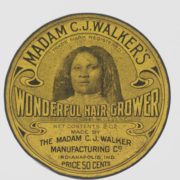
Madam C J Walker was a noted philanthropist, activist and business entrepreneur becoming American’s first self-made female millionaire. Her will has often been used to discuss her attitude and approach to philanthropy, but the will only records the monetary gifts and her philanthropic approach was much broader than just giving donations – you can read more about her philanthropy here as “her life was her treatise on philanthropy”. 

Looking through her will, here are ten things to think about in your legacy and in memory fundraising.

1. Giving as identity and looking back

When making a legacy gift to a charity, donors are often looking back over a lifetime and selecting the causes or charities that have been important, that have helped them and that they want to say thank you to and pay back in some way. The importance of family, faith and the causes Madam Walker supported in her life are well represented in the 19 charities that received charitable bequests in her will.

Supporting a charity in life is a strong indicator of where legacy supporters might choose to give gifts, but it is the ones that link with their personal story and life events that might be the stickiest. Madam C J Walker had been an orphan, widow and a poor washerwoman, supported fed and educated by a range of female led African American clubs and her in life and in death giving reflect these causes. 

  • How do you connect with your donor’s life story? How can you empower to tell that story and connect their giving to you as part of their identity?

2. Looking forward – an extension of self

Legacy gifts are also about how someone wants to be remembered and the gifts in wills can be seen as  “a desire to invest one’s substance in forms of life and work that will outlive the self” (Kotre, 1996) and extend the self forwards in the gifts being made. With the choice of charities to receive bequests Madam Walker was extending herself and her values forward. 

  • What is your legacy vision? How are you helping a donor to extend themselves forward through the vision of your charity?

3. Wills – as public or private documents 

In the UK we tend to think of wills as personal and private documents and do not ask legacy pledgers to disclose the details of what is in a will. 

But a will tells a life story, and although a private document in life, on death it becomes more public and the contents known by the beneficiaries – family or charities.  

Madam C J Walker knew that her will would be a public document and the distributions and gifts she chose to make public. 

“women have historically used their wills to portray their respectability, honor and social status to society as well as to generate their public image” 

Tyrone McKinley Freeman

There were deliberate choices about the charities and the bequests made that aligned with her approach to philanthropy and the causes that were important to her. 

4. The power of codicil 

When Madam Walker knew she was unwell in 1919, she amended her 1917 will with a codicil. She used this to add in additional pecuniary gifts to charities already supported but also to add in financial gifts to more charities especially those run by other African American women and less supported by other philanthropists. 

  • Adding a codicil is a way to formally and legally add additional bequests to a will that reflect changes. It is useful for gifting money but not residual gifts (it messes up the maths!) As we can see from Madam Walker they reflect additional gifts to charities that she cared about in her life and how these evolved over her lifetime. Donors can also add a letter of wishes is a more informal way to capture the changes that they might wish to make. With either a codicil or a letter of wishes it might be a great way for a donor to add in a financial gift in their will. 

5. Too much money can be an issue

Booker T Washington’s Tuskegee Institute received a legacy pledge but in her codicil she notes that because it is “so bountifully provided for” she will not add in another gift. At the time it had an endowment of $2million.

  • How can you show you need the money and will spend it wisely if you already have large endowments and funds?

6. You can’t always get what you want…

In her will, all of Madam Walker’s  unallocated stocks and shares were gifted to create a Tuskegee Institute in Africa and if no such Institute existed at the time of her death then $100,000 was pledged to establish it. No such Institute did exist when she died and during probate this clause was deemed null and void because of it. 

7. Ambition vs reality 

Madam Walker wanted one third of her estate to go to charity but debts and Walker Company expenses meant that in the end only 10% went to the causes in the will. 

  • Remember – you cannot count on the bequest gift until other items in the will have been given. With a residual gift this could work in your favour.  

8. But if you try sometimes, you get what you need …

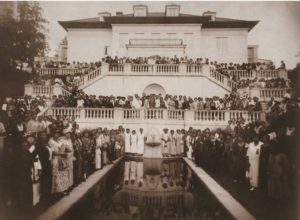
In her will she wanted to endow Villa Lewaro – her mansion – to be a “a monument to success” and give it to the NCAAP (National Association of the Advancement of Coloured People) as a memorial. Her will states she never wanted it to become an orphanage, old people’s home or school. The Villa was sold during the Depression due to rising costs and was actually used as an old people’s home. However, in 2018 Richelieu Dennis bought the villa and established an African American think tank there – Richelieu Dennis’s company Sundial had bought up the Walker Company. 

  • Donors can sometimes suggest legacy gifts that cannot be honoured – if you can encourage discussions as they make your will you can discuss what might be possible and get them to work with legal representatives to look at how this is wording. Or you can work with executors after the will is enacted to find ways to honour the wishes and intentions and in keeping with the spirit of the gift. 

9. Unknown futures

‘Mme Walker lives on in the organizations whose progress she forwarded’

Willard Ransom, Manager, Walker Comopany, 1952

When someone makes a legacy gift in their will they do not know what their gift will achieve or what will happen to the charity they support. At the time of her gifts her manager had concerns about her supporting the NAACP but she was believed in it. The Secretary of the NAACP Walter White said in the 1950s that ‘Madam Walker’s generosity virtually saved the NAACP in the dark days of depression.’

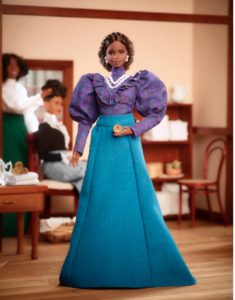
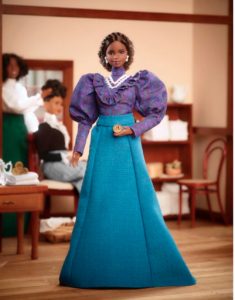
Madam Walker was immortalised as a Barbie
  • Sharing and celebrating what other legacy gifts have helped your charity to achieve can normalise legacy gifts and make people realise that it is usual to leave gifts to your charity. They can also demonstrate the impact that gifts like these can have way into the future.  

10. In memory fundraising & donor recognition 

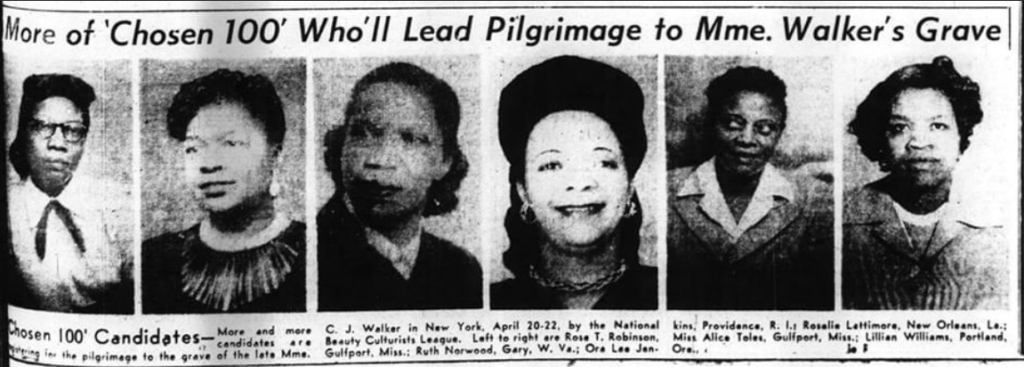
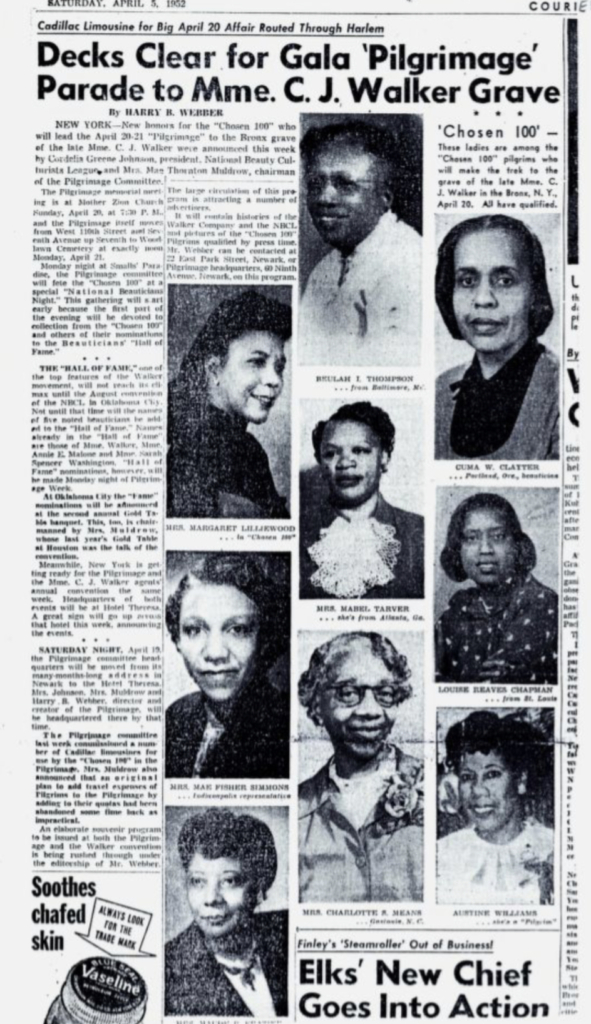
In 1952, 33 years after Madam C J Walker had died a 4 day celebration of her life and work took place with a pilgrimage to her grave. This memorial was in itself a fundraiser, and it had the aspiration to pay off the mortgage of the National Beauticians Home in Washington. At the front of the procession to the tomb were the ‘Chosen 100’. One hundred women who had raised at least $100 to support the event. They wore insignia and sashes – the more stars they had on the sashes the quicker they had raised the money. Following the Chosen 100 were the Platinum, Pearl, Diamond, Gold, Silver, Copper, Red and Blue divisions – all categorised by how much they had made.

Raising funds to complete a legacy associated project of a loved one can be a powerful inspiration. 

  • 33 years after Madam Walker’s death was not using the hook of an anniversary ending in a 0 or a 5 – but an opportunity to fulfil an ambition 
  • How can you ignite the passion they have to do more and get involved?
  • How can you give you donors status and recognition?
  • How can you group them together as like-minded people? Is a legacy club a good idea?
  • Those that give in memory gifts for loved ones are more likely to make a gift in their own will how can you help donors celebrate memories of loved ones and bring them closer to what you do?
https://marinajones.uk/wp-content/uploads/2023/10/IMG_9008.jpeg 950 920 admin https://marinajones.uk/wp-content/uploads/2022/12/f2b903e010104f5aa61ea1821a685913.png admin2023-10-27 10:19:172023-10-27 10:19:1710 things legacy and in memory fundraisers can learn from Madam C J Walker

In Celebration of Madam C J Walker – Philanthropist, fundraiser, activist, entrepreneur and so much more

October 24, 2023/0 Comments/in What I'm Reading/by admin

I have just finished Tyrone McKinley Freeman’s book Madam C J Walker’s Gospel of Giving Black Women’s Philanthropy during Jim Crow and thoroughly recommend it. I first heard about it on Rhodri Davies’ podcast with an interview with Tyrone McKinley Freeman. and was surprised that she was not more known and celebrated. Too often our knowledge of philanthropy reflects our own cultural biases. 

So a few reflections in celebration of Madam C J Walker. 

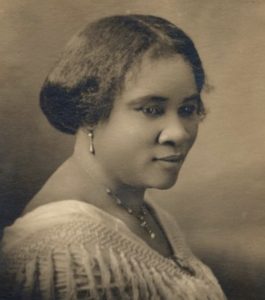
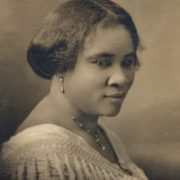
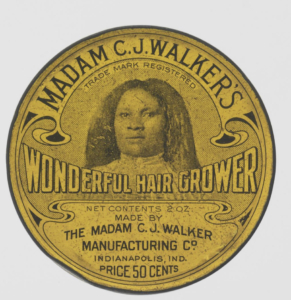
Madam C J Walker was a noted philanthropist, activist and business entrepreneur becoming American’s first self-made female millionaire. Her parents were slaves, and she was the first in her family to be freeborn. Orphaned at seven, widowed at twenty, with her young daughter she moved to St Louis and worked as a washerwoman. She suffered with severe dandruff and lost her hair. After working selling hair care products for a rival hair culturist, she moved to Denver and began her own hair care business, the Walker Company, selling products for African American women and trained an empire of agents to sell the products across the country.  Contemporary with Rockefeller and Carnegie, Madam C J Walker’s philanthropy came from and was lived out due to her experiences as an orphan, widow and African American woman.

The stereotype version of a philanthropist would be a probably bearded male industrialist who comes from relatively modest background, makes a fortune and then from their wealth and success begins a second career in philanthropy. Doing good and naming lots of buildings and creating a philanthropic empire to rival their business one. The female philanthropist is someone who inherits or marries into wealth and dabbles helping the poor or artists and is generally mentioned in a list of names and recognised by husband/father’s name. They are giving out of surplus wealth and their philanthropy is generally to others unknown to them.  

Madam C  J Walker was different. Her model for philanthropy blended Christian duty, activism, practical assistance as well as money and encompassed her whole approach to business. The ethos of the Walker Company was built on racial uplift by offering employment, independence and respectability to African American women. African American women were paid 60% less than white women, who were paid significantly less than men. Work at the Walker Company gave employment, pride and autonomy. 

There were not the clear lines between charity and business that are usually seen. In her philanthropic model, there is less distance between those helping and those needing assistance, and the assistance given might be practical or financial. Her approach offers a challenge to the traditional Western/WEIRD perceptions of philanthropist and philanthropy.  She deserves to be more well known and celebrated for her philanthropy – as well as her work for African American women. She has even been celebrated and immortalised as a Barbie.

She said of her philanthropy in 1914

“I am unlike your white friends who have waited until they were rich and then help but have in proportion to my success, I have reached out and helped others.”

Tyrone McKinley Freeman says 

“In the African American experience, philanthropy did not originate in wealth but rather in resourceful efforts to meet social needs in the face of overwhelming societal constraints and impositions.”

Perhaps a great illustration of this is found in the woman’s club movement which started in the 1790s (the first recorded African American branch dates from 1793 and was the Female Benevolent Society of St Thomas in Philadelphia.)  Clubs of women gathered to try and improve society and drive change – some focussing on temperance or library creation. African Americans were excluded from the white female clubs, so they developed their own model answering their specific communities’ needs such as women’s suffrage or anti lynching. In 1900, 30,000 African American women were members of these clubs.  Charity was inherent in the clubs DNA with an expectation, that as members, they would make the world a better place – not just for the members paying subscription, but for all.  Weekly subscriptions were due, and they provided mutual aid, financial assistance and scholarships but also actively ran orphanages and old people’s homes. 

The widow’s mite

Madam Walker was involved with several of these clubs, including the Missionary Mite Society. The title of this comes from the Bible and Mark’s gospel. Jesus is seated in The Temple watching people make contributions. A poor widow came and put two small coins in and “this poor widow put in more than all the other contributors to the treasury. For they have all contributed out of their surplus wealth, but she, from her poverty, has contributed all she had”. As a widow herself Walker was giving according to her ability and not out of her surplus wealth. Giving for Walker and many of these clubwomen was “grounded in the fierce urgency of the times and the lifeblood of generosity itself.” (Tyrone McKinley Freeman)

Madam Walker’s daughter received education and was cared for at an orphanage run and funded by the clubwomen, this allowed Walker to earn a living by working. 

“Through her giving, Walker expressed her greatest aspiration for herself, her race and her gender” 

Tyrone McKinley Freeman

She gave lead financial gifts for major capital campaigns, donated fees from her lecture tours, ran collections at lectures, donated regular smaller amounts of $5 and $10 to local charities, created Christmas food baskets and supported the unemployable by employing them (for example, an 85 year old mute woman) 

The test gift

Sometimes donors like to give a small test gift to see how the relationship goes and how the charity delivers on its promise. 

Madam Walker offered $50 of the $98 scholarship fees for students at Booker T Washington’s Tuskegee Institute. This was partly as it was all she could afford to do, and she was giving in proportion to what she had. But it also came with the offer that if the gift was well used there would be more money. 

How can we help donors make these gifts? And value gifts even if they cannot fund the whole amount? 

Joy of giving

After reading about an elderly man in need, Madam Walker organised a financial collection from friends and neighbours. The newspaper reported that she was:

“so pleased with the joy manifest by giving that she felt herself not only well paid in this instance, but well enough to enlist her future sympathy she felt it was her duty to do even more for the poor people spoken of”

Giving is a joy and a habit – how we can make it joyful and habitual for our supporters?

Everyone a Fundraiser at the Walker Company 

Fundraisers are always charged with creating a culture of philanthropy within their organisations and inspiring and getting all members of the charity to understand the role and impact of philanthropy. For Madame Walker, giving and being involved in the community were inherent in the nature of her work and her business, and through her work training agents to work for the Walker Company the expectations around philanthropy were indoctrinated and instilled within the teams. 

“Madam Walker envisaged her agents performing charitable work in their communities as they sold products and advanced beauty products” 

Tyrone McKinley Freeman

To become a Walker agent you had to enrol in a $25 correspondence course. Philanthropy was on the curriculum and “The curriculum emphases philanthropy and the expectation that agents would continue Walker’s legacy of generosity and racial uplift”. You learned how to use the products, received a starter set of products, uniform and a certificate. But were also taught the expectations of a ‘women’s duty to women’ to be actively raising money and supporting the community as they sold products.

[Aside – How many inductions would place the culture of philanthropy and need to give so high?]

The 1920 publication The Ritual for the Local Bodies of the Natural Beauty Culturalists and Benevolent Association of Madam C J Walker Agents Inc detailed the format of a meeting which included starting exactly on time, wearing badges, gavel banging, singing an ‘Ode to Hairdressers’ to the tune of Onward Christian Soldiers

“Onward Walker Hair Dressers

Outward to the fray

Have your combs all sterilised”

They also read psalms and collectively recited a poem called ‘The Secret to a Happy Life’ on their Christian duty to help others. The subscription would include gifts to charity as well as sickness benefits and burial insurance. Charity work included care for the sick, funding furniture for black colleges, raising money for Christmas baskets, Christmas carolling or supporting the NCAAP financially. Madam Walker rewarded the most charitable clubs – both the volume of gifts (a penny a day per member scheme) and the value.

Helping create the world you want to see 

Philanthropy is often about the moral imagination of the donor and the world that they want to see and how their donations can help create that world. A great deal of Madam Walker’s philanthropy focussed on racial uplift through her business ethos and providing work, dignity, autonomy for African American women, but also through her work directly as an activist in the causes she supported and practical support she provided (accommodation for those on marches). In 1919, Madam Walker give $1000 to an anti-lynching conference and then $5000 towards legal battles.

In 1918, Madam Walker donated the final $500 needed to buy Cedar Hill the former house of abolitionist Frederick Douglas. This was a symbolic purchase and motivated by the desire to own this house and to celebrate black success. It also highlights something useful about the psychology of giving – donors like to be the first or the last to make a gift. People are keen to give at the start of the campaign and then donations pick up as you near your goal and people are incentivised to help you complete the task. 


And in a wonderful piece of donor recognition and theatre. Madam C J Walker got to burn the mortgage papers as celebration of the achievement. 

What would today’s equivalent be? How can we celebrate the final gift that achieves the campaign goal? 

Final thoughts

As we seek to explore more about the history of fundraising, figures like Madam Walker and her approach to philanthropy should be explored and celebrated more. 

Too often the historical examples that we find are wealthy white men and we need to actively seek out more stories of women, of global majority fundraisers and philanthropists and challenge our preconceptions about what it means to be a philanthropist. Madam Walker’s approach offers a broader and more blended approach for trying to make the world a better place. Other cultural understanding of philanthropy are broader and more integrated and less top down, this can be seen in the African word and concept of unbuntu which can be defined as humanity to others. 

The term philanthropist even today conjures up and usually refers to the mega wealthy (McKenzie Scott or Gates or Buffett) but it could have more universal application. How would you answer if someone asked if you were a philanthropist? Prevaricate, talk about helping where and when you can? 

Maybe if we all leant into Madam Walker’s approach and give in proportion to what we have (which many of us do), encourage others to be joyful givers, work to support the causes we care about, mutual aid to those in need (foodbanks) and organise our business and income on ethical lines, then we could more proudly claim the title philanthropist? Maybe we all need to be a little more Madam Walker. 

Want to read more …

Then read Tyrone McKinley Freeman’s book

You can read more about what Madam CJ Walker’s will said and how that could help you with your legacy and in memory fundraising here.

https://marinajones.uk/wp-content/uploads/2023/10/IMG_9007.jpeg 1049 927 admin https://marinajones.uk/wp-content/uploads/2022/12/f2b903e010104f5aa61ea1821a685913.png admin2023-10-24 20:44:052023-10-27 10:23:57In Celebration of Madam C J Walker – Philanthropist, fundraiser, activist, entrepreneur and so much more

In praise of library fundraising & philanthropy

October 5, 2023/0 Comments/in Thoughts/by admin

So a few fundraising and philanthropy examples featuring or inspired by libraries, including:

  • Legacy gifts
  • Naming rights
  • Campaign publicity
  • Donor crediting
  • New funding models ensuring long term support 
  • Early grant application forms
  • And inevitably Andrew Carnegie 
  • Earliest library gift

Pliny the Younger, a first century Roman letter writer, lawyer, author, magistrate and sometime philanthropist, is the first noted library donor. He donated over 1,600,000 sestertii to construct the library at Como with additional funds to maintain it. Like many funders, he paid in instalments with the largest 1,000,000 sestertii to fund the building but also made maintenance instalments (always important to convert capital donors into revenue ones.)

Pliny’s will details his bequests for the public good including gifts to the public baths and their upkeep (we like a legacy bequest that comes with maintenance costs.) In his will, he also supported Freemen of the city which included spend on an annual dinner. The will does not include another gift to the library but notes his life time gifts which included 100,000 sesterii for the upkeep of the library.

Copy of Pliny’s will
  • Naming rights 

The Bodleian in Oxford is named after its founder and patron – Sir Thomas Bodley. 

Sir Thomas re-founded the library in 1602. The first Oxford library had been founded by a 1327 legacy gift from Bishop of Worcester, Thomas Cobham. Through patchy patronage it was maintained for a century but in fell into disrepair until Sir Thomas offered to develop the library – with assistance from his recent fortune from a marriage to a wealthy widow, and Oxford dons the library was reinvigorated. Officially Bodley’s Library it became known as the Bodleian.

To secure support for the library, Bodley created an early form of a ‘Friends of’ with a Vellum bound book that was a ‘Register of Donations.’ This book was kept on prominent display so visitors could not miss it, but was also used to record all donors and their gifts. He wanted this register “to stir up other men’s benevolence to help furnish it with books”. He also used an element of fear in soliciting gifts – so soon after the Reformation and various book burnings – donating books to this new library was a way to keep them safe.

Bodley had the Librarian, Thomas James, greet all visitors and introduce hem to the Library which encouraged making a gift.

This personal welcome and the chance to have the donation recorded in the ‘Register of Donations’ proved so popular that he had to become a bit more selective about recording donors in the register – saying they would need to ‘better their gifts’ if they wanted inclusion. 

Bodleian Library

Interestingly he also refused donations of ‘riff raff’ books which included ‘modern’ works such as Shakespeare!  

When he died, his will also included a legacy gift of £7,000 gift towards the library – disappointing friends and family who had expected to be more kindly remembered. 

(It is interesting to note that the founding of the library comes at the time of the new Statute of Charitable Uses of 1601 which codified charitable purposes especially for the ‘relief of aged, impotent and poor people’ – when so many were concerned with the poor it is interesting to see that Thomas Bodley focussed learning and a library – a criticism that was levelled at Carnegie and Rockefeller 300 years later!) 

  • Running a campaign

In the 1731, American Founding Father Benjamin Franklin ran a public subscription scheme to fund the Library Company of Philadelphia. This was to be a subscription library where his literary set, the Junto – a group of “like minded aspiring artisans and tradesmen who hoped to improve themselves while they improved their community“.

Before he embarked on the fundraising campaign for the library, he used a newspaper publicity to raise awareness and educate the public.

He was also one of the first to use donor segments dividing his prospect pipeline up into – likely to give, might give, and others. He always wanted the person soliciting the gift to fade into the background and that gifts be seen “not as an act of mine but of some public spirited gentleman.”

  • Founding Fundraising

In 1872 to raise funds to found the Los Angeles Library a Dickens Party was held where participants dressed up as their favourite Dickens character. The funds raised purchased the first books of the library including Hints to Horse-keepers and On the Sheep Industry.

A ChatGPT created image of what a Dickens party might look like

  • Andrew Carnegie

Hands up who had a Carnegie library in their home town? Here was my local.

Teddington Library – one of 2,500 Carnegie libraries built

There were over 2,500 built in the UK, US but also in New Zealand, Mauritius, Malaysia, Fiji, France, Belgium and Serbia. 

Carnegie invested over $56.2m into the construction of the libraries – but the funds were not just handed over to towns to create a library. Carnegie wanted the each recipient town to demonstrate the need for the library and commit to the ongoing cost of maintaining it. Towns who were interested in having a Carnegie library had to submit a proto grant application form with a schedule of questions to answer including demonstrating need, that they have a site ready for the library and can provide annually 10% of the cost of the library’s construction to support its operation.  

Carnegie was often criticised for prioritising libraries and building his philanthropic legacy over helping those that who were hungry and in desperate need.  See these cartoons from Puck magazine:

Carnegie’s plans and approach led to libraries being municipally and state funded rather than private philanthropic institutes. Interesting to see the impact of mega philanthropy influencing the enactment of public policy.

The investment that Carnegie put into libraries is cited as the main reason for the growth of female librarians as they needed more library workers and it was considered an appropriate profession.

In 1997 Bill and Melinda Gates followed this lead and aimed to get every US library onto the internet – once they complete this in 2002 they expanded the programme globally, founding the Global Libraries Initiative in 2004. In 2014 the foundation shifted focus to health and science programmes and tapered down the grant giving in libraries ending in 2018.

  • Libraries receive donations

Libraries often received bequests – most of the two thousand scores in the Los Angeles Library came from bequests including 752 scores from the founder of the LA Philharmonic William Andrews Clark Jnr and Meredith Wilson (writer of The Music Man) gifted his sheet music.

  • Victory Book Campaign

Throughout 1942/43 there was a Victory Book Campaign to send ‘Good Books’ to service men – they set a target of 10m and received over 17m (although not all were suitable). Read more about it here. The challenge with asking for donations like this is that they received unsuitable books – too many handbooks. too many people clearing out their shelves, too many beloved books that were not in the right condition to send abroad. We have a tendency to want to give stuff, and stuff that we care about when a tragedy strikes. Read more about our desire to give stuff not money here. As well as restorative and pleasant books to read, they also needed funds to purchase technical manuals – rare books that were donated were sold at auction to fund these purchases.

War is one of the worst things that can happen to books – an estimated 20m books burned in the UK or were ruined by water damage putting out fires. By the end of the war 1/3 of books in Germany were gone.

  • Researching the past

And libraries are also a fantastic place to find out about curious and not so curious bits of fundraising history. 

Here are a few finds:

A celebrity and royal filled auction to save the London Library from bankruptcy in 1960. Items for the auction included

  • Barbara Hepworth painting
  • T S Eliot’s personally transcribed ‘The Waste Land’
  • Graham Greene & John Betjeman manuscripts
  • A silver coaster from the Queen Mother and a book from the Queen

£25,000 was raised at the auction at Christie’s to avert the crisis and clear their debts.

And discovered in the Bishopsgate Institute from The Stage Yearbook 1911 detailing Actors Day an annual day in October each year when actors, stage management and theatre administration  donated one day’s wages to supporting others in the profession – a guild/mutual aid type of enterprise.


https://marinajones.uk/wp-content/uploads/2023/10/bodleian.jpg 459 612 admin https://marinajones.uk/wp-content/uploads/2022/12/f2b903e010104f5aa61ea1821a685913.png admin2023-10-05 09:52:222025-07-26 21:35:12In praise of library fundraising & philanthropy
Page 5 of 7«‹34567›»
Tweets by meenamtj
All content © Marina Jones 2023
  • Link to X
  • Link to Instagram
  • Link to LinkedIn
Scroll to top Scroll to top Scroll to top

This site uses cookies. By continuing to browse the site, you are agreeing to our use of cookies.

Accept settingsHide notification onlySettings

Cookie and Privacy Settings


How we use cookies

We may request cookies to be set on your device. We use cookies to let us know when you visit our websites, how you interact with us, to enrich your user experience, and to customize your relationship with our website.

Click on the different category headings to find out more. You can also change some of your preferences. Note that blocking some types of cookies may impact your experience on our websites and the services we are able to offer.

Essential Website Cookies

These cookies are strictly necessary to provide you with services available through our website and to use some of its features.

Because these cookies are strictly necessary to deliver the website, refusing them will have impact how our site functions. You always can block or delete cookies by changing your browser settings and force blocking all cookies on this website. But this will always prompt you to accept/refuse cookies when revisiting our site.

We fully respect if you want to refuse cookies but to avoid asking you again and again kindly allow us to store a cookie for that. You are free to opt out any time or opt in for other cookies to get a better experience. If you refuse cookies we will remove all set cookies in our domain.

We provide you with a list of stored cookies on your computer in our domain so you can check what we stored. Due to security reasons we are not able to show or modify cookies from other domains. You can check these in your browser security settings.

Google Analytics Cookies

These cookies collect information that is used either in aggregate form to help us understand how our website is being used or how effective our marketing campaigns are, or to help us customize our website and application for you in order to enhance your experience.

If you do not want that we track your visit to our site you can disable tracking in your browser here:

Other external services

We also use different external services like Google Webfonts, Google Maps, and external Video providers. Since these providers may collect personal data like your IP address we allow you to block them here. Please be aware that this might heavily reduce the functionality and appearance of our site. Changes will take effect once you reload the page.

Google Webfont Settings:

Google Map Settings:

Google reCaptcha Settings:

Vimeo and Youtube video embeds:

Other cookies

The following cookies are also needed - You can choose if you want to allow them:

Privacy Policy

You can read about our cookies and privacy settings in detail on our Privacy Policy Page.

Privacy Policy
Accept settingsHide notification only