That’s what happened to Marco Carelli, a wealthy wool merchant from Milan and Venice, who in 1393 signed over his entire fortune to fund the construction of Milan Cathedral. His extraordinary gift of 35,000 ducats left him virtually penniless for the last years of his life — a man once rich enough to shape a city, reduced to begging for the basics.
But why did Carelli make such a gift? And what can his story tell us about legacy giving and donor behaviour even today?
What made him leave this extraordinary gift, and what can the available sources tell us about him?
Marco appears to have had no children. His wills make no provision for children (they may have been married or died) but convention and custom would have dictated that they be included. Often our best legacy prospects can be those without children who do not have to adhere to these social conventions.
In Venice, there was a state requirement for citizenship of a bequest to the state church (as well as an oath of fidelity to the republic and property ownership in Venice – this had to be renewed every five years. Three years before he gifted all his property he made a will in Venice (in those days before Italy was unified each city state had its own legal system and laws).
This was a planned gift and set in motion by the liquidation of his Venetian assets three years before the final gift was made.
He made a will in 1390 for his property in Venice (which because of the organisation of the city states needed its own will)
Second will for other property in 1393 and a codicil in 1391
Where was the capital campaign for Milan cathedral?
They had laid the cornerstone for the cathedral five years ago, but the campaign had stalled.
Despite the St Luke’s Gospel cautioning “For which of you, desiring to build a tower, does not first sit down and count the cost, whether he has enough to complete it? Otherwise, when he has laid the foundation and is not able to finish it and who see it begin to mock him, saying ‘This man began to build but was not able to finish it’ – they began but did not enough to complete it.
This was common when building cathedrals – the campaign began with no definite plan of the cost, the timing or the completion date. Cathedrals needed money to build – some had a slow and steady supply and others worked in fits and starts. We all know of capital campaigns that have stalled on the way to their goal.
Goal gradient effect means that we are more likely to give at the start to be the first to give – and towards the end when success is almost guaranteed the speed of donations increases as the target approaches. But in the middle donations had stalled.
What happened after the pledge?
Marco made the gift and afterwards – rather like a proto effective altruist – lived on nothing. His will gave various properties and assets to other members of the family but he has to ask permission from the capital committee at the cathedral to realise these assets.
At this point he was so poor he had to beg money to buy soap – although this may be an apocryphal tale designed to highlight his piety. The story endures….
When did he make the gift?
Marco chose to sign the will giving his fortune away on 15th August, the Assumption. He was devoted to Our Lady, Mary, mother of Jesus to whom the cathedral was dedicated. The Assumption is the day that Mary ascended to heaven (Catholics believe she did not die but ascended). The date that we make gifts matter – they demonstrate the personal within personal gifts. Donors want autonomy about when they make gifts – linking to personal or religious or cultural dates. See more about identity giving here.
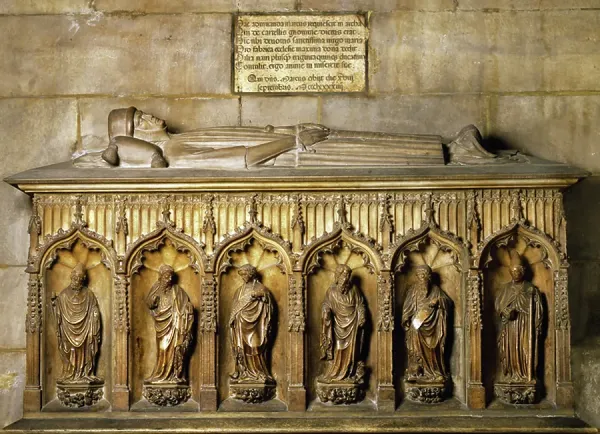
Memorial to Marco in Milan cathedral which was built decades after the gift as a way to encourage other donors to be as generous
Marco died in Venice and because of plague restrictions it took a year before they could bring his body back to Milan. The funeral procession passed through all the important places, churches and home in his life in Milan.
We are all used to waiting for probate – and they had to wait 35 years to sell all the assets they were given. And it was after that a memorial (above) was erected to commemorate the gift and encourage others to be as generous.
What can we learn from it as fundraisers today?
Look to the childless: Donors without direct heirs may feel freer to leave transformational legacy gifts.
Planned giving matters: Carelli’s gift was years in the making, involving multiple wills and the liquidation of assets — a reminder that legacies are usually a long game.
Timing is powerful: Donors often align their giving to personal, cultural, or religious dates, making gifts feel deeply meaningful.
Campaigns stall: Just as in the 14th century, campaigns risk losing momentum in the middle. Smart fundraisers must plan for this – speak to donors about the timings of their gifts.
Stories endure: Whether or not he truly borrowed money for soap, the tale captures the imagination — and has carried Carelli’s name for centuries.
https://marinajones.uk/wp-content/uploads/2025/08/IMG_6296.jpeg10371170adminhttps://marinajones.uk/wp-content/uploads/2022/12/f2b903e010104f5aa61ea1821a685913.pngadmin2025-09-07 18:27:572025-09-07 18:28:10Imagine giving so much away that you have to borrow money for soap
How did people in the Middle Ages approach legacy fundraising?
And what kind of bequests did people make?
Solicitation
How were people asked for gifts in wills?
It was common for the priest to attend the dying to give last rights and the final sacrament. In the thirteenth century Paris there was an instruction that, as well as these final ministries, the priest ought to be encouraging legacy bequests to the cathedral. (With literacy rates lower, very much using the face to face ask approach!)
When you did leave a bequest, it was common that as well as the monetary gift you also left instructions for the priests to say mass for your soul – on various days after your death, and on the anniversary of your death.
Praying for the dead and benefactors would have been a slow drip feed reminder of the donors that had gone before hand – creating a strong social norm to do the same. (As well as obviously the spiritual and religious benefits of reducing the amount of time you spent in purgatory.)
Social conventions shape giving
We are social creatures and our primitive brains know that it is safest to follow the herd – and behave like others.
We have seen that the saying of masses for the dead provided a strong social norm that bequests were common and expected but how common were they really?
Local customs really dictated how much, and how frequent bequests to cathedrals were – in some areas it was common for most people to include a small gift to the cathedral amongst other bequests. The Bishop of Wells donated as much to the roads of Somerset as he did to the cathedral so it was part of a list of charitable gifts people might make. Between 1321-1460, 90/356 wills in York left gifts to the cathedral fabric and it became a standard for a few coins to be left. Bequests, like Agatha who left a house, or Marco Carelli who left his entire estate to the cathedral were unusual.
So not as common as might be expected.
Crediting the fundraiser
Often in charities we focus on thanking the donors.
We don’t always remember to credit the fundraiser.
In Utrecht Cathedral the records show the name of the priest that solicited the bequest – and their name is recorded alongside the gift.
Now this could be an early example of a CRM system showing who was in which portfolio.
With priests attending to last rights and encouraging gifts in wills there was not the lag time that we see today between a will being written and a gift being received.
Nowadays, we often need to thank a fundraiser that worked in our charity ten or twenty years ago. As the legacy pledges we received today come in addressed to former fundraisers, or in response to old campaigns. So we get to thank their hard work and foresight for investing in legacy fundraising. (After all, the best time to start a legacy campaign is twenty years ago, the second best is today!)
When reminded about our own death, mortality salience kicks in (a fear that we are going to die) and we want to distract, delay and deny that death will happen to us. When major life events happen – like other members of our family die, retirement, divorce, grandchildren or children arrive or illness – we know that we need to update, or make a will. But that fear remains and it can still take our donors years to make (or re-make a will). In the Middle Ages with shorter live expectancies death was perhaps more apparent (and therefore a shorter lag time between pledge and receipt of the gift).
Predicting your legacy income
Everyone knows that legacy income is bumpy and you can never predict what you might get, donors might not tell you what they are giving you or may change their minds, or just not be dead yet.
Notaries had to disclose to the Fabricca (Cathedral building committee) in Milan wills that included donations to the building and how much the gifts were for.
This might not tell you when to expect the gift, but gets over the modern sensibility of shying away from asking and respecting people’s privacy.
Often we want to donate items rather than cash, cash can feel impersonal and items that we have loved and cared for can feel more meaningful. We endow them with emotional connections.
It was common to bequeath items to the church. Frequently people gave their most expensive garment to the church which went to the priest to make a new vestment. But other gifts were given in wills including wood, wool, rosaries, rings, horses and a basket of cherries.
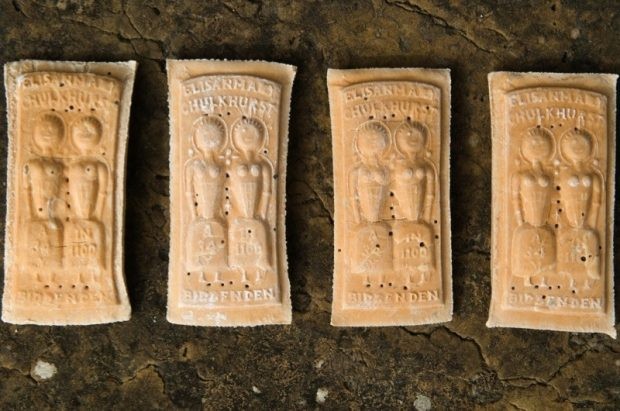
Born in 1100 conjoined twins Eliza and Mary Chulkhurst were conjoined twins. They died aged 34 within 6 hours of each other, and in their will left the church land and the means to provide a charitable dole for the poor, needy and elderly of the village. This was bread and cheese and at some point this evolved into biscuits depicting the two twins. The biscuits are reportedly very hard and not super tasty. Today as well as biscuits a church ceremony takes place and the elderly get tea, bread and cheese – as well as the biscuit.
Biscuits1902 queue for the Bibbendum dole
In the legacy benchmarking research I did for arts and cultural charities, 50% had only received cash but gifts of items included:
Royalties 5%
Property 21%
Paintings 25%
Musical instruments 21%
Archival materials 23%
Shares 5%
A tiara
And two pizza shops in Derby!
Sometimes things are more meaningful, sometimes more practical, or perceived as more needed. If you do want and accept items have a clear policy about what you accept – and how to say no politely (how many programmes do you need?)
Identity shapes giving
The gifts that we make it our wills speak of our identities, to the things and causes that were important to us. On how we want to be remembered by other people – as a culture lover, a fighter for justice – the gifts tell our autobiography, our life stories.
Two of the biggest bequest gifts to the Utrecht Cathedral were from architects.
Cornelius de Wael 1476-1505 master mason gave 156.5 rhinegulden (rhinegold is real!)
Jacob van der Boch spent 31 years working on cathedral and donated rhinegulden
This speaks of their professional identity as architects influencing their gifts and the stories they tell.
Legacy gifts speak of our autobiographical self – what do those gifts and the choices that pledgers make speak about their final chapter and how they want to be summed up to friends and family – as someone who loved opera, fought for equal rights, was a dutiful Christian.
How can you frame your legacy proposition to align with the identity of your donors and their support of your charity?
Un-voluntary contributions
To define ‘philanthropy’ it is common to use Robert Payton and Michael Moody’s definition as ‘voluntary action for public good’. The church in the middle ages was often a little short of the voluntary aspect!
In Venice as part of the annual citizenship test which you had to complete every five years, you had to swear fidelity to the republic, own a house and make a bequest to the state church. They were also wary of the too much wealth leaving the city so you had to find loopholes if you wanted to send bequests to other non Venetian churches.
The church of San Lorenzo in Gerona from 1174-1270 imposed tariff on all church bequests 10% tax.
Nowadays we would never make giving compulsory although legal precedent and cultural custom can still dictate pledgers distributionsto family and other causes.
Donor recognition
We know how important it is to thank donors for their gifts, and that donor recognition boards can encourage and normalise gifts.
As well as masses for the dead which we have talked about above. There were other ways that legacy donors could be recognised.
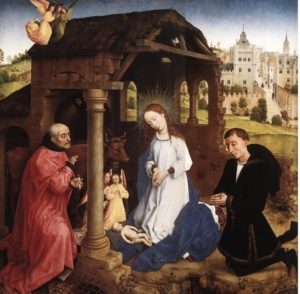
In the fourteenth and fifteenth centuries donors included themselves in paintings they commissioned on altar panels as part of their legacy gifts. It highlighted their contribution to the church and also their personal piety – but was very much a donor led decision about the credit!
Above, Braque, the donor, is seen dressed in modern clothes and praying at the Nativity Scene. This is the central part of the triptych of an altar painted by Rogier van der Weyden in the fifteenth century.
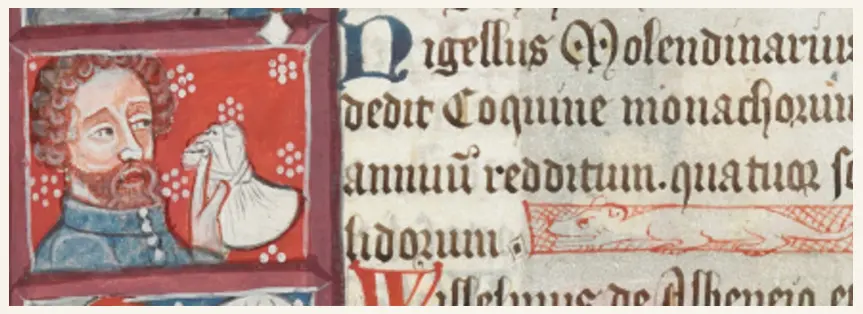
Below, Nigel the miller is recorded in the donor book at St Alban’s Abbey.
Why does donor recognition work and how might in inspire more gifts
People do more pro-social things when they are rewarded because incentives work. When we give a gift, we get a hit of happy chemicals – dopamine, oxytocin, serotonin and endorphins. And that means it gives our donors joy to be giving money to us.
It also works for us, as fundraisers. If I give a gift, and you receive that gift – the same bit of your brain is lit up. So, donor recognition should give us the same warm and fuzzy feeling that our donors get when they receive our thanks.
All of this illustrates why seeing your name on a donor wall is one of the ultimate ego strokes. It provides social reinforcement of your identity as a kind and generous person.
We’ve all seen our donors go over to a wall of recognition, scan the list with their finger, looking for their name, checking that it is there.
It’s so important to donors that they are recognised for what they do, and that fundraisers say thank you.
So how should that shape how we solicit for gifts in wills today
Legacy giving is shaped by identity and in life connections – remind donors and supporters of their lifetime of connection and how giving to your charity reflects their identity.
Being asked increases the number of gifts you get
People are terrified of their own deaths and will put off these decisions as long as possible
Donor recognition can reinforce the social norm of legacy giving.
Are you going to be publicly weighed and then donate the equivalent of your weight in grain or gold to charity?
What?
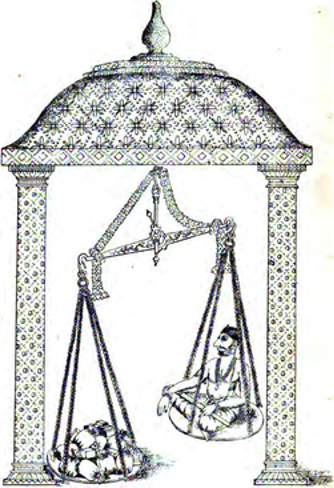
There is an ancient Hindu ritual from the first century where individuals were weighed and made a charitable donation equivalent to their weight in grain or gold – this is known as tulabhara and often people did it on their birthdays.
There was a custom to weigh the king on his solar and lunar birthdays in precious stones (and in diamonds for a diamond jubilee) and the jewels sold and monies given to charity.
We see it in sixth century in Europe in the writings of Gregory of Tours which also records the tradition of weighing a donor for gifts (known as ponderito). This is also done as a thank offering for recovering from being sick.
A few historic birthday fundraisers
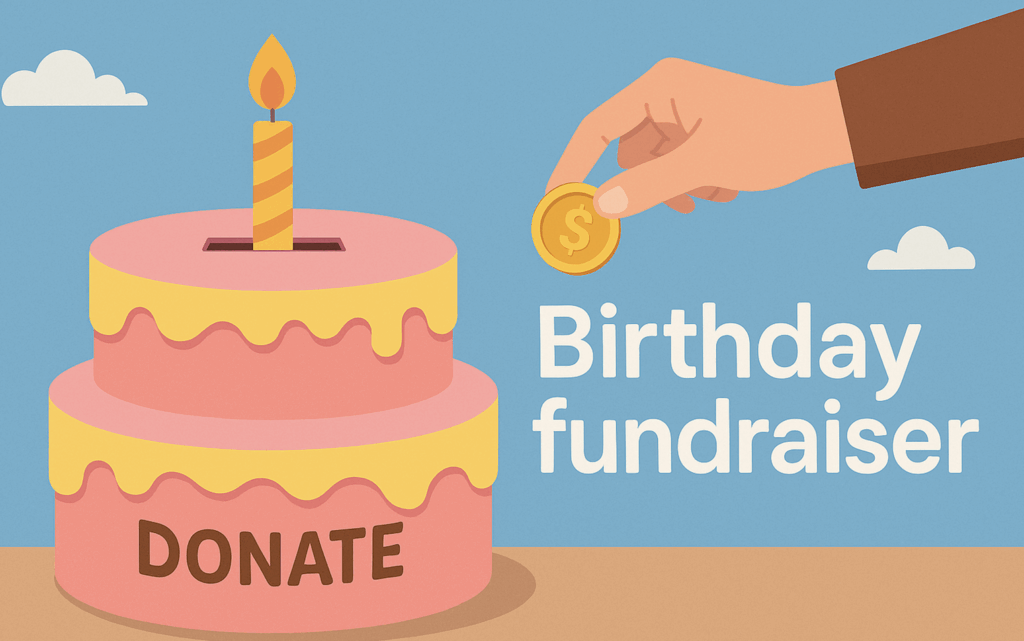
Since Facebook introduced the birthday fundraiser in 2017 other social media platforms have followed suit, but here are a few other historical birthday fundraisers.
Charities tend to focus on their birthday and anniversary campaigns rather than the birthday of the donor, or anniversary of their giving.
Some historic birthday fundraising examples include:
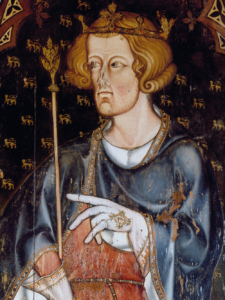
Edward I on his son’s fourteenth birthday fed fourteen hundred paupers, and when his son was seventeen, gave alms to seventeen hundred people
Edward 1
Edward III on his 50th birthday fifty poor men get shoes to celebrate
It was not just in life that birthdays were celebrated, you could specify an act of charity to occur annually on your birthday like a dole of bread to the poor, which is what Elizabeth Nickus did in her will in nineteenth century Bristol.
The Happy Birthday League
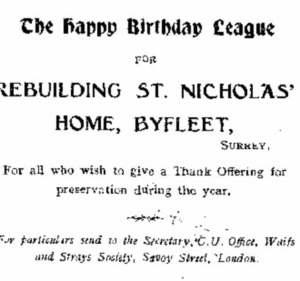
Celebrating your birthday with a philanthropic gift was a Children’s Union giving circle called the Happy Birthday League. It was raising funds for the rebuilding of St Nicholas’ Home begun in 1904.
The League involved signing a form (to show your commitment) and donating 1 shilling on your birthday “as a thank-offering for your preservation during the year that has past.”
Each issue of the monthly magazine ‘Brothers and Sisters’ listed new members and the total members to date – demonstrating both the momentum of the campaign, and that it was as social norm for your peers to join. Listing celebrity patrons such as Dowager Countess and other titled people gives status to the membership as well.
You are never too young to start giving – the campaign encouraged you to sign up a baby before their first birthday.
You were also encouraged to those that were dead – “People are and also sending offerings with tender thoughts of those who are at rest.“
With birthday cards you send to friends you were encouraged to send a leaflet inviting them to join as well – a strong peer to peer ask!
Within six months they had over 7,000 members.
What might be going on in a donor’s brain here?
Part of this is because there are just numbers that mean something to us, and our identity – and our birthday is one key personal date, and our weight another personal part of our identity.
How can donors help construct personal stories about the gifts they give?
Sometimes as charities by not giving donor’s choice we can cause reactance – when we react against being told what to do.
So when we are talking about us, and our charity, and our anniversary we disengage our donor, and they start to ask ‘so what?’ Sometimes the list of giving options does not give us the option we want – the options are too small and not meaningful enough, or too big and beyond our capacity.
When we give our donor autonomy and empower them to make a choice they can make gifts that are more personally meaningful to them.
However, how this choice is presented is important. We need to provide a structure. If it is too open an offer – such as ‘pay what you feel‘ we might nudge the brain into a system two space and ask ‘how do I feel about this? and what value does that mean I should give? And by pausing to ask these questions we have no frame of reference, and increased cognitive load can stop us making any gift.
The frame of the question is important here.
How could you give your donor’s more autonomy and choice about how they make a gift and how much?
How can you invite them to make gifts that mean more to them? How can you provide a useful frame?
How can you use important dates to your supporters to become giving opportunities?
How can you make it about them, not you the charity.
How can you get your supporters to be ambassadors for you? they are already super fans, and can act as great ambassadors with their networks to find others to support you.
https://marinajones.uk/wp-content/uploads/2025/07/Picture-11-e1753730425211.jpg676904adminhttps://marinajones.uk/wp-content/uploads/2022/12/f2b903e010104f5aa61ea1821a685913.pngadmin2025-07-28 20:21:002025-07-28 20:21:00How much do you weigh? How much do you give to charity?
As fundraisers and communicators it is more powerful to show than to tell – to show through actions, words, subtext and images the stories we want to share.
Chekhov said:
“Don’t tell me the moon is shining. Show me the glint of light on broken glass.”
Humans are hard wired to notice what other humans are doing. The Social Hypothesis Theory shows us that human actions are processed quicker. So if we show humans in the images we use in our fundraising it can give our audiences a short cut to show audiences a desired behaviour or action. Show don’t tell engages the reader more, and becomes a more memorable way to demonstrate the help needed, the desired behaviour and the impact of the gift.
Here are a 5 historic examples of where – show don’t tell was used to powerful effect.
1. When you want people to adopt a new behaviour – show don’t tell
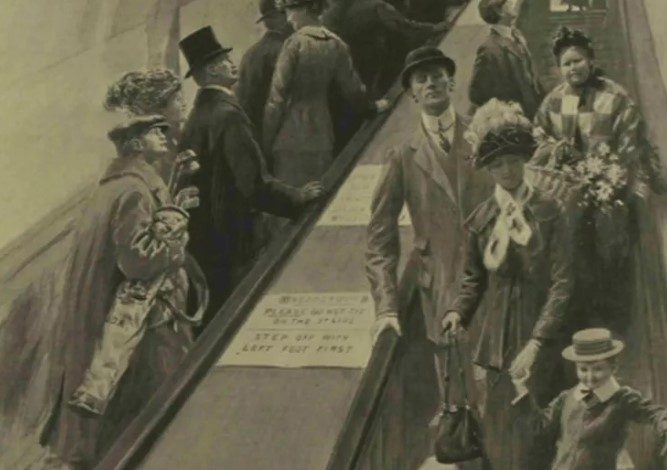
Escalators were introduced to the underground in 1911 but treated with suspicion.
One legged engineer William ‘Bumper’ Harris was employed at Earl’s Court station to ride up and down the escalator. We take our cues from the social behaviours of others around us and mimic it – Bumper Harris demonstrating how easy and enjoyable the moving escalator was reassured passengers. If a one legged man could easily and successfully navigate this moving staircase they could do too.
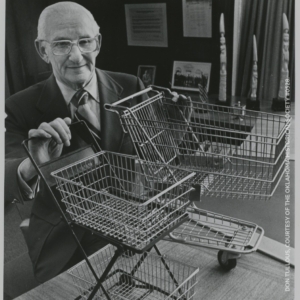
In 1937 when super market trolleys were introduced the same thing happened. People did not use them. Men thought they were unmanly. Women thought they were like baby pushchairs. Models were hired to walk around using them in the shop to make them socially acceptable.
2. When you want to get donors to give – show don’t tell
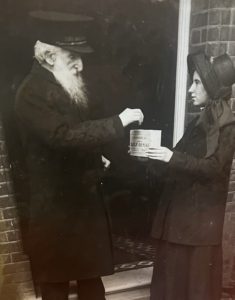
General William Booth the founder and leader of the Salvation Army was often depicted on postcards making contributions to the self denial week. Having a visual clue of what we want donors to do – put money in the donation box shows them what to do. It is also leading by example – denying self and contributing. It gives him the authority to ask others to join in supporting the cause.
A 2010 lab study verifies this and shows that when a person observes someone giving money away they are more likely to give money themselves, and that this effect ripples out to other people (from person to person to person to person), (Fowler and Christakus, 2010). It creates a powerful social norm that encourages others to join in.
3. When you want to show how awful something is – show don’t tell
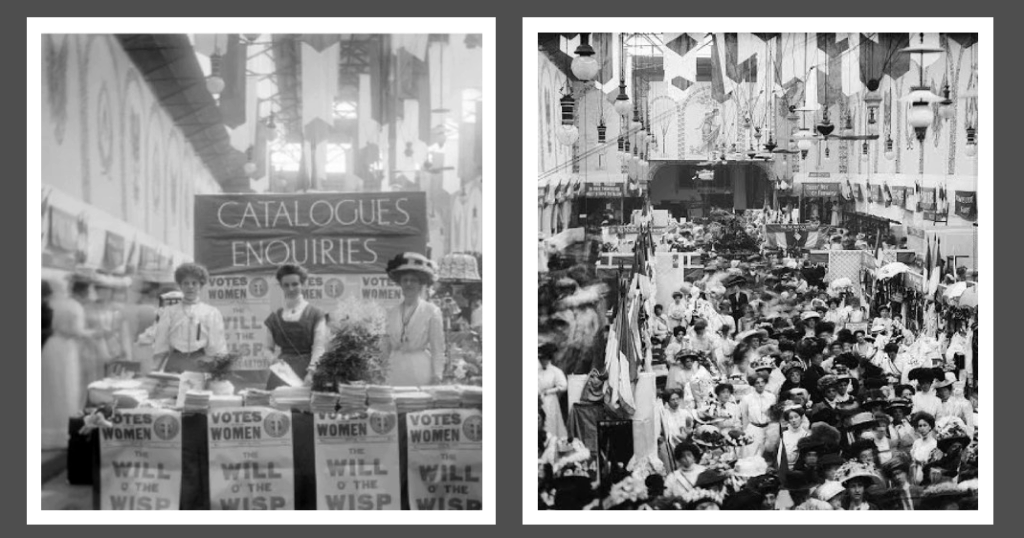
To demonstrate the horrors and trauma of being arrested and force fed the suffragettes had replica jail cells in their 1909 Exhibition.
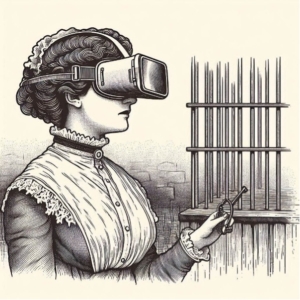
Before the advent of VR and AR headsets the Suffragettes created an immersive and interactive experience. The tours of the cells were led by women who had been imprisoned. The cells demonstrated clearly the difference between the male and female prisoners. Men, even if imprisoned for treason or murder, had bigger cells and better treatment. Women were in smaller and treated as common criminals. By the time of this exhibition over 400 women had been imprisoned for the cause.
Bing AI generated image of a Suffragette using VR googles
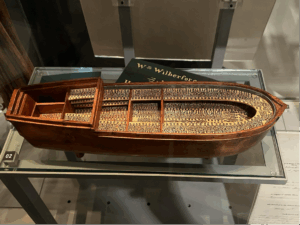
This was a model of a Liverpool slave ship created in 1780s. There is something very tangible about seeing the bodies packed in like this that words cannot capture (it was turned into a famous print).
A a copy of model this was given to prominent Abolitionist William Wilberforce who used it in parliament to demonstrate the awful conditions of enslaved Africans on the ships. Visual impact can demonstrate more than words
4. Put the impact on display – show don’t tell
The Foundling Hospital which opened in 1739 became a fashionable place for benefactors to come and see the impact of their donations. Supporters could come and see the children sing in Church on Sunday and then buy a ticket and see formerly destitute children dressed and eating well.
In 1837 the boys of the Queen Elizabeth Hospital in Bristol processed through the city ‘The object .. was the shew off the poor children as being under the patronage of the Liberal Trustees’. They also lined the Clifton Suspension Bridge on its opening in 1864, against showing what the philanthropic support had achieved.
5. The before and after photograph to demonstrate your impact – show don’t tell
Dr Barnardo’s opened his first homes for rescued children in the 1860s with an est 30,000 destitute or orphaned children in London following a cholera outbreak – the need was urgent
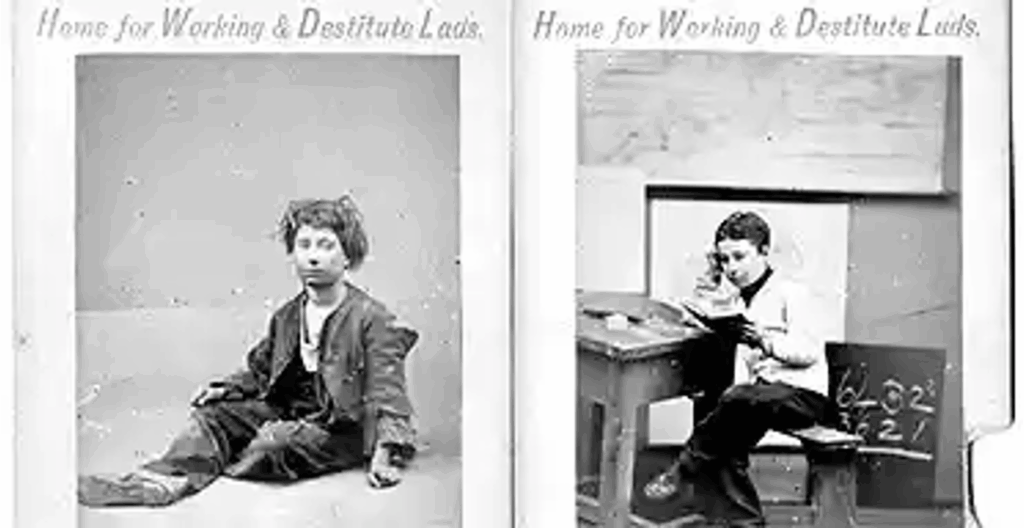
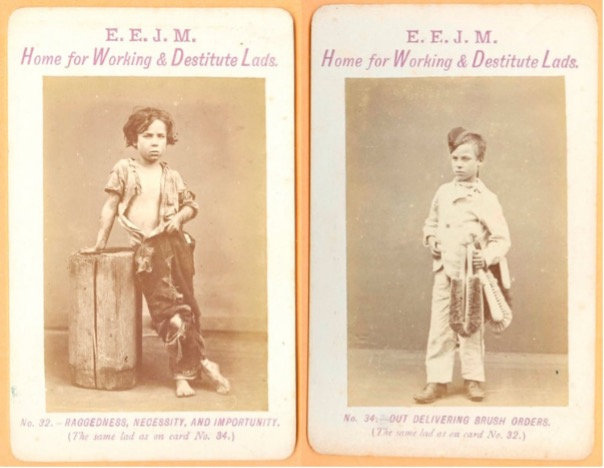
In 1874 he opened a photography studio in his Stepney Boys Home. Every child who came in was photographed when they entered for the next 30 years
The photographs were kept as case history for the charity
And they were also sold as postcards (twenty for 5 shillings or 6d for one) to raise funds for the charity (Salvation Army and others did as well). As well as photography being a new technology printing had become cheaper and easier and charities like Dr Barnardos and Salvation Army embraced these commercial opportunities to grow revenue.
Dr Barnardo used photography to great effect and became a champion of the before and after photo
Now the before and after photo has become a fundraising staple – detailing powerfully visually what your support has done.
The before photos showed children as they arrived at the homes
The after demonstrated the impact of your donation and how their life had been transformed by the charity.
But in 1877 these photographs ended up with Dr Barnardo in court.The issue – the photos – were criticised for being faked and for being exploitative of the children pictured – showing bare arms and legs and the bodies of children (we are in Victorian times) They were criticised for being staged and emotionally manipulative.
Why was it so controversial?
Photography was a new science and seen to reveal the truth of a situation in a more realistic way – the fact that it did not reveal but was artificial and this perceived manipoulation alarmed people. There was concern that if the photo was fake then the charity itself might also be fake. We know how important trust is to charities nowadays for donors making decisions.
A minister -George Reynolds criticised the pictures and the charity in a pamphlet called ‘Startling Revelations’ them saying
“[Barnardo] tears their clothes, so as to make them appear worse than they really are. A lad named Fletcher is taken with a shoeblack’s box upon his back, although he never was a shoeblack.”
And that this exploitation destroyed the ‘better feelings” of the children.
In court Dr Barnardo admitted that they were portraits rather than realistic and he was using artistic licence
This is what he said in defence of the images used:
“we are often compelled to seize the most favorable opportunities of fine weather, and the reception of some boy or girl of a less destitute class whose expression of face, form, and general carriage may, if aided by suitable additions or subtractions of clothing … convey a truthful picture … of the class of children received in unfavourable weather, whom we could not … photograph immediately”.
He went on to say that the images:
”not intended so much to represent the individual boy or girl whose face is depicted, as a whole class of street children, of whom very many have been rescued, but from some one or other of the following causes could not at the time be photographed in the condition in which they were received.”
Dr Barnardo was cleared of most of the charges however his methods were criticised in the judgment which said t
“This use of artistic fiction to represent actual facts is, in our opinion, not only morally wrong as thus employed, but might, in the absence of a very strict control, grow into a system of deception dangerous to the cause on behalf of which it is practised.”
The Times reassured the public that the homes were “real and valuable charities, worthy of public confidence and support“.
So a cautionary tale about the adoption of new technologies and ensuring that when we use it, we are transparent about how we are using it so that we don’t abuse or loose the trust of our supporters.
So how could you apply this in your fundraising?
Show, don’t tell: It’s more powerful to demonstrate than describe.
Human behavior is contagious: We’re wired to notice and mirror others’ actions.
Social Hypothesis Theory: People process actions faster than words—seeing behavior prompts imitation.
Boost engagement: Visual cues are more memorable and emotionally impactful.
Drive action: Showing need, behavior, and impact makes fundraising messages more compelling.
When we think about social change we think in terms of great leaders, of the justice of the change, of the collective action of many to be effect the change they want to see in the world.
We celebrate the individuals and what happened. We think about being on the right side of history, of moral fibre, of progression.
We don’t want to think about the logistics. We don’t want to talk about the money. We don’t think about the fundraising.
We just talk about the injustice overcame.
This speaks to the taboos in our society talking about money.
Social change does not happen in a vacuum and however much we want to think change happens because of well meaning people doing the right thing. To get change you need to organize. To organize you need money. And to get money you need to ask. As academics Bekkers & Wipeking (2007) say the main reason that someone gives to a charitable cause is because they were aware of the need and were asked.
So how were these social change movements funded?
Even when you start digging into how these movements were funded is obscured – partly through what is recorded in the archives from social change, and that within that fundraising is not prioritized.
When we think of the civil rights leaders and the activists – we think of Martin Luther King, Rosa Parks on the bus, we think of the ‘I have a dream speech’, we think of the hundreds of thousands marching on Washington, the sit ins and the civil disobedience, the horror of Jim Crow laws, we think of an organized nonviolent movement
As historian Tanisha C Ford says
“The civil rights movement has become crystalized in our collective and national consciousness as this ideal movement, led by principled and charismatic male leaders that showed the power of racial liberation”
but as with all history it is
“never simple, never perfect and new never obedient”
We don’t think about how that change was funded. We prefer a narrative of passion good people making that social change. Of civil rights won, voting rights gained, a step towards equality – rather than a fundraising campaign, donor segments for targeted asks, fundraising events and securing grants. To make these things happen didn’t just take guts and determination. It took organization. It took donor lists. It took asking. It took preparation, passion, persuasion. It took stewardship.
It took fundraisers.
And today I want to share and celebrate some of those stories of fundraising for social change
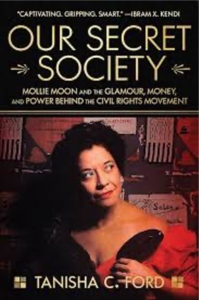
Let me introduce you to Mollie Moon a fundraiser who I learned about in Tanisha C Ford’s book Our Secret Society.
Mollie was a fundraiser and activist who played a crucial role in the civil rights movements raising money from African American grassroots supporters and also courting the wealthy New York philanthropists and grant givers
Ford notes that Mollie Moon had the fundraisers skill of choreography and
“bringing the right people – politicians, artists, European aristocrats and philanthropists together in the right rooms”
As we understand and study more about history, the history of the civil rights movements and the role that women played we are increasingly finding active and involved women who played pivotal roles in social change and as fundraisers.
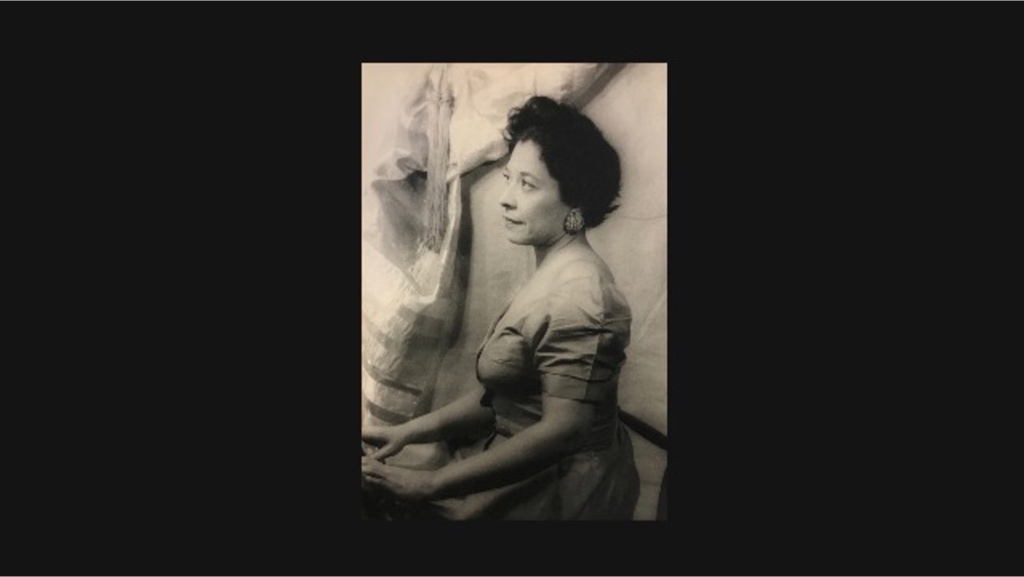
Mollie Moon was born in 1912 in Ohio. She trained to be a pharmacist at college before her interest in social work and moved to New York. She went to Moscow with a bit part in a propaganda film (the communist equated the cause of civil rights with workers’ rights) and returned home via a few years in Berlin. On returning to New York, she worked at the Department of Social Services. The National Urban League was founded to “to enable African Americans to secure economic self-reliance, parity, power and civil rights.”. Mollie founded the National Urban League Guild – one of the key fundraising arms of the League and for decades was a leading fundraiser, activist and campaigner.
So what did Mollie do? Why is she so important in the civil rights movement?
What lessons can fundraisers learn from her about fundraising, and fundraising for social change?
1. Create the event that everyone wants to be at – and that all your supporters can afford to attend
In 1941 Mollie founded the Beaux Arts Ball – a major fundraiser.
Now events fundraising has been around since Biblical times so what did Mollie do differently?
The Beaux Arts Ball was the equivalent of today’s Met Gala. This was the must go to / must be seen at society event. The ball was costumed and the costumes allowed a certain level of licentiousness and risqué skimpy outfits.
Mollie recognized that within this type of event the audience attending had very different motivations
the great night out gala guest
the support the artists gala guest
the support the cause
and she catered for all of these.
The gala model was criticized by some as all events fundraisers is for costing too much vs its ROI and perpetuating the conspicuous consumerism of the Gilded Age. Detractors saw it as at odds with the needs of the League’s work to help the poorest amongst them struggling to get by.
There was concern that these types of glamourous social events would price out in the grassroots community supporters. But Mollie ensured that there was a sliding scale of prices to suit all purses. This made sure that the grassroot community supporters and the white philanthropists could attend and paid proportionally according to their means.
Mollie was pressurized to take the event downtown into Manhattan (from Uptown Harlem) to appeal more to wealthy white elites but held her ground. She wanted to keep it in Harlem and keep its grassroots origins. There was a home court advantage of making whites come to a traditionally black space
These balls raised thousands of dollars for the Guild and its work. Throughout the decades it evolved in terms of location (from Harlem to South Bronx to the Waldorf Astoria in Manhattan) and themes (from costume to fashion) as every fundraiser knows you want to have the calendar highlight event but you need to keep it fresh and your loyal audience coming back for more.
Her work on the balls was trivialized as being a socialite (she was called ‘a beauty with a social mission’ by the Pittsburgh Courier) bringing in both racist and sexist assumptions about the breadth, approach and strategy involved in raising this money.
2. Fundraising – is also education
Mollie spent a lot of telling rich white Americans why racism is bad and how it impacted on her day-to-day life. If you cannot see something happening you cannot understand that it is happening or what it means. Telling the truth and giving powerful testimony is an important but also an emotional labour for fundraisers. And Mollie had to do that. She also, as many fundraisers do, had a guiding role in understanding what the donor wants and finding the right project for them to support. This match making of matching the donor to the project is a key fundraising attribute.
3. The power of an emergency appeal
Mollie knew the power of urgency and the need to act now. She rebranded appeals to create a sense of urgency to get people to come
“Unless the citizens of Harlem respond to this call, the continuation of the cultural program at the center will cease and the community will cease and the community lose one of the most progressive institutions of its kind”
Tanisha C Ford
4. Celebrity endorsers
We listen to the message more when it is someone likeable and with authority that is endorsing it – so from Beaux Arts Ball to the other events – having the names of prominent sponsors on the event advertisement was crucial. And Mollie used this to her advantage – the adverts in the papers for the balls contained lists of celebrity patrons and endorsers including Orson Welles, Paul Robeson, Katherine Dunham, Billie Holliday and Marlon Brando.
It was not just their endorsement she also wanted their talent. She arranged fundraisers of Paintings by Famous Amateurs getting Dwight Eisenhower and Bojangles amongst others to paint pictures and auctioning them for the League.
5. Power of press
Mollie used her networks and contacts to get stories of the fundraisers and the League’s work into the press. She didn’t just focus on the news section but also society and fashion.
6. Importance of CPD
Like every good fundraiser Mollie understood the power of professional development and training. She ran programmes to train and inspire volunteers to go out asking.
7. Importance of being organized
fundraising doesn’t happen in a vacuum. You need to be organized. You need to know who has given and when, who knows who, who asked who. Mollie and the Guild had donor rolls, lists of last donation and last contact like any good fundraisers CRM system.
Mollie Moon
But fundraising for social change – like any kind of fundraising – is not easy.
It raises questions about who you work with.
So who did Mollie work with?
One of the key people was Winthtrop Rockefeller – known as Win – grandson of John D Rockefeller. He positioned himself as a rebel. A former a soldier, expelled from Yale, worked Texan oilfields. Win Rockefeller did not want to trade on family name, but had cash and connections (and perhaps an element of rebelling against the establishment family by supporting civil rights)
Win was known for saying:
“its not enough to contribute money. People must make the gift of themselves of their own time, their creative talent and spiritual strength”
A precursor of the 3 TS of fundraising – treasure, time and talent
How you treat donors differently? (They aways know)
The National Urban League suffered controversy in 1949 when a newspaper leaked the existence of separate donor lists. A list for downtown Manhattan white donors offered exclusive events and a list of uptown Harlem African American supporters invited to engage in the struggle. This caused their membership to drop 150,000.
This feeds into an issue at the centre of funding for social change
Who do you take the money from and if you take money from certain people does that change what you are fighting for?
Are there more ‘donor friendly’ projects that are less radical projects and therefore more palatable? Within the civil rights movement was education for African Americans more fundable than voting rights? How do you know what cause to focus on when there are so many urgent needs? How led are you by where the money is vs the cause you are fighting for?
Ebony magazine said that taking white money reproduced white supremacy and racial hierarchy and for many within the movement taking money from wealthy philanthropists or foundations for many perpetuated the capitalist structure that had so benefited from slavery.
Do you like Greenpeace say you wont solicit corporate money? Or like the Mackenzie Scott grant recipients, Frida- the young feminist fund, take the money and then release a statement saying how you fundamentally disagree with the wealth that created it? Take it and hold your nose? Have more money for the education programme but not enough for the activist work?
These were fundamental challenges for those fighting for social change – and social change is not just one agenda item, it is a broad movement, some want fast radical change – you have to hold the collective together as well as get the money.
When there are mixed motives for giving, do you take the cash or question the principles?
Many businesses supported civil rights movement and made donations because it was good for business. Companies like General Electric and American Airlines wanted to attract the new wealth African American professional classes to spend their money with them.
Although there were those that genuinely supported the cause and championed it, in 1962 a business man’s lunch aim to raise $3m for the League and a business man stood up to say cost of racial prejudice costing business $7.5bn
Competition for limited resources – but play to your unique strengths
There was competition between different organsiations trying to achieve the same aim – sounds familiar? There have always been arguments about too many similar charities doing the same thing. The National Urban League and the NAACP (National Association for the Advancement of Coloured People) were in competition for donors and resources. However they each played to their strengths and structures – the National Urban League was 501c3 so had structure to receive grants and tax efficient giving but could not be politically active – the NAACP was a 501c4 so could lead on sits ins and strikes.
Things change – do you?
Funding models change and evolve over time. Can you and the movement you are funding?
In 1963 a new president of the National Urban League, Whitney Young declared they would no longer be a ‘nickel and dime’ outfit signifying a strategic shift from small grassroots membership to major philanthropic contributions. This strategy had a powerful impact shifting the funding model – from being 18% foundations to 75% and pushing down the grassroots membership support. By the end of 60s 14% of annual income coming from African American donors. It is worth noting that the money from African American donors came without restriction but often the money from philanthropists comes directed towards programme.
Legacy fundraising for social change? Social change always feels immediate and urgent – so you would not be thinking about legacies for it. Your ideals and aspirations would be that the problem has been solved by the time that the legacy is realised. But there were two substantial legacies that helped support the civil rights movement – which speak to sophistication of the methods used by the fundraising divisions of the movement (and that somewhere in an archive the legacy brochures might exist…)
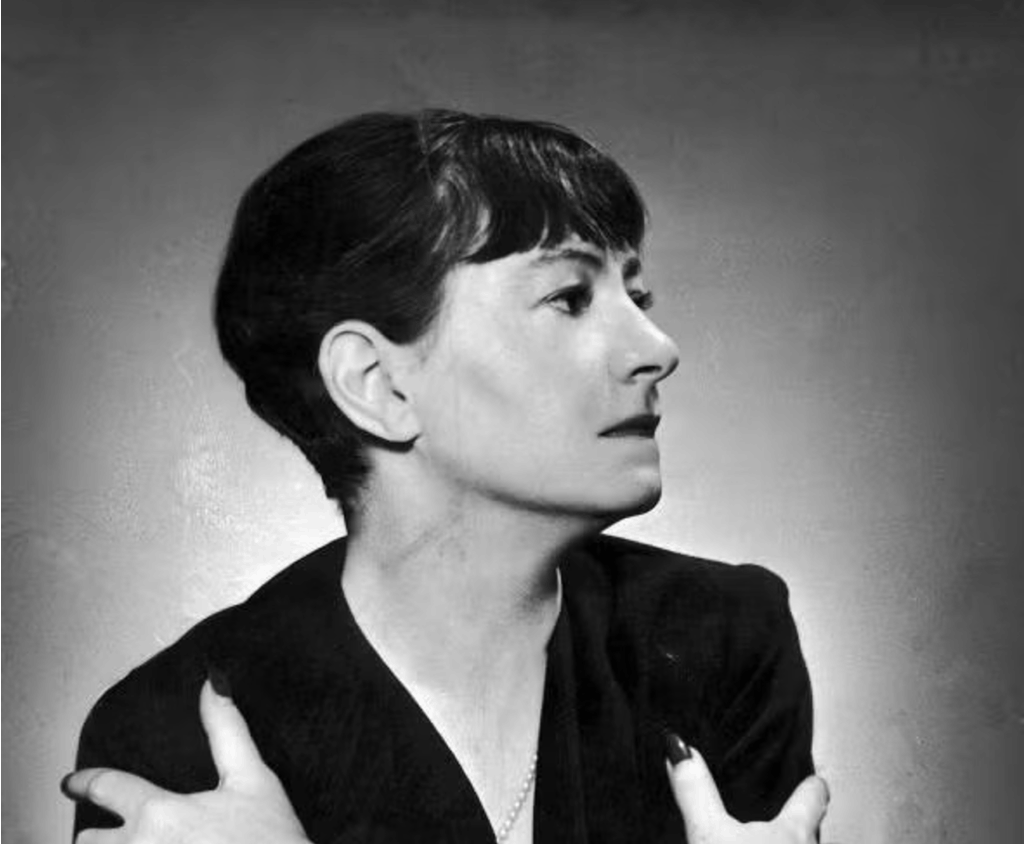
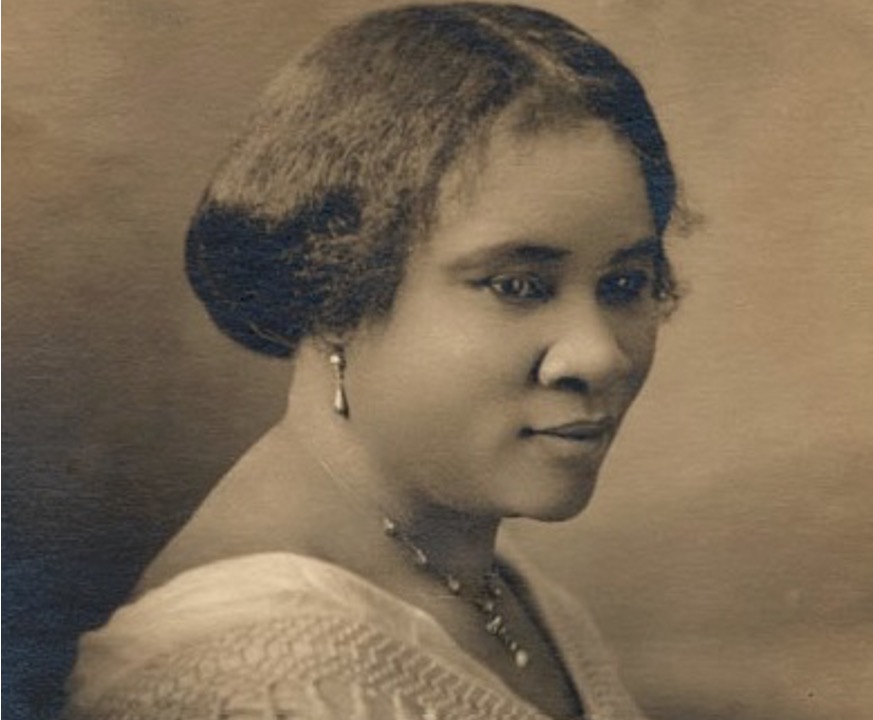
Dorothy ParkerMadam CJ Walker
Dorothy Parker left her literary estate to Martin Luther King having been a funder and supporter of civil rights in her lifetime, which got her put on the FBI watchlist. After he was assassinated the copyright for her works moved to the NAACP which still approves use of her work and benefits from her estate.
Madam CJ Walker left a left legacy to the NAACP against the advise of her financial advisors who thought that it was a nascent organisation that wouldn’t last. The Secretary of the NAACP Walter White said in the 1950s that ‘Madam Walker’s generosity virtually saved the NAACP in the dark days of depression.’
As with any legacy gift you never know what it may go on to accomplish …
With fundraising for social change and with the history of fundraising there is a challenge of what gets recorded and how we record history.
What does the academic world regard as historic? Where are gendered and racial lens applied to what ‘counts’ as what is worth recording.
With most history we rely on written records. And when you are campaigning to change laws less is written down.
Fundraising history hidden at the best of times – and especially within social change movements. We don’t want to talk about the money that made change happen. And that means the history of fundraising, social change is poorer – we don’t get to hear the impact of powerful players and fundraisers like Mollie Moon.
And with all fundraising history – money talks. Major foundations have archives that record what was given and to which organizations. This fails to record and recognize the many small gifts by hundreds of thousands – the National Urban League did have 501c3 status but many campaigning organisations didn’t so there are not records of these gifts.
Where we look for the items that form this history is also different. In writing the history of Mollie Moon Tanisha C Ford has used ephemera – menus from gala, newspaper reports not just traditional
“recognizing that Black women’s documents, objects and keepsakes are rarely housed in brick-and-mortar archives. To tell our stories we must be willing to dig in unexpected places, to utilise objects and other materials that archives and museums might consider of little use. And we must approach this work with an ethic of care that honours our subjects.”
Even in Mollie’s lifetime we see how history gets forgotten, remembered and retold. At the 1972 at the Beaux Arts Ball was led by all male board celebrating the history of the National Urban League. Mollie was present but there was no mention of her contribution and work and this led to a backlash from a new generation of activists who sought to get Mollie’s place and skills recognized.
When we tell our history we are always as Tanisha C Ford says
“how we choose to remember people, how we choose to forget, what we omit and distort’
changes the narrative of how the fundraising for social change happens.
We can be too close to an event to see it – we may need to reevaluate it and see the complexity
Philanthropy is always historically and culturally placed . They raised funds to keep slavery, to stop women getting the vote and to marry off unmarried ladies.
What is right side of history now that we will look at differently in 100 years and be shocked that there was an anti side?
And where will that fundraising appear in the history of social change?
https://marinajones.uk/wp-content/uploads/2025/04/Cover-Book.jpg1052698adminhttps://marinajones.uk/wp-content/uploads/2022/12/f2b903e010104f5aa61ea1821a685913.pngadmin2025-04-25 18:35:242025-04-25 20:31:26Mollie Moon – fundraising for social change
Fundraising has been plagued with a history of fake fundraisers, and fundraising for charities that never existed, or donations not going where they should.
Did you know the first fundraising regulation came in at the Lateran Council IV in 1215 in the wake of scandals about fake fundraisers collecting money for cathedral capital campaigns? Pope Innocent III decreed that all questors (those that asked for funds) needed a licence from the Pope and permission from the local diocesan bishop, or king, to be travelling around with relics and soliciting gifts.
This shows that concerns about fundraising have been with us a long time.
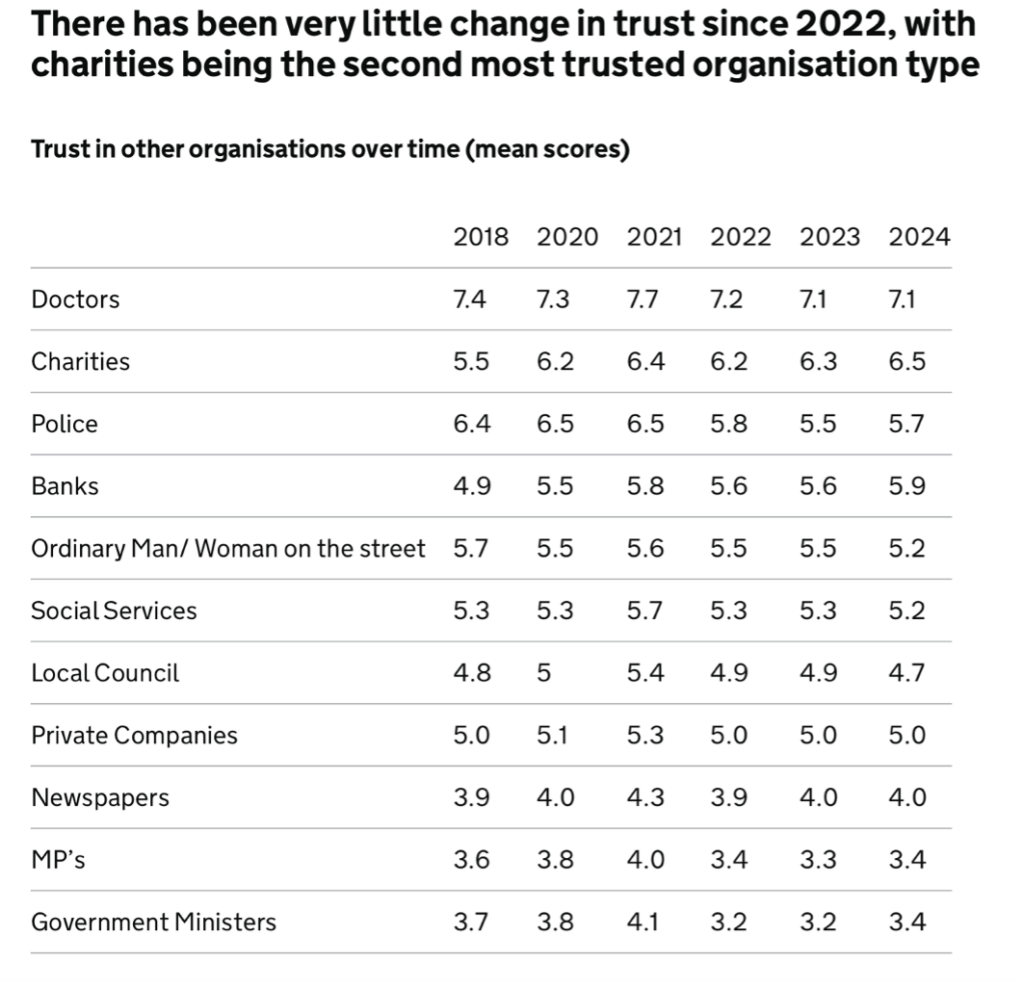
We trust charities – even now, charities are the second most trusted public organisation, and there has been little change in that over time.
We want to trust charities. We see them as mission aligned organisations, doing good in the world, and as bodies that have integrity. So we trust that the money given to them, and their representatives, is used appropriately.
There is a bigger and more wide reaching debate to be had about trust in charities and its impact and how all charities can be tarred with the brush of bad actors using the veneer of charity for their personal gain.
But when might using the veneer of charity, and creating a fake charity, actually help the greater good?
Here are two historical examples. Fake charities created to deceive but for a wider societal benefit. In both cases the deception was not revealed until years, or decades, after the ‘fraud’ was perpetrated.
Monopoly
Yes the board game. How is that connected with a fake charity?
Well during World War Two, prisoners of war were allowed by the Geneva Convention to have board and card games to occupy their time. These were sent by the Red Cross and other charities.
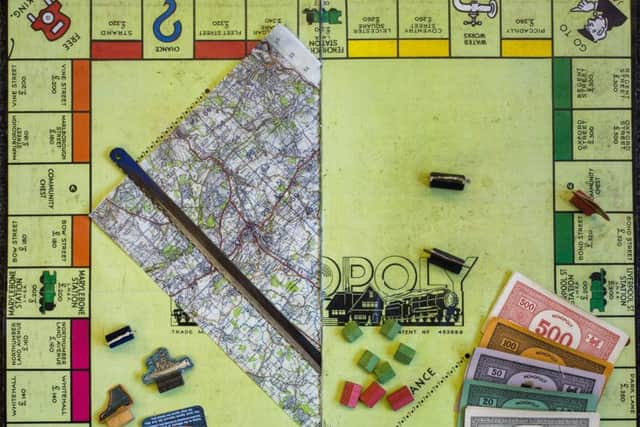
However, some very special sets of Monopoly were created by British Secret Service and game makers Waddingtons and sent to prisoners by fake charities to help prisoners escape.
This was the brainchild of Christopher Clayton Hutton who worked with the game makers Waddingtons. He has been likened to Q in James Bond and met Harry Houdini as a child. He had the idea to use the pieces and game of Monopoly to hide items in to assist prisoners to escape.
To the uninformed these boards looked like any other Monopoly board – same pieces, same weight. But a few subtle details alerted people that these were special ‘escape boards’.
And how did you know which map you had? A certain full stop on the map gave a clue to its secrets
a full stop after Mayfair – map of Norway and Sweden
after Free Parking – maps of Northern France
after Marylebone – map of Italy
British Secret Service and Waddingtons introduced compasses, ropes, knives and metal files all cleverly hidden and disguised within the playing pieces. Some playing tokens were made of pure gold so that the escaped prisoners could use it for safe passage during their escape.
And perhaps most ingenious (and Bond-esque) of all were the maps. Printed on silk so that it could be folded into playing pieces. Silk was chosen as it would not rustle or attract attention of prison guards, or disintegrate when wet.
Once the scheme had been successfully tired Monopoly money was substituted for local currency as well to make escape easier.
However, British Secret Service did not want to send them through the Red Cross, or any other established charity, in case they were discovered and real items of support and welfare did not get through. So they created a series of fake charities called:
Licensed Victuallers’ Sports Association
Prisoners’ Leisure Hour Fund
Licensed Victuallers’ Prisoners Relief Fund.
As well as sending through the games, to add veracity to their cover, these fake charities also sent parcels of clothes. These fake charities were based in address in bombed out buildings.
And did it work? Yes. There was no suspicion of the Monopoly boards. A 19 year old RAF prisoner of war reported that the sets were destroyed before the escapes were enacted so the secret was not revealed.
It is estimated over 10,000 Allied prisoners of war were assisted in some way by these escape kit Monopoly sets. This story was not declassified until 2007 and all those that escaped had to swear to uphold the Official Secrets Act in case the trick was needed in future wars.
Spitfires
A group of Prisoners of War in Germany made up a fake British charity to send German money to England to help buy a Spitfire and fight the Nazis.
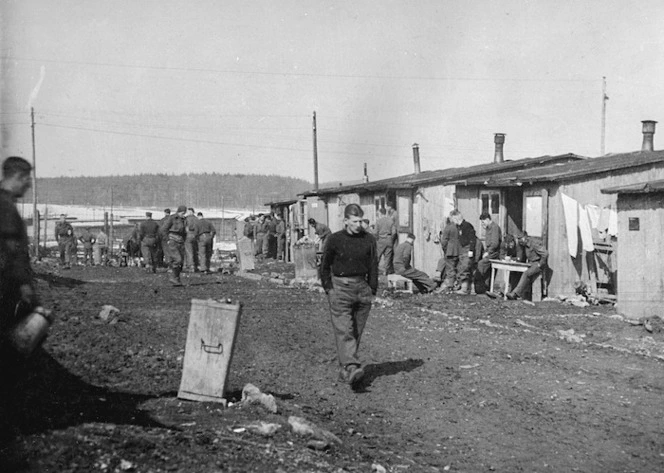
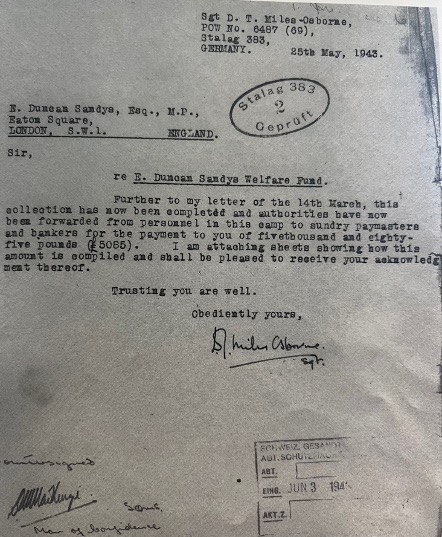
Sergeant Miles-Osborne was shot down and imprisoned in the prisoner of war camp Stalag 383. He organised fellow prisoners of war to donate towards the Spitfire Fund. The Spitfire Fund was a national campaign to raise funds for Spitfires.
But to do this they had to do it through a fake charity
Miles-Osborne wanted to fund a spitfire – but knew that all the letter he sent would be censored so he wrote to a friend, now Duncan Sandys MP. This letter established a fake charity – the Duncan Sandys Welfare Fund. Miles-Osbourne and prisoners raised £5,085 and listed 108 different military units and the payment from each
Royal Horse Guards £3
Royal Navy £4
Royal Marines £27
Gordon Highlanders £82 etc.,
(Now you may be wondering where prisoners got money to donate to charity – fake or not. Well, in prison prisoners still received their army pay, but also ordinary soldiers also received payments (minimum wage) from the Germans for manual work that they did in the camps, and these funds were credited to their army accounts. So, the soldiers used these funds to donate and via the great bureaucratic machine these could be used for donations.)
The above letter confused Duncan Sandys who had no idea what this Welfare Fund was or why monies were being directed to it. Miles-Osborne had written a previous letter that was lost in transit.
Cheques and postcards from the prisoner of war camp with pledges started arriving at the Ministry of Supply for the Duncan Sandys Welfare Fund. This Duncan Sandys Fund was a fake – under the ruse of contributing to a welfare fund (of undetermined nature) the prisoners were funding a spitfire to fight the war. They could not say what the funds were for as all letters were read and censored by their German guards.
The pledges continued to come in but Duncan Sandys had no idea what the funds were for. It took many months before he cracked the coded messages to realise that they were funds were for a spitfire – and all through the guise of a fake charity.
So sometimes faking it can be for the greater good.
Reference
The detail for the Spitfire story comes from Colin Pateman’s book Unshackled Spirit Prisoners of War and the Secret Spitfire
https://marinajones.uk/wp-content/uploads/2025/01/fake.jpeg194259adminhttps://marinajones.uk/wp-content/uploads/2022/12/f2b903e010104f5aa61ea1821a685913.pngadmin2025-01-18 10:44:372026-11-08 17:58:13Fake charity – sometimes a good idea?
As part of our Christmas team outing we had a private backstage tour at the Theatre Royal Drury Lane so sharing a few lovely fundraising history examples. In 2019 the theatre underwent a £60m restoration to refurbish, renovate and modernise it whilst also sensitively taking it back to its Regency roots.
Let them eat cake
229 a years a by all reports a mediocre actor (but a great chef) died. So what?
He left a legacy whose effects are still being felt today.
Robert Baddley began life as a chef but wanted to leave the kitchen for the bright lights of the stage and embarked on a theatrical career. He as a member of Sheridan’s Company at Theatre Royal Drury Lane. He was best known for playing Moses in The School for Scandal.
When he died in 1795 he left a legacy of £100 to the theatre which was to be invested and produce £3 a year which should be used.
to produce as nearly as possible the Annual Sum of Three Pounds which… I DIRECT shall be applied and expended in the purchase of a twelfth Cake or Cakes and Wine and Punch or both of them which… it is my request the Ladies and Gentlemen performers of Drury lane Theatre… will do me the favour to accept on twelfth night in every year in the Green Room…”
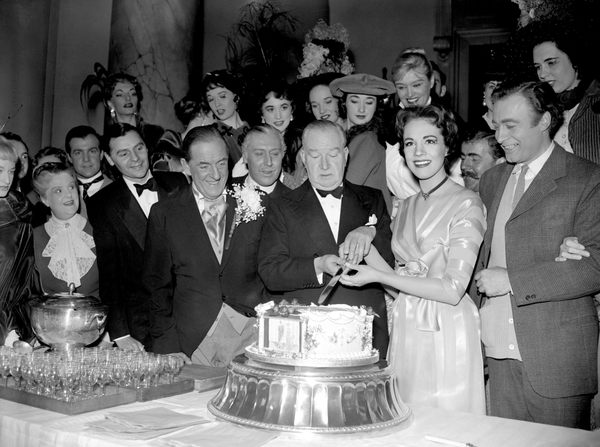
The twelfth night cake became known as Baddley cake is his honour and the first ceremony took place in 1796. It became a society occasion and the invitation to have with Oscar Wilfe and Alfred, Lord Tennyson attending in 1888.
The company of My Fair Lady including Rex Harrison, Julie Andrews and Stanley Holloway bought the theatre a punch bowl and cups to enhance the celebrations.
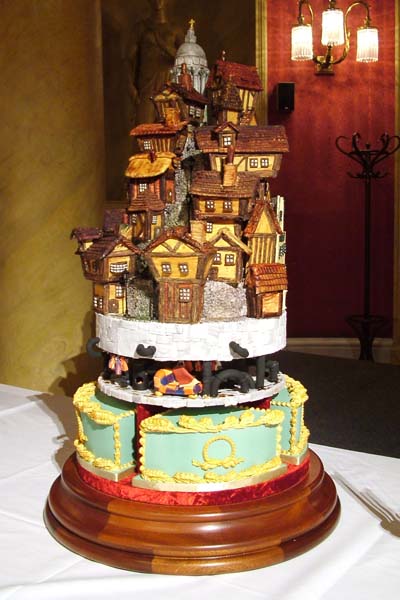
The tradition continues to this day and like the first cake occasion they have been themed to the show on at the theatre including a giant Wonka chocolate bar for Charlie and the Chocolate Factory.
Of course wars, rationing and theatre closures have interrupted the ceremony – but only 13 times in the last 229 years, including when the performing company were French and “They wouldn’t give the cake to the French company.”
And all from leaving £100 in your will.
This year The Tempest is on … what form will the cake take?
Mad bad and dangerous to know
Theatre Royal Drury Lane is not the first theatre on the site. Like many a London theatrical establishment it has burnt down, been rebuild again and again. The first on the site was in 1663, and the current theatre is from the 1812 incarnation when Samuel Whitbread (of the brewing family) took on rebuilding it after a fire. It was then run by a volunteer committee (like a modern board) but they need to raise funds to rebuild and were struggling.
What do you do when you need a huge injection of cash?
Recruit a superstar to the board.
And in the 1810s there wasn’t a bigger celebrity in London than …
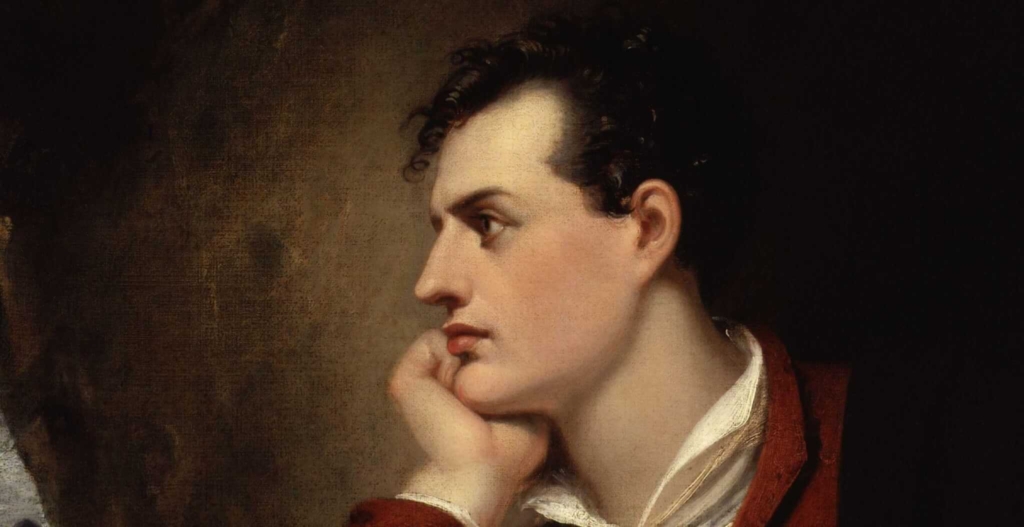
Lord Byron
Result – a huge fundraising income. We are swayed by the messenger for any campaign – but we have to like them or want to imitate them, and they need an authentic connection with the cause they are promoting. After returning from his Grand Tour and publishing several cantos and poems Lord Byron was the hit of Regency London sought after at parties and soirees.
Who would be the equivalent of Lord Byron now? (And would they pass the ethics assessment to get on the board?)
‘I Dreamt I Dwelled in Marble Halls‘
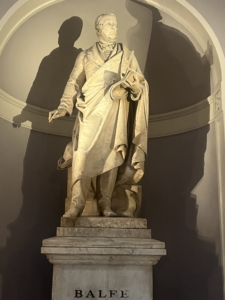
In the central rotunda is a statue to the actor and composer Michael William Balfe raised by public subscription – this means a popular crowd funding campaign. Balfe is not a popular name now, but he was a much loved actor and the composer of The Bohemian Girl which was popular hit that premiered in 1843 and regularly in the rep (about as popular as La Boheme, La traviata and Carmen today).
If a much-loved actor died now, would we crowd fund to make a statue of them in a theatre?
‘All I want is a room somewhere’
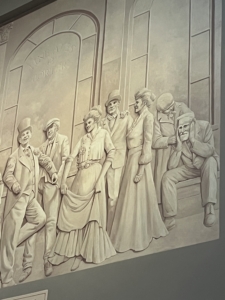
My Fair Lady opened in 1958 at the Theatre Royal Drury Lane. During the recent restoration, to recognise the important part in the theatre’s history that the show played new paintings were commissioned that celebrate this . They include the famous cast but also a few modern nods to the commissioners and there is even George Bernard Shaw holding his ears against the music!
The success of the film My Fair Lady created a greater financial legacy for George Bernard Shaw and he was keen to introduce a rational spelling system for English which proved controversial – you can read more about it here.
https://marinajones.uk/wp-content/uploads/2024/12/stage.jpeg183275adminhttps://marinajones.uk/wp-content/uploads/2022/12/f2b903e010104f5aa61ea1821a685913.pngadmin2024-12-29 16:05:242024-12-29 16:05:24 Theatrical Treats from fundraising history of Theatre Royal Drury Lane
Any gift you can give make whatever size makes a huge difference…
And we are asked to know what 1p, £1, or £1m could do for our cause.
What difference do these micro-donations make?
Is microphilanthropy a new thing?
First what is a microphilanthropy? The clue is in the name they are small gifts. It has been defined, in the US, as gifts from 25c to $10, and is sometimes called ‘spare change philanthropy’.
Recent technological advances claim to have revolutionised the microphilanthropy giving space – from Amazon Smile, to rounding up at the supermarket, the ways we can make frequent small donations has expanded. But from the Biblical widow’s mite, small gifts have been making a mighty impact on the philanthropic landscape – and not just on how much we raise, but how we engage with supporters.
A note on size of gift – micro in monetary value does not mean it has no meaning to your donor, or charity. In the Biblical account (Luke 21:1-4), Jesus describes a poor widow putting in two small coins to the Temple collection and says
“Truly I say to you that this poor widow has put in more than all; for all these out of their abundance have put in offerings for God, but she out of her poverty put in all the livelihood that she had.”
Just because gifts are small in monetary value does not mean that are not significant amounts to our donors.
Here are two historic examples of regular microdonations from fundraising history. They illustrate why these are powerful tools that we can use to build the philanthropic tribe, and explore why they work.
Salvation Army – Grace Before Meat
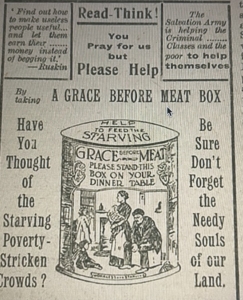
As part of its encouragement of regular and mindful giving, the Salvation Army mass produced ‘Grace Before Meat’ donation boxes in the late Victorian period. These were to be put out on the table, so that when the family was saying grace before a meal they would be reminded of those less fortunate, and develop the regular habit of putting a small donation in the box. Salvation Army collectors regularly visited houses with these boxes to collect the takings.
British Red Cross – Penny a Week
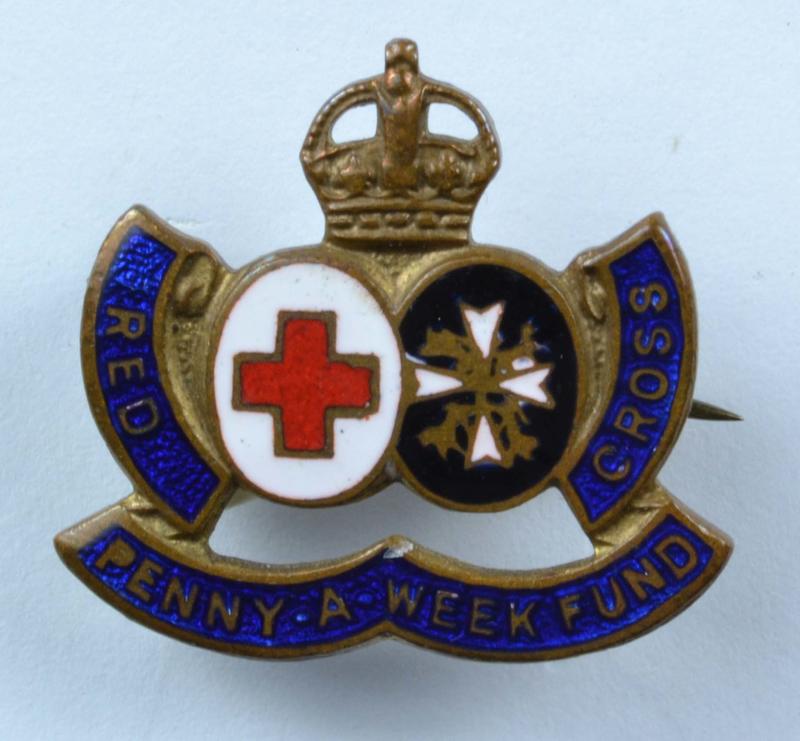
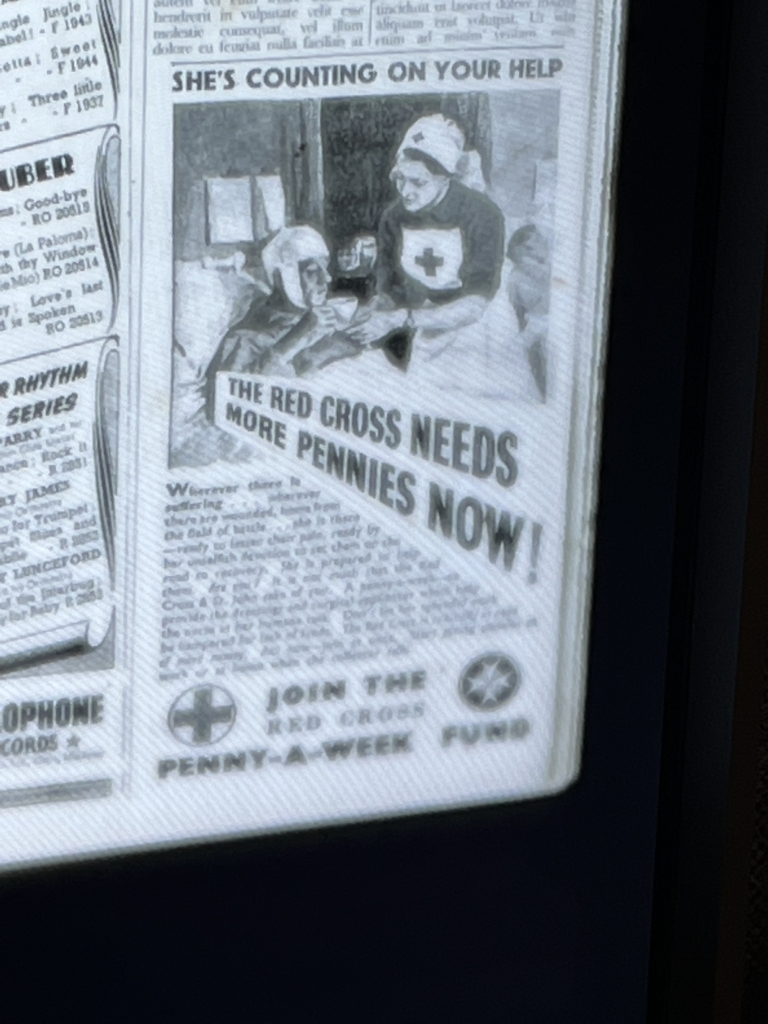
During the Second World War the Duke of Gloucester spearheaded a Penny-a-Week campaign for the British Red Cross. This worked through habitual donations, people knocking at the door to solicit the penny a week and was also via Trade Unions introduced as one of the earliest form of payroll giving.
Why do these schemes work?
Habits and Behavioural bundling – we find it easier to do something if we do it regularly with another behaviour, for example you can only listen to your favourite podcast when you go to the gym, or treat yourself to a sweet treat when visiting with a relation you don’t like. Coupling two behaviours together helps us maintain and sustain them which is why the Salvation Army ‘Grace Before Meat’ works so well – they are linked and repeated. This form of giving also has the added bonus of linking to our natural human desire to reciprocate – we think ‘I am about to eat a lovely meal, I can do something nice for others who do not have what I have’. (Today we see it with Giving Tuesday, hot on the heels of Black Friday – the need to do something good for the world after indulging in the consumerist excess of purchasing gifts for yourself and loved ones.)
Social signifier – the ‘Grace Before Meat’ donation box and the ‘Penny a Week’ collecting box could be put on display demonstrating to anyone visiting your house how philanthropic and charitable you were. And encouraging visitors to give as well.
Norming and conforming behaviour – the more you see these boxes, or the thank you badges that people were rewarded with or pre printed receipts sent out by the Duke of Gloucester the more normal this behaviour was seen amongst your social group and the more you would want to imitate it by supporting, or getting your own donation box.
Pattern completion – humans want to create and complete patterns. Have you ever done a 30 day Yoga challenge? Or filled a Smartie’s tubes with 20ps for Brownies? Or spend extra time at a museum to complete the stamp trail? We want to complete the challenge. We have made that the commitment, whether publicly or privately, and feel duty bound to stick to it. So completing a time limited giving of a ‘Penny a Week’ feels like both an achievable goal, one that we have committed to, and once we start we do not want to break the pattern!
The Goldilocks effect of friction …
The Goldilocks effect says we don’t want too much, or too little, like Golilocks and the porridge in the fairy story, we want the middle option that is ‘just right’
Often with giving we talk about reducing the friction and effort that the donor needs to make to give you a gift – if it is too hard, too many clicks, too many forms to fill in then it it is ‘too hard’. and donors lose patience and abandon the gift.
On the other hand. it can be ‘too easy’ and requires too little thought or engagement and the donor might not know what charity they gave to, how much or why.
So sometimes, like Goldilocks, you need the ‘just right’ amount of friction – what is powerful about these two historical examples is that they require a low level of repeated effort – just the right amount of friction – to engage with donating.
It is important to remember for every donation you give you get a hit of the happy chemicals (dopamine, oxytocin, serotonin and endorphins). So a microdonation of microphilanthropy = microdose of happy chemicals. Once someone is signed up for a Direct Debit – donors can forget about it. Seeing it on the bank statement doesn’t give you the ‘warm glow’ or the same rush of happy chemicals as the active act of giving. How can you keep that happy hit going by just the right amount of friction?
And remember when it comes to these small micro donations … every penny does make a difference
Over 1million EUROS are donated through coins in the Trevi fountain each year which supports Caritas which amongst other things provides 100 families a day with access to a free supermarket.
When the Roman Baths in Bath banned throwing coins into the water donations went down £90,000
How could you use this in your fundraising?
How can you remind people regularly of the joy of giving and what their donation does?
How can you provide an option to round up?
Interestingly rounding up helps reduce the psychological pain of paying – and as humans we prefer round numbers. At petrol pumps 56% of transactions end in a round number, we round tips up to a round number and supermarket donations.
How can you provide regular injections of the happy chemicals to your supporters?
How can you bundle the giving behaviour with another behaviour – a treat for them, or encourage them to give for a duration?
How can giving help the donor signify to the wider world their identity and who they are?
How can you help donors complete a pattern of giving? A durational gift?
How can you include good friction into your supporter journey to connect with supporters?
https://marinajones.uk/wp-content/uploads/2024/10/OIG3.7p6GwWXt5AzuzZikWPX7.jpeg10241024adminhttps://marinajones.uk/wp-content/uploads/2022/12/f2b903e010104f5aa61ea1821a685913.pngadmin2024-10-24 18:16:072024-10-24 18:16:07Every little helps …. Microphilanthropy then and now
Here are a few quirky and unusual examples of legacy giving from the fundraising history archives and some reflections on how they might help us think about legacy giving today.
Legacies – continue your in life passions
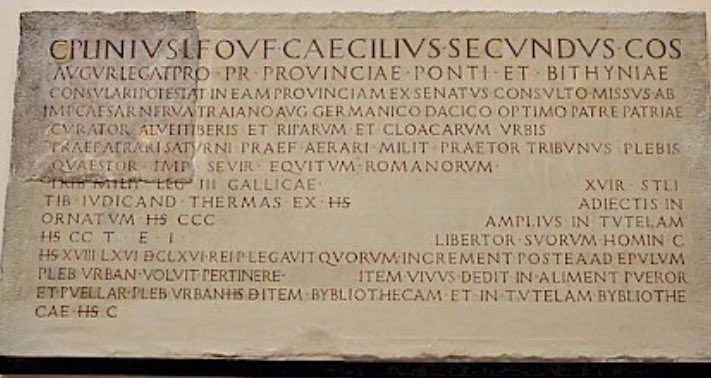
Pliny the Younger, a first century Roman letter writer, lawyer, author, magistrate and sometime philanthropist, is the first noted library donor. He donated over 1,600,000 sestertii to construct the library at Como with additional funds to maintain it. Like many funders, he paid in instalments with the largest 1,000,000 sestertii to fund the building but also made maintenance instalments (always important to convert capital donors into revenue ones.)
Pliny’s will details his bequests for the public good including gifts to the public baths and their upkeep (we like a legacy bequest that comes with maintenance costs.) In his will, he also supported Freemen of the city which included spend on an annual dinner. The will does not include another gift to the library but notes his life time gifts which included 100,000 sesterii for the upkeep of the library.
For Pliny his in life charitable commitments were reflected in his bequests.
Two of the architects working on the construction of Utrecht Cathedral also left gifts to support the building of the cathedral – here their professional identity was reflected in their legacy gifts.
Other food related legacies
Say it with biscuits – Bibbendum Dole
Born in 1100 conjoined twins Eliza and Mary Chulkhurst were conjoined twins. They died aged 34 within 6 hours of each other, and in their will left the church land and the means to provide a charitable dole for the poor, needy and elderly of the village. This was bread and cheese and at some point this evolved into biscuits depicting the two twins. The biscuits are reportedly very hard and not super tasty. Today as well as biscuits a church ceremony takes place and the elderly get tea, bread and cheese – as well as the biscuit.
Biscuits1902 queue for the Bibbendum dole
Bread or cake?
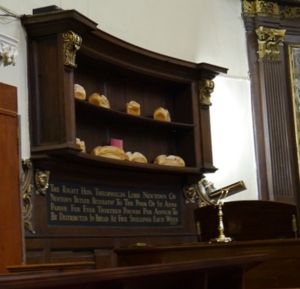
Bread shelf St Ann’s Dublin
Since 1723 and the legacy of Lord Newtown of Newtown Butler there has been a bread shelf at St Ann’s Church Dublin where every day there is bread for the hungry of the city.
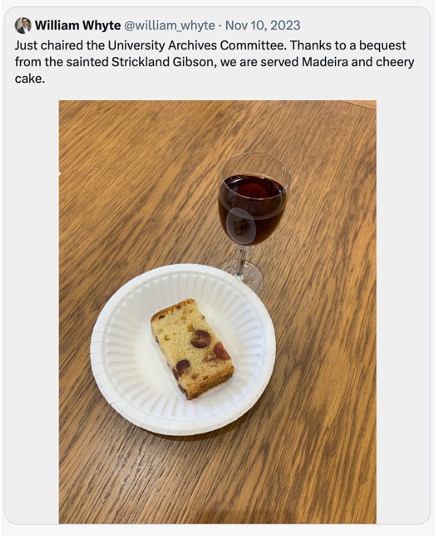
In 1958 Strickland Gibson died. He was the Keeper of the Archives at the University of Cambridge – his legacy lives on to this day with a stipulation that Maderia and cheery cake are served a the University Archives Committee.
Small and kind acts
Legacies don’t need to be big to be effective; how about the widow who required that sixpences be put on her grave every Good Friday for aged and infirm women to visit and pick up
But also more personal and odd bequests
A donor named Henry Greene who died in 1679 left money to clothe four women in green waistcoats (to be lined with green galloon lace) and to be delivered on 21st December every year so they could wear their green waistcoat at Christmas.
Why can’t the English teach their children how to speak?
So asks Professor Henry Higgins in George Bernard Shaw’s ‘Pygmalion’. Professor Higgins fascination with language was also reflected by Shaw.
Shaw died in 1950, aged 94, after falling from an apple tree.
The residual part of his estate was divided three ways:
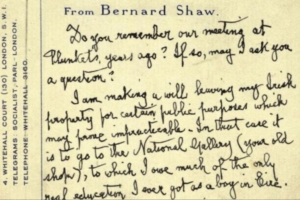
1/3 to the National Gallery of Ireland inspired & in thanks for ‘priceless part’ of his education and childhood (and the legacy group at the gallery is called Shaw Circle)
1/3 RADA
1/3 to the British Museum and improvement of the Reading Room.
These legacies were to be paid from the copyright from his plays, but the success of the ‘My Fair Lady’ film made these more substantial than he might have envisaged and a legal battle ensued.
One clause that he added and that was hard to interpret and enact was for the reform of the English language a rational spelling system based on phonetics and a simplification of the alphabet
The will was challenged on the grounds that waiting for the reform of the English language might take until Doomsday. This dispute went on for 49 years – during which time the British Museum and the British Library split to be separate entities.The library argued from the start that it, not the museum, was clearly Shaw’s intended beneficiary, since his will acknowledged “the incalculable value to me of my daily resort to the reading room of the institution at the beginning of my career“.
Another literary legacy was Dorothy Parker who left her entire estate to Martin Luther King Jnr but had never met him, after he was assassinated the copyright for her works moved to the N.A.A.C.P. (National Association for the Advancement of Coloured People_ which still approves use of her work and benefits from her estate.
Importance of super clear instructions in your bequest
Like George Bernard Shaw’s bequest the exact wording of Miss Frances Ethel Scarborough’s will caused controversy and ultimately meant her will could not be enacted as she planned.
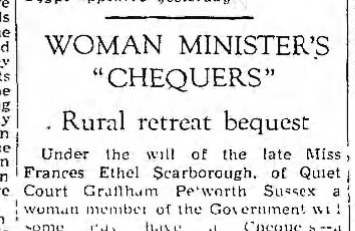
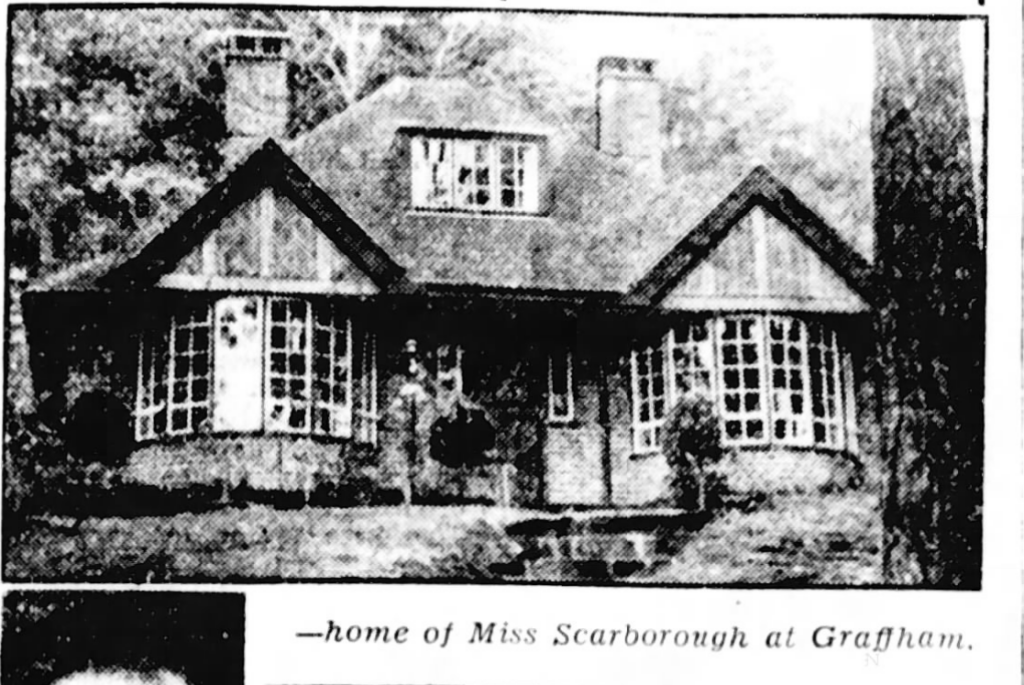
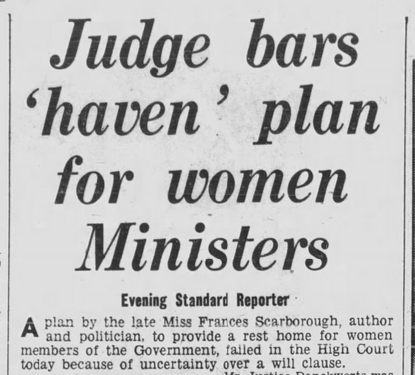
Ethel Scarborough once stood in parliament against Nye Bevan and had been a Conservative Councillor. She died aged 76 in 1956 and wanted to reflect her passion for politics in her will. With no children or dependents her will left her 5.5 acres of land in Graffham Sussex known as Quiet Corner to the most senior woman in the British government – a ‘Woman Minister’s Chequers’ was gifted to the nation, but it was never used by any female ministers. Her siblings challenged the bequest arguing there was not enough money to maintain the property for the nation. Judge Danckwerts was called upon to adjudicate the will and there was debate about how to ascertain who was the most senior female politician. He asked ‘We know what the word woman means, but what is senior? And what is a senior member?’ – there were two potential candidates at the time Edith Pitt (junior pensions minister) or Patricia Hornsby-Smith (junior home office minister). With no agreement on whether senior refried to age, rank or length of service the will was ruled void, depriving the nation of this unique gift.
Meet Callum – you want my money, you hang a portrait of my dog
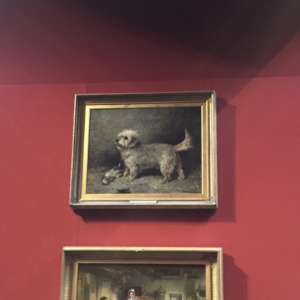
Callum was a Dandie Dismount terrier owned by James Cowan Smith – and James Smith loved this dog do much that he commissioned his portrait by artist John Emms. When James Smith was thinking about his legacy he left a bequest to the National Potrait of Scotland of £55,000 in 1919 on the condition that this portrait of his dog was displayed in perpetuity. It is still in the gallery and has helped pay for for El Medico by Goya, Dedham Vale by Constable and Lady Agnew by John Singer Sergeant.
Alas, Poor Yorrick, I knew him Horatio
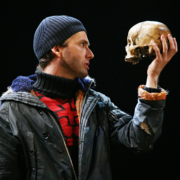
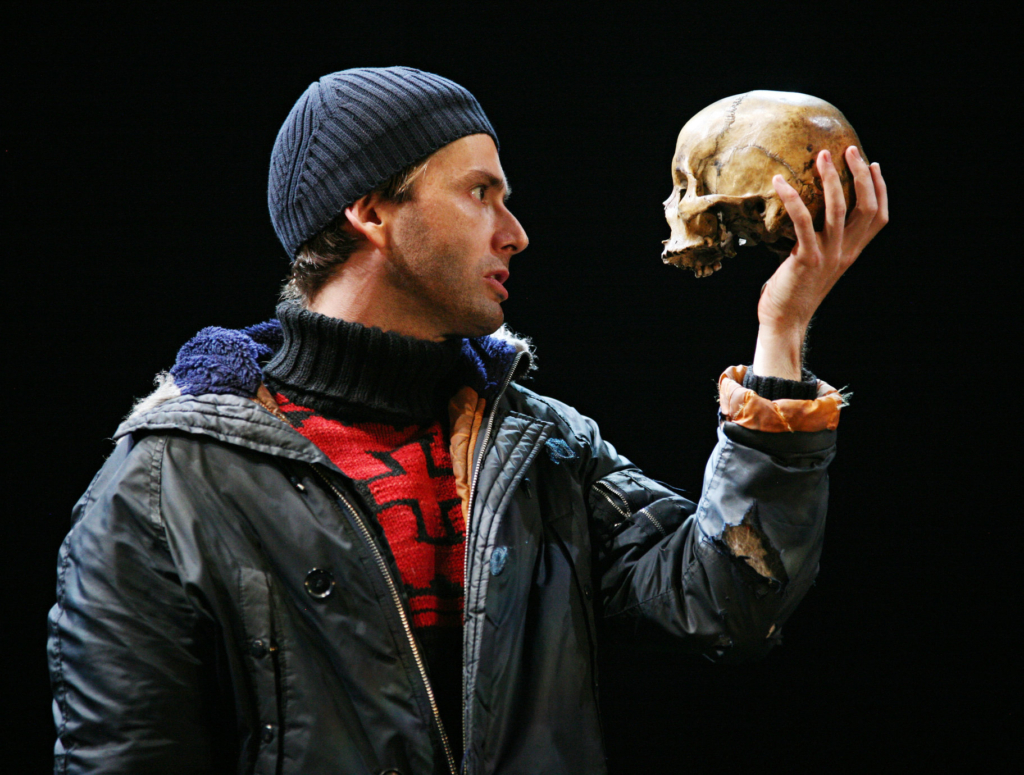
The skull used by the RSC for every production of Hamlet is the result of a legacy gift from Polish pianist, André Tchaikowsky, in 1982 – he left his body to medical science
‘with the exception of my skull, which shall be offered by the institution receiving my body to the Royal Shakespeare Company for use in theatrical performance’.
It was in the prop box for 25 years before its first official outing in David Tennant’s Hamlet (Mark Rylance reportedly rehearsed with it but he didn’t use it for the final performance)
Beautify the city you love
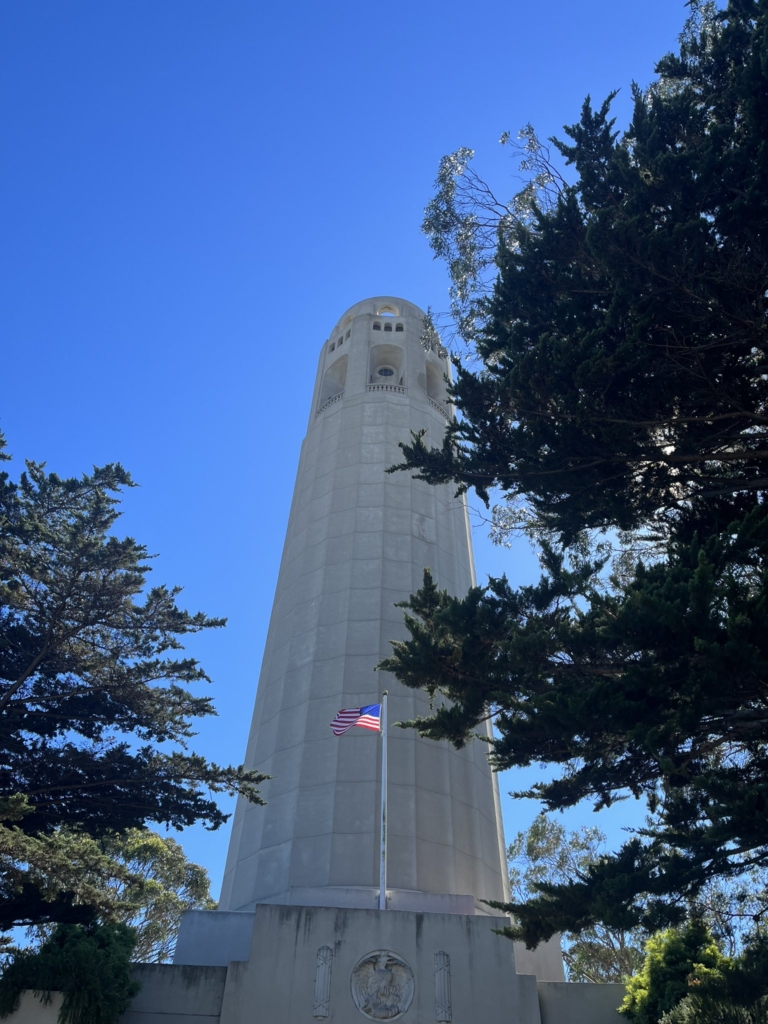
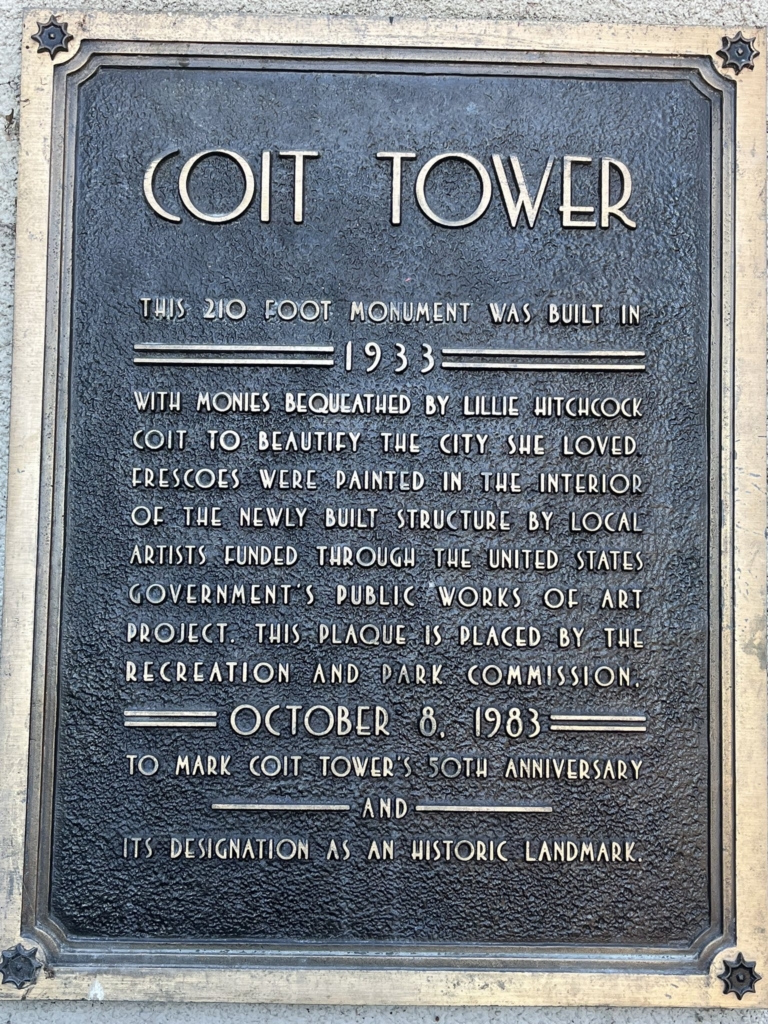
‘Loopy’ Lillie Hitchcock Coit gave $100,000 to the city she loved – San Francisco ‘to be expended in an appropriate manner for the purpose of adding beauty of the city which I have always loved’. This gift resulted in the Coit Tower erected in 1933 in San Francisco.
Lillie was a huge fan of the fire service and used to volunteer to help. She used to leave society balls when she heard the fire truck. The Coit Tower which her legacy created supposedly resembles a fireman’s hose.
Super fans, super loyal but also need super care
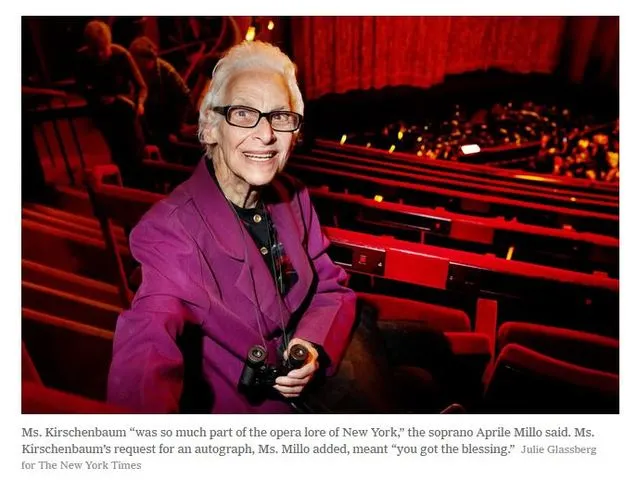
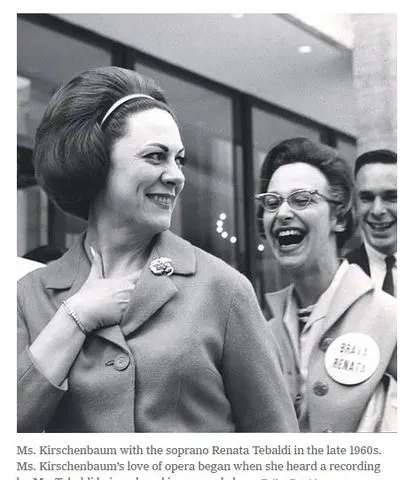
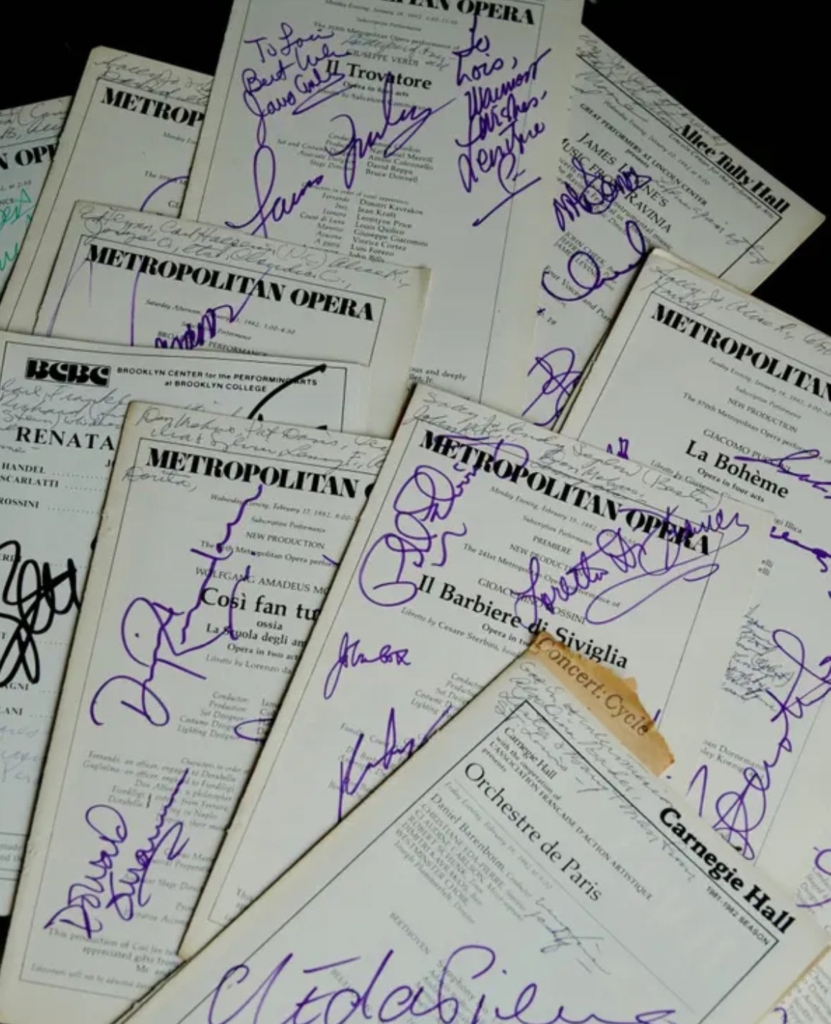
Since the 1950s Lois Kirschenbaum attended nearly every performance and always hung around stage door to get her programme or ticket signed. She was an opera super fan, although the data collected would not have shown her up as a potential major legacy giver. Lois Kirschenbaum bought standing places. She was legally blind and watched the opera through big binoculars. She lived in a rent controlled apartment, worked for a charity and caught the bus to the opera. However the lived frugally and left $4m to 18 charities giving $1.7m to the arts but not to the Met Opera because of a decision 30 yrs ago not to let her backstage to continue to gather the signatures she loved. Often legacy pledgers are not big donors in their lifetime but their gifts reflect a lifetime of connection.
So what can we learn from all of this and how does that us help encourage our lovely supporters to remember us in their wills?
Identity is important – whether that is regional and place based, or connected to cultural identity
Donors want to make an impact with their legacy gifts – whether it be big or small
In life giving often predicts legacy gifts
Sometimes you have to honour a quirky bequest to get the money
Look after your donors – they may be super loyal but loyalty does not guarantee a gift if what you do annoys them
Encourage supporters to talk to a legal professional so that whatever their particular conditions in their will can be legally honoured and enacted
https://marinajones.uk/wp-content/uploads/2024/09/ham.jpeg13801823adminhttps://marinajones.uk/wp-content/uploads/2022/12/f2b903e010104f5aa61ea1821a685913.pngadmin2024-09-08 19:49:512025-07-30 22:01:13Legacies – some quirky legacy stories
A few photos from a recent trip to the People’s History Museum in Manchester and the importance of fundraising to make change happen.
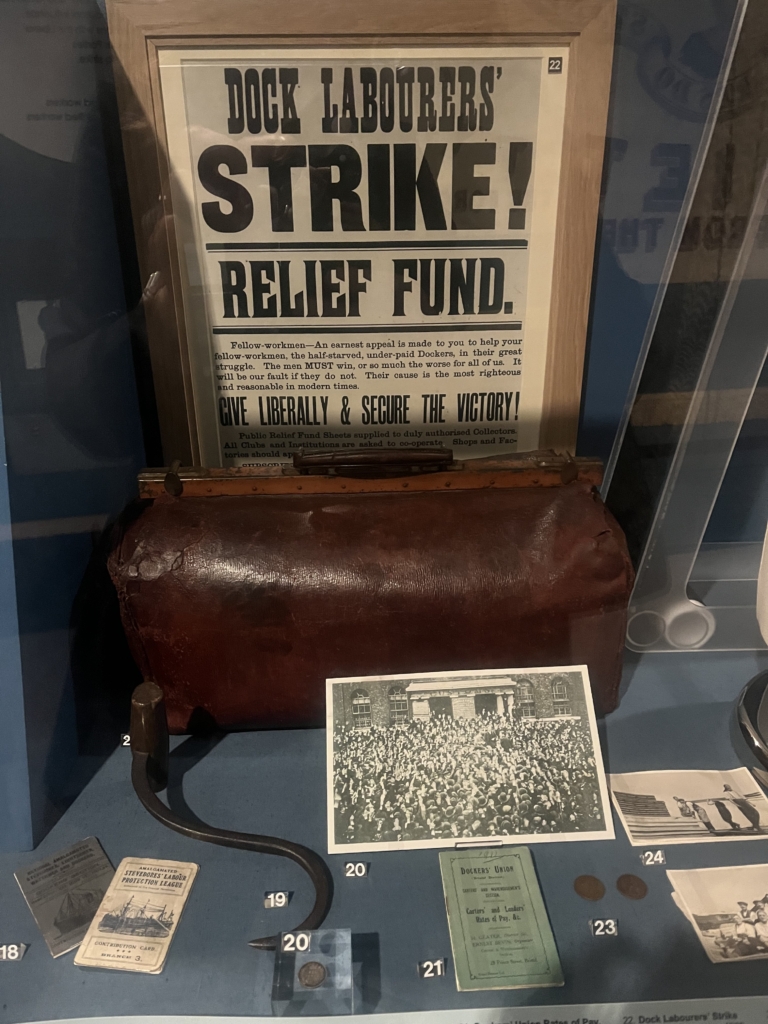
1899 – London Dock Strike
A fundraising poster asking for support for the Strike Relief Fund to support the striking dock workers. The dockers went on strike over wages, with the dockers requesting to get a tanner (6d) an hour – this was London’s first living wage. The strikes spread with other workers coming out in sympathy with the dockers. The unions helped fund those on strike but they needed extra funds to support a prolonged strike, and this is where the donations came in,
The Strike Relief Fund raised over £46,000. Tom Mann, one of the organisers of the strike, collected donations in the brown bag below.
£30,000 of the £46,000 raised which came from Australia. Sympathetic dockers in Australia and other trade unions including the timber yards, football clubs sent donations – a shared affinity across countries often inspires gifts.
This shared affinity can be seen throughout history. A great example is the Choctaw Nation who after a difficult period of migration had recently arrived in Oklahoma in 1847, and sent a donation to Ireland for those impacted by famine – as they too had experienced hunger. This has developed into a reciprocal relationship with the people of Ireland sending the Choctaw Nation donations during the pandemic when the community was particularly affected.
It was not just the affiliated dockers and trade unions but also the Melbourne police and archbishop donated to support the dockers. The funds raised in England and Australia ensured that the strikers could hold on and negotiate for better conditions.
The Dockers had been inspired by the Match Girls of the Bryant & May match factory who had gone on strike in 1888 previously in protest over their dangerous working conditions. The phosphorus used in the production of matches was harmful and caused their jaws and bones to deteriorate. Social campaigner and Fabian, Annie Besant supported them, and with George Bernard Shaw, raised money to support their strike (and as an aside I played Annie Besant in an amateur production of the musical of ‘The Match Girls’ by Bill Owen and Tony Russell, and directed a production in Sixth Form). To counteract this unethical production methods the Salvation Army created more ethical matches which you can read about here.
.
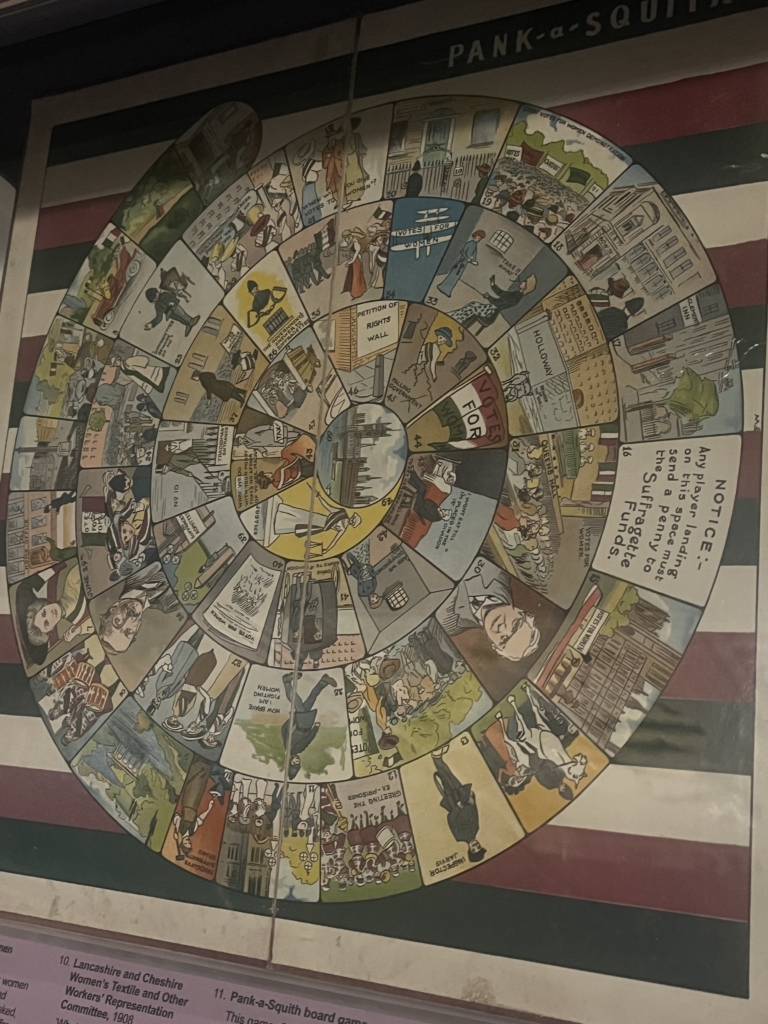
Early Gamificiation – Pank-a-squith
Gamification has become a popular way to raise funds but it is nothing new in fundraising.
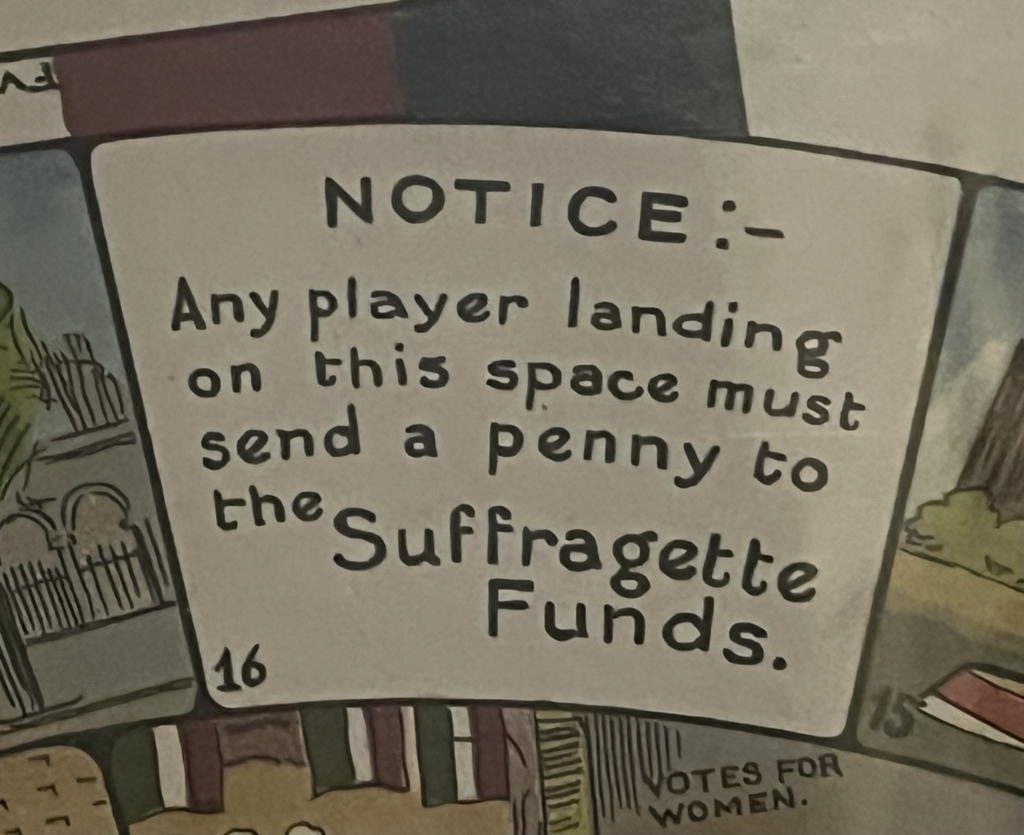
This board game from the 1910s with a board game called Pank-a-squith used to raise funds and awareness of the Suffragettes and their cause
It had one space on the board dedicated to raising funds.
“Any player landing on this space must send a penny to the Suffragette funds”
And the whole game, which involves moving from home towards Westminster and includes spaces throwing rocks at the British Home Offices.
They also sold card games called Suffragette and other board games – again to raise funds and awareness.
As well as early adopters of gamification, the Suffragettes also sold merchandise and in 1909 ran a two week Women’s Exhibition which had an immersive exhibit. So before VR headsets they created an interactive and immersive experience. They had a replicas of a jail cell clearly demonstrating the difference between the treatment and size of male and female prisons. Men, even if imprisoned for treason or murder, had bigger cells and better treatment. Women were in smaller and treated as common criminals. A suffragette who had been imprisoned in one of these cells led tours at the Exhibit.
Demonstrating the importance of show don’t tell!
Bing AI generated image of a Suffragette using VR googles
Emmeline Pankhurst wrote in the programme
‘This Exhibition is intended to help the most wonderful movement the world has ever seen. A movement to set free that half of the human race that has always been in bondage, to give women the power to work out their own salvation – political, social and industrial.’
The event raised over £5,000 in its two weeks and Emmeline Pankhurst also noted that
‘although it usually happens that the women who have worked to raise the money are not in any way consulted as to how the money raised shall be spent.’
Before the welfare state, friendly societies and unions looked after their members and their dependents. This union banner emphasises the important work of the unions in supporting and caring for those left behind with its promise to “Help the Widows and Orphans.”
Spain’s Civil War
In 1937 the Spanish Civil War the printing trade and other unions sent money to Spain
The printers union raised £5,000 to provide aid.
Here is a selection of campaign posters to promote charitable giving to support those impacted by the civil war from the late 1930s. I always find it interesting to look at older charity adverts and see how little has changed.
Rose Queen Pageants
A North West tradition, these pageants were used to raise money and support local causes. A Rose Queen was elected every year – a girl aged 8-14. More research needed to find out more about this tradition.
The first charity single
Forget Band Aid! Think Arthur Sullivan and Rudyard Kipling and the 1899 hit ‘The Absent Minded Beggar’ – raising money for soldiers fighting and returning from the Boer War. Sales from the sheet m
Sales of the sheet music raise £250,000 (best part of £40m/US$49m/€46m) at today’s values) to support soldiers fighting in and returning from the Boer War.
With the advances in modern technology not just popular as printed sheet music (raising over £250,000 – best part of £40m/US$49m/€46m) at today’s values) but also printed on handkerchiefs!
The lyrics to the poem/song include the lines:
Each of ’em doing his country’s work (and what have you got to spare?) Pass the hat for your credit’s sake, and pay—pay—pay!
Encouraging donations.
Miners’ strikes
A collecting box from the miners’ strikes
I am sure I missed lots of other examples but a useful reminder of the power of. philanthropy, powered by fundraising and fundraisers, supporting social change.
https://marinajones.uk/wp-content/uploads/2024/06/IMG_1549-1-scaled.jpeg19172560adminhttps://marinajones.uk/wp-content/uploads/2022/12/f2b903e010104f5aa61ea1821a685913.pngadmin2024-06-30 13:41:212024-07-01 10:03:36The revolution will be fundraised for …
We may request cookies to be set on your device. We use cookies to let us know when you visit our websites, how you interact with us, to enrich your user experience, and to customize your relationship with our website.
Click on the different category headings to find out more. You can also change some of your preferences. Note that blocking some types of cookies may impact your experience on our websites and the services we are able to offer.
Essential Website Cookies
These cookies are strictly necessary to provide you with services available through our website and to use some of its features.
Because these cookies are strictly necessary to deliver the website, refusing them will have impact how our site functions. You always can block or delete cookies by changing your browser settings and force blocking all cookies on this website. But this will always prompt you to accept/refuse cookies when revisiting our site.
We fully respect if you want to refuse cookies but to avoid asking you again and again kindly allow us to store a cookie for that. You are free to opt out any time or opt in for other cookies to get a better experience. If you refuse cookies we will remove all set cookies in our domain.
We provide you with a list of stored cookies on your computer in our domain so you can check what we stored. Due to security reasons we are not able to show or modify cookies from other domains. You can check these in your browser security settings.
Google Analytics Cookies
These cookies collect information that is used either in aggregate form to help us understand how our website is being used or how effective our marketing campaigns are, or to help us customize our website and application for you in order to enhance your experience.
If you do not want that we track your visit to our site you can disable tracking in your browser here:
Other external services
We also use different external services like Google Webfonts, Google Maps, and external Video providers. Since these providers may collect personal data like your IP address we allow you to block them here. Please be aware that this might heavily reduce the functionality and appearance of our site. Changes will take effect once you reload the page.
Google Webfont Settings:
Google Map Settings:
Google reCaptcha Settings:
Vimeo and Youtube video embeds:
Other cookies
The following cookies are also needed - You can choose if you want to allow them:
Privacy Policy
You can read about our cookies and privacy settings in detail on our Privacy Policy Page.