• Link to X
  • Link to Instagram
  • Link to LinkedIn
Marina Jones
  • My Thoughts
  • What I’m Reading
  • About Me
  • Contact Me
  • Home Page
  • Click to open the search input field Click to open the search input field Search
  • Menu Menu

Ladies to the rescue!

May 19, 2026/in Thoughts/by admin

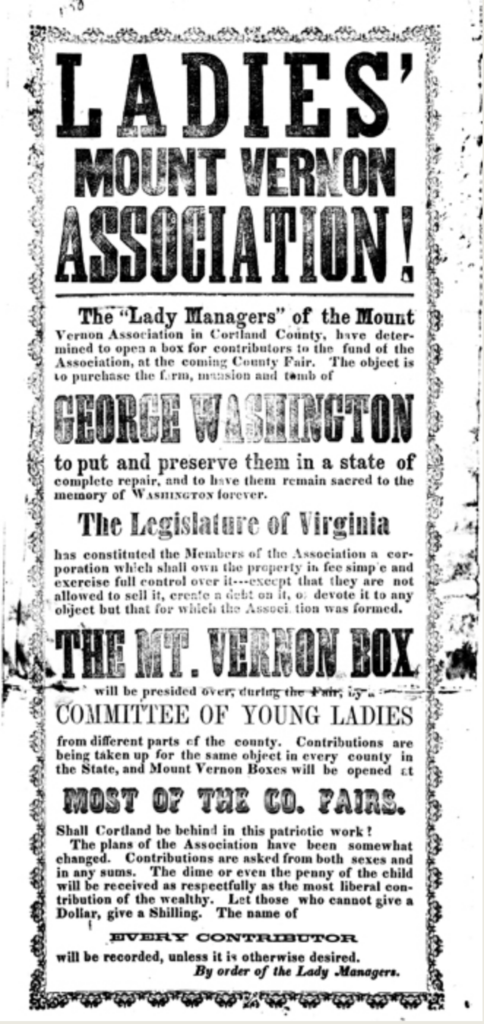
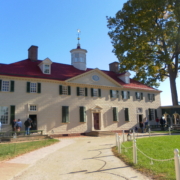
Washington’s home, Mount Vernon, was saved and preserved thanks to the fundraising efforts of women in the 1850s. 

Background

George Washington – America’s first President and one of the founding fathers – lived at Mount Vernon, just 15 miles from Washington down the Potomac River. Even during his lifetime, fans of the former President would disturb his day by visiting and ‘trophy-ing’ fruit or soil from the estate. In the years after his death, day trippers would arrive on steamboats to visit, and over 10,000 people a year came. 

Over the course of the decades the estate fell into disrepair and his heirs wanted to sell it. 

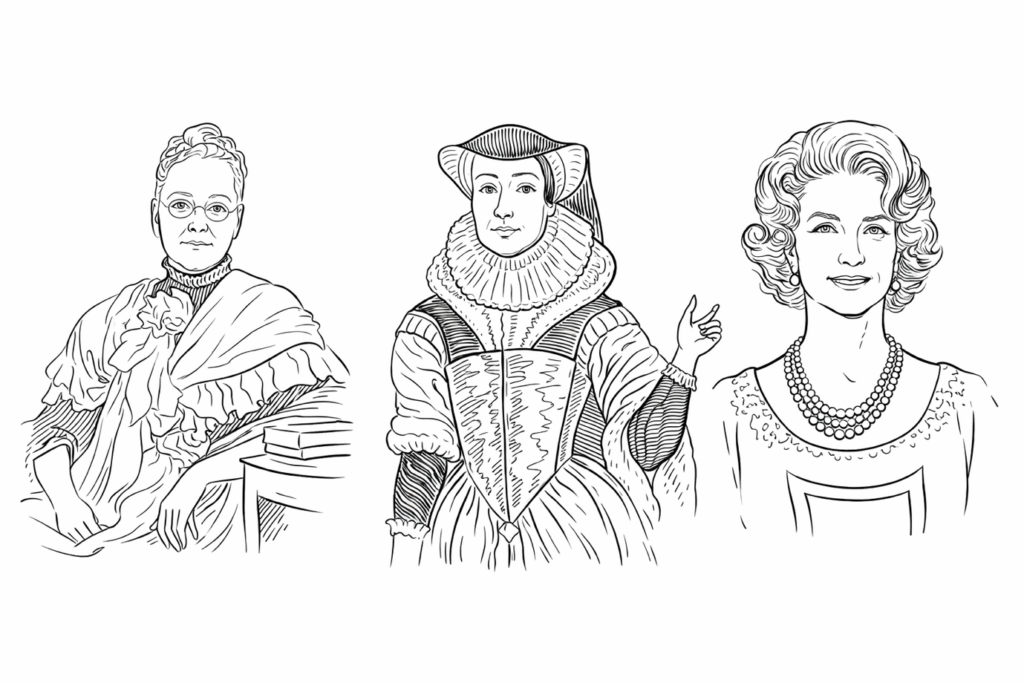
In stepped Ann Pamela Cunningham (following a letter from her mother) to organise the fundraising campaign under the auspices of the newly founded Mount Vernon Ladies Association. This was a female led and run organisation that raised the money to buy, furnish, and run Mount Vernon for the nation. This was one of the first historical preservation efforts in American history, and the methods and structures they developed formed the basis for future campaigns.

What Cunningham innately knew was the power of identity — and her appeals called on donor’s identities as women, as patriots, as citizens with a shared responsibility to history. We now have the science: behavioural economics, decision science, and a growing understanding of what happens in the brain when people give. We use it to shape clearer asks and reduce friction for donors. But the practice came first. History shows that long before these ideas were named or codified, fundraisers were already intuitively applying the same principles to influence behaviour and inspire generosity.
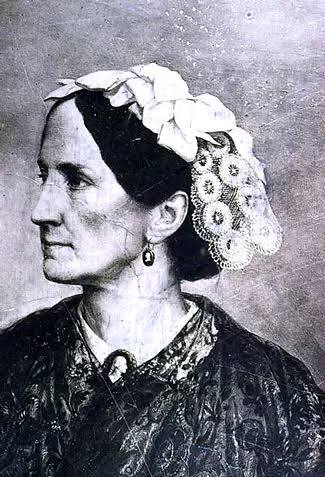
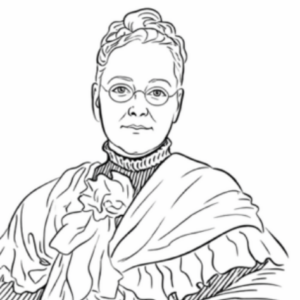
Ann Pamela Cunningham

(On a side note – John A Washington, George’s heir, refused to sell to a group of women, so the State of Virginia had to be the purchaser on the deed)

How did the Mount Vernon Ladies Association raise the money, and what does it show us about donor psychology and how we can fundraise today?

1. Appeal to supporters’ identity 

“Let us rise as one woman and in strength of our united womanhood decide that this shall not be”

How you frame your appeal, and how you ask are crucial – you need to target and tailor your ask to your donor’s identities. We give to express who we are, or who we want to be seen to be, and seek to be consistent with that identity. Sargeant and Shang have shown that identity linked appeals outperform ones that only talk about impact. 

Cunningham knew this and throughout her appeals she highlights the identity of her supporters – not just one identity (we all contain multitudes!) but the many identities they had  – as women, as Southerners and as patriots.  For example: 

.

“in the name of the mother of Washington, and of Southern feeling and honour to all that is sympathetic and generous

in your nature”

.

“Ladies of the South, can you sit, with closed souls and purses, while the world cries ‘Shame on America’’

.

Although some of the appeals to identity border on psychological coercion.

.

“when you look down at your gorgeous silks and your glittering jewellery remember that a tithe of that expenditure

from each of you would give us the glorious privilege of converting Mount Vernon into the Mecca of America”

.

“let us see whether any hearts are beating under this mass of millinery and upholstery”

.

Fundraisers nowadays, must not place undue pressure on donors, and that includes the misuse of guilt.

Although I do love giving being framed as a ‘glorious privilege’ 

2. Crowding in support?

.

“Will a people possessing untold wealth, numbering over ten millions of dollars, from whom the contribution of three cents each would bestow $300,000”

.

We often see appeals opting for the ‘every little helps approach’. This is known as ‘crowding in’. Why does crowding in work?

  • A small gift like three cents makes giving feel easy and affordable. 
  • It creates momentum for social proof and defines the social norm and creates the sense of collective norm. 

Crowding in can make it easier to give – but sometimes it can have the opposite effect as we cannot see the power of impact of our individual gift, and our gift feels like a drop in the ocean (what can three cents do?), or we expect others to give, or give more substantially. Think carefully about how you use it, and whether you can add an impactful frame to the three cents and what it achieves.

3. Anchor the gift

How do we know how much to give?

“we only ask one dollar, but we trust to the generosity of those whose means are more abundant”

Although some appeals focussed on the whole of the republic giving three cents. Most asks were more ambitious than that, and $1 became a clear reference point.

One of the biggest hidden barriers in fundraising is uncertainty.  Uncertainty can cause indecision – if we don’t know how much to give and what is expected we can spiral into questions of how much should I give? Is that too much? Too little? 

Giving a number makes the decision easier-  a strong anchor creates reassurance about what is expected. 

4. The livestream of the day: Use the latest technology 

Fundraisers have always used the latest technology to support their fundraising efforts and use the novelty effect to generate interest and press attention (from NFTs to the camera). 

The Mount Vernon Ladies Association was no different. They used the novelty of the telegraph (invented in the 1830s, and gaining in commercial use by the 1850s). At fundraising fairs and festival days they used a live telegraph link up to talk to other fundraising fairs and leaders in statehouses across the country. For example, in 1859 Mount Vernon festival in Augusta, Georgia, delegates sent live telegrams to each other and to supporters in other cities. This novel use of technology made the cause feel urgent and modern. 

5. Incentivise giving 

Every $1 donation earned a tangible reward: a portrait of George Washington. This small incentive helped create a constant reminder displayed in their home of their giving and connection to the cause. 

Incentives work because they layer reward. The “warm glow” of giving is amplified by the power of a free gift — something tangible that donors receive, keep, and return to.

That object becomes a physical cue of identity and belonging, reinforcing their connection to the cause each time they see or use it.

Today it might be a pin badge or a tote bag — small, but powerful. Not just an incentive to give, but a signal: this is who I am, and this is what I stand for.

The Mount Vernon campaign also sold merchandise, such as medals, a further way to earn money for the campaign and cement supporter identity. 
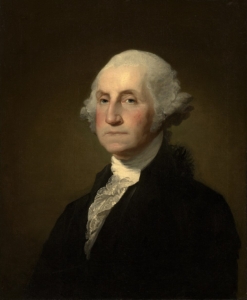
Gilbert Stuart’s portrait of Washington

6. Be organised but not prescriptive –  Give ownership to those fundraising on your behalf 

Cunningham was organised, but she also delegated. Each state had a Vice Regent who organised the fundraising in their area. But each state was empowered to raise money in their own way – what works in Georgia does not necessarily work in New York, so each evolved and created their own ways of raising money.

These included:

  • The newsboys of New York city clubbing together their pennies to make a donation of $4.18 to support the cause
  • A ‘Ladies’ Strawberry Feast in Alabama (raised £334) 
  • Brother of the President assassinating John Wilkes Booth, Edwin Booth held a benefit performance that raised $500
  • Children in Kansas donating their pennies to support the campaign 
  • Sailors abroad the US Savannah donating $150 as a gesture of patriotism whilst homesick
  • As well as fairs, fancy dress balls and dinner parties. 

This gave agency and autonomy to the supporters and the leaders – giving choice deepens commitment. When people feel they have a choice (about how to give, or how to fundraise)  rather than being pushed, they experience stronger motivation, greater satisfaction and deeper long-term commitment.

7. Use the power of anniversaries

It is easy to be cynical about the power of anniversaries, but they can and do work.


Throughout the campaign, the Mount Vernon Ladies Association used the anniversary of Washington’s birth, and death, to hold fundraising events, and also make significant donations and publicity moments. 
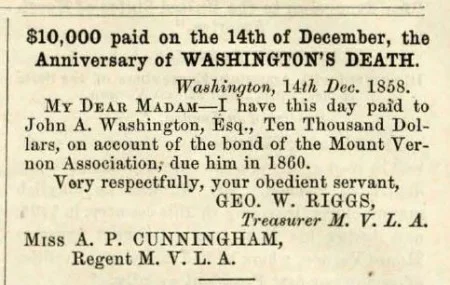
Anniversaries are temporal landmarks. They can turn an ask into a meaningful, timely, and socially validated moment to give. They combine the nostalgia with the hope for the future, which was so central in this campaign, looking back to Washington’s glorious work for the Union and the need to preserve the house for the future. Anniversaries have a great focussing effect for donors and campaigns. 

8. Celebrity Speakers

Although the campaign was organised and led by women, $69,000 of the $200,000 needed was raised by one man: Edward Everett.

Edward Everett

Senator Everett also spoke on the day of the Gettysburg Address alongside Abraham Lincoln. Lincoln may have used 272 words, but Everett spoke for two hours at Gettysburg. This speaking prowess stood him in good stead; he delivered his lecture on Washington 129 times across the country, charging $1–2 for entry and donating all proceeds to the cause.

9. Recognising Donors

“The names, residence and sums given by every subscriber …. As a record and lasting memorial of patriotism for their descendants”

All donors of $1 or more were listed and publicised. 

Why does donor recognition matter? It is about psychological exchange.  Recognition reinforces to the donor that what they did matters, has been noticed and appreciated – deepening the emotional payoff. The recognition closes the loop between action, meaning and identity. By reinforcing the identity as a donor you are cementing in your donor’s psyche reaffirming their identity, as a donor. 

Campaign lead Cunningham wrote about the importance of naming donors

“The name of every subscriber is to be published in some influential newspaper, appointed to be the organ of the Association for the State. Such publication is not only an announcement that their contributions are received and names registered but a great stimulus in drawing out subscriptions…My own experience has convinced me that the most important step to success is enlisting zealous editors to place the subject in an attractive manner before the people.” 

The Mount Vernon Record consistently named donors, a public-recognition tactic. Honor rolls were printed in newspapers, and ceremonies held to award plaques and acknowledge support in speeches.

Did it work?

Yes all the money was raised within 7 years, and the Mount Vernon Ladies Associated purchased the deeds. 
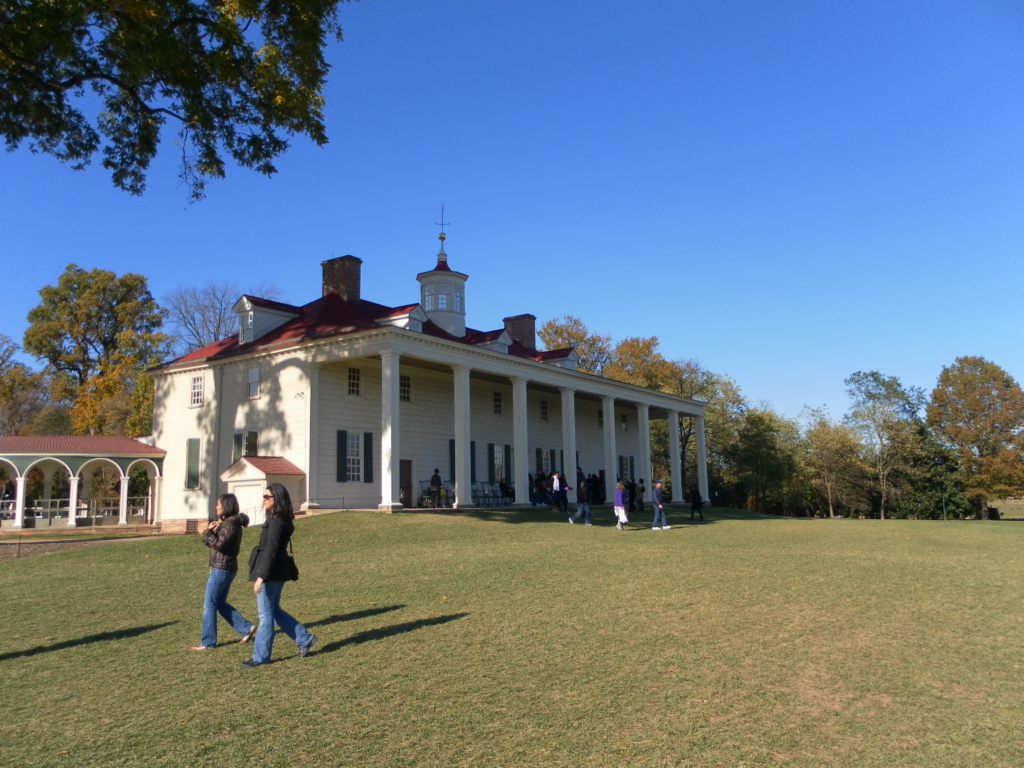
Mount Vernon

And in conclusion…

The techniques that the Mount Vernon Ladies Association used are not new – they are timeless human behaviours and persuasive techniques.

We now call them behavioural economics, decision science, and donor psychology and have codified the heuristics in academic papers, proven them in field studies but the real fundraising lesson is simpler – fundraising works when it aligns with how people already, think, feel and see themselves, and gives them a way to live out who they are and want to be.

References

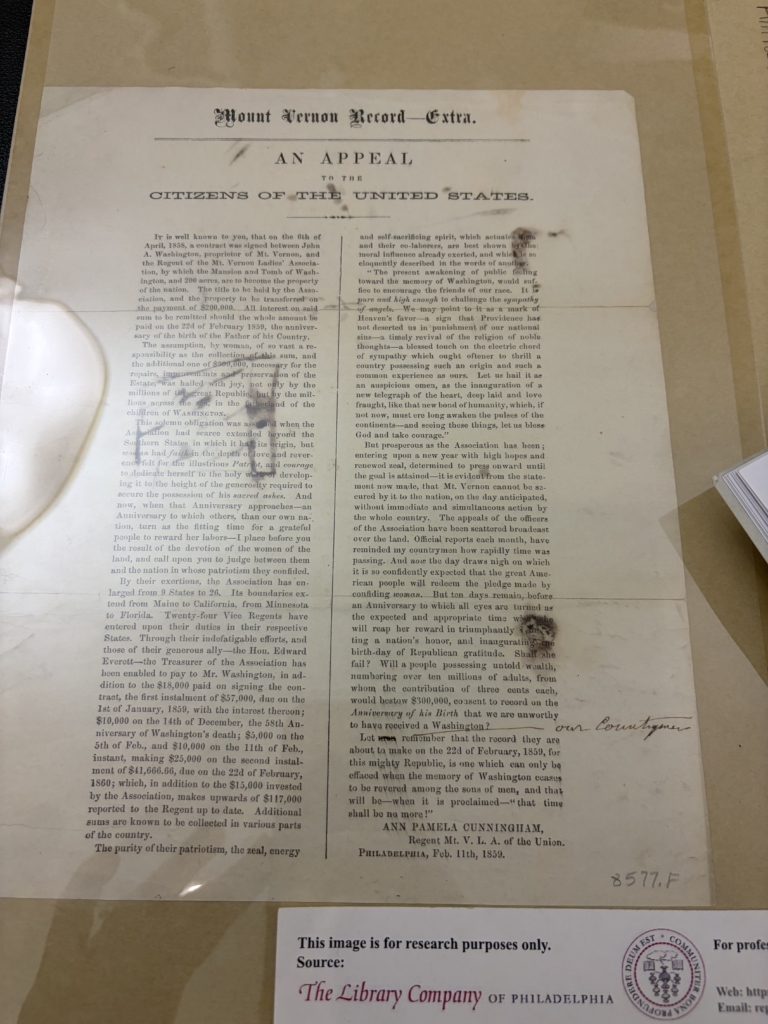
‘An Appeal to the Citizens of the United States’ by Ann Pamela Cunningham, 1859

An Appeal to for the future preservation of the home and grave of Washington’, 1855

‘Two Magazines and the Fight to Save Mount Vernon 1855-1860’ by E J Pribanic-Smith, American Periodicals 26.11

‘Remembrance and the American Revolution: Women and the 1876 Centennial Exhibtion’ phD thesis by Dolores Pfeuffer Schemer, 2016

‘For the Love of One’s Country: The Construction of Gendered Memory in Philadelphia and Montgomery County, Pennsylvania 1860-1914’ phD thesis by Smadar Shtuhl

(And delightful to see some first hand sources at the archives in Philadelphia)
https://marinajones.uk/wp-content/uploads/2026/05/SAM_2558-scaled.jpeg 1920 2560 admin https://marinajones.uk/wp-content/uploads/2022/12/f2b903e010104f5aa61ea1821a685913.png admin2026-05-19 21:34:092026-05-30 16:31:06Ladies to the rescue!

Magnanimous, malicious or mysterious intentions?

May 14, 2026/in Thoughts/by admin

Why do people give legacy gifts?

  • To say thank you to a charity.
  • Because of a long term personal connection and how that charity impacted their life and identity.
  • To pay back a kindness.
  • To continue supporting a charity that has been part of their philanthropic portfolio.
  • To immortalise a loved one.
  • To spite a family member.
  • To secure the financial future of an institution.
  • To fund a specific area of work that is meaningful to the donor.
  • To make a difference beyond their lifetimes for future generations.
  • Sometimes the executors decide and make in memory gifts
  • Or are the motives mysterious and unknown, lost in the mist of time

The stories below explore some historic legacies and their motivations – magnanimous, malicious and mysterious

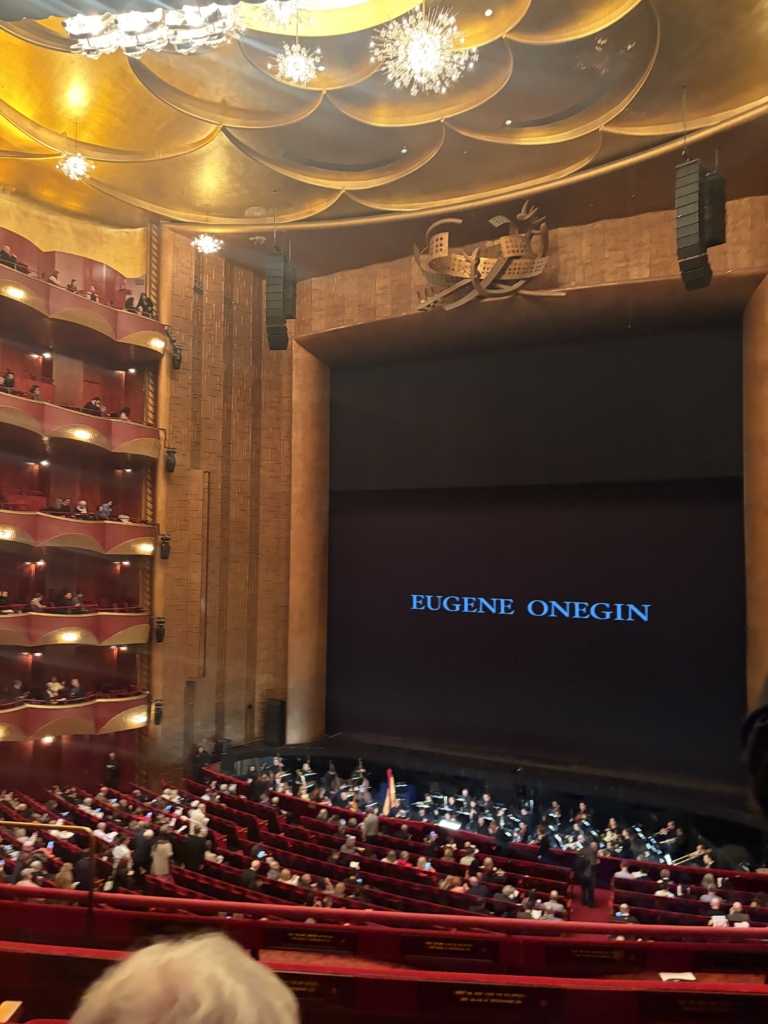
 “It’s all there – beautiful sets, great costumes, great music. What more could you want?”

Within the arts and cultural space legacies that connect with someone’s passion are common. As a way of saying thank you for a lifetime of experiences and making sure that they are there for future generations (it is still there today).

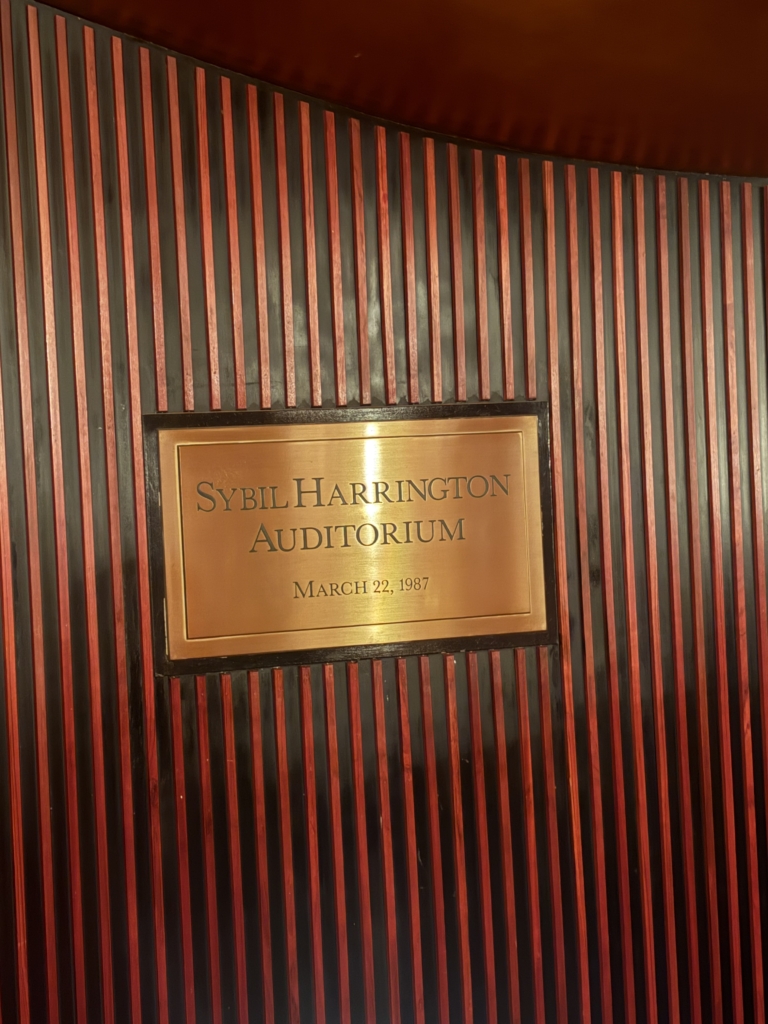
This is the case of Sybil B Harington who has been a major in life donor to the Metropolitan Opera in New York. During her life she gave c$30m to support its work, and the main hall was named in her honour in 1987.

She sat on the board, and funded galas and televised performances and opera. However, she did not just fund any opera, she liked grand opera, done as the original composer and librettist would have wanted (so traditional settings, staging and costumes – think Julius Caesar set in Rome with singers in togas – not in bleak dystopian futures with combat trousers and machine guns).

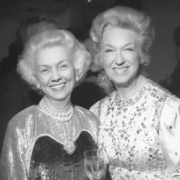
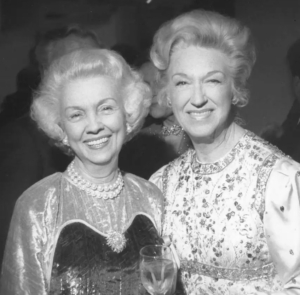
Sybil B Harrington with mezzo soprano Rise Stevens

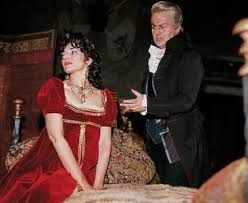
Her gifts supported, amongst others, the iconic but traditional Zeffirelli’s ‘Tosca’ with Maria Callas and Tito Gobbi in the 1960s – a production that was not retired until 2006 (and which I saw several times)

On her death she left a gift of $6m, with $1m to fund young artists, and the rest for “exclusively for the televising of traditional/grand opera productions of the Metropolitan Opera and for no other purposes” and that “these traditional/grand opera productions shall be set in a place and time and staged as the composer placed it.” Her will stipulated:

“…by composers such as Verdi, Puccini, Bizet, Wagner, Strauss and others whose works have been the core of the repertory of the Metropolitan Opera during its first century, with each such new production to be staged and performed in a traditional manner that is generally faithful to the intentions of the composer and the librettist.”

(1987 stipulation for her gift)

The money was invested and each year the Met used the funds. 

Until 2001.

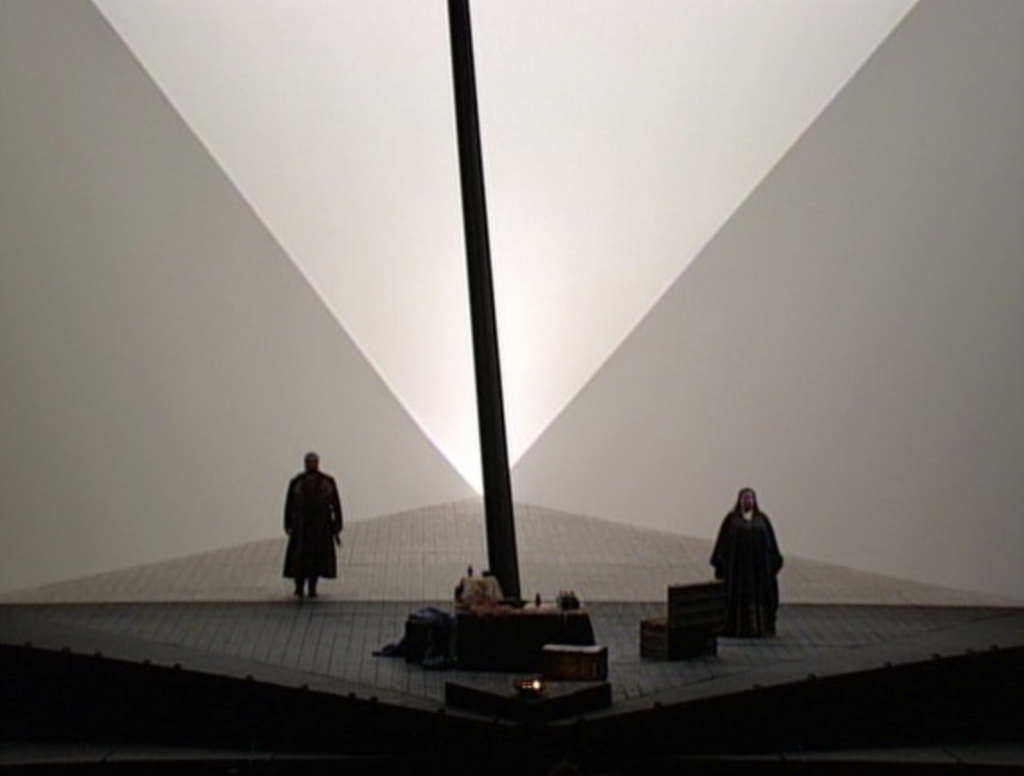
The Met used the fund (which had grown through investments) to televise Dieter Dorn’s production of Wagner’s ‘Tristan and Isolde’. The story is traditionally set in a medieval Celtic world and tells the story of a ship travelling from Cornwall to Brittany. Dorn’s production was minimalist focussing on the emotions and psychology of the characters rather than the ‘visual ballast’ of a boat. Those managing her estate sued the Met claiming that it had breached the terms of the gift and that the production was not traditional and in keeping with the stipulations of the bequest. 

Trisatan and Isolde
Tristan and Isolde

The Met said in the court papers: 

“While not a traditional staging of the opera it was a traditional interpretation and the case was made to the Trust that support of this telecast was in keeping with the wishes of Mrs. Harrington and the stipulation of her estate. We are grateful that the Trustees understood the importance of the ‘Tristan’ telecast and agreed to its funding.” 

The estate said: “The Met’s failure to utilize funds in accordance with Mrs. Harrington’s wishes is not inadvertent or even negligent, but is the result of a willful and calculated intent to disregard and evade Mrs. Harrington’s wishes” 

General Manager of The Met, Joseph Volpe responded: “The charges are untrue and we will show them to be untrue in court. Sybil Harrington was a beloved member of the Met family and we would never do anything to dishonor her wishes or her legacy.” 

Who was right?

The parties settled out of court. 

But Sybil B Harrington’s legacy gift continues, and the credit ‘for her ‘Production a gift of The Sybil B. Harrington Endowment Fund’ is on streamed performances for the 2026/27 season at the Met.

Say it with flowers

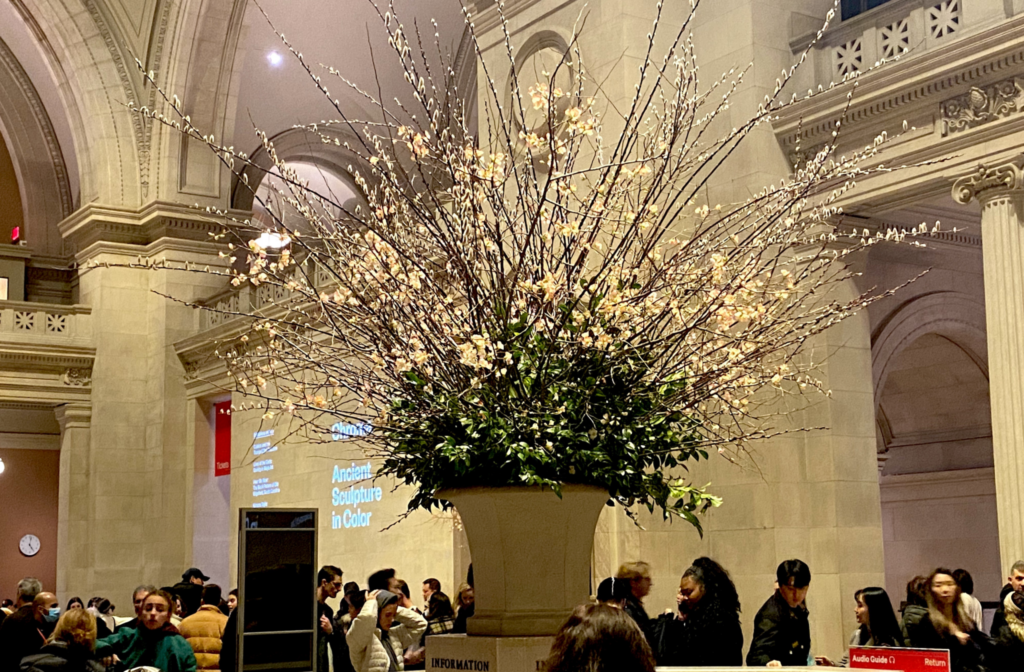
Another lovely example of a way in which in life giving continued in death is the story of the flowers in the Met Museum in New York. In the late 1960s, Lila Acheson Wallace, philanthropist and founder of heir to Readers Digest set up a fund to change the flowers in the hall of the Met each week and to hold theatrical large starburst displays so that visitors would know

“We’re expecting you—welcome.”

When she died in 1984, her endowment gift continued this donation and it continues to this day. (Thanks to Niamh Walshe for pointing this one out to me).

Unexpected windfalls and spite filled gifts

Sometimes legacy gifts come in and you have no known relationship or connection, this might be a CRM lacking the data, or might be that some of our pledgers engage under the radar (in a theatre, this can mean they are not the ticket buyer and always come with someone else)

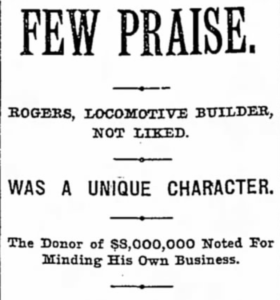
In 1904 Jacob S Rogers left $5m to the Metropolitan Art Museum in New York. This was a surprising gift to the museum as he was not a known art fan; he was a wealthy and miserly locomotive entrepreneur. He had visited the Met and given his $10 annual membership fee in by hand, and asked questions about the governance of the museum. Although no one is ever sure if he visited galleries or had any interest in the art.

During his life he was known his miserly ways indeed one of his obituaries said he was an

“a pure animal man, with no sentiments born of human love or human sympathy.“

He frequently threatened to

“If I could convert all my possessions into paper and provide that this paper should be burned after my death I should do so.”

From the obituaries at the time …

Even his friends described him as

“character was anything but loveable.”

Apparently, about 10 years before his death, he had read about a Chicago man who had left his whole estate to an educational institution and cut his family out of this will. He requested a copy of this will and it seems to have acted as an inspiration for this gift to the Met.

However, rather than leave it to the museum to do with what was most needed (often the ideal), the gift was restricted to an endowment, with the gift to remain in tact and the interest to be used to purchase paintings.

“the income only of the fund hereby created, or intended so to be, to be used for the purchase of rare and desirable art objects, and in the purchase of books for the Library of said Museum, and for such purposes exclusively, the principal of said fund is not to be used, diminished or impaired for any purpose whatever”

There was also a condition to focus on non American items which was common at the time as the American art market was considered immature and many looked to Europe for ‘proper’ and ‘collectable’ art.

The Rogers Fund is still going strong and funding the purchase of art for the museum (more than 10.000 entries appear if you search on the Met website)

In memory motivation

Did you know that MOMA in New York was founded by three women?

By Abby Aldrich Rockefeller, Lillie Bliss and Mary Quinn Sullivan.

When Abby Aldrich Rockefeller died – despite her husband, J D Rockeller Jnr, not being a fan of modern art (‘never greatly appealed to me‘ – he preferred porcelain and medieval tapestries) – he gave $4m in securities and land “to preserve for the future the important work of this institution which meant so much [to Abby]”

(Another founder Bliss died leaving a condition in her will that MOMA have enough of an endowment to be financially secure before the gift could be handed over. The executors set a challenge for the museum to raise $1m – this was in the Depression so fundraising was slow and hard. MOMA raised $600,000 at which time the executors lowered the financial threshold and handed over the legacy gift.)

Mysterious motives

In 1869, Elizabeth Lawrence, the widow of Col T Bigelow Lawrence donated his military connection to the Boston Fine Arts Museum,

“Unfortunately her motives are not recorded. Whether she acted out of a desire to memorialise her husband or simply wished to rid herself of the vestiges of his martial enthusiasm remain a matter for speculation“

Kathleen D McCarthy in ‘Women’s Culture’

As a bonus she also gave $25,000 to fund the housing of the collection (whenever you receive an item as part of a legacy it is always handy to have the money to store, conserve and protect it).

However, the collection was destroyed by fire, his widow allowed the insurance money to be used to purchase other items for the museum.

Keep family members engaged – even on the WCs!

When Maria Antoinette Evans’ husband died she wanted to honour his legacy wishes and support the Boston Fine Arts museum. She originally offered a grant to support salaries (fantastic a core costs grant!) but the museum persuaded her to support a new wing with a gift of $1m. Determined to keep her potential giving up, they involved her in the design of the wing including asking for her input on where and at what height her husband’s portrait ought to be hung, which wallpaper and fittings to use and,

“Will you find [an] opportunity some day soon to visit the new building with me and visit the ladies’ rest room? there are one or two points one which I should like your opinion’

Often the smallest details matter most.

How do you know which of these motivations are the real reason?

You can ask.

In your legacy promotional material having a ‘Tell us about why you have included us in your will..” often yields the answer

But be warned about the say:do gap. In terms of social acceptability bias we will not admit that we included charity X because we despise our family and want to disinherit them and could provide a more socially acceptable reason about that it means to us.

What else do these historic examples teach us?

Be clear about what you want and how you want it

The examples above highlight the importance of promoting gifts in will as you are never sure where and when supporters may be inspired to include a gift.

When promoting legacies or talking to potential legators it is important to consider:

  • how you want to receive gifts
  • how gifts ought to be worded to allow donor’s wishes to be honoured as well as the evolving needs of the charity (it is complicated to get a legacy gift to a long defunct programme or niche area)
  • how any endowment gift might be structured to support changing mission over time.
  • But if there are conditions stick to them and keep the family engaged

https://marinajones.uk/wp-content/uploads/2026/03/IMG_1573.jpeg 834 848 admin https://marinajones.uk/wp-content/uploads/2022/12/f2b903e010104f5aa61ea1821a685913.png admin2026-05-14 18:31:402026-05-14 18:32:00Magnanimous, malicious or mysterious intentions?

How (not to) look after your legacy pledgers
April 19, 2026/in Thoughts/by admin

Until your legacy pledger dies they can always change their mind and take you out of their will. So stewarding and ensuring the connection remains strong and salient is vital.

Many charities have legacy giving circles with newsletter, events and Christmas cards keeping donors in touch with the work of the charity and seeing where their eventual legacy might have impact, and saying thank you during their lifetime.

When time is unlimited we follow knowledge based goals, but when time is limited – as you near the end of a job, college, university, or your life – emotional goals become more important. This impacts on who you want to spend that limited time with, and which relationships you hold onto. That is socioemotional selectivity. A theory proposed and tested by social scientists Laura T Cartesen, Derek M Issacowitz and Susan T Charles. Often charities have been told that they are in the will, and they may have been. But data shows a real gap between those that thought they are in the will, and those that get a gift – Legacy Foresight sighting 50% of gifts pledged in will are never realised (2019).

Without careful stewardship and engagement, you could risk a pledger removing you from their will. Being in the will is great, but being in the final will is crucial. On average, people make a final will in their mid 80s and what matters then and who has that emotional connection is crucial. If there is a sense of relationship are more likely to make the final cut. That is why continued stewardship of your supporters is so crucial.

A few historic legacy stories that demonstrate the importance of caring for potential legacy pledgers.

Super fans, super loyal but also need super care

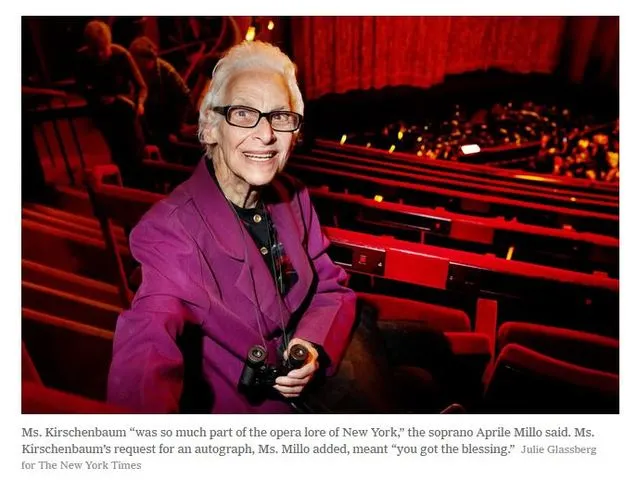
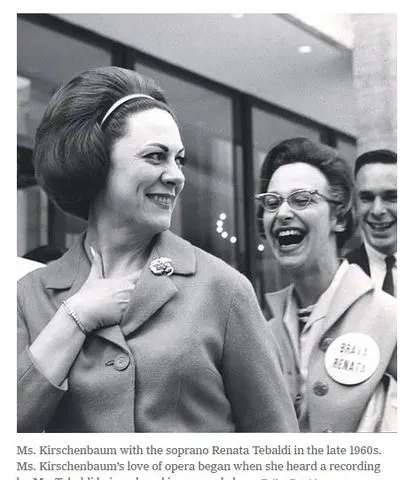
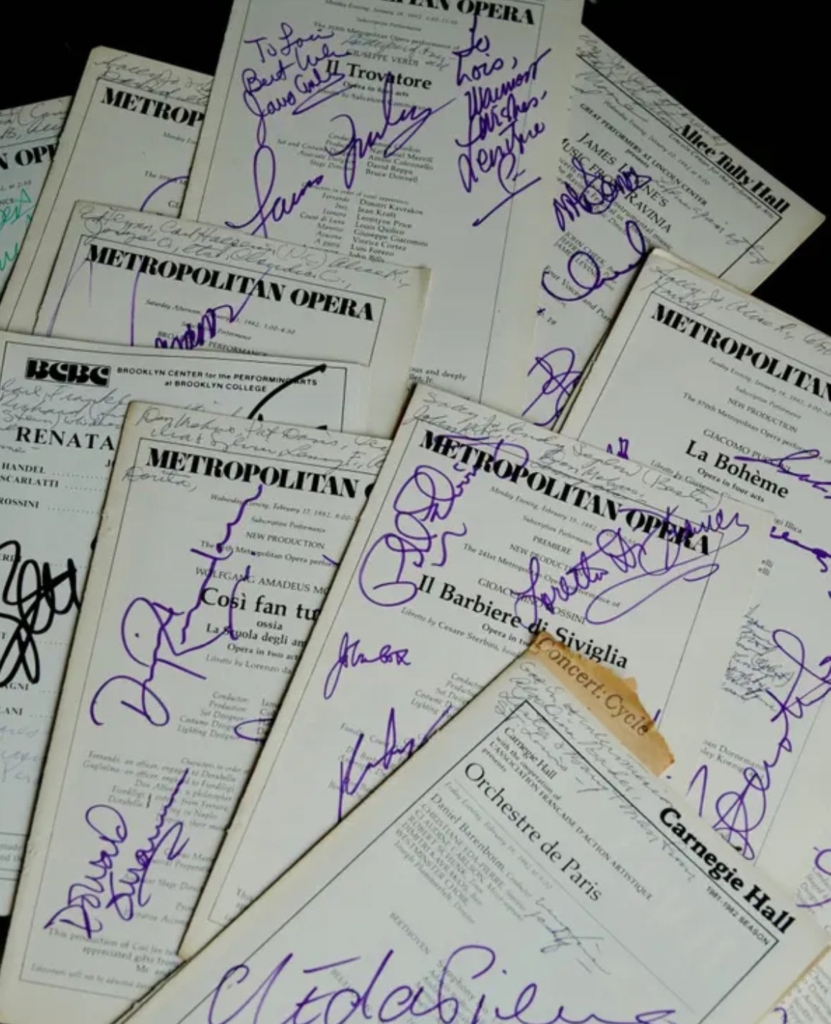
Since the 1950s Lois Kirschenbaum attended nearly every performance at the Metropolitan Opera in New York, and hung around stage door to get her programme or ticket signed. She was an opera super fan, although the data collected might not have singled her out as a legacy prospect. Lois Kirschenbaum bought standing places (typically in an opera house at the very top and back of the auditorium and cheaper – sometimes known as listening seats). She was legally blind and watched the opera through big binoculars. She lived in a rent controlled apartment, worked for a charity and caught the bus to the opera.

When she died she left $4m to 18 charities giving $1.7m to the arts but none to the Met Opera.

Why not? When she went so frequently and clearly loved it.

Because of a decision 30 years before her death to stop letting her go backstage to gather the signatures she loved. This was enough, despite years of continued engagement after that, to remove the opera from her final will.

Stewarding for the long term gain vs genuine engagement

In contrast to upsetting a long standing super fan, the Metropolitan Art Museum kept accepting items from Olive Sage in the hope and expectation of a substantial legacy (after being made a widow by the death of notoriously stingy Russell Sage). As a former teacher she was a great in life philanthropist and wanted to donate items not just cash to the museum. In the last twelve years of her life she gave away over $45m. When the museum’s curators tried to reject items that they did not want in the collection, for instance a teapot, they were told:-

‘I have not attempted to pass judgment upon the teapot. It may or may not be sometimehing we care for, but I clearly wanted to accept any gift from Mrs Sage”

This policy of accepting donated items resulted in a $1m+ legacy gift when she died in 1918.

However, many items that had been accepted in life from Mrs Sage’s collection were returned to the family after her death. As they did not really want them – they wanted to keep her sweet for a legacy.

For charities that accept items it is important to have a collecting policy and clear guidance about what items you accept and why, and also that they come with the funds to care, preserve and exhibit them. It is disingenuous to accept gifts in life that you have no interest in owning – just in the hope of a substantial legacy.

So how might you steward legacy pledgers

Don’t forget about them – keep stewarding them and keep them engaged in your work

  • Create a legacy circle (only 44% of arts and cultural charities had one in a recent benchmark)
  • Give it a name to connect with your mission and cause area
  • Send regular newsletters about the impact of legacy gifts to continue to remind them of the importance of their future gift
  • Run events where they can see first hand the work of the charity and receive a thank you in their life time and enjoy meeting other like minded donors who have that shared connection with the charity’s mission
  • Send Christmas cards
  • Make sure that the legacy pledgers are included in key news and information moments
  • Remember some are non online – and prefer a letter or a phonecall
  • Say thank you
  • Think about crediting (are legacy pledgers credited as pledgers or just when they donate?)
  • Think about how they can share their history with your charity – what might they know about previous work, campaigns, staff that could be great to share with other supporters
  • Ask them to share why they have pledged a legacy with you and whether you can share that in a magazine or newsletter and their inspiration could encourage others to remember the charity as well.
  • Ask them to speak at an event with other supporters about why they have chosen to leave a gift

Often if longstanding donors stop giving they may fall off your segmentation list and you stop engaging or asking them to support. They do not meet the recency or frequency criteria that have been set. However, the length of engagement should not be ignored. It may be limited mobility or limited capital that prevents them giving now, but you are in the will and want to remain so. So do not forget about them.

https://marinajones.uk/wp-content/uploads/2024/09/Lois.webp 480 637 admin https://marinajones.uk/wp-content/uploads/2022/12/f2b903e010104f5aa61ea1821a685913.png admin2026-04-19 14:20:222026-04-19 14:21:43How (not to) look after your legacy pledgers

BYOB – Bring your own bobbin

April 9, 2026/in Thoughts/by admin

Fully embracing the ‘time, talent and treasure’ mantra the first female voluntary society founded in 1780 in Philadelphia mobilised women to raise funds by going door to door (time), donate (treasure) and then use the funds to sew shirts for the soldiers (talent). 

When something terrible is happening we want to do something to help. To feel agency and control – personally and collectively. The women of Philadelphia founded a Ladies Voluntary Aid Society as they wanted to do something to help in the war (American War of Independence). The Ladies Voluntary Aid Society was led by upper class and wealthy women but they wanted to appeal beyond class boundaries and engage all women in supporting the war effort. Previous fundraising had relied on wealthy women being ‘at home’ to receive donations, but the Aid Society decided to take a different approach, and actively went out and chose to go door-to-door soliciting gifts rather than rely on passive giving. They wanted to signal that there were all in the war together and demonstrate their equality and shared purpose. (There may also have been some authority messenger signalling here – we give to people like us, but also people we respect and want to think well of us so giving can be used to enhance social status within a group)

This was coupled with an “every little helps” principle. Donations of all sizes were actively encouraged – as they expressed it, even “the shilling offered by the widow or young girl” was as welcome as larger sums, reinforcing inclusion and broad participation. Gifts were received ranging from $1 to $10,000.

This inclusive framing tapped into social identity and collective action. Giving became a way for women to express their patriotism. Supporting the cause was not just financial, it was symbolic of belonging and shared values.

The campaign proved popular and successful with widespread participation. It was common at the time to list all subscribers in the newspapers but the scheme was so popular the newspaper stated:

“was so great that it would exceed the limits of a newspaper”

With the desire to do something they had begun collecting but not decided how best to use the funds. Often when crisis hits we want to help and giving us gives us a sense of agency, what Beth Breeze has called ‘practical allyship’ demonstrating that we are with those in criss and doing something to support. However, in a crisis, it is not always clear what help is needed and where. So they consulted George Washington, at that time commander of the Continental Army, who advised that soldiers most needed shirts. 

Rather than outsourcing production (and spending more of their donated funds on creating these garments), the women chose to make the shirts themselves, purchasing linen from the funds they had raised and sewing the shirts. a

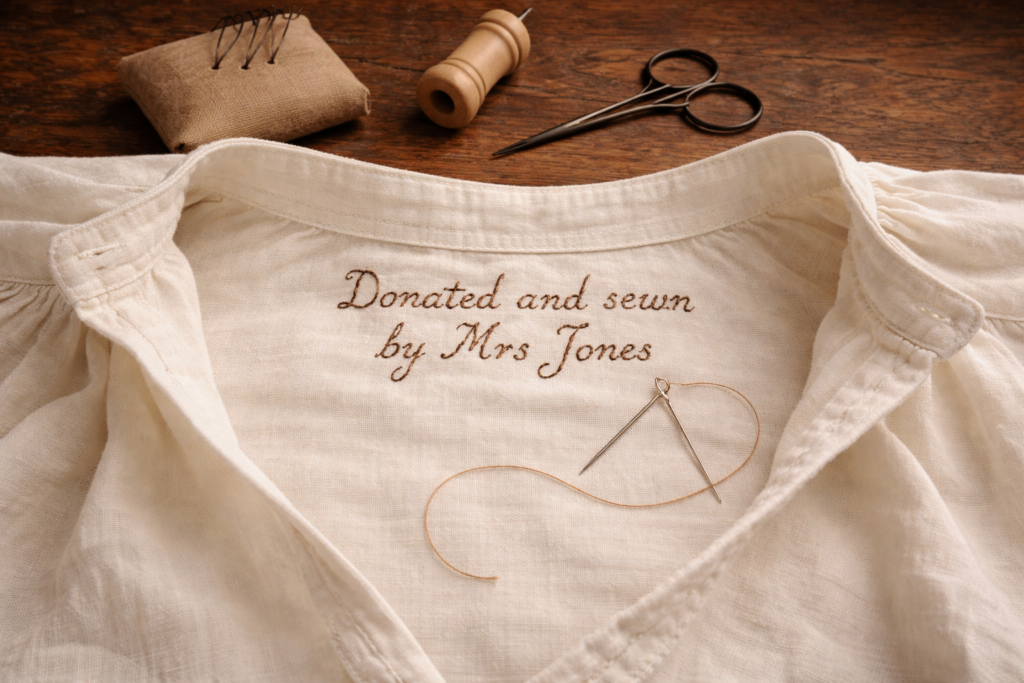
They did not just sew the shirts but they sewed their own donor credit into each shirt. 

“bought the linen from their own private purses, and took pleasure in cutting them out, and sewing them themselves. On each shirt was the name of the married, or unmarried lady who made it”

AI generated image of a 1780s shirt with a donor credit sewn in

This illustrates the IKEA effect – people place higher value on things they help create – what better way of creating that connection that sewing your donor credit inyouself?

It also creates the endowment effect, where personal involvement increases perceived worth. Sewing the shirt for a soldier and personalising it with your name reinforces their identity as a patriot, a donor and emotional engagement. It is a tangible and real commitment to the cause.

The act of making and giving also generated emotional rewards. Donors likely experienced both an endorphin “helper’s high” from doing good and a dopamine-driven anticipation of impact, captured in the idea that the shirts would “be worn with as much pleasure as they were made.”

The campaign’s success led to replication in other states, including Maryland, Virginia, and New Jersey, showing how successful fundraising models are often copied, especially when they combine emotional engagement with visible impact.

Challenges

The initiative was not without controversy. Some criticised the women for “going about for money,” revealing social tensions about the expectations of women and their role outside the home. 

There were also concerns about the methods used to secure donations. In some cases, social pressure bordered on coercion, with threats of reputational damage for those who refused to give (with one potential subscriber being told that if they did not give then they would ‘hand his name down to posterity with infamy‘) The female fundraisers sometimes relied on gendered behavioural tactics, such as flirtation or scolding, to persuade donors. 

“they relied about hyper feminized forms of behaviour – flirting, and failing that, scolding – to induce support from those who for economic or political reasons would otherwise not donate”

While potentially effective, these approaches raise ethical questions about manipulation and the reinforcement of stereotypes.

What this should make us think about today

 Effective fundraising today should combine 

  • agency – giving people something meaningful to do
  • inclusivity – valuing all gifts
  • identity  – connecting giving to who people are
  • & tangible impact – showing exactly what donations achieve

while maintaining clear ethical boundaries around how influence and social pressure are used.

References:

‘Ladies going about for money’ Female voluntary associations and civic consciousness in the American revolution’ ‘by Emily J Arendt

https://marinajones.uk/wp-content/uploads/2026/04/ChatGPT-Image-Mar-31-2026-at-05_06_56-PM.png 1024 1536 admin https://marinajones.uk/wp-content/uploads/2022/12/f2b903e010104f5aa61ea1821a685913.png admin2026-04-09 12:27:362026-04-09 12:29:06BYOB – Bring your own bobbin

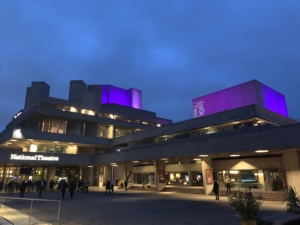
Lessons on how to raise money for a theatre from the National Theatre archives

March 22, 2026/in Thoughts/by admin

In five acts (with prologue and an epilogue)

The campaign for a National Theatre for England began in 1848 and often aligned with the desire for a national monument for Shakespeare, however, it was not until 1949 that an Act of Parliament established the theatre. For over hundred years various schemes and fundraisers tried to raise enough public support and funds to make it a reality 

Prologue

“We few, we happy few, we band of brothers”

Henry V

Have a fan base. To get your charity and your project going you need a group of committed talented people (think of the infamous Margaret Mead quote). This is what the National Theatre had. A group refreshed over the decades that it took to secure the site(s) and build the theatre.

First you need the believers.  From there you can build your tribe of supporters and champions. 

Act One

“We’ll hear a play tomorrow.”

Hamlet

Use the art that people love to connect with your fundraising.  

How?

Get the playwright of the day to write a fundraising propaganda play promoting your cause. That’s what George Bernard Shaw did in 1910 – a one act play called ‘The Dark Lady of the Sonnets’ which was put on to raise funds for the campaign. In the play, William Shakespeare asks Elizabeth I to create a national theatre

“But the boon I crave is that you do endow a great playhouse, or, if I may make bold to coin a scholarly name for it, a National Theatre, for the better instruction and gracing of your Majesty’s subjects.”


Elizabeth I says ..
“there be a thousand things to be done in this London of mine before your poetry can have its penny from the general purse”


[plus ca change!]

but she goes on to speak to future generations pleading:
“that if I could speak across the ages to our descendants, I should heartily recommend them to fulfil your wish”
(full play text here – https://lnkd.in/ecz2DgxG)

How can you use the art to get your donors giving and closer?  

We pay more attention to things that are salient (relevant) to us. Connecting your charity with how it resonates with your supporters, their passions, interests and knowledge makes it stand out for them. They feel connected and ‘seen’ by your charity and it brings their identity and yours closer together and generates more income. 

Act Two

“All things are ready if our minds be so.”

Henry V 

To be able to fundraise you need to be organised.

Scene 1: Have a good CRM

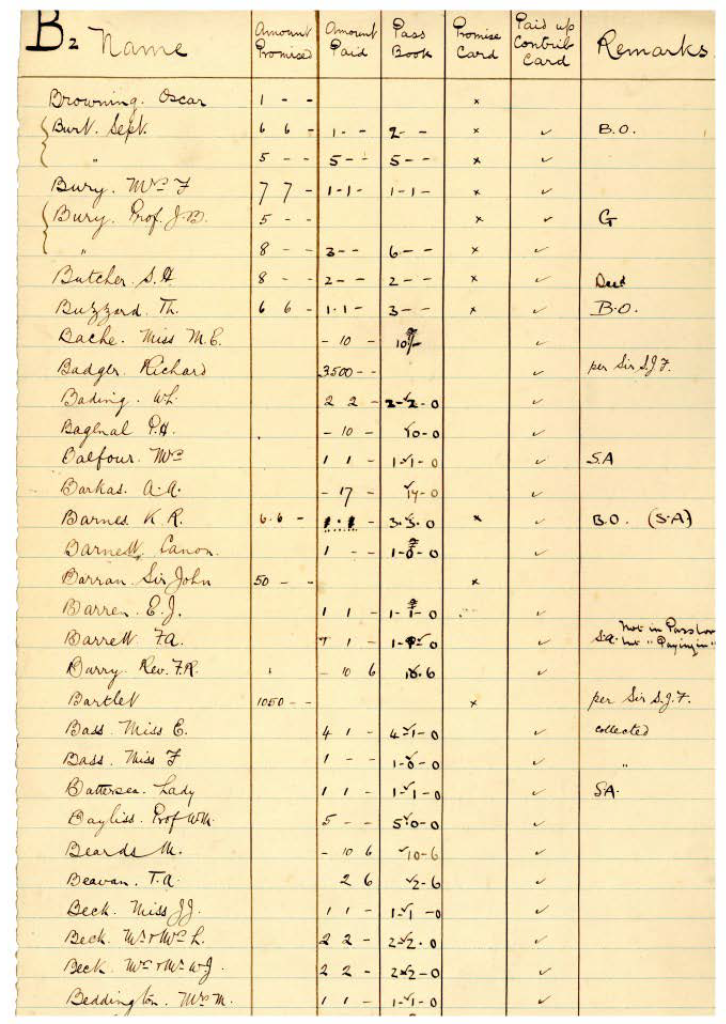
You need to know what is pledged, asked for and paid. Before complex computer systems this entry shows how they were tracking what was paid (and where) and pledged as well as the notes function to record other information. 

A sample from the CRM in the 1930s showing what was promised, paid and whether they had the promise card.

From the National Theatre archives


 Scene 2: Wait for the right time to make an ask – and trust your fundraisers to know when that is

There is a letter in the archives to Oliver Lyttelton in 1947 (after whom the Lyttelton theatre is named) about a donation that they are all waiting for. Lord Esher says that the intermediary has told him:

‘He has repeatedly told me that at the right psychological moment he is quite sure the donor will come across in a big way’

Fundraisers know when the right time in the fundraising journey to make the big ask. Asking too soon can get a no, or even, a small ‘go away’ gift. Lord Esher who is writing to Oliver Lyttelton expresses his impatience with this approach but trust your fundraiser to know when the time is right to make the best ask of each donor. 

Act Three

“Is the chair empty?” 

Richard III 

A default often used in theatre is to run a ‘name a seat’ campaign. The committee began this decades before the theatre opened with a campaign to endow seats for £100 in the 1930s. Seats could be named for yourself, your city, or for a favourite and famous actor or even a virtue. 

‘buying the right to dedicate one seat either in the name of a person, a society, a township or in the name of some historic act, ambition or ideal, in exchange for £100”

Dame Sybil Thorndike

All the records of those that named seats were lost in the war following a bombing raid during World War Two, and in the 1950s they had to advertise for their lost donors (read more about how to find your lost donors https://marinajones.uk/lostdonors/)

People love having their name on seats, and often go and visit their seat every time they go to the theatre.

Why?

Naming seats is about converting a transaction into identity and permanence.

The endowment effect (named by Richard Thaler) suggests we place higher value on things once they are ‘ours’. Our name on a seat asserts a psychological ownership – it moves from a seat in the theatre to my seat. Our identity is extended into the seat – and it becomes a social and visible symbol that I belong here, I am part of the fabric of this place. It demonstrates a commitment to the organisation. It provides social reinforcement of your identity as a kind and generous person. 

How can you recognise your donors and reinforce their generosity and kindness?

Act Four

Scene One

“Lord, what fools these mortals be!”  

A Midsummer Night’s Dream 

We never know what the future holds and what new products come on the market that may help or hinder our fundraising. Is it cryptocurrency, NFTs or crowdfunding? 

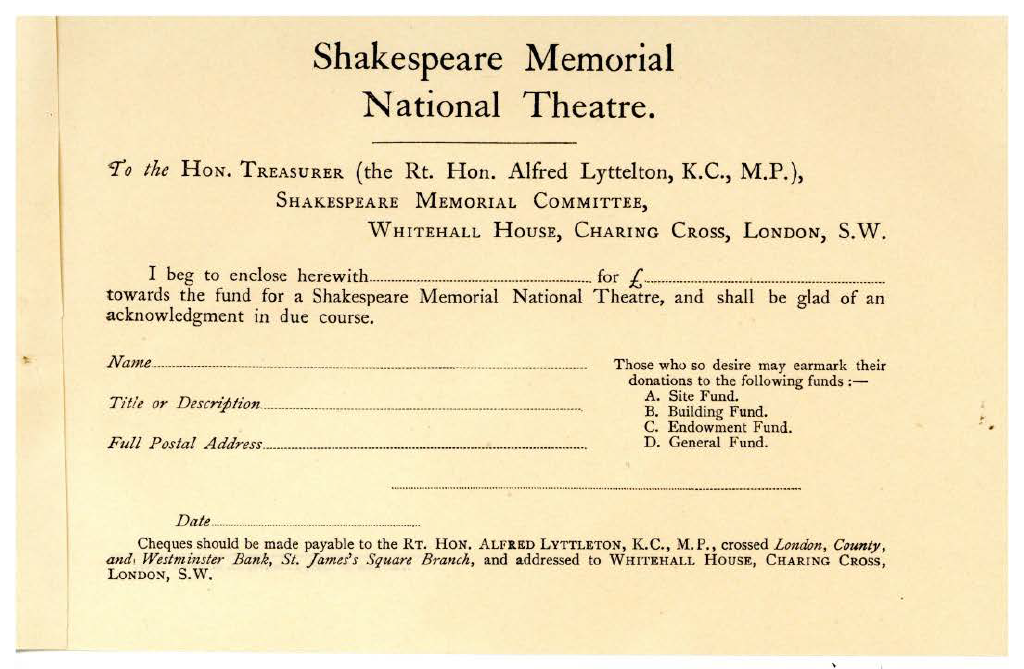
In 1954, the author of the newly published ‘Guide to Trusts and Foundations’ wrote to the Secretary of the Committee suggesting they purchase a copy to aid their fundraising. The reply:

“at the moment we are not contemplating any trusts or foundations for funds”

How times have changed. 

Scene Two

“I have had a most rare vision. I had a dream, past the wit of man to say what dream it was…”

A Midsummer Night’s Dream 

Financial security and endowments that support the long term investment remain a dream for most… 

In 1923 the brochure raising funds states:

“a theatre should be owned by the nation and placed, by some form of endowment, above the necessity of constant and immediate profit making’

The financial plan involved £100,000 for the site, £150,000 for the building and an ambitious £250,000 for this endowment. 

From the National Theatre archive

I have known several capital campaigns that begin with the dream of endowment, a dream that never materialises. 

Keep dreaming big. 

Act Five 

“Love sought is good, but given unsought is better.” 

Twelfth Night 

You have fans everywhere – and you can get unexpected gifts. Throughout the campaign there were generous and often unexpected gifts. Theatre groups disbanded sent in remainder of their funds

A group of school children saw an article about the proposed theatre in 1946 and sent it £2 as the proceeds of their amateur play after seeing an article in a magazine.

Who are your fans? And how do they know what you are doing and that you need funds?

Epilogue

“Will it please you to see the Epilogue or to hear a Bergomask dance between  two of our company?”

A Midsummer Night’s Dream

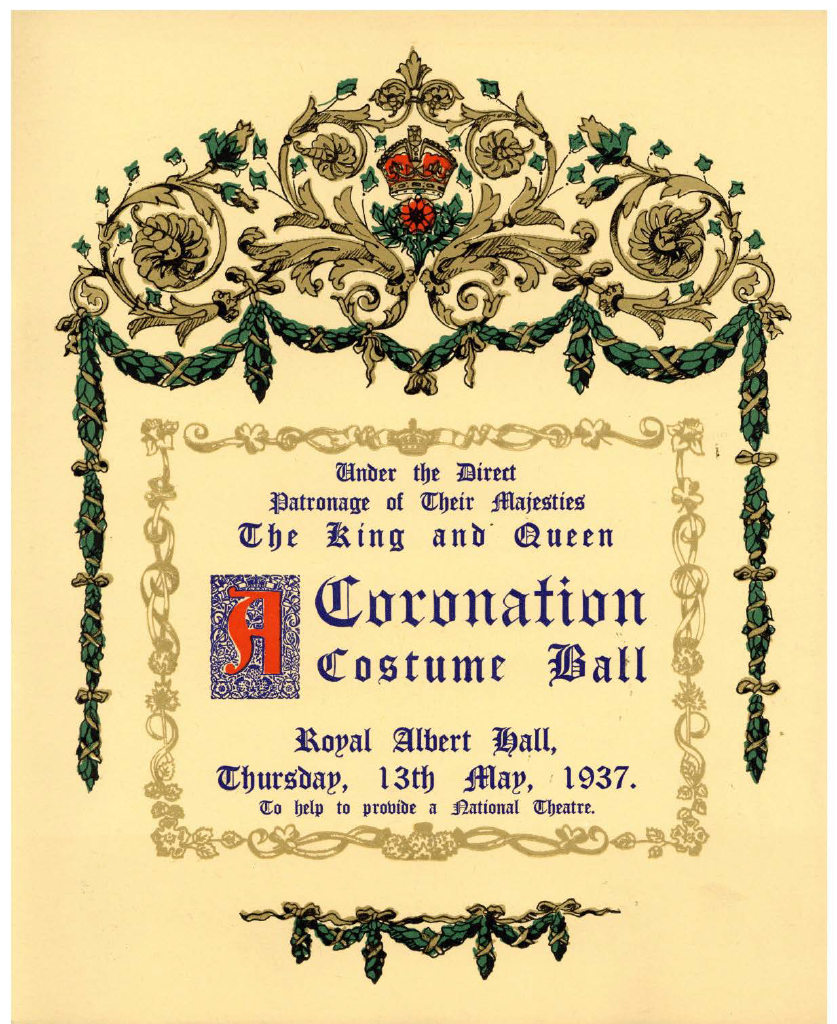
Like a Shakespeare play we finish with a dance – and this time a ball – proving not much has changed. George VI coronation ball was a fancy dress and a procession of theatre from Greek tragedy through medieval and Shakespeare to modern day with a setting of ‘A Midsummer Night’s Dream’. And like the 2026 a gala and star-studded celebrity affair. 

From the National Theatre archive

Events fundraising and celebrity connections continues to be a foundational way to raise funds.

So what does that mean for fundraisers today

  • Build a core group of committed champions first.
  • Fundraising is strongest when it aligns with what audiences already love – when it is emotional, relevant and compelling
  • Create ways to build identity and connection – make the donors part of the fabric of the organisation 
  • Make it easy for anyone to feel part of the story
  • The operational side also needs to work – as well as the inspiration.
  • Fundraisers manage pace, patience, and psychology.

It’s never just about money – it’s about building a movement people want to belong to.

https://marinajones.uk/wp-content/uploads/2026/02/IMG_1887-scaled.jpeg 1920 2560 admin https://marinajones.uk/wp-content/uploads/2022/12/f2b903e010104f5aa61ea1821a685913.png admin2026-03-22 19:46:332026-03-25 11:42:45Lessons on how to raise money for a theatre from the National Theatre archives

10 Fundraising Lessons from the Suffragettes

March 2, 2026/in Thoughts/by admin

1. Show Don’t Tell

As fundraisers and communicators it is more powerful to show than to tell – to show through actions, words, images and experiences the stories we want to share. 

Chekhov said:

“Don’t tell me the moon is shining. Show me the glint of light on broken glass.”

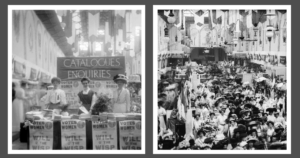
Humans are hard wired to notice what other humans are doing and we process it quicker. In 1909, the British Suffragettes ran a two week Women’s Exhibition which took show don’t tell to new levels. They had an immersive exhibit. But not just any exhibit – a jail cell. So before VR/AR headsets they created an interactive and immersive experience. They had a replica of a jail cell clearly demonstrating the where women were held after being arrested and on hunger strike. A suffragette who had been imprisoned in one of these cells led tours at the Exhibit. 

Demonstrating the importance of show don’t tell!

2. Make Giving Fun

Gamification has become a popular way to raise funds with brand partnership between charities and online platforms and gamers running charity campaigns, but games for charity are nothing new.

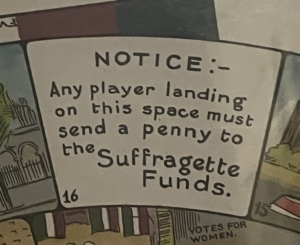
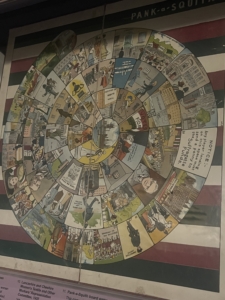
This board game from the 1910s with a board game called Pank-a-squith used to raise funds and awareness of the Suffragettes and their cause 

It had one space on the board dedicated to raising funds.

“Any player landing on this space must send a penny to the Suffragette funds”

3. Diversity your income

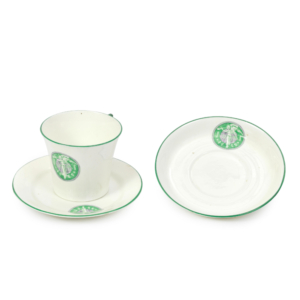
Don’t rely on just one source of income or even just fundraised income. Diversity your income streams. You can earn money too by selling merchandise.

The suffragettes sold this crockery set. Charity merch plays a very important role in helping supporters cement their identity as part of your supporter tribe.Yes, the motive for the purchase may be blurred and they buy the item because it is pretty or practical but is also personal – a personal allyship with the cause. Like wearing a football shirt, a university scarf or a t-shirt with your favourite band on it – it is showing affinity and identity. Collecting and using the item reinforces their connection with your charity and a memory associated with it – perhaps with each use of the cup, the bag, the gin they are getting a microdose of dopamine (the happy chemical) and being reminded of the warm glow of giving to your charity. For your supporter having your merchandise is a way of them signalling they are someone that cares about preserving art or fighting for justice – and literally have the t-shirt, bracelet or crockery to prove it. 

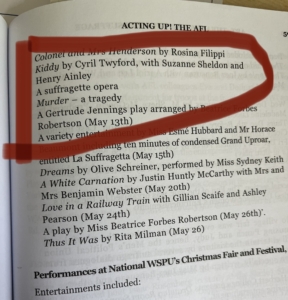
4. Write an Opera

Events fundraising has been a constant throughout fundraising history. Entertain and raise funds.

5. Money talks – how do you use your power

Supporter of women’s rights to vote Mary Elizabeth Garrett used her considerable wealth to advance her agenda. Named ‘coercive philanthropy’ by historian Margaret Rossiter, Garrett funded the medical school at John Hopkins University on the condition that it allowed women students and that she shaped the curriculum. It took many years and negotiation and was she was concerned about them honouring it as the grant agreement read:

“That in the event of any violation of any of the aforesaid stipulations the said sum of $306,977 shall revert to me, or such person or persons, institution or institutions, as I by testament or otherwise may hereafter appoint.”  Part of the grant agreement

Mary Elizabeth Garrett’s gift ultimately founded the Johns Hopkins Medical School. Her conditions did more than secure funding, it cemented women’s equal place within the institution and established rigorous standards for both the curriculum and the quality of medical training. Although her method might raise red flags today, her insistence and use of financial leverage forced the hand of the university to accept the gift on her terms.

In hindsight, the results of her intervention are an example of using power for the public good. The long-term benefits to women’s education, professional equality and the modernization of medical training have been substantial and enduring. While her methods may be ethically uncomfortable, the outcomes have been profoundly positive.

6. Where you make the ask matters

Preparing and choosing where to make the ask is an important consideration for the fundraiser. Where are your potential donors going to be most receptive, have time to listen and engage and understand why you need the funds and what they will be used for.

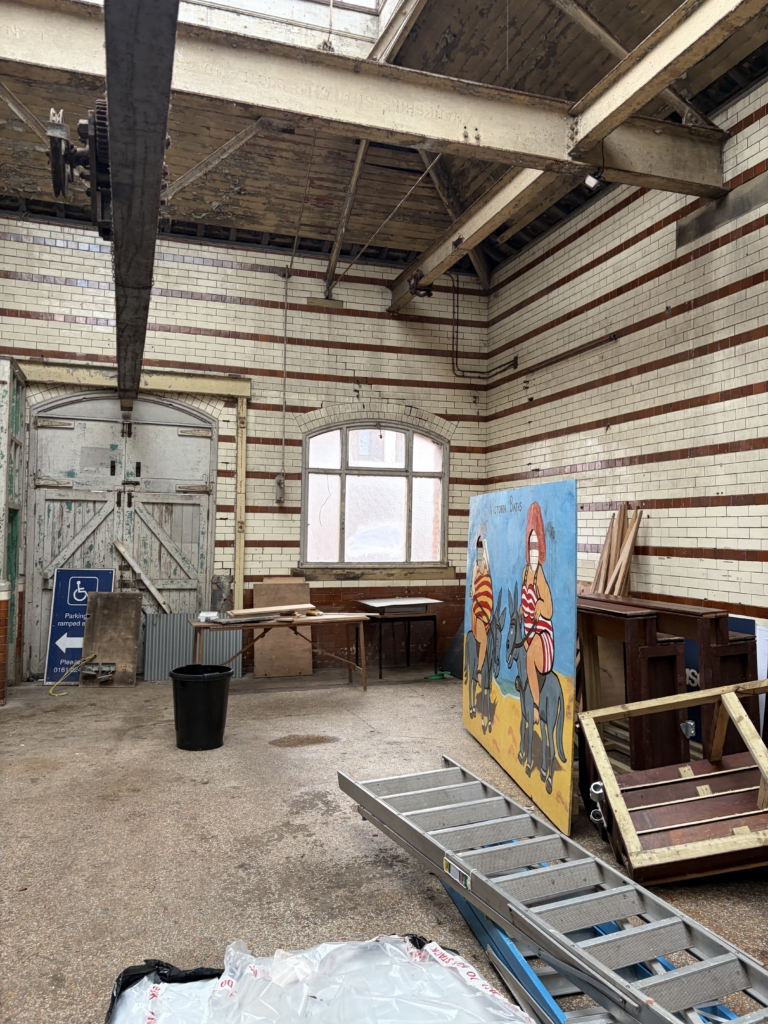
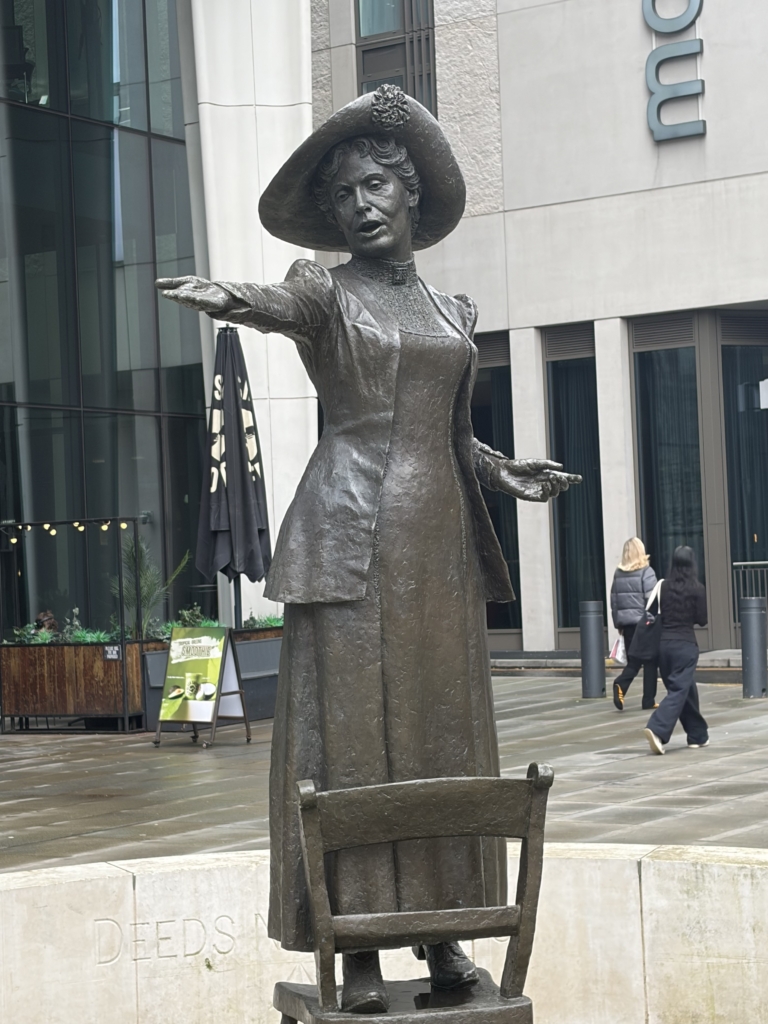
Victoria Baths in Manchester, founded in 1906, was a public baths. They had a laundry to wash the towels used in the baths but in order to earn more money they used it as a laundry where people could pay to come to do their washing. This was a segregated – female only space. It was a space used by Emmeline Pankhurst to champion the cause, to educate and explain about the fight for vote.

Think about where you can make the case without being disturbed.

7. Legacies often save the day

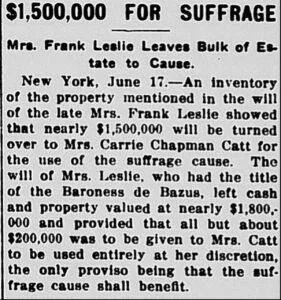
In the 1850s and the 1860s two legacies (one from Francis Jordan and one from Charles F Hovey) helped advance the cause when it has stalled. Mrs Frank Leslie left all her estate to Carrie Chapman Catt for the suffrage movement and that large and unrestricted gift is credited for helping the cause in the US.


A common theme in fundraising when all looks bleak and legacy suddenly comes in and saves the day/balances the books!

8. Dreams do come true!

Anonymous donors who pay salaries

On the wish list for fundraisers and realised by Pauline Shaw who gave anonymously from the 1880s and more than was asked for to support salaries.

9. Fundraising is emotional and hard work

“more than half my spiritual, intellectual and physical strength has been expended in the anxiety of the getting the money to pay for the Herculean work that has to be done in our movement“

Susan B Anthony

Plus ca change.

10. Name it & Publicity matters

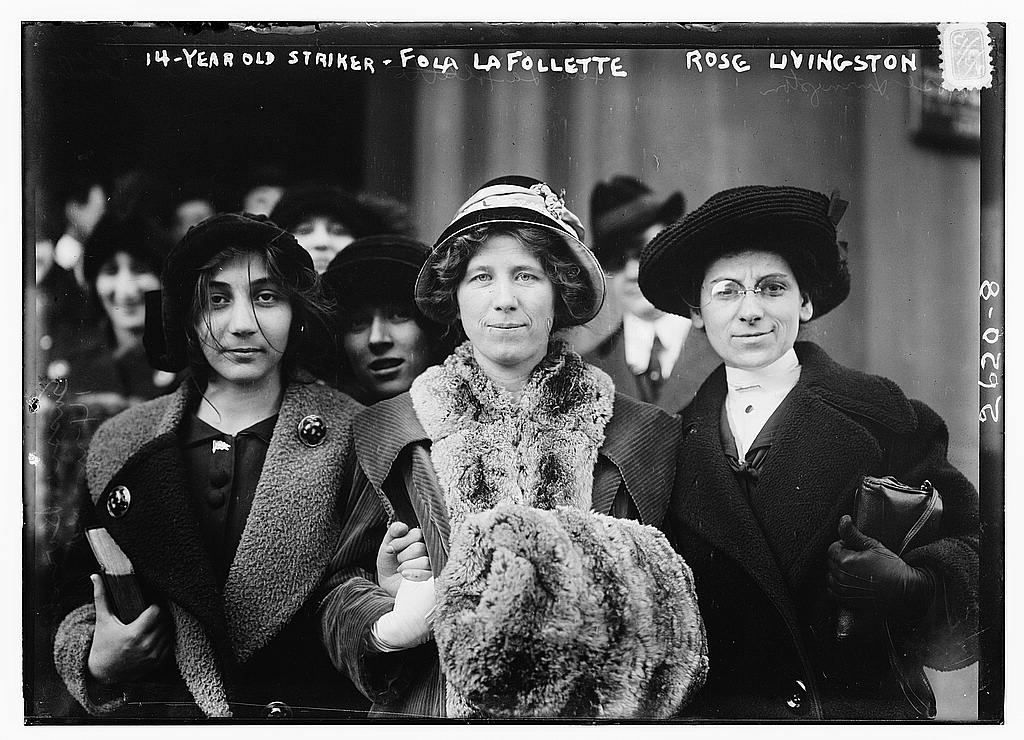
Once something has a name it becomes more concrete in our brains (known as the Sapir-Whorf hypothesis or linguistic relativity). In New York, in 1909 wealth donors supported the Shirtwaist Strike (female garment workers) – the presence of wealthy women not ordinary campaigners on the strike attracted more press attention. They were named in the press as the Mink Brigade. Having a name (Mink Brigade) shapes our understanding and perception.

The tactic of getting well known people or influencers to be involved in campaigns is not a new thing.

“a society women in a street corner soap box is worth reporting in the papers”

Louisine Honemeyer allowed herself to be arrested more publicity

Mary Simpson Sperry to Phoebe Hearst

“We need financial aid for this campaign but far more than that we need the public utterance of women beloved and respected … your influence, dear Mrs Hearst will be on untold assistance to us”

And the right amount of flattery!

And a word of caution … don’t treat donors like an ATM

“I feel as if I were nothing but a money machine”

Margaret Dreir Robbins

So said Margaret Dreir Robbins in 1921 we need to be careful not to take the wealth and willingness of our donors and not to treat them like a cash machine! Even over 100 years ago a danger for fundraisers.

The history of suffrage fundraising.

Fundraising is seen perhaps an adjunct, a means to an end, and not as worthy of study in itself. What can be gleaned about the fundraising history is told through asides in the history of suffrage and other movements.

The focus so far has been on the historical change and not the fundraising.

When the histories of these movement are written, because histories is written by the victors, tend to focus on the social change and ignore the role that money played in social change.

Joan Marie Johnson argues that histories of the women’s suffrage movement marginalise the role of wealth and tend to lead with the grass roots activist. She argues that the movement resented the wealthy women’s influence and when writing memoirs their involvement has been downplayed and most historians have used their narratives to shape the wider history.

More research is needed into how the Suffrage movement was funded and how they raised funds.

Renowned British social historian Frank Prochaska argues that the sophisticated organisation of female-led charity collections in the early 19th century paved the way for the suffrage movement, giving women the skills and legitimacy to act charitably outside of the house. These skills placed the movement in a stronger place and led to change in the law quicker.

https://marinajones.uk/wp-content/uploads/2026/02/Mink.jpeg 740 1024 admin https://marinajones.uk/wp-content/uploads/2022/12/f2b903e010104f5aa61ea1821a685913.png admin2026-03-02 13:06:202026-03-02 13:06:2010 Fundraising Lessons from the Suffragettes

What do you do about lost donors?

February 24, 2026/in Thoughts/by admin

Advertise for them?

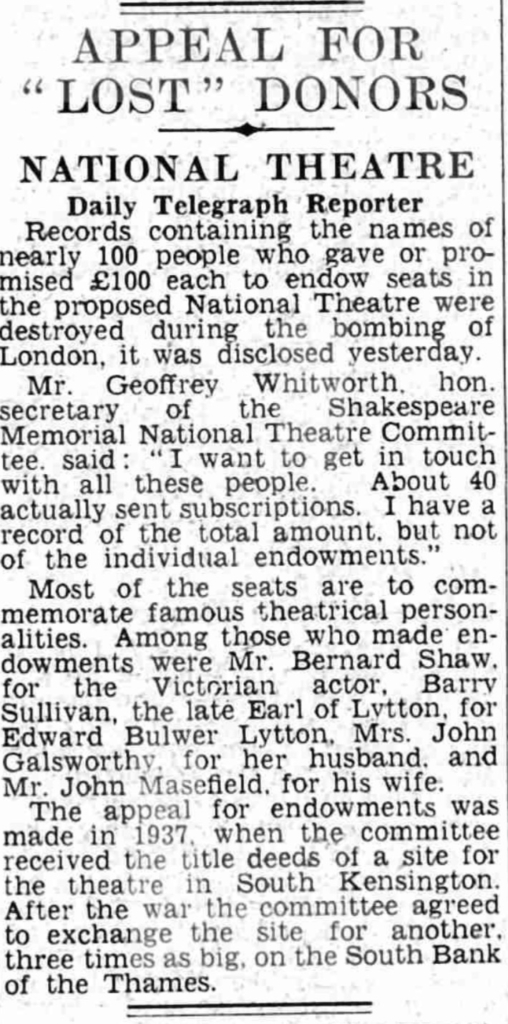
In January 1950 that’s exactly what the Shakespeare Memorial National Theatre Committee  – the proto National Theatre, did. 

Can you remember donations you made 20 years ago?

We can only know who our donors are if we have records – but what if those records were destroyed.

 How do you go about locating them? Put an advert in the paper?

The campaign for a National Theatre for England began in 1848 and it was not until 1949 that an Act of Parliament established it. For over hundred years various schemes and fundraisers tried to raise enough public support and funds to make it a reality (more of that in future articles). 

In the 1930s as part of the fundraising campaign,  seats were sold at the theatre for £100 – supporters were invited to dedicate a seat in the theatre – in their own name, the name of a famous actor or artist, a virtue, or in the name of their city.

‘buying the right to dedicate one seat either in the name of a person, a society, a township or in the name of some historic act, ambition or ideal, in exchange for an endowment gift of £100”

Dame Sybil Thorndike

The seats are offered in perpetuity – rarely done now – the National Theatre the website states – Seats will bear your dedication for at least 10 years)

“And so when you head of proposals that your home town should endow a seat, and commemorate itself, at a cost of £100 of when (for all I know) you are boldly asked on your own half crown, do not shrug your shoulders as no concern of yours. A Theatre is National because the nation needs it. And you, after all, are the nation”

Lord Elton

This seat naming scheme was popular, and examples include the University of Cambridge endowed a seat in the name of Christopher Marlowe, the Dickens Society bought one for Charles Dickens and many cities and local authorities supported the scheme (would they today?) 

However, all the records from the 1930s campaign to endow seats had been destroyed by ‘enemy action during the war’. 

When the archives are patchy, the other thing we rely on is organisational memory – the longest serving member of staff but the Committee had disbanded before the war and many of the members were dead. So, this is where the advert comes in. 

Screenshot

Following the advert, the archives record people writing in with their names and that they subscribed a seat 20+ years ago. 

“I found my cheque book I sent you a cheque for £100 … on the 16th April 1930” 

They have the details of the date that they wrote the cheque (Do your records go back that far? Do your donors? I know some donors who have all their donations in a spreadsheet) 

All of these responses are taken on trust and added to the paper sheets of names for the future theatre.  One letter alludes to the original form and says it is included with the letter but, alas, it is not in the archive. One response from The Mayor of Fulham writes to ask about ‘the use of this seat by Fulham people’ – as this was promised as part of the endowment scheme – one night in that seat. (a great offer but feels very impractical to implement).

In 1958 one donor requested a refund ‘with interest’ for the £100 paid back as the theatre was not open. 

According to the Bank of England inflation calculator what cost £100 in 1938 would be nearly £6,000 nowadays (£5,873 in January 2026) so it is not an insignificant amount of money to contribute towards the scheme. (Seats are available to name today at the Dorfman Theatre, one of the three theatres at the National for £6,000) 

Is the Zeigarnik effect in action? 

The Zeigarnik effect refers to the tendency for people to remember unfinished or interrupted tasks better than completed ones. An “open loop” keeps cognitive tension active, which motivates attention, recall, and often completion. Not having the theatre built, their name on a seat keeps a loop open in the donor’s brain and so this advert would stand out – both for being unusual,  and for those that have made a significant contribution, but not had the satisfaction of seeing the project happen. 

It also raises an interesting question: do your donors see their gift as a donation or a transaction?

How are they mentally accounting for it in their heads and mental budgets?

Gifts and donations are legally voluntary and with no expectation of return.

Does the name on the seat move it mentally from being a pure donation into a transaction with the obligation and expectation of a name on a seat as a contractual type relationship?

Are you demanding the rights you were promised? Or more aligned to the mission and goal? 

The language we use around asking for gifts and donations make a difference. Framing a charitable gift as a ‘gift’ rather than a ‘donation’ significantly boosts giving – both amounts given and intention to give (Wang et al 2022) (In one of their studies amounts contributed rose over 25% when framed as a gift not a donation)

So, what does the term ‘endow’ mean to donors?

The publicity that remains of this campaign uses the phrase ‘endow’ – no academic tests I can see have tested the use of this phrase. However, because an endowment is meant to last, donors who use the term “endow” might have stronger expectations about how the money will be used. Endowment equals permanence. They expect permanent support for this specific purpose – to name a seat in a theatre and mentally have assigned it to a different mental account. Decision science shows that people categorise money by its source and purpose in the mental accounts, but also how we use words matters – the linguistic relativity (or Saphir-Whorl hypothesis – we assign words meaning) – by assigning this to an endowment they have potentially given it a profile and status above a charitable gift or donation – tracking its use and implementation separately. 

These seats were even considered in legacy bequests

One of the letters in the archive in response to the advert a letter from an executor of a will in 1955 enquires about passing the right of the seat to a new recipient in the will. The publicity had said that they were entitled to use the seat one night a year. 

‘this endowment entitles the donor to have the right to nominate a guest occupant for one night of a year’

The reply states: ‘I doubt very much whether the question of the right of nominating a guest should pass on death was ever considered by the Committee as the question has never been raised before’ 

A lesson for fundraisers to always thinking of the unintended and future consequences of the fundraising offers and opportunities we make available to donors. 

The results of this advert shows how meaningful these gifts are to the donors – even twenty years later.

What fundraisers today can learn

  • Record-keeping is mission-critical. Lost data creates real financial and stewardship risk decades later.
  • Donor memory can outlast organisational memory. Never assume supporters will forget.
  • Language shapes expectations. ‘Gift’, ‘donation’, and ‘endowment’ create materially different mental contracts.
  • Naming rights blur the line between philanthropy and transaction. Be explicit about what is and is not guaranteed (and for how long!)
  • Perpetuity promises are dangerous. Time-limit benefits wherever possible and state this clearly.
  • Open loops drive engagement. Unfulfilled promises keep donors cognitively and emotionally invested — sometimes for decades.
  • Historical cases are live warnings. Today’s campaign wording may shape donor expectations for generations.
https://marinajones.uk/wp-content/uploads/2026/02/IMG_1484.jpeg 435 1018 admin https://marinajones.uk/wp-content/uploads/2022/12/f2b903e010104f5aa61ea1821a685913.png admin2026-02-24 19:45:282026-02-24 19:45:29What do you do about lost donors?

Great Fire of London – disaster relief fundraising

February 12, 2026/in Thoughts/by admin

Disaster fundraising is nothing new.

How was the Great Fire of London used to raise funds to care for those impacted and rebuild the city? A three day fire decimated the city leaving 100,000 were left without homes and livelihoods 

And what can we learn about fundraising from it?

Lessons

  • Act quickly whilst the situation is salient and live in people’s minds – the fire took place  2-5 September 1666, and on 13 September King Charles II declared a national fast that ( a day without eating) that would ask God for forgiveness of sins, but also be used to donate to those ‘poor Sufferers by this fire‘. (When Notre Dame burnt down in 2019 over one million euros was raised in two days.) Acting quickly in a disaster maximises the money we can raise.
  • People give to people not buildings – the fundraising brief (proclamation to be read out in every church in the kingdom)  to raise funds for those impacted by the fire raised more than the brief to rebuild St Paul’s (which made just over £7k). How can you make your asks about people?
  • Follow up your asks – sometimes however well intentioned donors are, they do not give. They need reminding … and reminding again. Repetition works. As well as the brief read out at local parishes, the request was followed up by door to door asks. On 16 October, in Asthon-in-Makerfield in Lancashire, Roger Lowe records in his diary that the parish priest came collecting on (6 days after brief issues) ‘towards the reliefe of such needie psons as had sustained losse by the great fire in London and to set their names down’. After the first ask, what is your follow up plan?
  • Who asks matters. Celebrity and influential patrons matter – having a Royal Patron makes a difference when asking (see King Charles II fasting proclamation). When the funds had been collected and those impacted by the fire were seeking individual grants to rebuild their lives and livelihoods having a titled patron make the ask on their behalf increased the grants they got given. The messenger matters. For example,  the Bishop of Norwich wrote letter detailing personal circumstances of a deserving victim could get £20 grant (whilst the average grant was  just under £5). Who asks matters.  Who is making your ask?
  • Connection matters – when people have a personal connection to the cause they are more likely to give. In 1666, there were more gifts from urban areas of the country who had previously been impacted by fire themselves. Their direct experience of fire inspired their gifts – a direct experience with the cause matters to people. This reminds me of the Choctaw nation of making a donation of $170 to help Irish sufferers of the Potato Famine in 1847. The Choctaw had suffered with starvation and famine on their enforced relocation and March of Tears and wanted to help – connection and direct experience matters. (This gift has sparked reciprocal gifts of support – with Irish pilgrims re-walking the March of Tears to raise funds for the Somalian famine in 1992, and financial support in excess of $2m to support the Choctaw during Covid 19 from Ireland). How can you inspire connection?
  • Diversify your fundraising – don’t rely on one source of income. As well as the fundraising briefs issued in all parish churches, a tax on coal entering London was used to raised funds to rebuild roads, buildings and the cathedral. Low cost loans from citizens. How can you find other fundraising or earned income streams?
  • Corruption is nothing new – the Lord Mayor of London, Sir William Bolton, was in charge of collecting and distributing the funds. He was found guilty of embezzling money given for the victims of the fire (£1,800  could not be accounted for) and this ended his career and diarist Pepys said ‘the greatest piece of roguery that they say was ever found in a Lord Mayor’. (the allegations were never proved.)  

How was the money raised spent

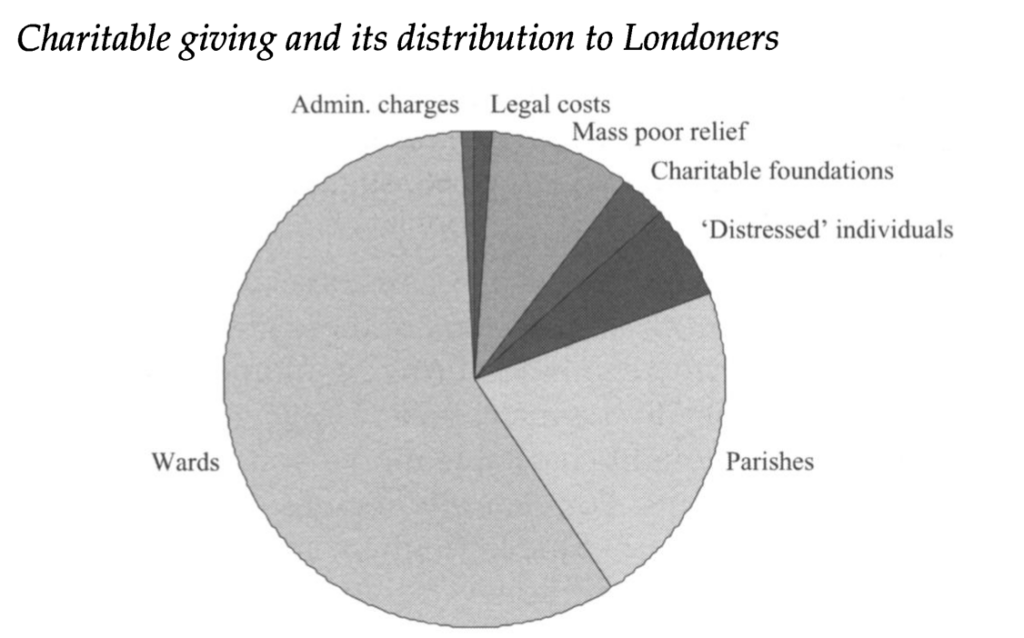
Interesting to see that administration of the brief and lobbying included in the chart showing how the money was spent. Even in 1666 you needed advocacy and admin costs (and there was no issue with the admin costs spent on print, stationary and sending our proclamations to raise the money!)

And one lesson we wont be taking forward – naming and shaming donors that don’t give – the parish records also record who didn’t give.

So …

  • Ask quickly – in an emergency getting an ask out as soon as possible increases income
  • People give to people
  • Ask and ask again – repeat your asks, follow up the initial ask, busy well intentioned people need a nudge
  • Use the power of celebrity (or royalty) – the messenger matters.
  • Diversify your fundraising – don’t just rely on one source of income

Reference:

Field, J F (2010) Charitable giving and its distribution to Londoners after the Great Fire, 1666–1676

https://marinajones.uk/wp-content/uploads/2025/12/Great_Fire_London.jpg 559 960 admin https://marinajones.uk/wp-content/uploads/2022/12/f2b903e010104f5aa61ea1821a685913.png admin2026-02-12 20:57:182026-02-12 20:57:19Great Fire of London – disaster relief fundraising

Why did five million people wear the same bracelet?

January 27, 2026/in Thoughts, What I'm Reading/by admin

Wear What You Feel

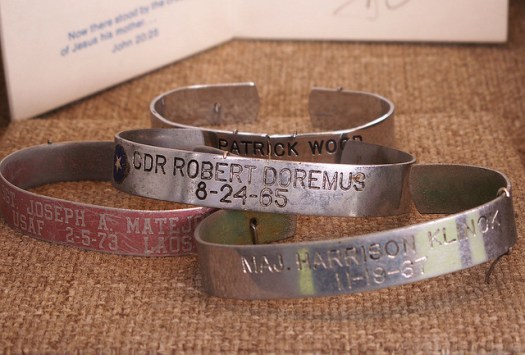
In the early 1970s, millions of Americans wore thin aluminium bracelets engraved with the name of a man they had never met.

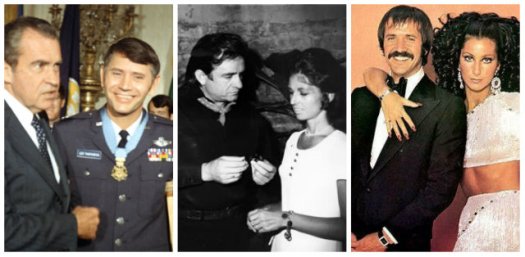
They wore them in classrooms, on television, on red carpets and at kitchen tables. Johnny Cash wore one. Sonny and Cher wore them. John Wayne wore one. So did Princess Grace of Monaco. So did students who could barely afford the $2.50 donation that came with it.

Each bracelet carried the name and date of capture of a single prisoner of war or missing serviceman in Vietnam. You wore the bracelet until the man named on it returned, or until the truth of his fate was known.

The bracelets worked because they exploited something deeply human: a personal connection. It connected you with one individual, one missing serviceman – they became yours. This is called the identifiable victim effect the tendency to feel greater empathy and act more decisively when a single, specific person is identified, rather than an anonymous group. The POW/MIA bracelets replaced a collective of anonymous prisoners with one named individual.

Development of the idea …

Congressman Bob Dornan wore a bracelet made from scrap aluminium, given to him by a Montagnard tribesman in the Vietnamese highlands in 1966. It came with the plea – ‘do not take it off until my people are free‘.

Bob did not take it off. He wore it every day. Every time his arm hit a wall the bracelet clinked, every time he saw it, every time it got caught in his sleeve – he was reminded of the suffering and why he was wearing it.

The story of Bob Dornan’s bracelet inspired Carol Bates and other students involved in Voices in Vital America (VIVA) to do something to raise awareness of the prisoners of war in the Vietnam war. The first batch of bracelets was intended for students, priced to match the cost of a cinema ticket.

Visibility as commitment

Behavioural economics tells us that public commitments change behaviour. Once we signal who we are, and especially when we do that visibly with an outward sign, like a bracelet or badge, we want to stay consistent to that identity. The bracelet didn’t just express alignment, it showed and embodied commitment.

What started as a kitchen table enterprise caught the imagination.

Demand jumped from hundreds a week, to tens of thousands. Nearly five million were eventually sold raising over $7m.

This is the behavioural hinge –  once support becomes visible, it stops being individual and starts being social.

Wearing the bracelet did three things at once.

  • It personalised an abstract war.
  • It signalled allegiance to others.
  • And it made non-participation noticeable.

When objects become norms

The POW/MIA bracelets didn’t just raise money. They changed the atmosphere.

The bracelet turned support into a default behaviour. If everyone else was wearing one, not wearing one became a decision.

It was not just a fundraiser. It became social norming made tangible.

This is the same dynamic we use as charities with badges, donor walls, name plaques, digital badges and public thank yous. Visibility creates legitimacy. Legitimacy creates momentum.

The difference is that the bracelet didn’t say I donated.
It said I’m part of this.

Wearing as giving

Psychologists call this social proof. Fundraisers call it recognition. Donors experience it as belonging.

We know from decades of research that people give more, and more often, when generosity is visible. Donation boxes that show visible gifts drive more donations – the social proof of others donating reassures us that this is the normal thing to do and encourages more gifts, more belonging. Public donor lists can increase participation by crowding in support (although be careful not to crowd it out). Badges, ribbons and pins turn our private values and identities into shared social norms.

But the bracelet did something more sophisticated. It fused identity, sacrifice and time.

You didn’t just buy a bracelet. You lived with it. Every day reminded of your soldier, your prisoner of war, your connection and your commitment.

From bracelets to badges

This logic has repeated itself across centuries. The bracelet was not a new way to belong and to embody commitment and identity.

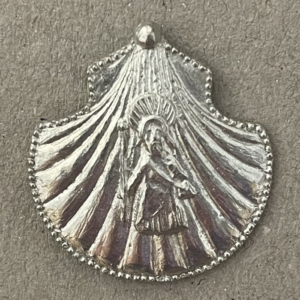
Medieval pilgrims wore badges showing the shrine they had visited. These could be bought as souvenirs to demonstrate your identity as a pilgrim, to show you had been on pilgrimage (and helped also raise additional funds). You wore them on your cloak or hat, put them in your prayer book or could nail them up at home. They showed to the world that they had been on pilgrimage and what tribe they belonged to. Each shrine had its own badges so you could collect them from various shrines demonstrating your piety and connection. 

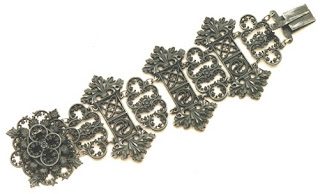
In 1813, Princess Marianne of Prussia used the power of social norming (and a bit of royal celebrity messenger) to appeal to Prussian aristocrats to give their gold jewellery for the Prussian cause against Napoleon. This proved a popular way to fundraise and the gold items were exchanged for iron jewellery emblazoned with ‘Gold gab fur Eisen’ (‘I gave gold for iron’). It became the social norm to wear these iron rings and broaches, and gold was considered unpatriotic. 

Our brains have evolved to feel social rejection in the same way that we feel real pain – as our primitive selves needed to be with the group to get food and shelter – that is why doing what is normal for the group is so important. What we know now about how our brains work helps us to understand what is happening inside our brains and why social norming and embodied commitment are such a powerful drivers of behaviour. 

Why we want the badge or the sticker everyone else has got.

We want to do what people like us are doing. 

We want to belong to the tribe. 

From tote bags to pin badges, from poppies to daffodils and forget-me-nots – charities continue to give supporters the chance to demonstrate their belonging and identity as a supporter. To belong to that supporter tribe. Each turns the body into a message, and the donor into a carrier.

Wear what you feel

Objects work when they carry emotional weight. When they ask something of the wearer. When they make values visible without making them performative.

The most powerful fundraising symbols don’t reward generosity — they enrol it.

They say:
If you care, wear it.
If you wear it, live up to it.
If enough of us do, it becomes normal.

And once something is normal, it no longer needs to shout. It just needs to be seen.

References:

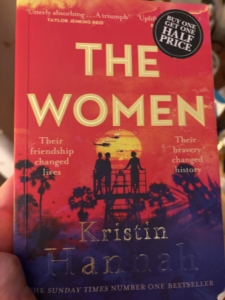
I found out about these bracelets by reading ‘The Women’ by Kristin Hannah – which tells the powerful story of American female nurses working in Vietnam, friendship and the aftermath of the war.

 https://reneebeck.com/2013/11/11/did-you-sport-a-vietnam-war-pow-bracelet-70s-ladies/

https://issuu.com/coronadomagazine/docs/aa_-_comag_05-23/s/24254205

https://www.krcu.org/show/telling-history/2024-08-26/telling-history-pow-mia-bracelets

Palm Springs Museum’s POW-MIA Bracelets Draw Attention to the Cause

https://www.pow-miafamilies.org/powmia-bracelet#:~:text=In%20Vital%20America,chairmen

https://marinajones.uk/wp-content/uploads/2026/01/image-4.jpeg 355 525 admin https://marinajones.uk/wp-content/uploads/2022/12/f2b903e010104f5aa61ea1821a685913.png admin2026-01-27 19:52:292026-01-30 20:33:34Why did five million people wear the same bracelet?

🚩 I will give you money on condition that…  

January 21, 2026/in Thoughts/by admin

… you put my name on the building, that I decide who comes to this university, that I choose the art you do… 

🚩 Red flag?

What if this was also about forcing another agenda? What if it was about equity?

Can coercive philanthropy ever be a good thing?

Three scenarios

  1. After being a major sponsor of this ballet company for several years, I want to rename the company to include my name and have influence on the art. 🚩
  2. As a donor, I want to rename this university college to include my name  🚩
  3. I will only give you money to fund a new medical school if you let me influence the admissions criteria 🚩

Here are three historical examples of female philanthropists offering gifts with conditions – one where they accepted the money and conditions, one where they said no and nothing happened, and one where they said no and it happened anyway.

What would you do?

How would you react according to your acceptance of gifts policy?

In the UK the Charity Commission has a clause that says that donations with conditions, “may undermine your charity’s independence’ and that trustees can refuse them. But might there be bigger issues at stake? 

1. After being a major sponsor of this ballet company for several years, I want to rename the company to include my name and have influence on the art.

The first scenario is from Joffrey Ballet in the US. Founded in 1956 by Robert Joffrey and Gerald Alprino, the ballet company was initially funded through ticket sales, and fees from Joffrey’s teaching. In 1962 they were offered the chance to tour aboard but needed funds to make it happen. Enter the Rebecca Harkness Foundation. 

Harkness took ballet lessons as a child and had been fascinated by it and wanted to support. 

From 1962, Rebecca Harkness through her Foundation funded workshops, new choreographers (including Twyla Tharp and Alvin Ailey) and the dancers themselves. Harkness composed for some of their pieces using her musical background and each morning took two hours of private ballet class saying “I must do it myself or else I’d just sit back and write out checks.”. She was a devoted and knowledge balletomane. 

“When I first decided to form a ballet company, Mother said: ‘Dear, why don’t you just see a psychiatrist?’ I told her it would be cheaper to form a ballet company.”

In 1964, the Foundation demanded that, in return for their financial contribution, the company be renamed the Harkness Ballet, that Rebecca Harkness would influence the artistic programme, with Joffrey remaining its Artistic Director.

🚩 Red flag? What’s in a name? Compromising artistic freedom?

This offer was further complicated by the fact that the Foundation through its funding paid and owned the contracts on many of the dancers, the scores, the sets and rights to many of the company’s ballets. 

What happened? Joffrey refused and maintained its independence, and in 2025 the company celebrated its 75thanniversary. 

But Harkness took the dancers, sets, scores and set up Harkness Ballet. She bought a theatre, just by the Lincoln Center naming its Harkness Theatre and spending over $5m to create “the first and only major theatre in the U.S. specifically designed for dance”. The theatre included an infamous mural with the trainee dancers all painted naked as gods and goddesses and Rebecca Harkness painted (clothed) as the goddess of dance. Patrick Swayze had a Ballet scholarship and trained at the Harkness House for Ballet Arts. 

The 1974 stock market crash contributed to the company’s decline, and it closed in 1975. The theatre auctioned off its chandeliers, fixtures, and fittings to recoup losses.

(Rebecca Harkness is the inspiration behind the Taylor  Swift song ‘The Last Great American Dynasty’ and the lyrics include a line about ‘And blew through the money on the boys and the ballet’)

2. As a donor, I want to rename this university college to include my name  

This scenario comes from 1570s when widow to Lord Mayor of London, Mary Dale used her inherited wealth to become an active philanthropist. She founded two Fellowships at Peterhouse college in Cambridge. She offered to give the College lands to the value of £500 a year if they would rename the college ‘the college of Peter and Mary’. This offer of a gift was refused and the Master of the College saying ‘Peter, who so long lived single, was now too old to have a Feminine Partner.’

Mary Dale stopped supporting the college after that (although they do continue to have a financial fund in her married name, Lady Mary Ramsey). But that did not stop her giving, as Thomas Fuller relates in Worthies of England ‘This not succeeding the stream of her Charity was not peevishly dried up’ and she turned her philanthropy to Christ’s Church Hospital (and without demanding naming rights), grammar schools in Essex and poor and destitute soldiers.

3. I will only give you money to fund a new medical school if you let me influence the admissions criteria and curriculum  

🚩Red flag? Straight no, right? 

John Hopkins died in 1873 leaving $7m to be used to establish a university, school and hospital. In 1890s the dividends from the investment in the B&O railroad stock had dried up and there was not enough investment income to fund the medical school. The President, Daniel Gilman, in response to this fundraising gap said that $100,000 was needed to fund the medical school.  The President sought a “man of large means” to fund the school. 

Raising the money: Mary Elizabeth Garrett and M Carey Thomas (who had tried to enrol as a student at John Hopkins in the 1870s) created the Women’s Medical Fund Committee raise the $100,000 and wanted to give the money on condition that qualified women allowed to be admitted on the same terms as men. They also used the committee to try and influence public opinion on the issue – at this time most universities were single sex and access to higher education to women was limited. 

“The avowed purpose of the committee was to raise a sum of money sufficient to establish the School of Medicine and to offer it to the Trustees of the University on condition that women be admitted to the school on the same basis as men.”  Alan Chesney, MD, Dean and Archivist at John Hopkins. 

They raised the $100,000. Garrett contributed over half herself, and other donors included  Mr J Pierpont Morgan, Mrs Leland Stanford and First Lady Mrs. Benjamin Harrison.

In 1890 they offered $100,000, which the trustees of John Hopkins accepted to invest — but they stated that $500,000 was needed to found the medical school, effectively moving the fundraising goalposts.

M Carey Thompson said of Daniel Gilman:

 “many of the trustees, and Gilman above all, seemed to prefer not to open the school at all if it meant that women were to be admitted.” 

By 1892, the initial donation of $100,000 had grown to $193k  through additional gifts and investment income. Mary Elizabeth Garrett pledged the $306k needed to reach the $500,000 target. 

Margaret Putnam Jocobi, the first female graduate of pharmacy college and suffragist commented:

“It is astonishing how many inviolate objections [to co-education] on the score of feasibility, modesty, propriety and prejudice melt away before the charmed touch of a few thousand dollars”

However, the $500,000 was a conditional gift with not one stipulation but many. They were carefully negotiated and included:

  • all admitted students needed an undergraduate degree in science (this was not usual for other medical schools) 
  • Clauses codifying women’s place and on the same terms as men
  • Rigorous scientific curriculum
  • Four-year course
  • Publish the funding agreement annually in the school catalogue
  • But she agreed that she would not interfere in the day to operations of the university. 

Any breach of these conditions would mean the money returned to her. She used the power of her wealth to give the gift on her own terms and advance the cause of female education.

“That in the event of any violation of any of the aforesaid stipulations the said sum of $306,977 shall revert to me, or such person or persons, institution or institutions, as I by testament or otherwise may hereafter appoint.” Part of the grant agreement

Mary Elizabeth Garrett’s gift ultimately founded the Johns Hopkins Medical School. Her conditions did more than secure funding, it cemented women’s equal place within the institution and established rigorous standards for both the curriculum and the quality of medical training. Her insistence and use of financial leverage forced the hand of the university to accept the gift on her terms.

In hindsight, the results of her intervention are an example of using power for the public good. The long-term benefits to women’s education, professional equality and the modernization of medical training have been substantial and enduring. While her methods may be ethically uncomfortable, the outcomes have been profoundly positive.

Garrett’s gift has been named ‘coercive philanthropy’ by historian Margaret Rossiter. William Osler one of the founding physicians of the medical school had a different take: 

“It was a pleasure to be bought.”

🚩

.

Reflection

Using the force of the gift to demand equality places Garett’s gift on the right side of history – but what would we do today? 

These three scenarios were all from female philanthropists, would the outcome have been different if it had been a man? 

As fundraisers we often fear the coercive nature of the gifts that we receive and how they might divert us from core mission and purpose. A gift that came with so many specific conditions in would be unlikely to pass through a modern acceptance of gifts policy. 

  • How might we assess what transformational gift pushes our charities or trustees to take radical steps forward for the greater good?
  • How might history judge our acceptance or declining of gifts? (Might there be gifts that are the equivalent of the record producer who turned down The Beatles?)
  • Should these gifts be judged by their intentions or methods?

References:

https://web.archive.org/web/20081024094605/http://www.time.com/time/magazine/article/0,9171,941032,00.html

https://richka.net/rh14.html

Mary Garrett

https://pages.jh.edu/gazette/2001/feb1201/12garret.html

The Need to Give The Patrons and the Arts – Andrew Sinclair

Funding Feminism– Joan Marie Johnson 

https://quod.lib.umich.edu/e/eebo/A40672.0001.001/1:27.4.11?rgn=div3;view=fulltext;q1=Hoo#:~:text=two%20Fellowships%20and%20Scholarships%20in,loose%20so%20good%20a%20Benefactres

Worthies of England – Thomas Fuller

https://marinajones.uk/wp-content/uploads/2026/01/Red-flag.png 1024 1536 admin https://marinajones.uk/wp-content/uploads/2022/12/f2b903e010104f5aa61ea1821a685913.png admin2026-01-21 18:49:482026-01-21 18:49:51🚩 I will give you money on condition that…  
Page 2 of 10‹1234›»
Tweets by meenamtj
All content © Marina Jones 2023
  • Link to X
  • Link to Instagram
  • Link to LinkedIn
Scroll to top Scroll to top Scroll to top

This site uses cookies. By continuing to browse the site, you are agreeing to our use of cookies.

Accept settingsHide notification onlySettings

Cookie and Privacy Settings


How we use cookies

We may request cookies to be set on your device. We use cookies to let us know when you visit our websites, how you interact with us, to enrich your user experience, and to customize your relationship with our website.

Click on the different category headings to find out more. You can also change some of your preferences. Note that blocking some types of cookies may impact your experience on our websites and the services we are able to offer.

Essential Website Cookies

These cookies are strictly necessary to provide you with services available through our website and to use some of its features.

Because these cookies are strictly necessary to deliver the website, refusing them will have impact how our site functions. You always can block or delete cookies by changing your browser settings and force blocking all cookies on this website. But this will always prompt you to accept/refuse cookies when revisiting our site.

We fully respect if you want to refuse cookies but to avoid asking you again and again kindly allow us to store a cookie for that. You are free to opt out any time or opt in for other cookies to get a better experience. If you refuse cookies we will remove all set cookies in our domain.

We provide you with a list of stored cookies on your computer in our domain so you can check what we stored. Due to security reasons we are not able to show or modify cookies from other domains. You can check these in your browser security settings.

Google Analytics Cookies

These cookies collect information that is used either in aggregate form to help us understand how our website is being used or how effective our marketing campaigns are, or to help us customize our website and application for you in order to enhance your experience.

If you do not want that we track your visit to our site you can disable tracking in your browser here:

Other external services

We also use different external services like Google Webfonts, Google Maps, and external Video providers. Since these providers may collect personal data like your IP address we allow you to block them here. Please be aware that this might heavily reduce the functionality and appearance of our site. Changes will take effect once you reload the page.

Google Webfont Settings:

Google Map Settings:

Google reCaptcha Settings:

Vimeo and Youtube video embeds:

Other cookies

The following cookies are also needed - You can choose if you want to allow them:

Privacy Policy

You can read about our cookies and privacy settings in detail on our Privacy Policy Page.

Privacy Policy
Accept settingsHide notification only