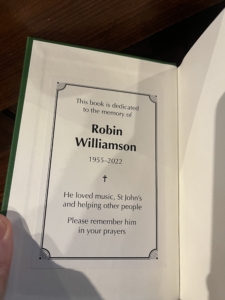
At church we have just got a new set of hymn books and a member of the congregation donated the funds for them. She wanted to share why.
She had chosen to donate in memory of her late husband and spoke so beautifully about the reasons – because he had loved music, and for many years played viola in the local orchestra. He had also loved Ralph Vaughan Williams (who worked on compiling the first English Hymnal). He had been a dedicated worshiper at the church, and member of the PCC. An opportunity and a need arose, new hymn books needed to be purchased; so she explained that she had made the gift to purchase the hymn books in his memory.
As fundraisers too often we focus on the story we tell to secure the gift, and not the story that the donor has to share about their why.
This why can have many different aspects, including
Every donation tells a story – it reflects different parts of someone’s life and the connections they have – to beliefs, to music, to favourite things, to memories, to people, to their professional life, to your charity, to the specific fundraiser. Just knowing that it was ‘in memory of’ is not the same as hearing the story, and the multiple reasons, connections and layers as to why this gift was made – to this, at this time and why it was meaningful and important.
Every donation tells a story – how can we encourage donors to share that story?
There are many ways we do this as fundraisers:-
Many charity runs allow you to personalise your running bib to say who you are running for and why ‘For mum’, or ‘For David’ or ‘To fight cancer’.
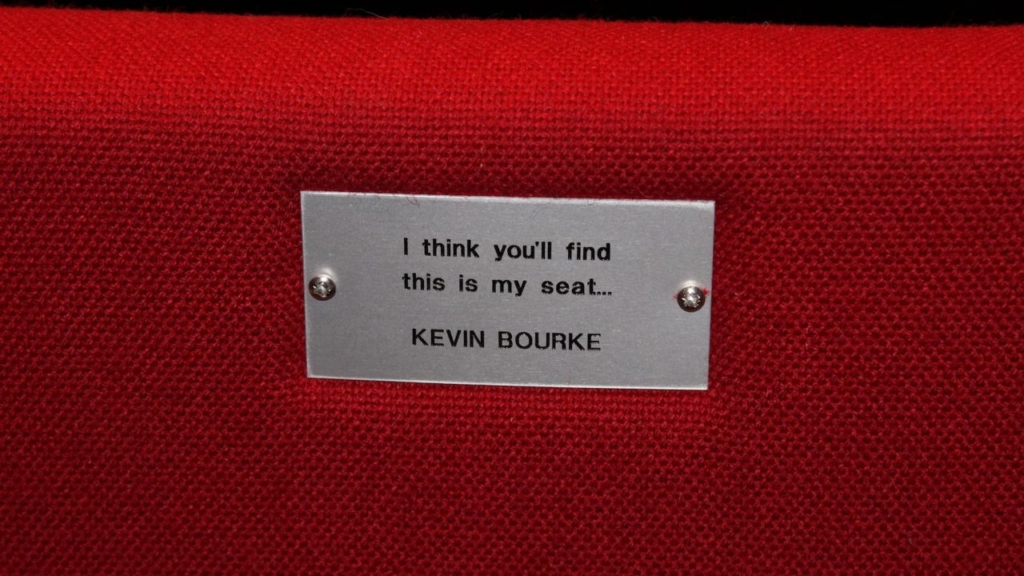
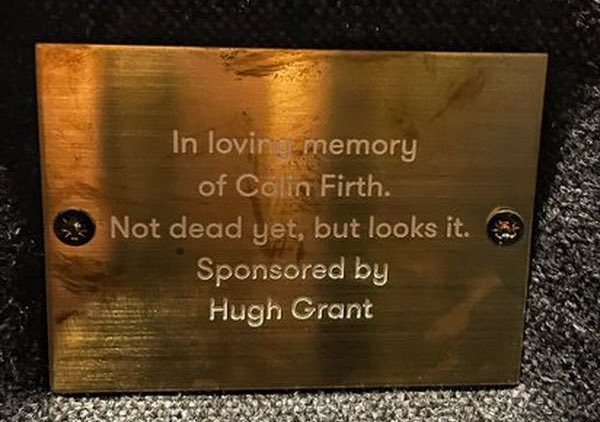
Seat dedications in a theatre can do the same – and tell some amazing and personal stories including a seat dedicated to an opera loving cat or a volunteer who had dedicated decades to a theatre or a chance for a bit of fun.
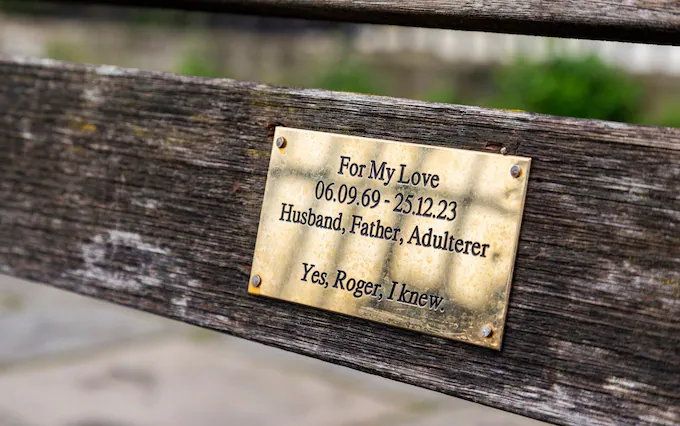
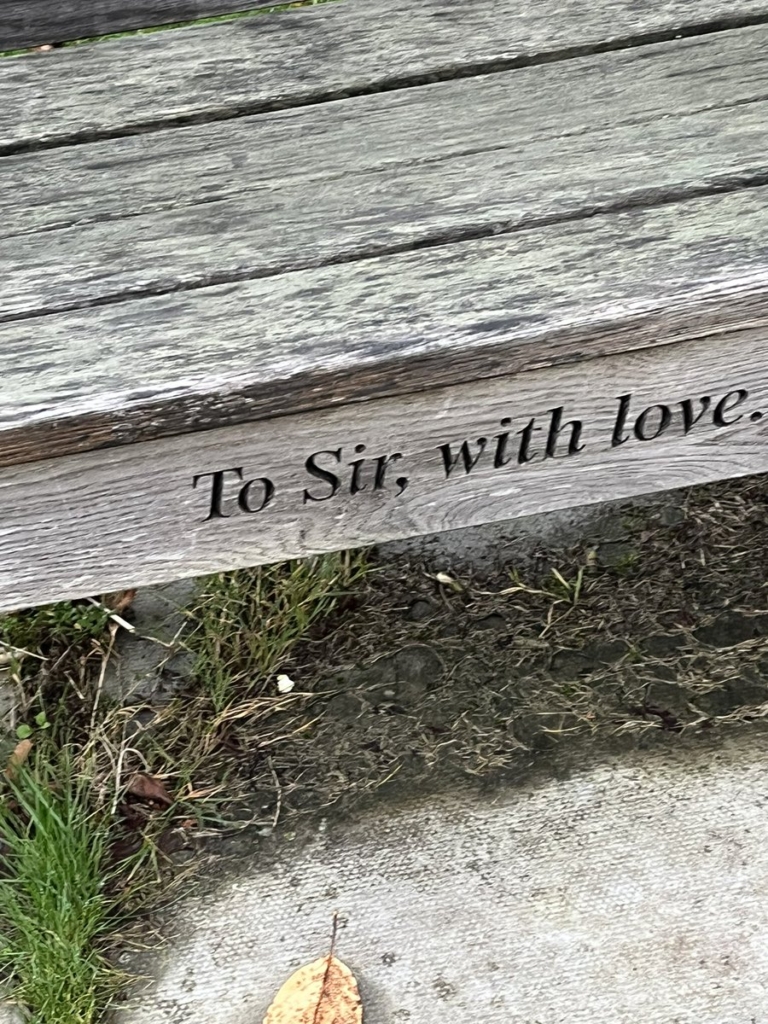
Memorial benches, can do the same as well. Sometimes they add a flavour of the character or hint at a further stories.
However the limited character count of these often limits the donor being able to tell the full story of their why.
So allowing that story to be told fully in the donor’s words can create greater connection, and there is evidence that it increases donation and conversion rates.
In legacy materials, adding in the option which allows someone to tell you why they are leaving a gift in their will gives you the loveliest stories. Even without a formal invitation to tell their why, I have found that legacy pledges can be accompanied by letters that detail their history with your charity and their favourite memories.
I remember one example, how a couple met at the theatre through joint friends, seeing Fonteyn and Nureyev ‘I was hooked in more ways than one, in the group was a beautiful lass in a green dress’. Five years later they were married and enjoyed a lifetime as members going to the ballet together. The letter detailed a life time of memories together, of sitting in the cheap seats, to being able to sit in the stalls, and how social groups were formed around attending. She had died and this legacy gift reflected their shared passion, but the letter also shared the oddness and mixed emotions of returning to the theatre without her to see the latest production of Swan Lake which they had first seen together with Fonteyn and Nureyev.
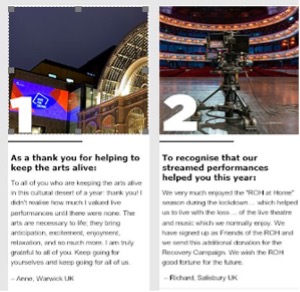
During the pandemic, we added an option with online donations asking people the reason that people were making the gift now. This produced some extraordinarily powerful reasons and stories. We categorised the common themes of these messages to create five different social norms. We then, with permission, used this feedback from supporters for to further support the campaign. There were five common reasons that came out – creating five ‘people like you’ norms to encourage further gifts.
Yes these (with permission) form amazing testimonies that may encourage other donors to give as we did for the pandemic ones. But it also makes the very act of giving more personal and more powerful for your supporters.
Why is that?
Daniel Kahneman in Thinking Fast and Slow talks about the two selves – the experiencing self and the remembering self.
The experiencing self is the one answering the direct question of the experience right now, and the remembering self that answers the questions ‘how was it, on the whole?’. The remembering self is the “one that keeps score and governs what we learn from living” – so it the remembering self that catalogues and keeps the memory and how we remember an experience is stronger than the actual experience itself.
Inviting, encouraging and providing the opportunity for supporters to be able to share their why and build their story is therefore really important. By articulating their story – either through telling you, or writing it down – you are cementing it as part of their story, their narrative, their identity and their memory. It becomes embedded as a memory.
“Memories are all we get to keep from our experience of living, and the only perspective that we can adopt is as think about our lives is therefore that of the remembering self”
Daniel Kahneman
By a supporter sharing their story it becomes part of their remembering self
Fundraisers are told to be storytellers and create stories in which the donor can be the hero, and their gift is making that transformation. As Daniel Kahneman says:
“we all care intensely for the narrative on our own life, and very much want it to be a good story, with a decent hero”
But sometimes we miss out the chance for them to share their story and their why in a meaningful and nuanced way.
And sometimes that story might be mundane
Because I was asked
Because I wanted to help
Because I like Eileen and she asked me
Because I am doing a fundraiser next year and I want people to support my cause
Because I can
Because I wanted to say thank you
But sometimes it can be very rich and very personal.
How can you find out your donors whys?
Why this
Why now
Why in this way
Why this much
Why you
And by giving them both the opportunity to give and the opportunity to share their story we are making the giving process and connection much deeper.
Every donation tells a story … what’s yours?
And how can you help your supporters to tell you their why?
The new hym books at church dedicated in memory of Robin Williamson
https://marinajones.uk/wp-content/uploads/2024/12/every.jpg604604adminhttps://marinajones.uk/wp-content/uploads/2022/12/f2b903e010104f5aa61ea1821a685913.pngadmin2025-01-09 09:24:012025-01-09 15:22:29Every donation tells a story
When we get Christmas money, or birthday money, that’s different money, right?
We set that money aside physically or mentally – it is not something we would spend on buying the milk, or the everyday. We frame it differently.
£20 Christmas money can still buy the loaf of bread, but we have reserved it our minds for a treat.
We constantly assign the money we have in our bank accounts to different pots – based on its origin, or intended use.
This is called ‘mental accounting’ and first described by economist Richard Thaler.
Technically money is fungible – that means it is interchangeable – any £10 note is the same as any other £10 notes but we don’t treat it as such.
Here are a few examples of it in literature to show how we think about money in different ways and how the source of money taints the gift.
In the Bible Judas receives thirty silver coins for the betrayal of Jesus in the Garden of Gethsemane. After his crucifixion he returns the money to the chief priests but they do not want it because
“The chief priests picked up the coins and said, “It is against the law to put this into the treasury, since it is blood money.” 7 So they decided to use the money to buy the potter’s field as a burial place for foreigners. 8 That is why it has been called the Field of Blood to this day.
Matthew 27
In Margaret Mitchell’s Gone With the Wind – Belle Watling the brothel owner wants to make her contribution towards the war effort but it is has been refused because of her profession and how she earned it. She goes to Melly Hamilton at night and in secret to hand the money over secretly saying ‘It’s good money even if it’s mine.’
In East Lynne by Ellen Wood, Mr Carlyle receives damages in his divorce from the man who runs off with his wife. He does not keep the money and it goes straight to the county hospital.
The source of those gifts makes the money unacceptable or problematic to accept.
But we all do this to an extent with our own money – with allocations for holiday, entertainment, charity or hobbies. We think about our money like this.
And this also applies to how we think about giving money to charity – we have a charitable allocation (formal or informal) in our mental accounts.
Even within the charity (mental) account we can allocate to different causes that reflect different areas of change for good we want to see in the world. These allocations might link to different parts of our story and identifies – as fighters for justice, as searchers for a cure, or lovers of art. We also may have the sunk cost of a monthly payment to a charity we love. That money is already spent and assigned in our mental charity account, so when the emergency appeal or match campaign lands we can assign that need to a different part of our mental charitable account.
As this legacy pledger articulates:
“So we gave some money to Oxfam for international development. Then he said ‘human rights is what I want’ … and then so I thought OK we’ve got international development, we’ve got human rights, great I can leave something to culture. And this was the one where I’d had the most pleasure by then over the years”
The language you use when asking supporters to help you change the world for the better can help them mentally assign it to different parts of their (charity) budgets. If we think about this when writing inspiring appeals then we can tap into different mental accounts and make it easier for people to give, and give more.
There are also other mental accounts that the money could come from – does the gala ticket come from the ‘charity’ mental account? or the leisure/entertainment one? Does the raffle ticket come from charity or ‘spare change’ or gambling or indulgence?
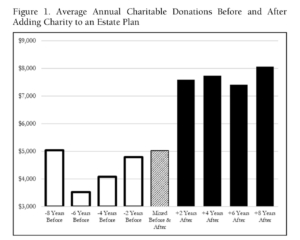
A fact that I love is that after adding a gift in their will, donors give more in their lifetime to that charity – by 77%! It is as if you have moved mental accounts once this commitment has been made, and are being treated as a member of the family (fundraisers can be reluctant to ask for legacy gifts fearing it will impact in year gifts but the reverse is true)
The Emerging Potential of Longitudinal Empirical Research in Estate Planning: Examples from Charitable Bequests Russell N. James III*
Think about the ways that you can make your charitable asks meet these different mental accounting pots.
https://marinajones.uk/wp-content/uploads/2024/12/IMG_3662-1.jpeg11141144adminhttps://marinajones.uk/wp-content/uploads/2022/12/f2b903e010104f5aa61ea1821a685913.pngadmin2024-12-24 13:00:382024-12-29 15:39:20Christmas money is different to other money…?
Any gift you can give make whatever size makes a huge difference…
And we are asked to know what 1p, £1, or £1m could do for our cause.
What difference do these micro-donations make?
Is microphilanthropy a new thing?
First what is a microphilanthropy? The clue is in the name they are small gifts. It has been defined, in the US, as gifts from 25c to $10, and is sometimes called ‘spare change philanthropy’.
Recent technological advances claim to have revolutionised the microphilanthropy giving space – from Amazon Smile, to rounding up at the supermarket, the ways we can make frequent small donations has expanded. But from the Biblical widow’s mite, small gifts have been making a mighty impact on the philanthropic landscape – and not just on how much we raise, but how we engage with supporters.
A note on size of gift – micro in monetary value does not mean it has no meaning to your donor, or charity. In the Biblical account (Luke 21:1-4), Jesus describes a poor widow putting in two small coins to the Temple collection and says
“Truly I say to you that this poor widow has put in more than all; for all these out of their abundance have put in offerings for God, but she out of her poverty put in all the livelihood that she had.”
Just because gifts are small in monetary value does not mean that are not significant amounts to our donors.
Here are two historic examples of regular microdonations from fundraising history. They illustrate why these are powerful tools that we can use to build the philanthropic tribe, and explore why they work.
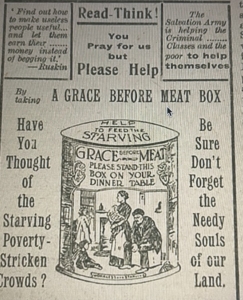
Salvation Army – Grace Before Meat
As part of its encouragement of regular and mindful giving, the Salvation Army mass produced ‘Grace Before Meat’ donation boxes in the late Victorian period. These were to be put out on the table, so that when the family was saying grace before a meal they would be reminded of those less fortunate, and develop the regular habit of putting a small donation in the box. Salvation Army collectors regularly visited houses with these boxes to collect the takings.
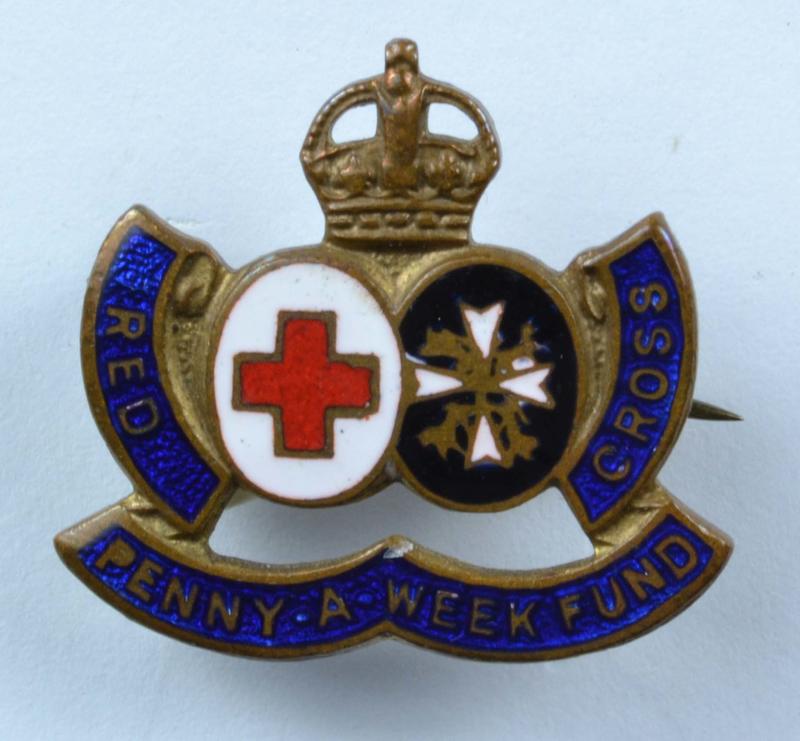
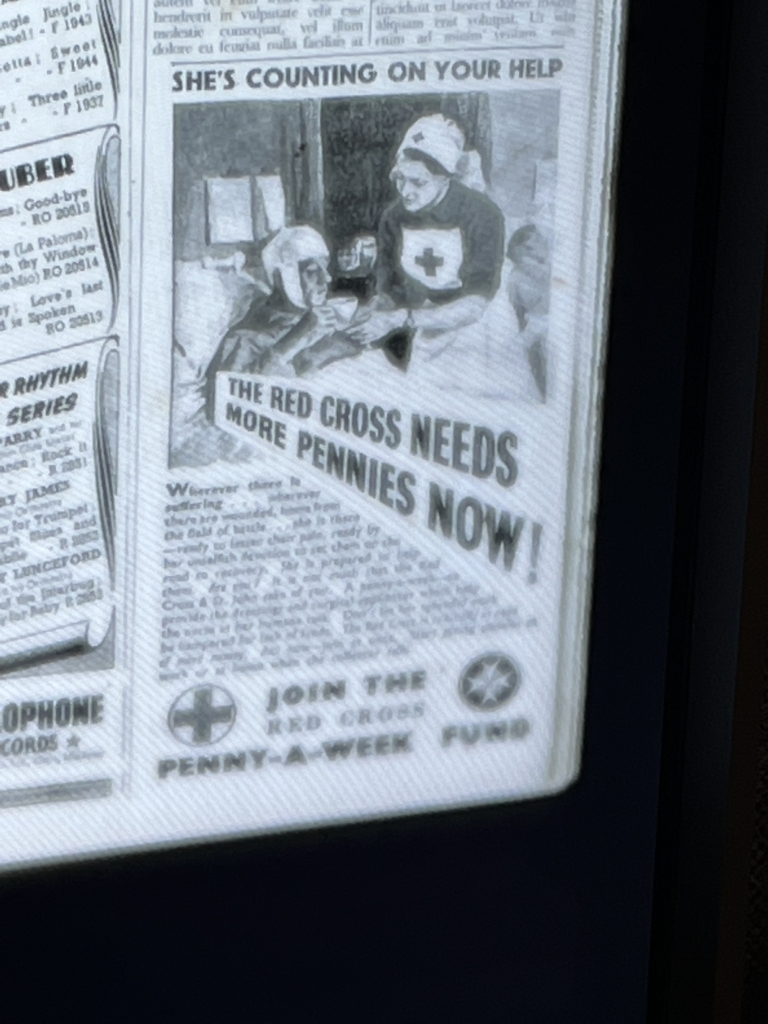
British Red Cross – Penny a Week
During the Second World War the Duke of Gloucester spearheaded a Penny-a-Week campaign for the British Red Cross. This worked through habitual donations, people knocking at the door to solicit the penny a week and was also via Trade Unions introduced as one of the earliest form of payroll giving.
Why do these schemes work?
Habits and Behavioural bundling – we find it easier to do something if we do it regularly with another behaviour, for example you can only listen to your favourite podcast when you go to the gym, or treat yourself to a sweet treat when visiting with a relation you don’t like. Coupling two behaviours together helps us maintain and sustain them which is why the Salvation Army ‘Grace Before Meat’ works so well – they are linked and repeated. This form of giving also has the added bonus of linking to our natural human desire to reciprocate – we think ‘I am about to eat a lovely meal, I can do something nice for others who do not have what I have’. (Today we see it with Giving Tuesday, hot on the heels of Black Friday – the need to do something good for the world after indulging in the consumerist excess of purchasing gifts for yourself and loved ones.)
Social signifier – the ‘Grace Before Meat’ donation box and the ‘Penny a Week’ collecting box could be put on display demonstrating to anyone visiting your house how philanthropic and charitable you were. And encouraging visitors to give as well.
Norming and conforming behaviour – the more you see these boxes, or the thank you badges that people were rewarded with or pre printed receipts sent out by the Duke of Gloucester the more normal this behaviour was seen amongst your social group and the more you would want to imitate it by supporting, or getting your own donation box.
Pattern completion – humans want to create and complete patterns. Have you ever done a 30 day Yoga challenge? Or filled a Smartie’s tubes with 20ps for Brownies? Or spend extra time at a museum to complete the stamp trail? We want to complete the challenge. We have made that the commitment, whether publicly or privately, and feel duty bound to stick to it. So completing a time limited giving of a ‘Penny a Week’ feels like both an achievable goal, one that we have committed to, and once we start we do not want to break the pattern!
The Goldilocks effect of friction …
The Goldilocks effect says we don’t want too much, or too little, like Golilocks and the porridge in the fairy story, we want the middle option that is ‘just right’
Often with giving we talk about reducing the friction and effort that the donor needs to make to give you a gift – if it is too hard, too many clicks, too many forms to fill in then it it is ‘too hard’. and donors lose patience and abandon the gift.
On the other hand. it can be ‘too easy’ and requires too little thought or engagement and the donor might not know what charity they gave to, how much or why.
So sometimes, like Goldilocks, you need the ‘just right’ amount of friction – what is powerful about these two historical examples is that they require a low level of repeated effort – just the right amount of friction – to engage with donating.
It is important to remember for every donation you give you get a hit of the happy chemicals (dopamine, oxytocin, serotonin and endorphins). So a microdonation of microphilanthropy = microdose of happy chemicals. Once someone is signed up for a Direct Debit – donors can forget about it. Seeing it on the bank statement doesn’t give you the ‘warm glow’ or the same rush of happy chemicals as the active act of giving. How can you keep that happy hit going by just the right amount of friction?
And remember when it comes to these small micro donations … every penny does make a difference
Over 1million EUROS are donated through coins in the Trevi fountain each year which supports Caritas which amongst other things provides 100 families a day with access to a free supermarket.
When the Roman Baths in Bath banned throwing coins into the water donations went down £90,000
How could you use this in your fundraising?
How can you remind people regularly of the joy of giving and what their donation does?
How can you provide an option to round up?
Interestingly rounding up helps reduce the psychological pain of paying – and as humans we prefer round numbers. At petrol pumps 56% of transactions end in a round number, we round tips up to a round number and supermarket donations.
How can you provide regular injections of the happy chemicals to your supporters?
How can you bundle the giving behaviour with another behaviour – a treat for them, or encourage them to give for a duration?
How can giving help the donor signify to the wider world their identity and who they are?
How can you help donors complete a pattern of giving? A durational gift?
How can you include good friction into your supporter journey to connect with supporters?
https://marinajones.uk/wp-content/uploads/2024/10/OIG3.7p6GwWXt5AzuzZikWPX7.jpeg10241024adminhttps://marinajones.uk/wp-content/uploads/2022/12/f2b903e010104f5aa61ea1821a685913.pngadmin2024-10-24 18:16:072024-10-24 18:16:07Every little helps …. Microphilanthropy then and now
There are thousands of tiny design choices that help make our interactions easier and simpler as we move around the world. This design architecture makes it easier for our brains to process what is asked of us.
And on restaurant menus – and you can use these to help with your fundraising here and here.
But, we also see it in bathrooms – so what do we see and why does it work.
So here are some ways that behavioural nudges in bathroom design could be used to add nudges to your fundraising
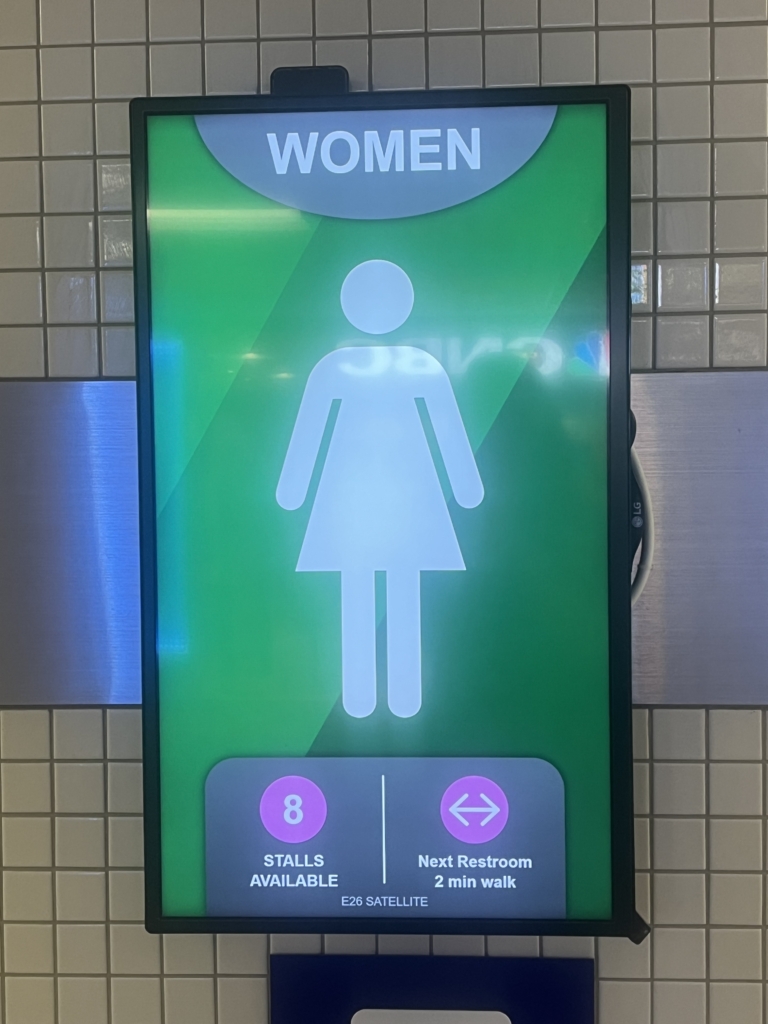
1. Make it easy – colour coding & availability
These WCs at Kings Cross station have lights above the stalls – green for free and red for occupied (this lighting scheme is also used in car parks).
Green in travel means go, and red says stop (also danger, anger, love and lust). Red traditionally means warning, and gets our attention – our primitive brains have evolved to respond quicker to red, and this quicker processing answers the evolutionary imperative and keeps us safe and away from danger.
So, if colours have this powerful and innate reaction in our brains, how can we use them to help our fundraising? To help guide our donors and to increase the fluency of a donor journey?
And, what colour should your donation buttons be?
Red for attention and urgency? If we can process it faster and know it grabs attention? Does red prime people to stop? Or increase the sense of urgency and demand action?
Or green for go?
Or a contrasting colour to your brand colour to stand out in a different way?
(I have not seen any experiments or data to show what works for one charity – we need to test the most impactful colours with our donor base and with specific appeals)
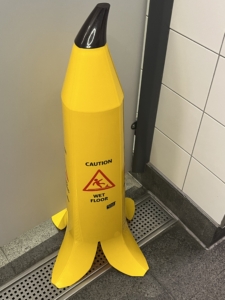
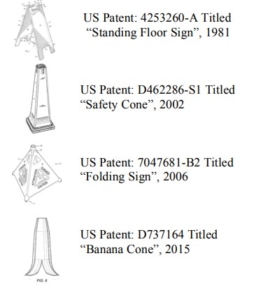
2. Why do banana skin safety cones increase safety?
We have a pre-existing knowledge that bananas are slippery.
This knowledge has been around since 1800s (or as long as people have eaten bananas and dropped them onto a hard surface). In the 1800s bananas were popular in New York but poor sanitation meant rotted on the streets and became slippery and the comedy gag developed. This well known trope is recognised by children and adults and in different cultures.
So scientists applied this knowledge to the safety cone – testing various shaped warning signs to warn people.
So banana shaped safety warning codes attract our attention because they are a novelty shape and colour and it links to our pre-existing knowledge that bananas as are slippery. The tests demonstrated that a banana shaped warning code reduced incidents and accidents.
How can we use our supporters pre existing knowledge of tropes or shapes (or fruit) to inform behaviour?
3. Feedback loop
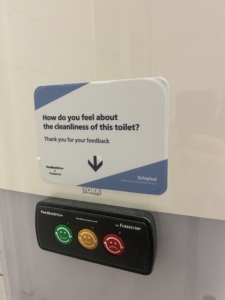
We appreciate immediate feedback that demonstrates the instant impact of our actions and choices – pressing a button gives us a reward – an ego boost – for contributing our opinion. This feedback about the cleanliness of the toilets gives us positive way to feedback. These buttons also enhance our agency by adding to our illusion of being in control . – it also links into the Ikea effect that we value something more if we have been involved in the construction of it. Offering feedback is a way of engaging and demonstrating our connection.
How can we ask for feedback from our supporters on the impact they make? That gives them an ego boost for participating, allowing us to quickly adjust our behaviour.
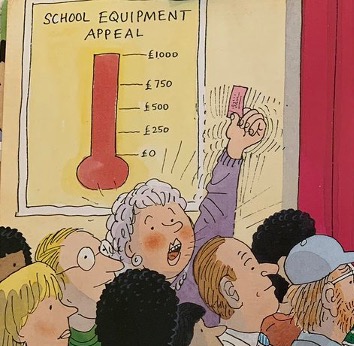
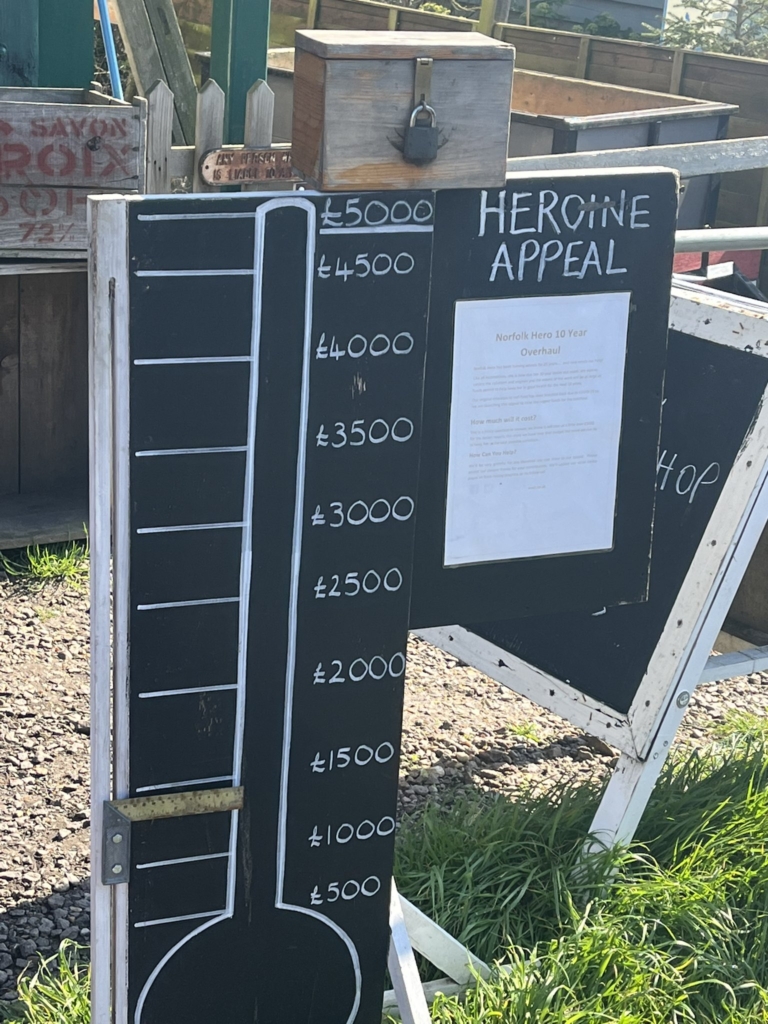
It can be something as simple as seeing the line rise on the fundraising thermometer – online, or a more old fashioned physical one likes these examples
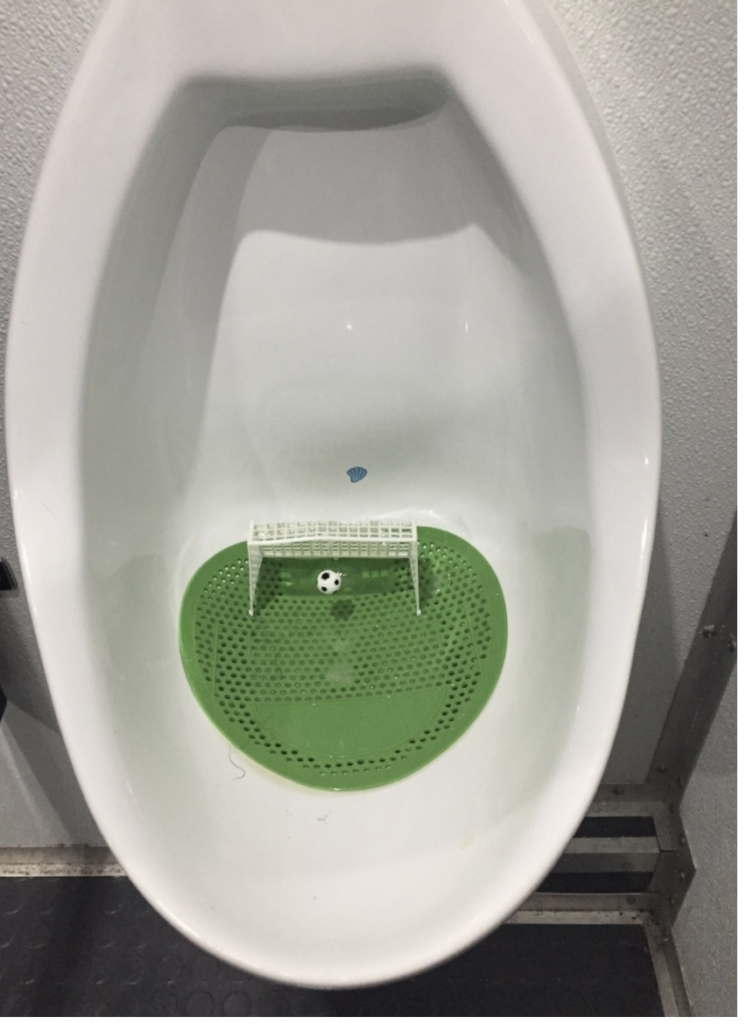
4. To pee or not to pee
An enormous amount of scientific time and effort has been spent trying to get men to reduce spillage when using urinals. A few notable examples:
Aim at the goal Aim at the fly
The fly example (right) at Schiphol airport reduced spillage by 80% and reduced cleaning costs by 8% – showing the power and efficacy of these fun but simple nudges.
And a drunk driving one…testing if you can ‘drive’ straight.
How could you apply this to your fundraising? And make a simple process more fun and engaging?More of a rewarding game?
5. Clear expectations
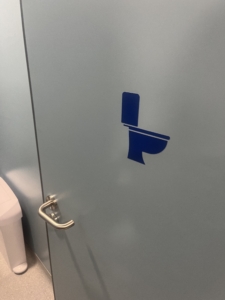
Public spaces are increasingly using visual signage – these from the People’s Museum in Manchester show you want to expect in the different WCs. We process images faster than words so this speed up cognitive processing and makes it easier for our brains to know what behaviours are expected.
How can you use visual signage and infographics to help donors process the information that you want them to know and understand what action you want them to take?
6. Catch people where they are
The mere exposure effect says that the more we are exposed to a message, the faster and easier it is for our neurons to process. The more we see the message, the faster we get at processing and understanding it.
How can you prime them to think about making a donation when they are in the WC?
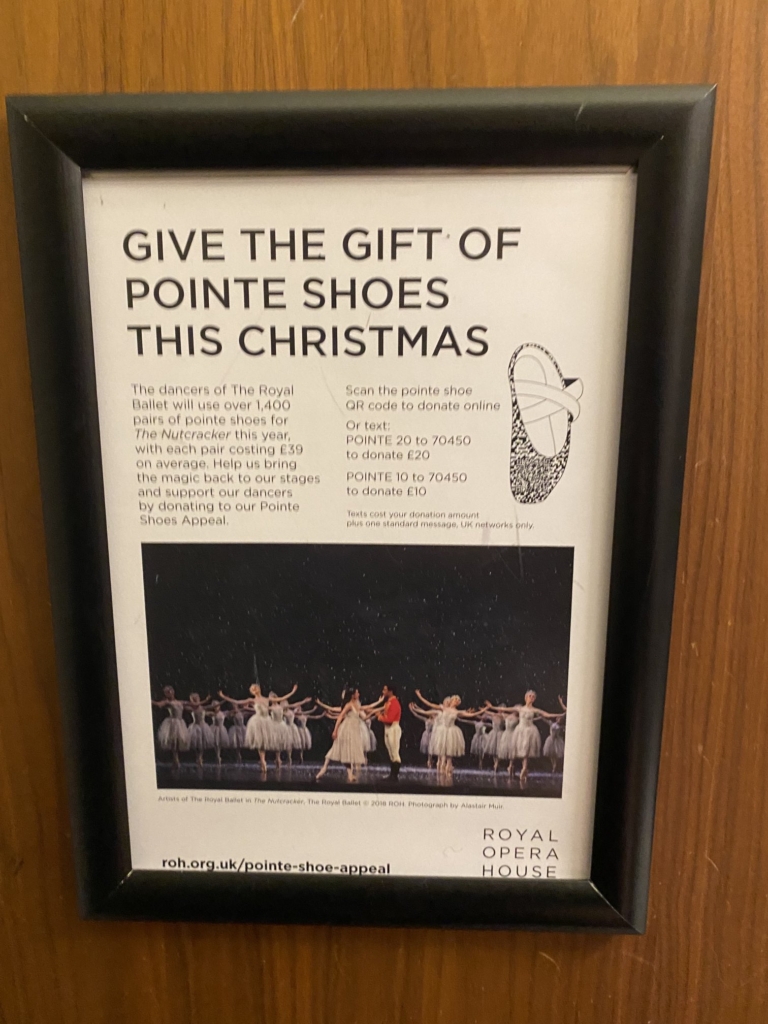
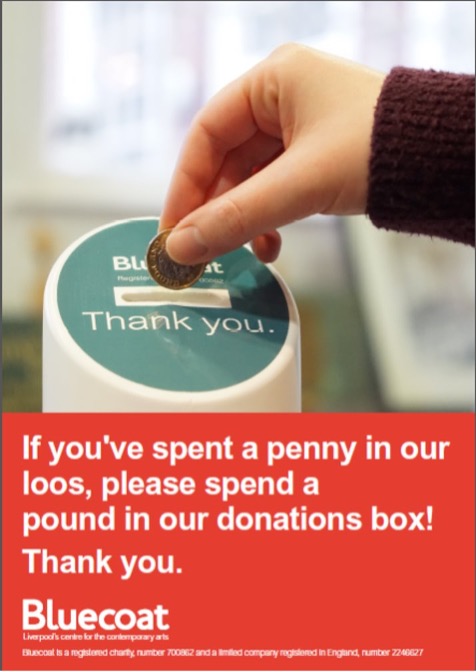
I am a big fan of posters on the back of toilet doors. Repeating messages that they have seen in other campaigns can nudge towards the desired behaviour. The Bluecoat example below shows someone giving and invites you to make a gift – when you see the donation box in the foyer you have been primed to put money in it.
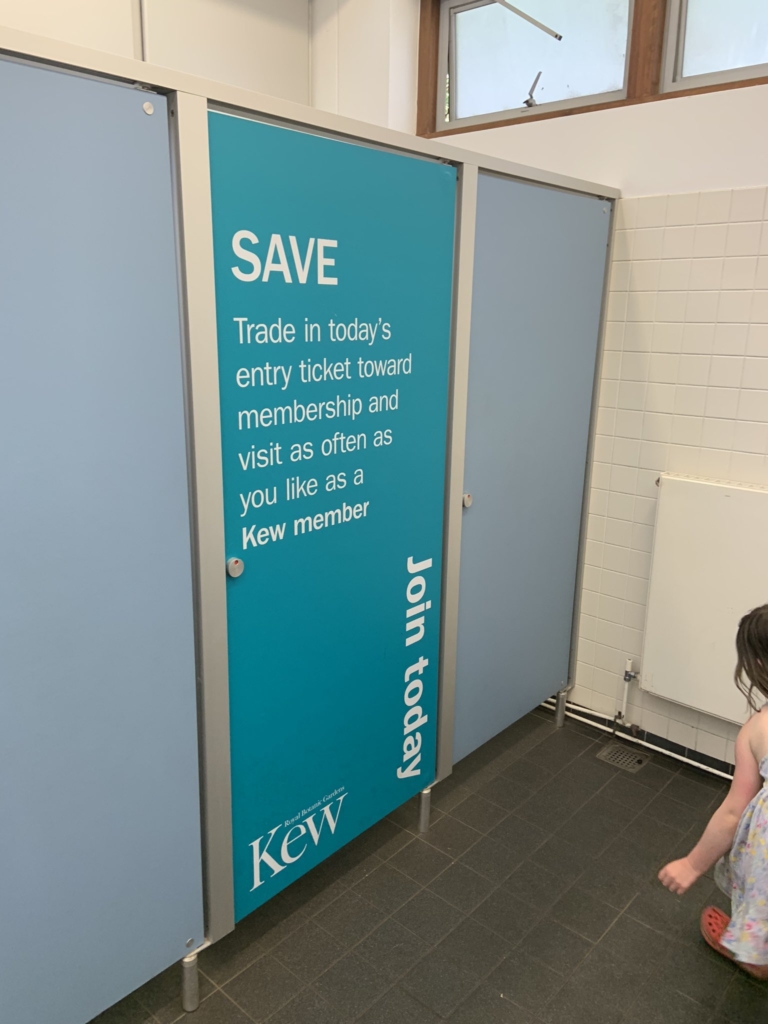
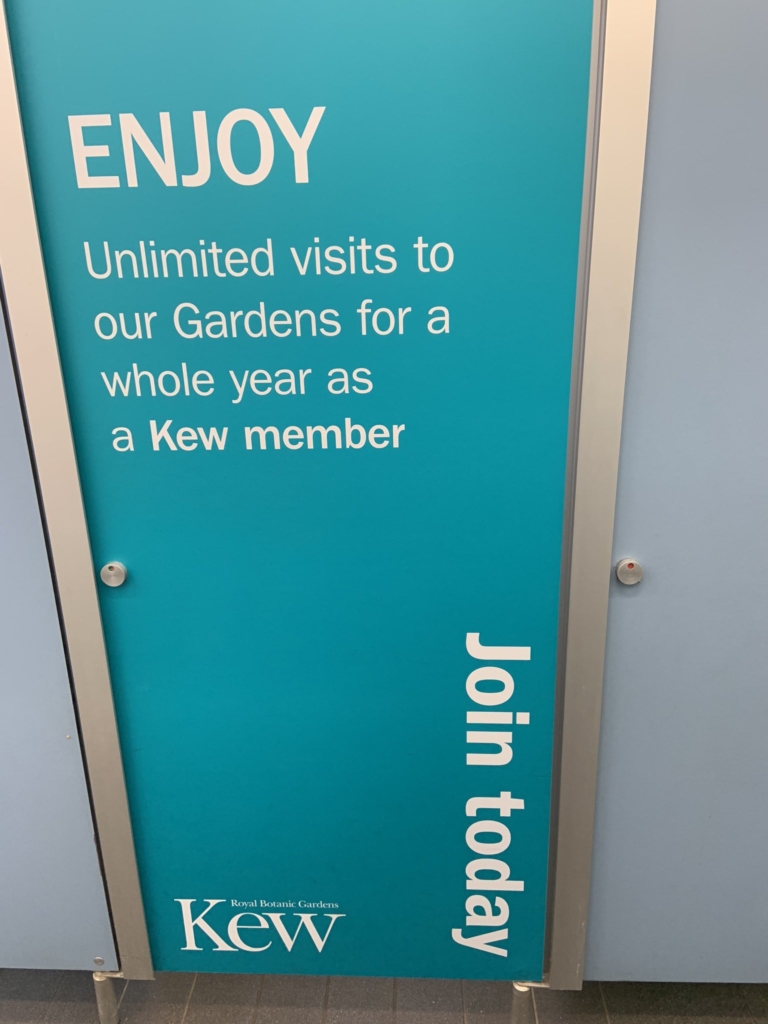
Or use the doors as a whole advert like these bold ones at Kew Gardens.
7. Donor recognition can go anywhere – even bathrooms!
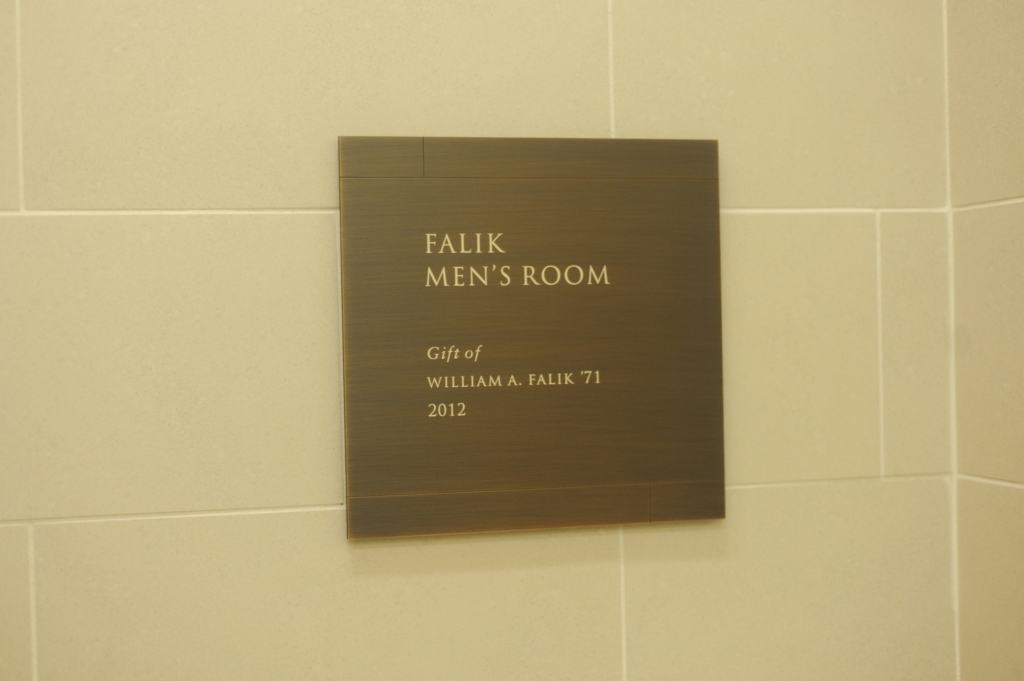
Harvard graduate William Falk wanted to fund a fellowship in public interest law to honour his father but when it came to naming rights he joked with the dean “The only thing I’ve ever been able to name with a name like ‘Falik’ is a restroom.” (pronounced ‘phallic’) and so his gift is recognised there.
After hearing that philanthropist Heidi Roizen was turned down by Stanford University with her offer of a gift to name a bathroom, Brad Feldman offered to name a bathroom at MIT but they also deemed it ‘inappropriate’. His local college in Boulder heard about it and invited him to make a gift to name a bathroom there and so he did. They received a donation of $25,000 and his donor credit includes this quote up in the bathroom
The best ideas often come at inconvenient times — don’t ever close your mind to them.
This has inspired him in a philanthropic bathroom donating career – he now has four bathrooms – each with a $25,000 gift his decided value of a bathroom naming right!
Another donor at the University of Pennsylvania has this quote up to recognise his gift
“The relief you are now experiencing is made possible by a gift from Michael Zinman”
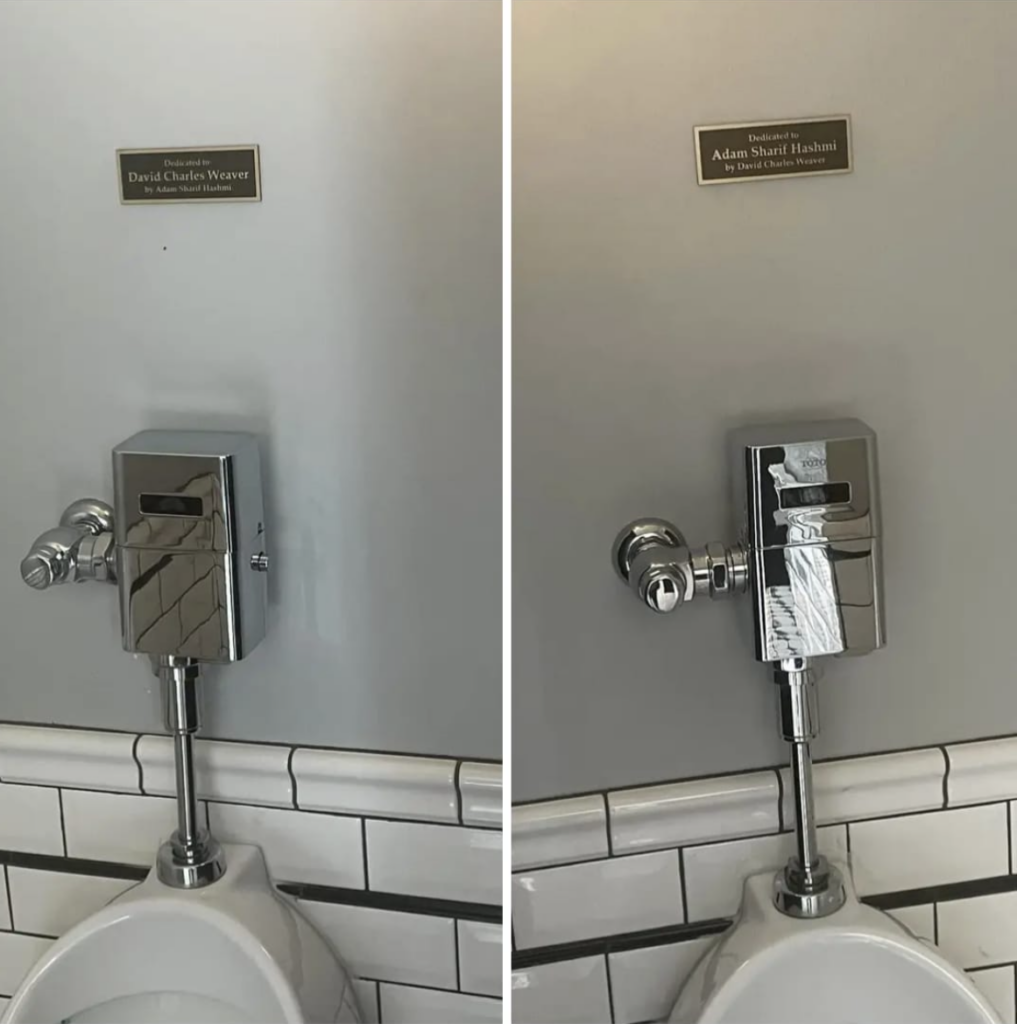
Naming rights is not just a solo activity – it can be a fun way to celebrate your friendship – these two urinals are next to each other – Adam gifted one to his friend David, and David reciprocated and named one for Adam.
And on restaurant menus – and you can use these to help with your fundraising here and here
https://marinajones.uk/wp-content/uploads/2024/07/Designer.png10241024adminhttps://marinajones.uk/wp-content/uploads/2022/12/f2b903e010104f5aa61ea1821a685913.pngadmin2024-07-09 20:47:092024-08-02 12:10:18Make it easy pee-sy; what can fundraisers learn from WC design
We all know that money appears in funny ways to fundraisers. Funny times and funny amounts.
We also know that donors don’t always know how much we need, what is the most appropriate amount to give, what will make a difference.
To make things easier for a donor and to reduce the brain power needed to process these decisions – we break down gifts into tangible amounts so that the donor can see the impact of what they are giving – a life changing vaccine, a warm meal, restoring a square inch of a Renaissance masterpiece, a new theatre or scanner. Their contribution to the wider problem and how they can help solve it becomes meaningful and concrete (something called then concreteness effect).
From a behavioural insight point of view, we want to keep the process friction free and easy for the donor’s brain to process and make the gift. Our brains are lazy and like to stay in the automatic system one intuitive space – it uses far more energy and slows us down to move into a more analytical space and ask questions about the amount. But sometime friction can be a good thing in the donation process.
This is a powerful and effective tool – and one that we should keep using.
However, this approach also makes it about us and what we need.
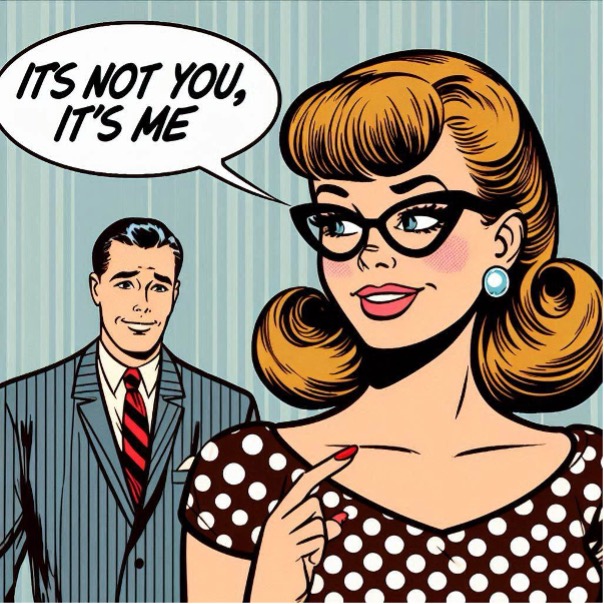
It makes it about us the charity, not them the donor.
What if we make it more about the donor?
Their choice of an amount that is meaningful to them.
When testing ask strings – I tested a £20, £50, £100 ask string and then a £100, £50, £20 knowing that the science should show that the higher anchor (starting with £100) generated a higher average donation as donor’s saw the highest number first. 97% of the time we saw people did not change from the preset defaulted numbers. But when the anchors were removed and the donation amount was left empty we saw much higher average donations.
People give in amounts that are salient to them (not always to you and the campaign)
Here are a few historic examples:
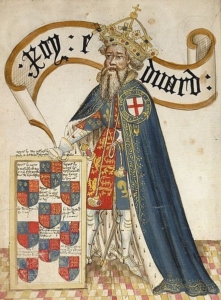
Edward I on his son’s 14th birthday fed fourteen hundred paupers, and when his son was 17, gave alms to seventeen hundred people
Edward III on his 50th birthday 50 poor men get shoes to celebrate
Worth your weight in diamonds. There is an ancient Hindu ritual where individuals were weighed against gold or grain and made a donation equivalent to their weight – this is known as tulabhara and often people did it on their birthdays. There was a custom to weigh the king on his solar and lunar birthdays in precious stones (and in diamonds for a diamond jubilee) and the jewels sold and monies given to charity. You can see the ceremony from 1946 on this newsreel https://www.youtube.com/watch?v=IEkdZlWCd4I&t=116s
We see these grain offerings in sixth century of Europe as well in the writings of Gregory of Tours which also records the tradition of weighing a donor for gifts. This is also done as a thank offering for recovering from being sick. The Abess of St Servatius was weighed at Our Lady of Buurkeerk in Amsterdam in 1444 to determine the amount the donation.
Legacy doles of food to the poor often fall on the testator’s birthday, for example, Elizabeth Nickus in c19th Bristol.
In 1393, wool merchant Marco Carelli signed over his entire fortune to the fabric fund at Milan cathedral living the last two years of his live as a pauper. The date he signed the declaration – the Assumption – the day that Mary, mother of Jesus was taken up to heaven – to reflect his donation to Our Lady that the cathedral was dedicated to. The choice of date matters.
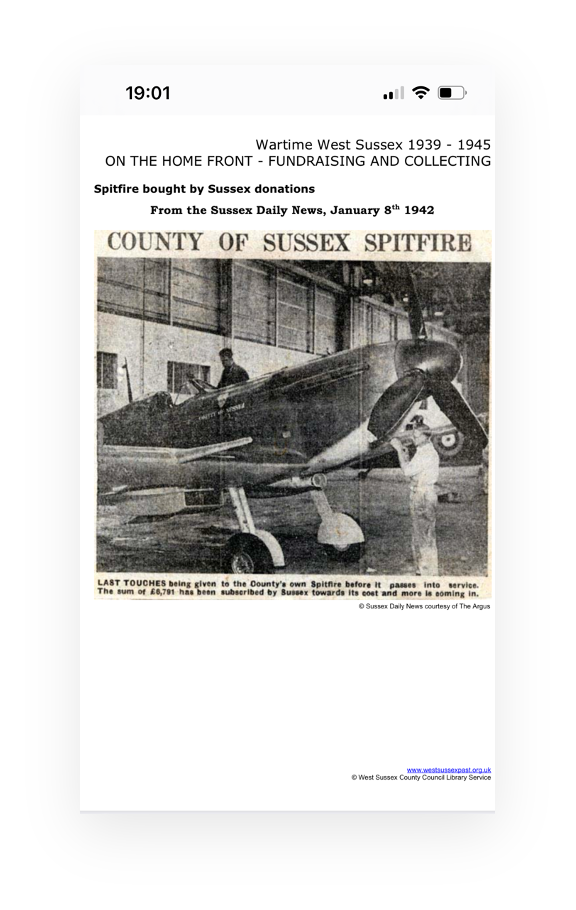
In Liverpool, during the Second World War, funds were raised to fund Spitfires to fight the Nazis. At a police station a gift was left ‘for the Spitfire Fund’ by a “lady of the night” – the amount? £3 which was the standard fine for soliciting.
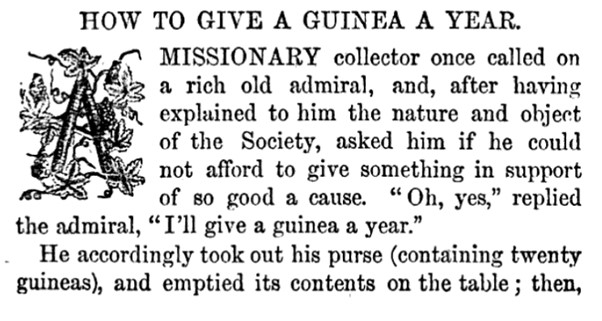
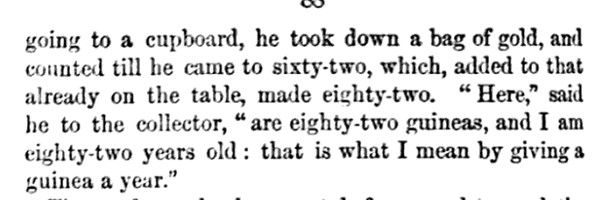
When we think about annual giving we tend to think of a gift every year – but this 82 year old admiral turned that on its head (in 1867) when asked by a missionary collector for a gift he said “a guinea a year” – he gave 82 guineas one for each year of his life. Again a number salient to him rather than the collection.
More recently we have seen Swifties (fans of Taylor Swift) support causes close to Taylor’s heart giving in $13 amounts. $13 is Taylor Swift’s favourite number so it an important way of identifying your philanthropy and allying with your ally and what they stand for. Taylor Swift also donates in $1989 amounts – linking to her album and birth date.
In the National Theatre’s campaign they proposed making annual donations on Shakespeare Day (23 April) to support the creation of the theatre.
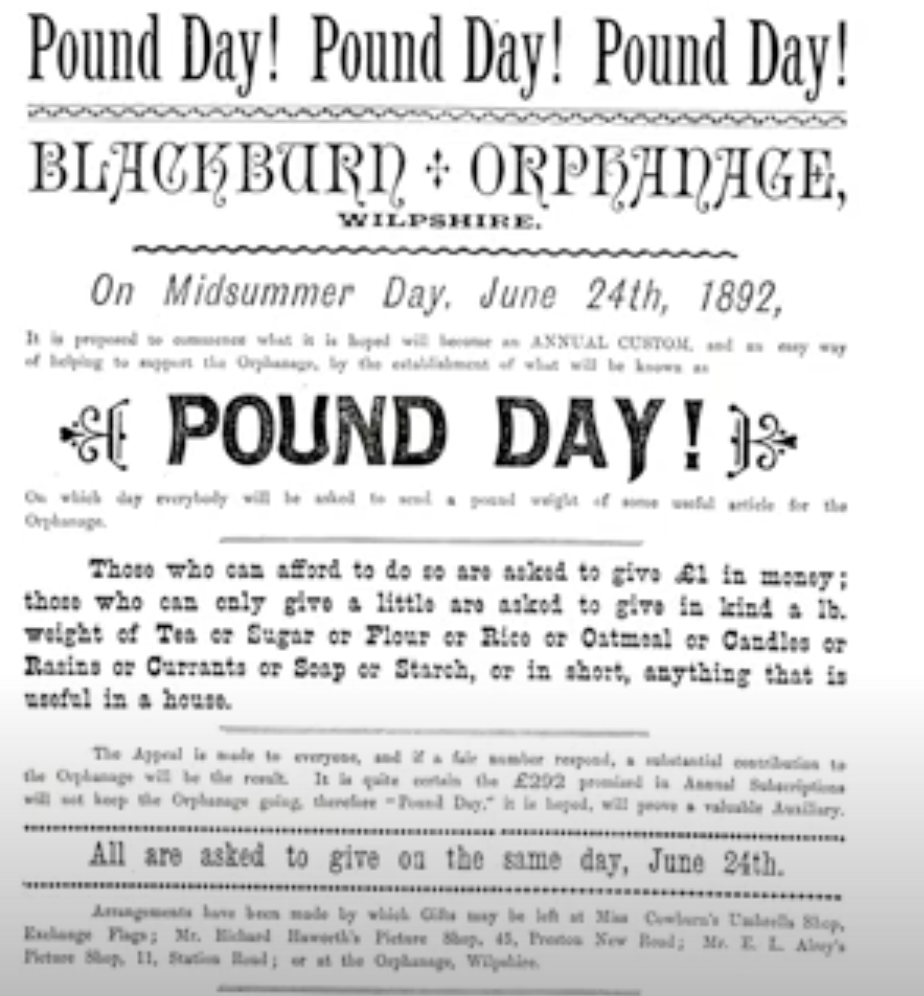
1891 Blackburn Orphanage founded and in 1892 started a Pound Day asking people to donate a £1 and those that could not afford to were asked to donate a pound of sugar, tea or flour or whatever they could afford.
What might be going on in a donor’s brain here?
Part of it is there are just numbers that mean something to us and our identity – our age, our favourite number, an important date (I have one charitable direct debit that deliberately goes on a certain date).
There is also an effect known as the Ikea effect – named after the furniture store – where we value something more because we have helped create it. So we value a Billy Bookcase more because of our involvement in constructing it.
How can donors help construct the gifts they give – the amount, the date?
Sometimes too prescriptive a list can cause reactance – when we react against being told what to do. Sometimes the list does not give us the option we want – the options are too small and not meaningful enough, or too big and beyond our capacity.
When we give donor’s the autonomy and empower them to make a choice they can make gifts that are more personally meaningful to them.
People want autonomy and agency and choosing the amount gives them that.
However, how this choice is presented is important. If it is too open an offer such as ‘pay what you feel‘ we might nudge the brain into a system two space and ask ‘how do I feel about this? and what value does that mean? And by pausing to ask these questions we have no frame of reference and can stop and not make the decision.
The frame of the question is important here.
How could you give your donor’s more autonomy and choice about how they make a gift and how much?
How can you invite them to make gifts that mean more to them?
So testing what works for your audience and donors works.
When Greenpeace in Argentina ran a telephone campaign seeking one off gifts they tested various options including Mother’s Day, National Argentina day – and the one that got the highest donations was gifts linked to their pet’s birthday.
So perhaps there is a blended way to offer a combination of the standard anchoring, defaults and social norms with some nudging towards a personally meaningful amount.
How do you make it about them?
Not about you?
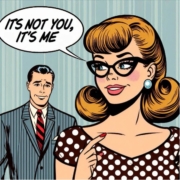
https://marinajones.uk/wp-content/uploads/2024/05/its-me-1.jpg604604adminhttps://marinajones.uk/wp-content/uploads/2022/12/f2b903e010104f5aa61ea1821a685913.pngadmin2024-05-26 09:27:182026-03-20 21:07:24It’s not you, its me
Would you ever write a blank cheque? Or have you ever received a blank cheque from a donor?
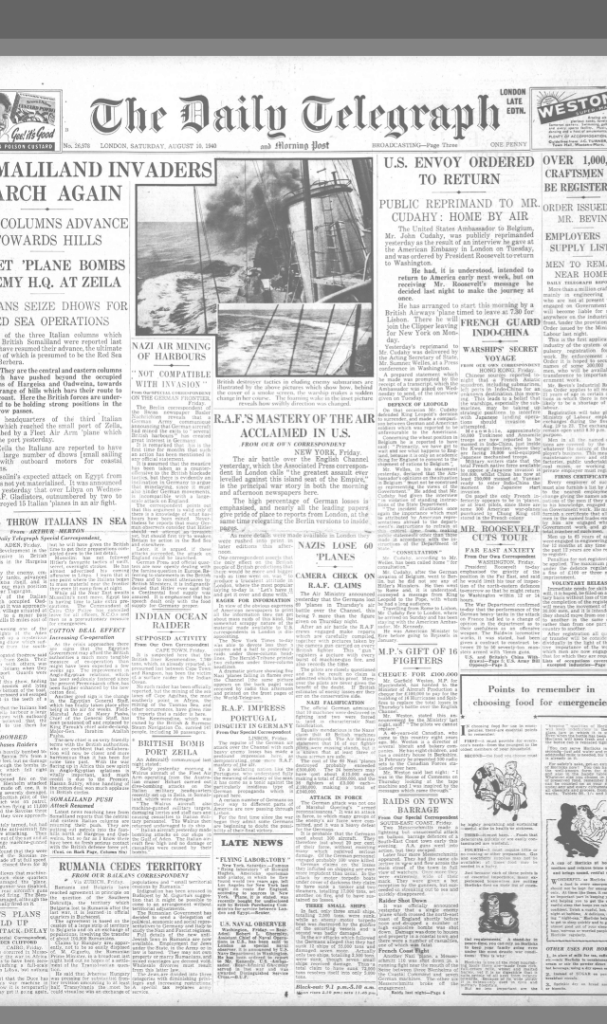
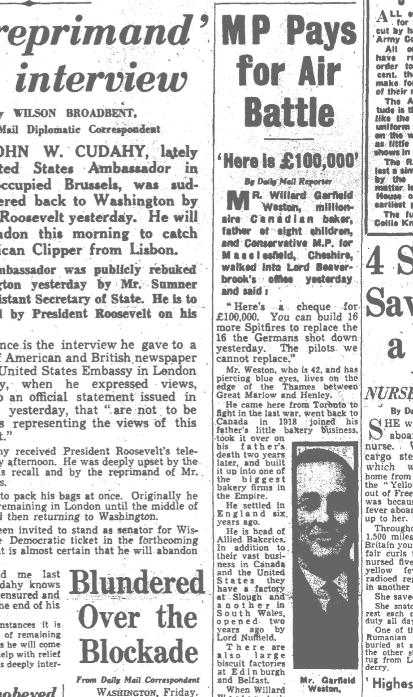
In August 1940 16 spitfires had been shot down in the English Channel and 13 pilots were killed Horrified by what he saw, Garfield Weston reacted – yes that Garfield Weston of the Garfield Weston Foundation that has given away over £2bn to good causes. At that time he was a businessman, entrepreneur and also a member of parliament in the UK.
Garfield Weston gave a blank cheque to Lord Beaverbrook saying:
‘All I can say is that I’ve a blank cheque here. You know, Max, only God can replace those boys, I’d like to replace the machines.’
Garfield Weston
This shows a total trust from a donor that we don’t always see – a complete trust that you will use the money you need for the purposes they want.
How did Lord Beaverbrook react?
He burst into tears. (who has had a gift so generous, or kind, that they have shed a little tear?)
Fundraising is, and continues to be emotional work, and we are emotionally invested in raising funds for the causes we support.
So what happened next…
First secure the gift.
Max Beaverbrook wrote in £100,000 in the cheque.
As good fundraisers know you should not waste an opportunity.
Lord Beaverbrook asked for permission to publicise the gift. Garfield Weston was reluctant and wanted the donation to remain private. But Lord Beaverbrook said “between you and me … there’s too [much] power behind this” and that if the gift was made public it would help raise over £1m. This incentive to do more good was too much to resist and so the story of this generous donation appeared in the papers (the Daily Mail mentions Garfield Weston’s ‘piercing blue eyes’).
Keeping up with the Joneses
The lead gift from Garfield Weston inspired J W McConnell another Canadian businessman to give $1m to buy a whole squadron.
We often use the inspiration of a lead gift to launch a campaign and inspire others to give.
Major philanthropists want to be seen to be supporting good causes and publicising gifts creates a powerful social norm about what your peers are doing – so publicity can help and inspire others.
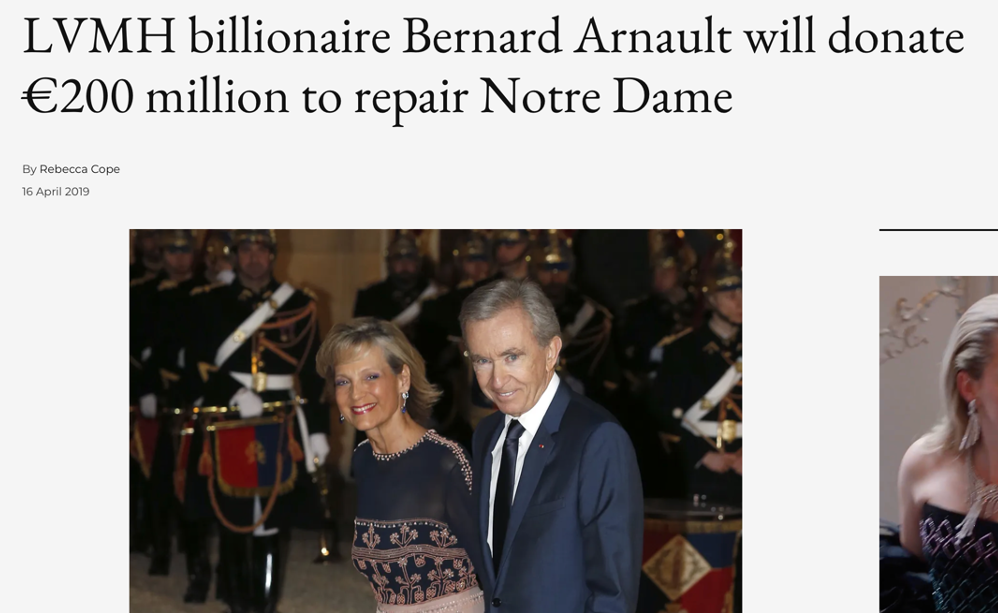
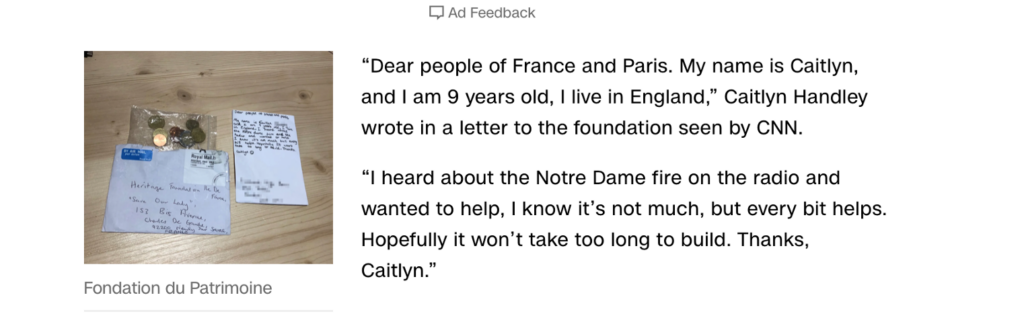
We saw similar behaviour after the Notre Dame fire. When one major donation was quickly followed by another – but as well as the big mega gifts our attention was also drawn to the smaller and more personal gifts. The two images below capture these extremes the 200 million and the 9 year old sending in her picket money. We tend to focus at both extremes of the gift spectrum. But like Notre Dame with spitfire campaigns – it was the big gifts and the small but mighty ones that attracted the attention.
Shopping list
So the promote the campaign, Lord Beaverbrook put together a price list of various engines needed but the Spitfire caught the imagination. On his list each Spitfire cost £5,000.
Now this was a made up number, the true cost was just over £12,000. So maybe not the most ethical approach.
This shopping list enabled every one to ‘do their bit’
A Merlin engine costs £2,000
Gun was £100
Spark plugs cost 8 shillings
60 screws cost 5 shillings
Rivet was sixpence
Why and how does this work?
When faced with a big target – financial or aspirational in changing the world (£10m or 2million starving children) donors can often worry that there small contribution is just a drop in the bucket and not going to make a tangible different to the cause. By breaking the total down into manageable chunks every person can see how their 8 shillings or sixpence is going to help and make a difference.
It reduces the cognitive load if we can see how one small – and real number makes the difference. And the realness and specificity of the number adds to our belief that it is a real number (we can sometimes mistrust a nice round number and have more belief that a mosquito net costs £5.20 rather than a round £5).
They can then exercise their moral imagination and see like this boy their gift in action….
Is that my rear tyre wheel mummy?
Every time one boy saw a spitfire he asked ‘Is that my rear wheel tyre?’ as he had donated his pocket money to the spitfire fund, and received a thank you from Buckingham Palace saying he had raised enough for the rear tyre.
Spitfires were constantly flying overhead so their personal donation remained salient and they were constantly reminded of the impact that they had. And to imagine that Spitfire was the one that they had contributed to. We often ask our supporters to imagine what their gift has done, but in this case they could see daily the planes in the air.
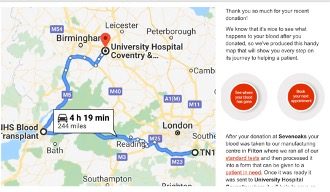
When you donate blood you get a text message after the donation to tell you where the donation has gone, with a map showing you where it is and in which hospital and that it has been used.
This is what happened to my blood after it was donated:
Isn’t that amazing? And a really powerful way to show donor’s the impact of what their gift is doing. What is the equivalent for your charity?
Receiving feedback like this floods our brain with happy reward chemicals.
As well as seeing the tangible impact of the donations we make, we like to see the progress we are making towards a goal – this is called the endowed progress effect.
This endowed progress effect is often employed in the famous fundraising thermometer. A device used by Mayor of Islington in August 1940. He sat opposite the Nag’s Head pub raising money (only interrupted for lunch and an air raid warning) with a giant thermometer marking progress hour by hour– he eventually raised £2,500 for spitfires.
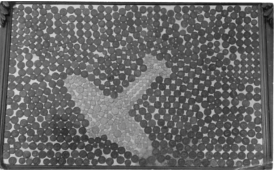
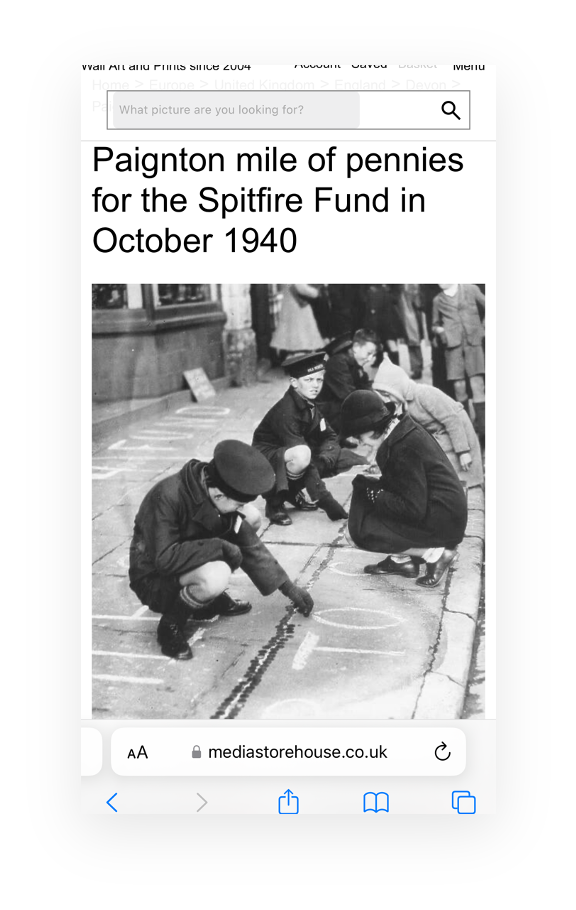
In Market Lavington – a village in Wiltshire – they created an outline of a Spitfire in the square and challenged the villagers to fill it with coins.
This image of a spitfire was created at the Green Dragon on 1941
Now we know that this uses something called the endowed progress effect.
You want some donors lined up at the start of the campaign to start donating, creating a powerful social norm, creating a bandwagon effect and showing that this is normal and anchoring people in what a normal gift looks like – if everyone is giving 6d, you will give 6d too but if others are giving two shillings you will follow suit. As we want to see our progress rewarded you would expect that the speed of donations would also increase as they near completion and people might be fighting over who gets to put that final coin down and complete the mission. Completing things is satisfying and proximity to success is motivational, as an individual realises they can make something happen.
Messengers like you
For some an authority messenger like Garfield Weston can be attractive and inspiring, but for others it can be off putting – it can make us react and say ‘well its fine for a millionaire entrepreneur to give but people like me can’t afford to’
However in this campaign they understood the power of likeable messengers who people could identify with. Donations came pouring in with testimonial messages of support such as:
“From all at No.15 Station Lane”,
“My week’s pocket money – Fred Smith aged 7″, “
“My first week’s old age pension – 10 shillings towards our Spitfire”.
Like all good fundraisers we know that testimony from real life donors helps create a powerful social norm showing other people like you are giving. This range of quotes from local areas, from children and pensioners enable people to identify with people like them.
So whether your regional identity, your gender, your employment status, your age was how you identified there was a messenger for you.
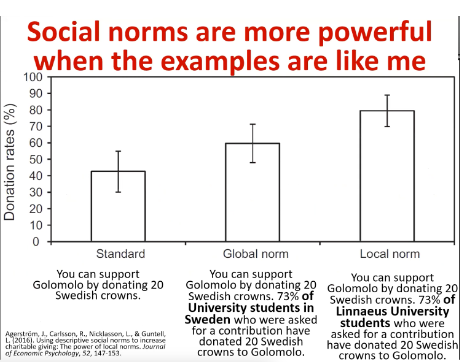
Now this might seem common sense to you and I think is one of the special things about looking into fundraising history – we see things that we instinctively know work as fundraisers, as humans interact with humans, about how we communicate – and in recent years we have the science to back that up – that might be academic papers, it might be fMRI scanners literally seeing what is happening inside our brains in certain conditions or often with lab tests with university students being studied for prosocial behaviour. This example comes from academic research and shows the real power of social norms when ‘people like me’ are used – generosity increases as the other people are identified as being nearer you – university students in Sweden are more generous than just other people, but university students from your university encourages even bigger donations.
All of these academic and other studies confirm what we know about the philanthropic psychology and human behaviour that the old wisdom from the past instinctively knew. But now we know it we can apply it rigorously and target the interventions we know work to help provide more ways to offer people ways to help change the world.
Name Letter effect
Have you ever heard your name spoken through the noise of a crowded pub or party?
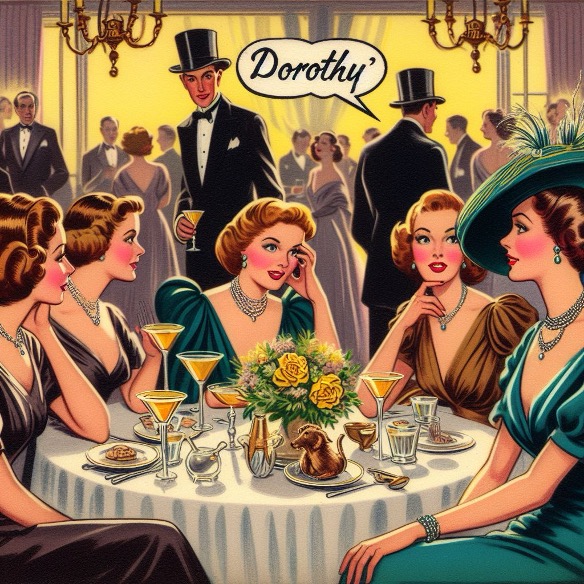
In behavioural science the ‘cocktail party effect’ is essentially selective attention. At a cocktail party or any loud social setting, we can hear our own name amongst the hubbub – we are the most important to ourselves and we pay attention to things that resonate with our sense of self.
This draws on a deep identity connection to our own name. Ever since we were born our neurons have been trained to react and fire together when they hear our own name (or names similar to our own).
So as a Dorothy you are wired to hear and pay attention to Dorothy.
And a Canadian Dorothy used the power of her name to fundraise …
Dorothy wanted to raise funds to support the Spitfire fund, so she sold some of her evening gowns to raise money. She printed cards that said
Is your name Dorothy? If so, rally around and help buy a Spitfire for Britain.
She and her friends posted them to every Dorothy they knew and themed their fundraising around Dorothys
20,000 tea parties all hosted by someone called Dorothy
All Dorothy musical evenings
Auction of actor Dorothy Lamour’s sarong
This created momentum and they took advantage of the bandwagon and excitement to get more Dorothy’s involved – t this spread across to US with the “Vancouver chapter of the Canadian Dorothy Spitfire Fund is seeking noted Dorothys of the United States,”
“Dorothys Plan Galloping Teas,” – 25 women called Dorothy invited friends to tea charging 25 cents each – and like a chain letter they passed it onto other Dorothys of their acquaintance.
Dorothy Thompson, journalist and broadcaster donated a copy of her radio talk
Dorothy Parker was invited to write a poem
This global appeal successfully raised the funds and they bought a Spitfire which was named for the Dorothys that raised the money and called Dorothy of Great Britain and Empire .
But why does this work?
In 2008, data from seven emergency hurricane appeals were examined including Hurricanes Katrina, Mitch and Rita. Researchers Chandler, Griffin, and Sorensen found donors who shared an initial with the hurricane were overrepresented in the donors. So donors beginning with ‘K’ were 31% more likely to have given to support Hurricane Katrina relief in the 6 months after the hurricane.
‘M’ named people made up 30% more of the donor population during the two months period after Mitch devastated Honduras and Nicaragua in 1998.
Sharing the same first name or letter has also been shown to help donors identify more with fundraisers (Burger, Messian, Patel, del Prado& Anderson, 2004 and Bekkers, 2010 in an article entitled ‘George gives to geology Jane’)
A lab experiment showed a request to give to a child in need resulted in 61% giving but adding the name, age and a picture increased giving rates to 90% (Kogut, Ritow, 2005)
Learning the fundraisers’ name increased the average gift size by 50% (Bohnet and Frey, 1999) For alumni fundraisers donors were more likely to give when their first name was similar to the name of the university.
Knowing someone’s name builds a connection, a relationship, when we know the name – the name of the beneficiary – even the name of the fundraiser we are more likely to give (people give to people!)
So Canadian Dorothy knew that innate and personal connection to a name as a rallying call to donate. (This is one of the reasons why decision science is fascinating – we know these things work, we have seen them used, maybe unconsciously used them ourselves, but as our understanding of the science develops we can prove they work, and test how they work and see what is happening inside our brains as these things work)
Naming Rights
Which brings me onto naming rights. One of the components of the campaign was the joy of raising the funds was naming the Spitfire.
Now when people are not just naming it for themselves and have a little creative freedom we can see some interesting names – Boaty McBoatface being a prime example, and the Greenpeace whale Mr Splashy Pants spring to mind (as well as the names of all the Scottish Gritters) And Spitfire names were no different. Some were conventionally named for the country that funded them such as Trinidad, or Hong Kong or Sheffield.
However, a sense humour was demonstrated in the naming of the planes
The Kennel Club named theirs the Dog Fighter
The ABC cinema chain named them– Miss ABCs (there were 3 bought)
Marks & Spencer named theirs ‘The Marksmen’ following in store collection
Woolworths named theirs Nix Six Primus (which referred to their pre-war policy of keeping all prices below sixpence – don’t waste a marketing opportunity to get your corporate message into a naming opportunity!)
Some were more traditionally named. One anonymous donor named a plane Heather for his daughter.
Interestingly the RAF faced a challenge similar to fundraisers today, with donors and their naming rights demands. There was a designated space on the plane where a name ought to go (9 inches by six inches) but donors wanted their names in all sorts of shapes, font and sizes even including coats of arms!
When planes were completed donors got a photograph and a certificate acknowledging their support and so they could see their plane. These were again used for publicity and to generate further funds.
Merch
Another important identity marker can be in self branding and wearing merchandise that aligns with the band, the cause or marks you out as you.
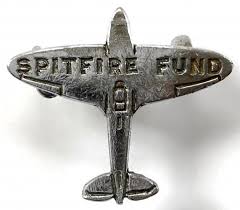
As part of the campaign an important visual symbol of your support of your local Spitfire fund was getting the badge. Some of these were your standard pin badge but many were shaped like spitfires and some were even made from the Perspex used in the windows of the planes. There were also bracelets made.
In certain towns and villages this became like not wearing a poppy on Remembrance Sunday – it would have been unpatriotic not to be seen to be supporting.
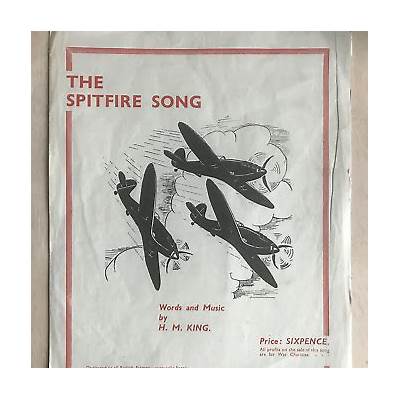
Strange how potent cheap music is
And what better than combining the power of the local identity with another powerful tool – the power of music, and rhyme.
The Spitfire Song was written as a fundraising song and it was customisable so you could add your local area name into the song e.g. Hampshire or Bournemouth
Again the importance of geography and local identity in fundraising
‘We’ll make one of their number, write our name upon the wing
When the planes are flying over, you will hear old Britain sing”
A Spitfire a Day keeps the Nazis Away – the Rhyme is the reason
The slogan of the Islington Spitfire Club was ‘each bob you pay keeps the bomber away.’
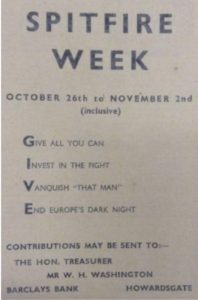
Or acrostic poems were made
Give All you can Invest in the Fight Vanquish ‘that man’ End Europe’s Dark Night
Why is that important? because we now know that we find messages more persuasive and more memorable when they rhyme and more accurate.
Using rhymes in campaigns can make them more memorable.
Creative and local fundraising
There was no centralised campaign and each community or group was empowered to fundraise and donate in ways that suited them.
We have already seen some creative examples, here are a few more … what links all of these that the methods are really linked to spitfires and the war
Penny on the red – every time the air raid siren sounded every member of the club had to donate a penny to the Shoreham Spitfire Club
6 pence was charged to view a crashed German plane in Kent to raise funds for Spitfires and in Dudley they charged sixpence to have a look at a Messerschmitt – band leader Henry Hall bought his band and they played They’ll Always Be an England and a dog called Jerry climbed on the wreck
A Mrs Clark charged a penny to see a deactivated mine and raised over £9 from 2000 visitors to it
In a London cinema, during an air raid, the manager of a cinema pushed a wheelbarrow up and down the aisle saying “the more you give, the less raids there will be” as he solicited donations.
10 a penny club – for every ten aircraft you had to donate penny – the fishmonger in Stevenage had a chalk board outside the shop to mark off shot down planes – they raised £454 in the first 5 days
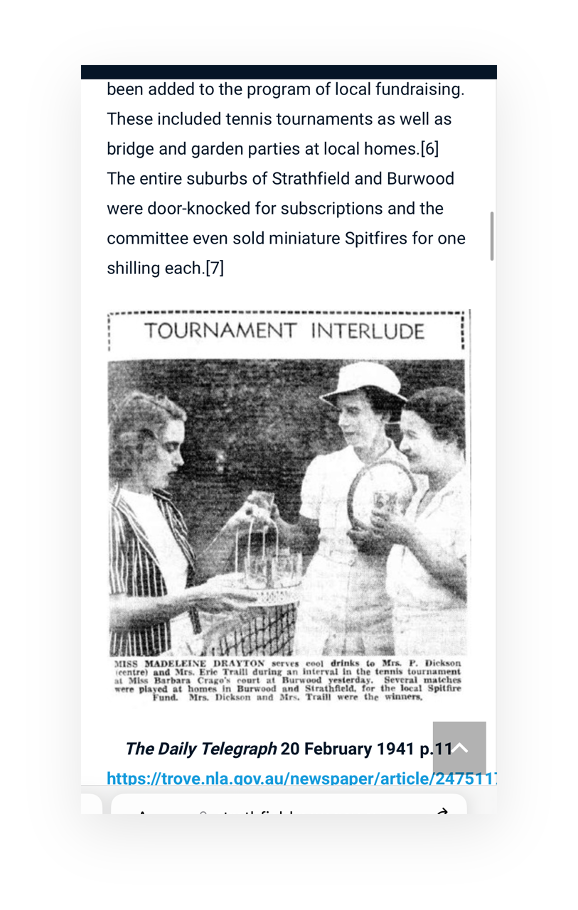
Madeline and Nanette Drayton painted 12 large posters of Spitfires and people filled them with coins – raising £3750
The campaign ultimately raised £13m.
What fundraising lessons are there from this Spitfire Fund campaign?
React quickly to current events
Keep the story in the news
Make it easy for donors to see their impact – chunk the campaign into small and manageable achievable goals that they can help achieve
You don’t have to do all the work – empower people to raise funds and have fun and be creatively
Use the identities that donors have – to their village, their town, to their employment status, age, gender to help connect and establish a powerful norm
This is a reduced version of a talk given at Fundraising Summer School in Dublin, May 2024.
https://marinajones.uk/wp-content/uploads/2024/05/blank.jpg7211280adminhttps://marinajones.uk/wp-content/uploads/2022/12/f2b903e010104f5aa61ea1821a685913.pngadmin2024-05-16 09:56:452024-06-06 19:50:53How a blank cheque sparked a fundraising revolution?
In the last few years gamification has been highlighted as a way to increase engagement with supporters – making charitable engagement more fun, and driving loyalty and community.
But it is not new in fundraising.
Competition and gaming elements can be seen in cathedral building in the thirteenth century – with areas of the city competing against each other to raise the most money (Pavia Gate vs Porta Nuevo Gate https://marinajones.uk/butter/).
But have you ever been asked to ‘winkle up’?
This is a particular request made by members of the Winkle Club in Hastings
Founded in the Prince Albert pub in Hastings in 1900 by local fisherman wanting to do something for poor local families and provide a special Christmas feast.
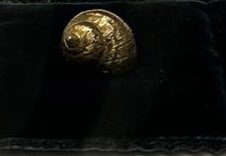
Each member is given a winkle shell (an edible sea snail – with snail removed and filled with wax) which must be produced if challenged to ‘winkle-up’ by a fellow member. If they cannot produce their winkle they are fined (originally 1 penny but now £1). The challenger must report the winkle up challenge before the week is out or pay a double fine!
They have become a local institution, in 1908
A hundred hungry men were served with dinner in the Harbour Shed, decorated with bunting, on Tuesday (31 Dec), while an estimated 750 children were given a good square meal dinner on Wednesday”.
Hastings Mail
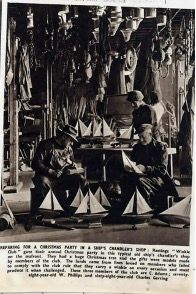
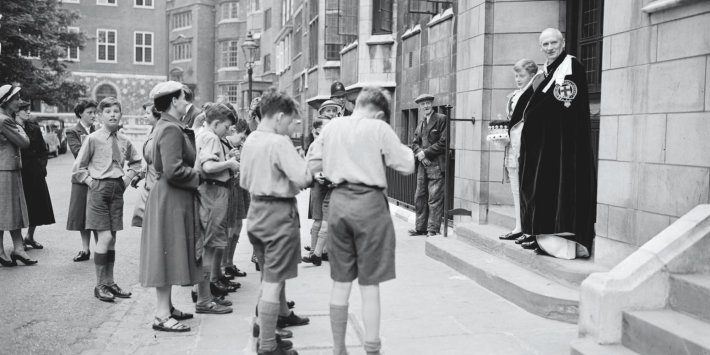
Members of the Winkle Club preparing for the annual Christmas party 1948
Pubs seem to be a fruitful place for the founding of charities as Howard Lake recently commented.
Additional fines and penalties were imposed, but all for fun, including
It is frequently easy to induce a member to ‘go over and Winkle Up old so-and-so there in the corner for a lark’, only to find that old-so-and-so is not a member. Another fine. All’s fair in Winkling-up and it all goes to charity
The Club’s rule also cite:
A favourite trick is for one member to say to another: “Put your winkle on the table for a moment; I should like to compare it with mine for colour” – or size or any other excuse. If the other fellow in a thoughtless moment puts his winkle down, he at once becomes liable for a fine. Moreover, no member may ever have two winkles in his possession. Another artful dodge is casually to invite a member to pick up and examine a second winkle with some appropriate remark – “Have you ever seen one like that?” or something of the sort. If he unthinkingly takes it, he is at once in trouble and a fine is duly levied“
The Winkle King
In the 1960s, Slogger Hoad was the Winkle King of Hastings and had special suit made out of 9,626 winkles which took six months to make (and can be seen at the Hastings Fisherman Museum)
Imitation is the sincerest form of flattery
The Winkle Club originally got the idea from the Hasting Acorn Club. This Club formed in the Royal Oak pub and has an acorn as their symbol, but the fisherman of the Prince Albert wanted something that reflected their fishing tradition so chose the winkle.
Cute local custom, yes, but also some fundraising lessons
So what can we learn from this local custom
Make donating fun – can you add gamification so that there is a fun and competitive element to your campaigns? The tricks that Winklers tried to play on each other to catch each other out and make more money aided the campaign. This can incentivise people to be involved in campaigns but also creates a sense of community which helps build loyalty. The fun element adds an extra dopamine happy chemical hit to their giving experience.
Your identity as a Winkler is important and a shared local one – recognising other supporters like you is important – whether it is asking someone to ‘winkle up’ or seeing a supporter has the tote bag or a badge identifying them as another supporter. We like to have ways to identify our support and have social proof of what others like us do.
Celebrity winklers – having famous members helps promote your cause. Famous Winkle Club members include the late Queen, the Queen Mother, Norman Wisdom, Admiral Montgomery and Winston Churchill.
Adapt your offer to target segments of your supporters – Winston Churchill was presented with a special gold monogrammed winkle as an honorary member (see below) and the Queen was given a gold winkle made into a broach form. How can you treat special members differently to honour and recognise their status?
News stories – make the most of getting press stories about ‘winkle up’ challenges especially from your famous members.
In 1953 at the dress rehearsal for the coronation Field Marshal Montgomery charged the Mayor of Dover to ‘winkle up’ – the mayor having been to several functions that day did not have his winkle in that pair of trousers and had to pay a fine (reported in the Hastings & St. Leonards Observer 6 June 1953 Pg. 0007)
In 2008, Admiral Boyce was answering questions at a government committee when an MP asked one final question – did he have his winkle with him? The Admiral did not so paid the fine – but the MP who asked the question – Hastings MP Michael Foster did not have his either so was also fined (there was also a light hearted debate about whether he ought to have been challenged when at work!) See curiosities here https://winkleclub.org/curiosities/
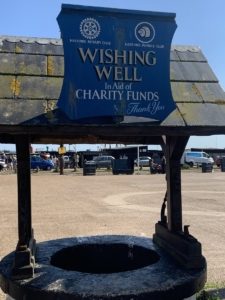
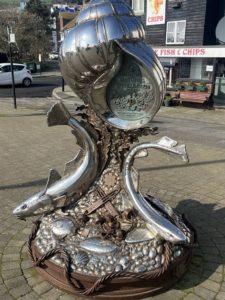
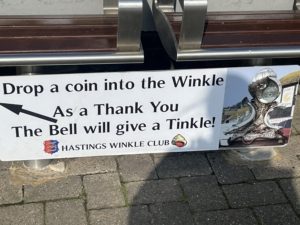
Rewards – both the current opportunities to donate that I saw to donate to the Winkle Club on a recent trip to Hastings are fun. Wishing wells and a giant winkle shell that makes a noise when you donate. Make your donation boxes fun, interactive and engaging.
Rhyme as the reason effect -using rhyming messages can make them more memorable.
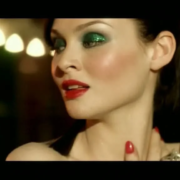
Saltburn ends with Barry Keoghan dancing to Sophie Ellis Bextor’s 2001 pop hit ‘Murder on the Dance Floor’ – for those that remember it from 23 years ago it will have specific associations and memories – a certain bar, lifestage or nightclub (and for some it may have completely passed you by).
Our brains are wired to emotionally respond to music which is why certain songs have a power to transport us physically and emotionally to a moment – a university bar, a crush, a city, a holiday, a road trip, childhood, someone we love. Familiar music, especially music with vocals, causes a psychological response (increased heart rate & blood pressure) – music is wired to our memory.
And our brains are constantly rewiring and making and remaking associations to music, so ‘Murder on the Dance Floor’ may become newly associated for you with Saltburn, as well as keeping a trace of the former memories.
Sound is one of the most powerful senses we have, but one often under used in fundraising.
Listening to music can give you thrills and produces endorphins and activates the brains reward circuits.
“Music does a lot of things for a lot of people. It’s transporting, for sure. It can take you right back, years back, to the very moment certain things happened in your life. It’s uplifting, it’s encouraging, it’s strengthening.”
Aretha Franklin
The power and embodiment of music can be seen in this former ballet dancer with Alzheimer’s hearing Swan Lake and recreating the steps
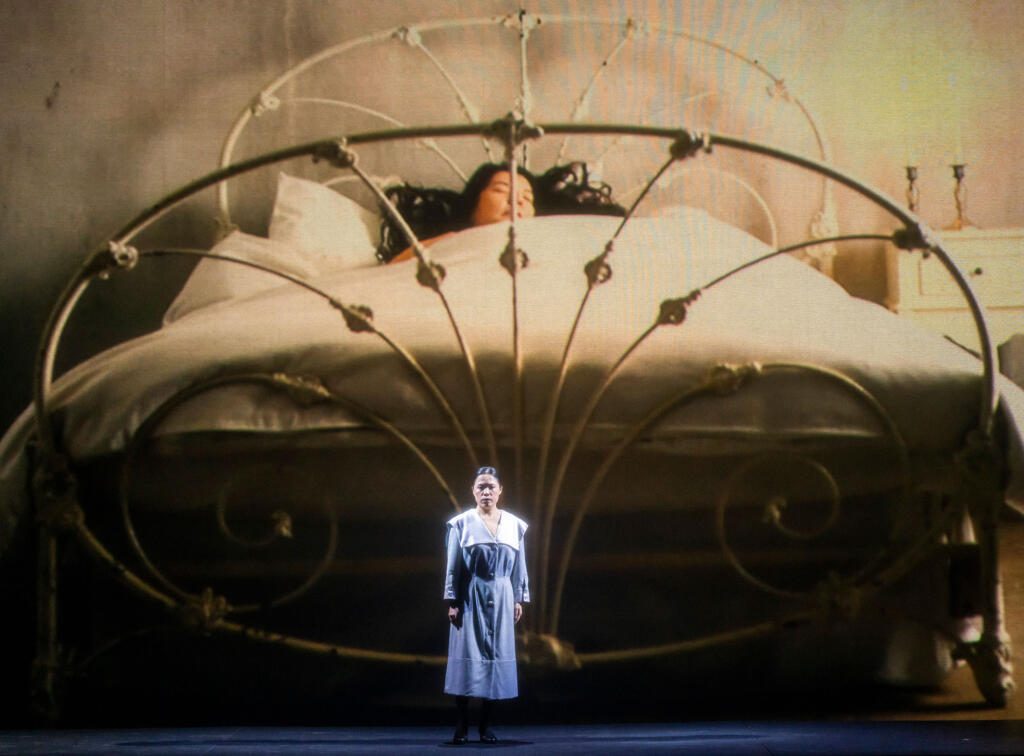
At the Coliseum we recently had Marina Abramovic’s opera project 7 Deaths of Maria Callas which used seven famous arias of dying sopranos to explore the life of Maria Callas. The first one was from La traviata – the aria at the beginning of the final act where a dying Violetta is contemplating her imminent death. For me, this 6 minute aria, was like a concentrated experience of the opera. Despite just having this extract, and not seeing the previous two acts, every time I saw this aria it moved me to tears as I could feel and remember the emotions I would have experienced watching the whole piece, and knew where we had reached in the plot, and what was coming.
Mood music
The cues music can give us are subliminal nudges, that can impact our mood, but also our behaviour, how fast and what we eat, and what we buy.
Music with a faster tempo makes us eat faster, and people tend to spend more money and eat slower when jazz or classical music is played. Think about the ambient background music you might have in a restaurant – fast and pop for somewhere that wants to turn tables, and more mellow and chilled for a restaurant that wants to encourage you to spend longer, spend more and enjoy the experience. (Although music can also be used as a deterrent, a Welsh branch of MacDonalds plays classical music after 17.00 to deter anti social behaviour)
This real life experiment in an East Midlands supermarket shows how the background music has more impact that we might think it would
When French music was played 75% bought French wine
When German music was played 73% bought German wine
When asked about their choice of wine, and whether the music had impacted their choice, only one of those surveyed noted the impact. (North, A. C., Hargreaves, D. J., & McKendrick, J. (1999))
What does your brand sound like?
Brands use sounds, known as sonic branding, to help us readily recognise them:-
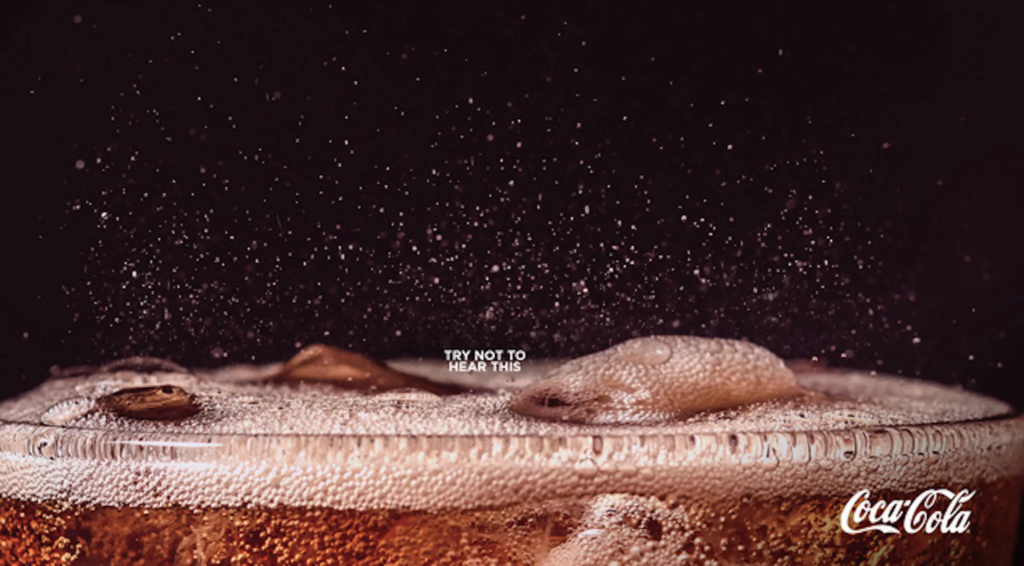
Coca Cola used this image and the slogan ‘try not to hear this’ to evoke the sound of the fizz of the bubbles (there were also adverts showing a detailed close up of the ring pull being pulled back, and a bottle opener opening a bottle). The advert invites us to hear the remembered sound and trick our brains to almost hear it.
We know sound (and taste/smell – think Proust and the madeleines) are some of the most powerful senses but unless you have the budget for a TV ad (or create a ‘scratch’n’sniff appeal) they can be underused in fundraising appeals (in direct mail or adverts.)
We know that we and our supporters receive information in many ways – that the words are only part of it, and that the real and imagined images we use have an impact – as does the weight of the paper, the design of the piece, the feel of appeal in the hand, the order we present information. We know that appealing to many of the donor’s senses can make our appeals more vivid and effective. So, we might appeal to donors to remember a sound (children crying) or imagine a future sound (children laughing), but we largely rely on the words and the visual of the design of the pack – letter, the lift letter, response mechanism, the call to action.
For someone working in opera and fundraising, the sounds created and remembered are key – the emotions they stir in audiences from the dopamine of anticipating what it will feel like to hear that music again, to the oxytocin of the emotional engagement with the story – music is so important. And not just the music, but the whole holistic and acoustic experience of the performance, of being together, with an audience, inside a theatre. The hubbub in the bars before hand, the orchestra tuning up as you take your seats, the silent anticipation with the audience holding its breath before the curtain rises and the applause at the end.
How can we integrate soundscapes into an appeal?
How can we create appeals that bring more of the sound world – real, remembered or future created by the donor’s action into our appeals?
How can technology help us integrate and create an immersive sound world?
How could we use sound to provide a richer and deeper connection with our donors? To their memory? To their identity?
What segments of donors will this soundscape be most effective with?
I have some ideas that I am developing to try and find ways to test, gamify and play with sound in supporter communications and see if it can be used to enhance the communication and their connections.
https://marinajones.uk/wp-content/uploads/2024/01/fTlCNdgFhcW1V5-OO8UV6xT-xw1k-LGXcpTIN_sgpSY.jpg.webp576768adminhttps://marinajones.uk/wp-content/uploads/2022/12/f2b903e010104f5aa61ea1821a685913.pngadmin2024-01-24 08:24:142024-01-24 08:24:14Murder on the Dance Floor – Extraordinary How Potent Cheap Music is
Nudges encourage us to change our behaviour for the better, but when nudges are used for nefarious reasons e.g. to get more money or do something not in our best interests, then it is called sludge.
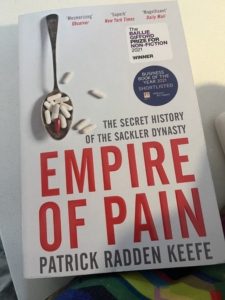
Having read Patrick Radden Keefe’s ‘Empire of Pain’ on the Sackler dynasty (which was a great charity shop find) I was struck by the uses of these sludge techniques in the Sackler’s Purdue Pharma’s marketing from the 1950s onwards. The understanding of what nudges are, and how they can be used, or abused, may have only been codified in the past few decades with the emerging field of behavioural science, but humans have always had an innate understanding of what motivates behaviours, and how to manipulate it.
The Sackler story is a timely reminder that nudges need to be used ethically and appropriately.
So what nudges did the Sacklers and Purdue Pharma use, and why were they effective?
Authority messenger
We react to who is telling us information – the messenger – they can be an authority figure or have authority in their field. This creates an authority bias, and we want to do what we are asked to because it reduces the cognitive load for our lazy brains to trust the person in authority.
In the 1950s, Arthur Sackler recruited doctors to sell medicines to other doctors.
“Seeing that physicians were most heavily influence by their own peers, he enlisted prominent doctors to endorse his products”
Patrick Radden Keefe ‘Empire of Pain’
Doctors trust and respect other doctors so using doctor as a messenger is effective as it uses their positional and medical authority, and the social norm of other peers doing it.
Authority messengers in a fundraising campaign might be the Chair of the Board, the CEO or a known figure with authority on your subject area (a teacher, a social worker), or a frontline worker.
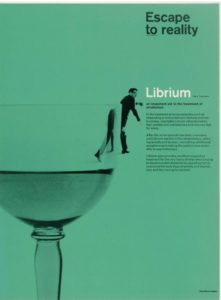
When launching Librium tranquilliser (a precursor to Valium), Purdue sent vinyl records to doctors with recordings of other doctors talking about how well the drugs worked.
Many doctors were anxious about prescribing opioids and concerned about the addictive nature, so Purdue and the advertising campaign really focussed on doctors endorsing the product. These trusted messengers could cut through these concerns and if your peers were also prescribing it was creating a strong social norm for other doctors to follow. Doctors were incentivised to be paid speakers to promote OxyContin at conferences and pain management seminars.
Made up doctors
However, sometimes this authority bias was entirely misused and abused, for example, in the 1956 adverts for the new antibiotic Sigmamycin produced by the Arthur Sackler’s marketing firm MacAdams. These adverts were in the form of a brochure entitled ‘More and More Physicians Find Sigmamycin the Antibiotic Therapy of Choice’. In the brochure, eight doctors were quoted giving testimony about the effectiveness of the drug and how it was clinically proven. The doctors were from across the country including Tucson, Miami, Massachusetts – as well as authority messengers, we react to what is relevant and salient to us – so if our local doctor has said we are more likely to trust them than one from another state. Investigative reporter John Lear wrote, rang and tried to reach these eight doctors – his letters were returned, the phones went unanswered – the doctors did not exist – they had been made up:
“it looked so plausible, so real with the special patina of authority conferred by eights MDs. The ad was polished, impressive and fundamentally deceptive”
Patrick Radden Keefe ‘Empire of Pain’
Blinded by the white coat
As well as being blinded by the title of doctor, we are susceptible to visual clues about authority – someone in a high vis jacket, a smart suit, with a clip board, wearing a lanyard, or a white coat signal to us their position of authority or their job. In the Milgram experiment (1961), 66% of people would shock a ‘patient’ with 450 volts (enough to kill them) if told to do so by a man in a lab coat – the visual signal of the white coat gives them authority and we trust that authority.
When the opioid court cases were dominating the news in the US, Purdue Pharma moved to the other emerging markets using a subsidiary called Mundipharma and they continued their focus on the authority bias –
“Mundipharma reps in hospitals actually donned white coats and pretended to be doctors themselves”
Patrick Radden Keefe “Empire of Pain’
This is an AI generated image of a doctor – the white coat bias persists and we listen to and follow instructions of those in perceived positions of authority.
Note in this case it was the sales reps not the doctors in the white coat. The visual clue is a shortcut for our brains as to the authority of the messenger – but again fundamentally deceptive.
Who might be the authority messengers that you are susceptible to? The white coat? The suit? The status? The blue tick?
Experience messenger
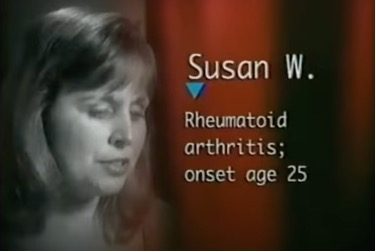
Messengers are not always those with positional authority, sometimes a messenger who has direct experience and their personal testimony can speak powerfully to the audience. They need to be likeable and believable and may have the authority of experience. In 1997 Purdue Pharma created a video called ‘I Got My Life Back’ which featured real life testimonials from those whose lives had been changed by taking OxyContin.
Incentives
Incentives motivate us to do something – they can be financial or moral, subtle or overt.
At Purdue, they used financial incentives for the pharmacy reps who worked on commission, and unlike other agencies, Purdue had no caps on bonuses for reps, so the financial incentive for them to get doctors prescribing OxyContin was a strong motivation.
FREE
One of the best known incentives is the free trial.
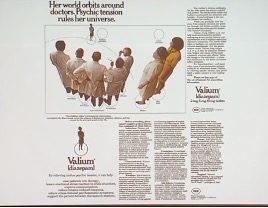
The word ‘free’ excites our brain and we fear that we are missing out on something. Purdue inherently knew this and used free trials to get doctors and patients to try the product (additionally concerning with a highly addictive painkiller, and a tactic often used by illegal drug dealers). Free monthly prescriptions and samples formed part of the marketing strategy for Valium and for OxyContin– with over 82 million free samples of Valium given in 1970s in Canada.
Reciprocity
When someone does something for you there is a natural human impulse to reciprocate and return the favour, and this builds relationship and can increase liking.
In the 1950s various pharmaceutical companies used free products to incite the reciprocal impulse with doctors – Eli Lilly gave free stethoscopes to students and Roche free text books.
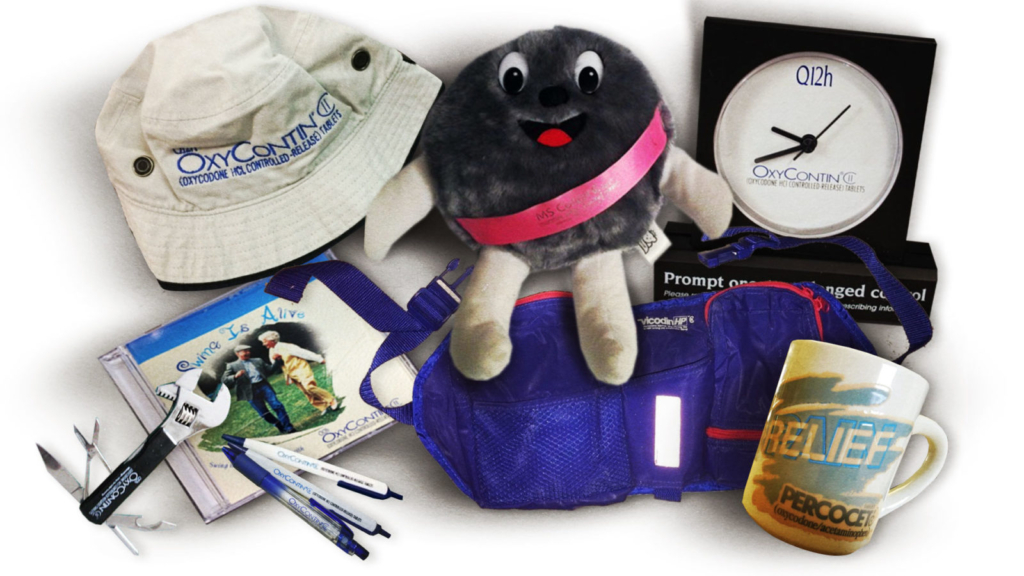
When Purdue were launching Oxycontin they delivered over 7,000 fully paid weekend pain management seminars in exotic in five years. They gave out branded free merchandise including fishing hats, plush toys, luggage tags, music CDs and a Percocet mug that says Pain and when hot liquid is added changes to Relief.
A selection of opioid related swag
There’s no such thing as a free lunch?
Free is not just about free products and swag. If someone does something nice for us. like buys us lunch, the same human impulse to reciprocate is triggered. In one year Purdue allocated a budget of $9m on food for physicians and an internal email in 1996 noted how effective these incentives were:
“physicians who attended dinner programs wrote more than double the number of new Rxs [prescription] for Oxycontin compared to the control group”
Patrick Radden Keefe ‘Empire of Pain’
Salience
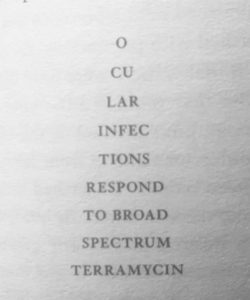
We pay more attention to things that are relevant to us. To make the adverts for antibiotics more relevant and noticeable to optometrists the 1950s MacAdams adverts were made to look like eye charts.
Linguistic relativity
Giving something a name makes it more real. The Sapir Whorf hypothesis says if you give something a name, you fundamentally alter the way it’s perceived. ‘Designated driver’ is one example of a phrase that was introduced when trying to promote safer approaches to alcohol and driving. It was introduced in Scandinavia in the 80s, and when it was used in the US they got $100m of donated airtime to cement the concept in the language by using it in over 100 TV shows like Cheers.
MacAdams advertising agency created the name ‘broad spectrum’ to cover the impacts of the new antibiotic Terramycin (above) in the 1950s. Previously antibiotics had been narrow spectrum and targeted at specific infections, by changing the name it changed how the drug was perceived and encouraged physicians to prescribe for a multiple of conditions.
How did the Sacklers respond to concerns about their marketing practices?
Arthur Sackler dismissed concerns about biasing physicians with marketing saying they were too smart to be biased by these endorsements and would follow the science.
“a cornerstone of Arthur Sackler’s world view; the notion that doctors are priest like figures, immune to flattery or temptation or greed, forced exclusively on the narrow dictates of appropriate medical care”
Patrick Radden Keefe ‘Empire of Pain’
In 1997 Dr Arthur Sackler was inducted into the Medical Advertising Hall of Fame with the citation “No one single individual did more to shape the character of medical advertising than the multi talented Dr Arthur Sackler”
We need to make sure that they are there to help people make better choices.
Sometimes in the charitable sector there can be a suspicion about applying behavioural science interventions to our work as it feels too commercial practices or like marketing. Charities can feel that the value of their work ought to speak for itself, and because the need is so great, or so obvious, charities should not need to resort to these ‘commercial tricks’. Perhaps there is a concern about a double standard, that using these nudges for business and profit is allowable, but charities with their desire to change the world for the better, ought to be somehow purer.
Nudges are powerful but must be used suitably, ethically and in a way that is aligned to the values of your organisation (and your own personal values) and ensure that the donor still has autonomy to make choices.
By not adopting what is known to work, and used to effect in the commercial sector, could the charitable sector be doing itself a disservice if it does not engage in these practices?
https://marinajones.uk/wp-content/uploads/2024/01/plushie.jpg164270adminhttps://marinajones.uk/wp-content/uploads/2022/12/f2b903e010104f5aa61ea1821a685913.pngadmin2024-01-10 08:14:412024-01-10 08:14:42Sackler Sludge and Purdue Priming
In December 2023, BP announced giving £50m to support the British Museum.
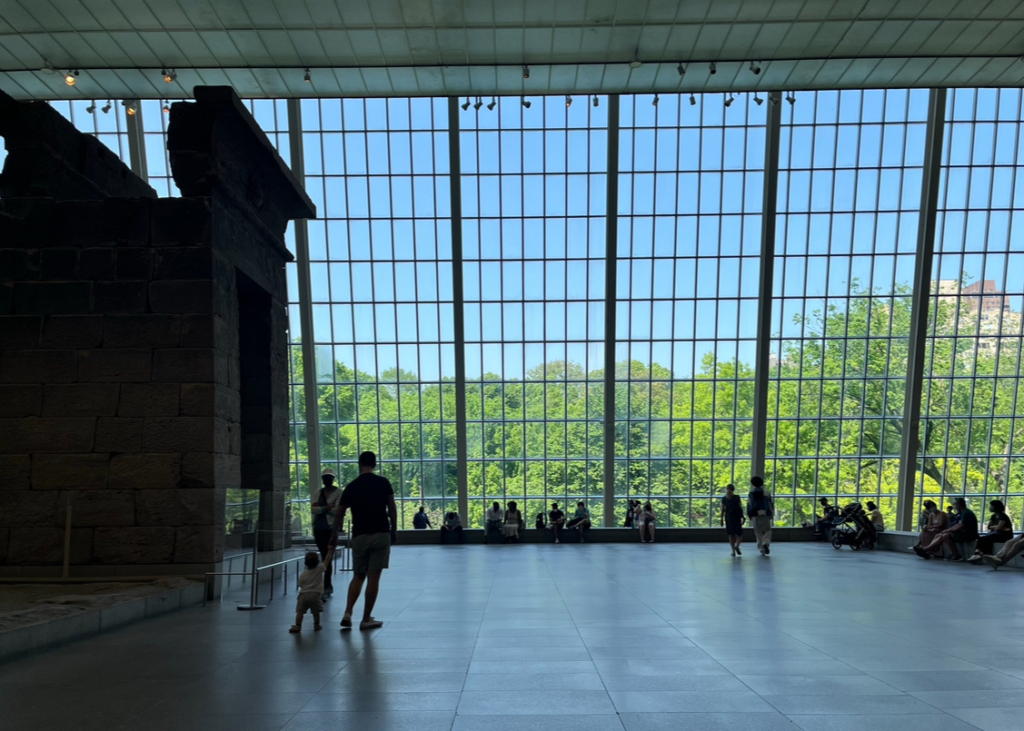
In 1974, the Sackler family gave $3.5m for the new Sackler wing at the Met Museum
What links these two headline gifts?
No, its not just the ethical concerns.
The headline gifts highlight an interesting trend that mega givers sometimes deploy. The headline grabs the attention but the gift is paid out in instalments.
The BP deal is £50m over five years.
The Sackler support of the Temple of Dendur was over 20 years (and actually required the Met to take out a loan to support the cash flow of the project).
Former Sackler Gallery at the Met, NYC
What if we framed our own giving differently?
Instead of thinking about the one off gift, what if we thought about the multi-year commitment and the cumulative total. How we frame a gift is really important.
What if this new year you were asked to make a £5,000 commitment to a charity you cared about?
Your first reaction might be denial – I can’t afford that, that’s beyond me. But if we frame it differently – might you already be a £5,000 donor, £1,000 donor or more?
The £5 monthly donation you started 14 years ago makes you a £1,000 donor.
The £3 a month donation from 23 years ago is over £1,000.
Which charities are already in that bracket for you?
Hyperbolic discounting vs goal gradient
These small monthly donations add up. Fundraisers often try and make small regular gifts salient, and anchor people to the small number e.g. ‘for just the price of a coffee a week you could save a life’. This is hyperbolic discounting – we tend to discount events that happen in the future and prefer to take a small amount of pain now (paying is painful).
What if we focused more on the goal and the pride or sense of achievement of reaching it? Each monthly direct debit would take us nearer to our goal.
Start a £75 a month donation (plus Gift Aid) and in 4 years and 6 months I becomes £5,000
Or start a £20 a month donation (plus Gift Aid) today and in 3 years and 4 months you will have given £1,000.
How might we celebrate those milestones for our donors?
Some charities have special donor board that recognise cumulative gifts of £1m+, what if instead of celebrating the amount we celebrated the sustained duration of the gifts? A donor board celebrating those that have given consistently for over ten years, or a badge. Blood donation is brilliant at celebrating those anniversaries of donations made with certificates, badges and gifts to mark milestones.
Today was the 50th anniversary for my blood donation. The hospital gave me some memorial items. Of course, it's not my goal. I started donating my blood in 1995 when Hanshin Awaji huge earthquake occurred. As of now, I regret that I hadn't done it in my 30s due to my busy days. pic.twitter.com/AJsczkU4Yk
Can we celebrate donor anniversaries rather than our charity’s?
Taking the ‘they are not your donors, you are one of their charities’ mantra, do we need to think about it being their anniversary with your charity and not yours that matters. My anniversary as a donor is more significant to me than the fact your charity has been around for 50 years or 93. Celebrating that I have been giving £10 a month for 10 years recognises my loyalty and commitment and enhances it. It makes my identity as a donor stronger. It makes me feel special and valued, -rather than just another donor.
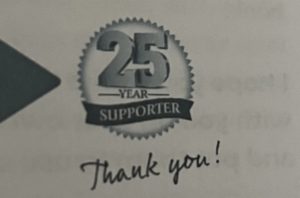
This is a great example from Lisa Sergeant used for a special segment of donors that had been supporting Trocaire for 25 years – by celebrating the donor identity they increased engagement, response rate and income in this mailing and it had ripple effects going forward.
Quoted in ‘Change for Better’
So in 2024, where might you give like BP or Sackler?
How can you think about your 5-10 year commitment to a charity and that adds up to and might do?
And how can you celebrate donors giving over a longer duration more?
https://marinajones.uk/wp-content/uploads/2023/12/IMG_9691.jpeg15121156adminhttps://marinajones.uk/wp-content/uploads/2022/12/f2b903e010104f5aa61ea1821a685913.pngadmin2024-01-03 07:55:102024-01-03 07:55:11Will you give like BP this year?
We may request cookies to be set on your device. We use cookies to let us know when you visit our websites, how you interact with us, to enrich your user experience, and to customize your relationship with our website.
Click on the different category headings to find out more. You can also change some of your preferences. Note that blocking some types of cookies may impact your experience on our websites and the services we are able to offer.
Essential Website Cookies
These cookies are strictly necessary to provide you with services available through our website and to use some of its features.
Because these cookies are strictly necessary to deliver the website, refusing them will have impact how our site functions. You always can block or delete cookies by changing your browser settings and force blocking all cookies on this website. But this will always prompt you to accept/refuse cookies when revisiting our site.
We fully respect if you want to refuse cookies but to avoid asking you again and again kindly allow us to store a cookie for that. You are free to opt out any time or opt in for other cookies to get a better experience. If you refuse cookies we will remove all set cookies in our domain.
We provide you with a list of stored cookies on your computer in our domain so you can check what we stored. Due to security reasons we are not able to show or modify cookies from other domains. You can check these in your browser security settings.
Google Analytics Cookies
These cookies collect information that is used either in aggregate form to help us understand how our website is being used or how effective our marketing campaigns are, or to help us customize our website and application for you in order to enhance your experience.
If you do not want that we track your visit to our site you can disable tracking in your browser here:
Other external services
We also use different external services like Google Webfonts, Google Maps, and external Video providers. Since these providers may collect personal data like your IP address we allow you to block them here. Please be aware that this might heavily reduce the functionality and appearance of our site. Changes will take effect once you reload the page.
Google Webfont Settings:
Google Map Settings:
Google reCaptcha Settings:
Vimeo and Youtube video embeds:
Other cookies
The following cookies are also needed - You can choose if you want to allow them:
Privacy Policy
You can read about our cookies and privacy settings in detail on our Privacy Policy Page.